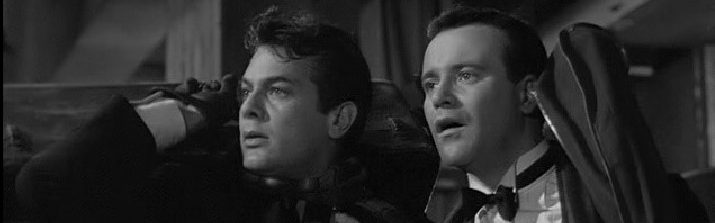
“Boomerang!” (1947) starring Dana Andrews, Lee J. Cobb, Arthur Kennedy, Jane Wyatt, & Ed Begley

[1] This is a pretty good, taut, realistic, gritty film-noirish film

[2] Most of the film’s dramatic moments take place in the courtroom, but there is a backstory involving municipal corruption

[3] Boomerang is the story of how the man who eventually became U.S. Attorney General, Homer Cummings, used the prosecutor’s office to prove the INNOCENCE of an arrested murder suspect. How often do you see that happen?

[4] …Lee J. Cobb, as the cop who changes his mind, is excellent, and so is Karl Malden, who has less to do. I’ve always loved Sam Levene… the cynical wisecracking reporter was made for him. Playwright Arthur Miller lived near where the film was shot; in the police line-up, he’s the tall man in the dark coat on the far left.

-Excerpts from IMDB reviews

The film was directed by Elia Kazan who got the New York Film Critic’s Award for this and Gentleman’s Agreement. Boomerang! got an Oscar nom for Best Screenplay (adapted by Richard Murphy). The story starts off w/ narration re: life in a seemingly idyllic community, which could be any town in America. The peace is shattered when an elderly Episcopal priest is shot on a street corner. When the investigation stalls, pressure is put on the cops to come up w/ a suspect. A reporter, Dave Woods (Sam Levene), writes a series of articles criticizing the city government for inaction. Many men are picked up for questioning, just b/c they wear a dark coat and light hat (as the killer is alleged to have worn). In a police line-up, seven witnesses identify John Waldron (Arthur Kennedy), a former WWII vet w/ no job, as the murderer. Waldron (who was carrying a gun) denies the crime. After being questioned by Chief Robinson (Lee J. Cobb), Det. White (Karl Malden in an uncredited role), and a psychiatrist, the suspect confesses. District Attorney Henry Harvey (Dana Andrews) is put on the case. His friends urge him to win the case and run for governor, while facts lead him to believe the suspect may be innocent.

Kazan aims for realism, making it seem like we’re watching events as they unfold. This film was shot on location and features many locals (non-actors) in the crowd scenes. Fans of Star Trek will recognize Jane Wyatt (AKA Spock’s mom); she plays Madge Harvey, the wife to the D.A. She’s the loving/supportive wife, but also on top of things. This is the film debut of Ed Begley; he’ll later appear in 12 Angry Men (w/ Cobb). Begley is a small-time bureaucrat; he sweats and acts nervous. Kennedy plays an ambiguous character, the police interrogate him for two days, depriving him of sleep until he breaks down. Cobb carries Kennedy over to a cot, as you’d do w/ a sleeping child. The second act of the film is the courtroom drama. You can rent this movie on YouTube.


“The Big Heat” (1953) starring Glenn Ford, Gloria Grahame, Lee Marvin, & Jocelyn Brando

[1] Glenn Ford is super bad ass in this film . He is 100% convincing as a complex man living in 2 worlds. Family life vs. the crime underworld.

It is some of the best writing in film noir history. Almost every line is a gem. There are tons of one-liners.

[2] He conveys so much in a look, a facial expression. And you are with him the whole way; he comes just close to the edge, but not so that he loses your sympathy.

[3] Glenn Ford now looks like one of the most quietly powerful actors of Hollywood`s “Golden Age”… He had a rare ability to portray a kind of slow-burn tension…

[4] Gloria Grahame was born for roles like this one, both tough and vulnerable, the ultimate tragic moll.

-Excerpts from reviews on Amazon

This (must-see) film noir is directed by a giant of this genre- Fritz Lang. It’s based on the novel by former Philly crime reporter William P. McGivern. It’s included on Roger Ebert’s “Great Movies” list and received an 100% rating from critics on Rotten Tomatoes. In the town of Kenport, Sgt Dave Bannion is an on the trail of a criminal syndicate which he suspects holds power over the local police force. Bannion is tipped off after another cop’s suicide; his fellow officers’ suspicious silence lead him to believe that they’re being paid off. When tragedy hits home, Bannion seeks revenge; he gets help from the gangster’s spurned girlfriend, Debby. They must use any means necessary to get to the truth.

Executive Producer Jerry Wald hoped to cast either Paul Muni, George Raft, or Edward G. Robinson as Bannion. It’s tough to imagine anyone else besides Glenn Ford in this role; he makes it look effortless. The best acting is in the eyes; if it’s not coming from w/in, the audience won’t find it believable. As has been said of Jimmy Stewart, I think that Ford was a great listener. You get the sense that he’s “in the moment” as he’s playing a scene opposite his fellow actors.

Bannion’s devoted wife, Katie, is played by Marlon Brando’s older sister, Jocelyn, who has looks and talent, too. In their domestic scenes, Brando and Ford have an easy chemistry, making them a relatable/happy couple. Columbia wanted to borrow Marilyn Monroe from 20th Century-Fox to play the role of Debby Marsh, but Fox’s price was too high, so Gloria Grahame was cast instead. Grahame is flirty, funny, vulnerable, and (eventually) takes control of her own story. The gangster, Vince Stone (Lee Marvin), has a quick/dangerous temper; he only fears the most powerful mobster in the area. There is violence against women (described and shown); some lines were unusual for the era. You can rent it on Amazon or YouTube.

“The Wedding Guest” (2018) starring Dev Patel & Radhika Apte

Jay (Dev Patel) is a quiet/mysterious Muslim man who travels from London to the Punjab region of Pakistan, supposedly to attend the wedding of a friend. He brings along duct tape, guns, several cell phones, and a plan to kidnap the bride-to-be, Samira (Radhika Apte). Despite his cold efficiency, the plan quickly gets out of control, sending Jay and his hostage on the run across the border and through different parts of India. Jay has various names and identities, so carries several passports and credit cards. He was hired by a wealthy man who is now nervous to meet up and pay. The kidnapping and fallout make international news (Samira is a British citizen). The story evolves into a road trip, but w/ settings we usually don’t see in movies.

The film (which I saw last week free On Demand) has British and Indian producers. It has some twists and turns, but isn’t a typical thriller. It seems to me like a neo noir (in some aspects). The British writer/director, Michael Winterbottom, is known for out of the box films; I’ve seen Jude and The Claim. The cinematographer, Giles Nuttgens, has shot several films in India (incl. Earth, Fire, Water, and Midnight’s Children w/ director Deepa Mehta). The music, composed by Harry Escott, is unique and helps to create tension. The attraction between Patel and Apte develops as they open up to each other (slowly); they have good chemistry together.

[1] The movie benefits enormously from Dev Patel’s excellent work. He is in virtually every frame of the movie. Indian actress Radhika Apte… turns out to be a worthy sparring partner for Patel.

[2] You’ll like this movie if you like human characters, feelings, & relationships, along with a “slice of life” style, where you witness the characters move through a time & set of shared experiences together & may end well, badly, or anywhere in between.

Patel is now a mature leading man — in this movie, a bit of a Jean Reno type. He’s deadpan, but I like it.

-Excerpts from IMDB reviews

Art, Gender, & Desire: “Venus in Fur” (2013) starring Mathieu Amalric & Emmanuelle Seigner

Based on the Tony-winning Broadway play by American writer, David Ives, Venus in Fur is a 2013 French film by famed/controversial director Roman Polanski. Alone in a Paris theater after a long day of auditioning actresses for his new play, writer-director Thomas (Mathieu Amalric), complains to his fiancee (on the phone) that no actress has what it takes to play the lead female character. Thomas is about to leave the theater when actress Vanda (Emmanuelle Seigner) bursts in, a whirlwind of energy. At first, she is pushy, desperate, and not prepared- or so it seems. Under her coat, Vanda wears a risque black leather and lace outfit (w/ a dog collar). Thomas reluctantly agrees to let her try out; he is stunned by her transformation. Vanda is perfect (even sharing the character’s name); she obviously researched the role, learned the lines by heart, and brought along some props! As the audition continues, Thomas’ feelings go from from attraction to obsession, and Vanda takes on a more dominant role in the story. Vanda comes to tower over Thomas as she becomes stronger.

This was Polanski’s first non-English feature film in over 51 yrs; I saw it several years ago (and didn’t realize he was the director). I re-watched it on YouTube (it’s available for rent). The lighting is superb and the music (composed by Frenchman Alexandre Desplat) is used very well. He moves the story from NYC to Paris, b/c Polanski wanted to work w/ his wife in her native language- French. Originally, Vanda was a 24 y.o. actress (thus her short resume) and Thomas was a young playwright (w/ a few plays under his belt). On Broadway, then recent NYU grad- Nina Arianda- made a name for herself (2010-2012) as Vanda opposite Wes Bentley and Hugh Dancy. In London, Natalie Dormer (The Tudors; Game of Thrones) played the role opposite David Oakes. Louis Garrel (who is young and conventionally handsome) was originally cast as Thomas for this movie. Amalric is middle-aged, w/ a small build, and dark/intense eyes. As some viewers noted, he resembles a younger Polanski. Amalric’s mother comes from a Polish/Jewish family; she was born in the Polish village where Polanski lived w/ his family before WWII. Directors don’t make decisions w/o a reason!

Forget that badly-written and adapted Fifty Shades trilogy! There are several layers to this clever story of power imbalance: woman vs. man (in the play set in 1870), actor who wants the role vs. director who decides who gets the role (in the theater), and man vs. goddess (Venus AKA Aphrodite). It’s also about life imitating art, hidden desires, misogyny, and role playing. Thomas has to read w/ Vanda b/c none of the actors are there; it turns out that he’s really into it. Thomas starts out directing Vanda, but later she doesn’t hesitate in directing him. She even knows how to adjust the lights in the theater- hmmm. They put on and take off clothing to create these characters, as is common backstage in the theater. They quickly and easily switch from being themselves to the characters in the play!

[1] Thanks to the brilliant connections between literature, stage and reality, and thanks to the many things that remain unclear about the character’s real identities and motivations, this movie sounds much more like a question than like a an answer…

[2] The characters conflict with each other perfectly, I don’t mean that they completely disagree on everything, I mean that they disagree on a certain number of things and they agree on a certain number of things for their characters to have great chemistry.

[3] What was most surprising for me is how much we laughed during the film. It was really hilarious…

[4] The mystery of who exactly Vanda is keeps getting bigger until it reaches deific proportions…

-Excerpts from IMDB reviews

“Star Trek: DS9”: Season 1, Episode 19 (“In the Hands of the Prophets”)

I was the like the space Pope. -Actress Louise Fletcher (on how she saw her DS9 character)

[Vedek Winn has asked Keiko O’Brien to refrain from teaching anything that might conflict with Bajoran beliefs]

Keiko O’Brien: I’m a teacher. My responsibility is to expose my students to knowledge, not hide it from them. The answer is no.

Keiko O’Brien (Rosalind Chao) is teaching the DS9 kids about the wormhole, when Vedek Winn (veteran actress/Oscar winner Louise Fletcher), one of the most important religious leaders of the Bajorans (and possible candidate to become the next Kai), arrives. She strongly disagrees w/ the scientific way Keiko chooses to explain the phenomenon, calling it “blasphemy.” She convinces the Bajoran parents to remove their kids (who are in the majority) from the school; only Jake and a handful of others remain.

[Jake is questioning the ‘stupidity’ of the Bajoran beliefs, comparing it with the Inquisition during the Middle Ages]

Cmndr. Sisko: You’ve got to realize something, Jake: for over fifty years, the one thing that allowed the Bajorans to survive the Cardassian occupation was their faith. The prophets were their only source of hope and courage.

Jake Sisko: But there were no prophets; they were just aliens that you found in the wormhole.

Cmndr. Sisko: To those aliens, the future is no more difficult to see than the past. Why shouldn’t they be considered prophets?

Jake Sisko: Are you serious?

Cmndr. Sisko: My point is, it’s a matter of interpretation. It may not be what you believe, but that doesn’t make it wrong…

Meanwhile, Chief O’Brien (Colm Meaney) finds an important item missing from his toolkit. He and his assistant, a young Bajoran named Neela (Robin Christopher), start looking for it. They find the tool in a corridor, together w/ the remains of a young ensign! What was he doing in this area? His death may have been an accident, but it seems suspicious to O’Brien.

[a group of Bajorans have arrived at the station]

Quark: Don’t tell me – there’s a Bajoran convention on this station I didn’t know about? Thanks, Odo! I need to call in more dabo girls.

Odo: It’s not a convention. They’re from an orthodox spiritual order coming to support Vedek Winn’s efforts to keep the Bajoran children out of school.

Quark: Orthodox? In that case I’ll need twice as many dabo girls. The spiritual types love those dabo girls!

This ep relates to the debate in US schools about the teaching of Evolution and Creationism in science classes. Both Keiko and Winn are unwilling to give in; perhaps surprising, Kira (Nana Visitor) agrees with Winn’s position. Kira suggests that there should be two schools on the station. Cmdr. Sisko (Avery Brooks) travels to Bajor to seek support from a more tolerant leader, Vedek Bareil (Philip Anglim). He is also a candidate for Kai, but has a different attitude and philosophy than Winn.

Vedek Bareil: Today I am only a vedek. If the Prophets will it, someday I may be Kai. And I can be a better friend to you then.

Cmdr. Sisko: In other words, being my friend now might hurt your chances?

Vedek Bareil: The Prophets teach us patience.

Cmdr. Sisko: It appears they also teach you politics.

This is the S1 finale of DS9; it circles back to issues/events from the pilot (which we learn occurred 7 mos ago). The matte painting from “Emissary” was modified to show that the damage to the Bajoran city had been repaired. The teleplay is by Robert Hewitt Wolfe (who worked on many eps of TNG). An early idea was a crossover w/ TNG and have Sisko, Picard and their crews work together to fight against an invasion by Cardassians. Instead of that external struggle, we have an internal one between the Bajorans themselves.

[1] …is pretty good, with a tightly interwoven set of story lines, further ugly truths about Bajoran culture (and beautiful faith in the goodness of individuals), and some good performances. 

[2] Real stakes and powerful social commentary. This ep gets mega points for being brave enough to address religion with a bit of honesty…

[3] This episode will be relevant forever. There are so many people in this world who use religion/idea/belief as a sword to achieve hidden agendas.

-Excerpts from IMDB comments