“Star Trek: DS9” – Season 1, Episode 5 (“Captive Pursuit”)

Tosk: [on holosuite programs] I have no use for fantasy adventure. I live the greatest adventure one could ever desire.

Michael Westmore and his makeup department won an Emmy for their work on this ep. The story was inspired by the 1924 Richard Connell short story The Most Dangerous Game (which is taught in many junior high schools). An unknown ship is coming from the Gamma Quadrant on the other side of the wormhole- could be exciting! The ship has engine trouble and the pilot (a new race of alien to DS9) seems nervous and reluctant to accept help. O’Brien convinces him to come on board and the alien introduces himself as “Tosk” (Scott MacDonald). The make-up was based on an alligator featured in Smithsonian Magazine. Tosk says the wormhole caused his ship’s problems. O’Brien senses that he has a secret. Some viewers noted that Tosk may be of a closely related species to the Jem’Hadar, who are created by the Dominion. Don’t miss this one- it’s considered a highlight of S1!

I loved how O’Brien was very tricky and behaved most unlike a Federation officer. The same, to a lesser extent, can be said for Sisko.

Despite Tosk’s reptilian appearance and mannerisms, Meaney and MacDonald give their characters a certain odd and subtle chemistry which helps to carry the intelligently plotted story and well-written script. Avery Brooks also makes a very nice impression…

This story hits all the notes of a classic Trek- moral issues, human moments, conflict between Federation and alien value systems, tension and suspense, sci-fi technology, exploring the unknown, and Prime Directive invocations.

-Excerpts from IMDB reviews

“Star Trek: DS9” – Season 1, Episode 4 (“Babel”)

Those of you fed up w/ quarantine life, coronavirus updates, and related topics may want to skip this one- LOL! This is the first time that Ira Stephen Behr wrote a teleplay for the series. Naren Shankar (who has a science background and started out as an intern on TNG) contributed to the story. The title is based on the biblical story of the The Tower of Babel in Genesis. Man wanted to be closer to God, so built this high tower. God was angered, destroyed the tower, and punished the men by making them speak many different languages (babbling), thus beginning the various nations and cultures.

The ep starts off comedic, then gets serious, building tension from scene to scene. Chief O’Brien is very busy as systems (built by the Cardassians) all over DS9 are failing. He has to free people stuck in an airlock and Dax wants him to repair a malfunction in the science lab. O’Brien must also repair the navigational computer for Kira, but Sisko can’t get good coffee, so wants the Ops replicator fixed ASAP. All of a sudden, he becomes aphasic- the words coming out of his mouth don’t make sense. Bashir has no clue what happened, as nothing is physically wrong w/ O’Brien. The crew works to find a cure before the entire station is effected. Eventually, Dax also turns aphasic during a meeting in Ops. People all over the station start displaying the symptoms- it’s an epidemic!

[1] Pretty unnerving though how relevant this still is in 2020.

[2] The O’Brien scenes at the start are great. I love his sarcastic comments, and Colm Meaney is such a great actor (with an awesome accent)…

[3] Some unusual partnerships are forged. Never question the strength of the Ferengi immune system.

-Excerpts from IMDB reviews

The frenemy relationship between Odo and Quark is explored further; we get moments of humor. When Odo discovers Quark accessing crew quarters illegally to make use of a replicator, Quark says: “Never ask when you can take.” This is the first example of a collection of Ferengi sayings which will later be called The Rules of Acquisition. Quark takes on responsibility when the command officers have been affected by the virus. To add to the excitement, a ship tries to break quarantine which threatens to cause an explosion (since it’s clamped to the station when the engines power up).

Odo: I need to get to Docking Port V now. That ship’s gonna explode in five minutes!

Quark: I’ll beam you over.

Odo: You?

Quark: Relax. I served on a Ferengi freighter for eight years.

Odo: All right.

[He rushes onto the transporter pad.]

Quark: I must have witnessed the procedure hundreds of times!

Odo: Witnessed? You mean to say you never handled the controls yourself?

Quark: Energizing!

[Waves Odo goodbye as he beams him away.]

“Star Trek: DS9” – Season 1, Episode 3 (“A Man Alone”)

Jake (Cirroc Lofton) makes friends w/ a teenage Ferengi, Nog (Aron Eisenberg), Quark’s nephew and prone to act mischievous. Chief O’Brien (Colm Meaney) argues w/ his wife Keiko (Rosalind Chao- who co-starred in The Joy Luck Club also in 1993), who hasn’t adjusted to life on DS9. On the Enterprise (TNG), Keiko was a botanist, but now she has no work. Odo (Rene Auberjonois) doesn’t see what’s so great about being a couple, as he comments to Quark (Armin Shimerman). This is a fun scene w/ actors who can do both comedy and drama. You also see their chemistry w/ each other as frenemies. Lt. Dax (Terry Farrell) explains to Dr. Bashir (Alexander Siddig) that her species don’t go seeking romantic relationships. I like the charm and confidence Farrell shows, even in early eps. Siddig also brings the charm, yet his character has much more naivete.

Sisko: [to Odo] If you can’t work within the rules I’ll find someone who can.

The A-story focuses on Odo, the shape-shifting constable w/ a strong sense of justice who is caught up in a mystery. Odo sees a familiar face on the Promenade, the Bajoran smuggler Ibudan, and gives him a day (26 hours in this world) to get off the station. Sisko (Avery Brooks) says that the man hasn’t done anything wrong, so Odo can’t just kick him out. Odo tells of how Ibudan once let a child die b/c the parents couldn’t afford medicine. Ibudan also killed a Cardassian w/o provocation during the Occupation, so Odo turned him in. When Ibudan is murdered on one of the holodecks, Odo becomes the prime suspect. However, things are not as they seem!

Quark: [about Odo] He’s an ill-tempered, overbearing, cross-patch. But he was no Cardassian collaborator, and he’s no killer.

Zayra: I can’t believe you’re defending him, Quark. You’re his worst enemy.

Quark: Guess that’s the closest thing he has in this world to a friend.

There are a lines and scenes which wouldn’t be out of place on a cop show. Kira (Nana Visitor) says that Odo is “the most honorable man on the station.” The actress really seemed comfortable w/ her character from the start of the series. Dax and Bashir sift through evidence gathered at the murder scene and on the ship which Ibudan came on, trying to solve the crime. Some Bajorans on the station, incl. Zayra (Edward Laurence Albert- son of actor Eddie Albert) grow very suspicious of Odo. He is unlike anyone else in this community and worked under the Cardassians for some years. After Odo is relieved of duty by Sisko (for his own safety), he goes to his office. We see that it has been trashed; along one wall, the word “SHIFTER” can be seen. A mob gathers outside and Sisko calls in security to prevent damage and violence.

Keiko’s plan to start a school for the few kids on the station was a practical idea. Sisko liked the idea very much and Jake had grown bored of studying alone w/ a computer (which is what many kids are doing in quarantine). I liked the scene where Keiko convinced Nog’s father, Rom (Max Grodenchik), to allow him to attend. Rom is portrayed as confident and decisive, which changes drastically later in the show. There is an ep focused on Keiko’s teaching at the end of the season which fans esp. comment about.

[1] I enjoy how DS9 gets to work on establishing it’s characters right away– the payoff doesn’t come for quite a while but damn is it delicious when it does.

[2] …the conflict between Odo’s sense of justice and Starfleet rules will be done much better in later episodes…

[3] Odo – who really is a man alone – must learn to trust others to help him figure this one out and clear him of suspicion.

-Excerpts from IMDB reviews
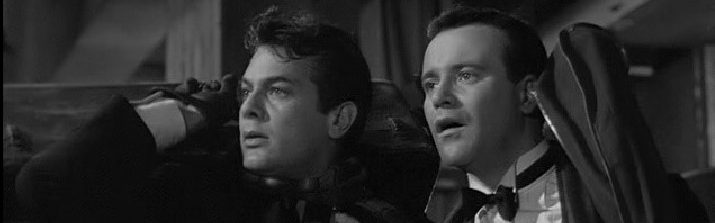
Hitchcock on Family Life: “Shadow of a Doubt” (1943) starring Teresa Wright & Joseph Cotten

[1] Joseph Cotten is the perfect charming monster.

[2] As for Teresa Wright, she finds some good notes as well in playing off of Cotten… …those kids are just the right icing to the cake the film cooks up.

[3] One of my favorite elements in the movie is the ongoing dialogue between Henry Travers and Hume Cronyn, avid mystery readers who are constantly discussing the best ways to murder each other. Apart from being a bit of comic relief… it also demonstrates how lightly people think of murder and murderers… until they encounter them face-to-face.

-Excerpts from IMDB reviews

Young Charlie: We eat and sleep and that’s about all. We don’t even have any real conversations. We just talk.

Charlotte “Charlie” Newton (Teresa Wright) is bored w/ her uneventful life, living in Santa Rosa, CA, w/ her family. She knows exactly what they need- a visit from her well-traveled/sophisticated Uncle Charlie Oakley (Joseph Cotten), her mother’s younger brother. Out of the blue, they receive a telegram from Uncle Charlie announcing that he is coming to visit. Uncle Charlie creates a stir as the new man in the small town, dressing stylish and charming locals. Young Charlie begins to notice some odd behavior on his part. Two strangers, Graham (Macdonald Carey) and Saunders (Wallace Ford), come to interview the Newton family, saying they were chosen for a national survey. It turns out that they are (undercover) detectives!

Uncle Charlie: The whole world’s a joke to me.

Uncle Charlie: I guess heaven takes care of fools and scoundrels.

One reason Sir Alfred Hitchcock considered this to be his favorite movie was that he loved the idea of bringing menace to a small town. Hitchcock believed that the expensive and sturdy, but weathered and worn, look to the house would give the suggestion that the Newton family could be anyone, an average American family in any American town. Edna May Wonacott (book-loving/chatty Ann) and Estelle Jewell (Young Charlie’s friend Catherine) were locals of Santa Rosa, where the movie was filmed. Many of the extras were also locals of the town. The story is lightened up by the patriarch, Joseph (Henry Travers), and his eccentric neighbor, Herbie (Hume Cronyn- in his first movie).

Young Charlie: We’re not just an uncle and a niece. It’s something else. I know you. I know you don’t tell people a lot of things. I don’t either. I have a feeling that inside you there’s something nobody knows about… something secret and wonderful. I’ll find it out.

In his interview with François Truffaut in 1967, Sir Alfred Hitchcock said the dense, black smoke coming from the train that brings Charles to town was a deliberate symbol of imminent evil. Some viewers may have missed his cameo; he is playing cards on the train w/ his back to the audience. The waltz tune is Franz Lehár’s “the Merry Widow;” the nickname of the killer is the Merry Widow killer. Charlie’s sister, Emma (Patricia Collinge), mentions that he’d had an accident on a bike as a boy; his personality changed after the accident (getting into mischief). I learned that Collinge wrote the romantic scene in the garage between Young Charlie and Graham.

You can watch the movie (for free) on YouTube!

“The Narrow Margin” (1952) starring Charles McGraw, Marie Windsor, & Jacqueline Wright

Once in a while a low-budgeted film from Hollywood gives off an unmistakable aura of big-time talent. The screenplay is taut, direction swift and performances crisp and clever. Continuity is paceful and tense, with a touch of glib humor…The New York Post

…pungent performances and inventive direction… the cramped train settings are put to striking dramatic effect through expert camera work and cutting. Refreshingly, there are convincing sound effects and no hammering musical score…The New York Journal-American

...Charles McGraw never relaxes his grim tension in a highly effective performance as a vigilant cop…Marie Windsor, a sultry beauty seething with vicious evil…The other girl is Jacqueline Wright, who cannot be described further without spoiling one of the surprises in the story…The New York Times

This is a B movie (check it out on YouTube for $3.99) shot in just 13 days w/ a mere budget of $230K in 1950, but released by RKO Pictures in 1952. Director Richard Fleischer decided to use a handheld camera; this was one of the first films to do that. To save money, the train sets were fixed to the floor and the camera was moved to simulate the train rocking. When a mobster’s widow decides to testify in front of a grand jury and provide names in a racketeering case, she is forced undercover. Two cops reach Chicago to escort her to LA; the mob are on their trail almost from the start. Several shady/gun-toting men are on the train attempting to make sure the widow never reaches her destination.

Brown: Well, what kind of a dame would marry a hood?

Forbes: All kinds.

Howard Hughes screened it in his private projection room; the film stayed in that room for more than a year b/c he forgot about it! Hughes loved the film, but thought he could improve it by removing the scenes w/ Det. Sgt. Brown (Charles McGraw) and Mrs. Neall (Marie Windsor) and reshooting them w/ Robert Mitchum and Jane Russell. However, Hughes sold his interest in RKO before he could carry out this plan. This was Windsor’s breakout part; most casting agents said she was “too tall, too voluptuous, and just too sexy” for any role besides “the other woman”. She was a former beauty queen from Utah who eventually became known as “the queen of the Bs” (as she could very convincingly be the femme fatale). Fans (incl. TCM host Eddie Muller) love the hard-boiled dialogue between McGraw and Windsor (considered some of the best in noir).