If Beale Street Could Talk (NOW PLAYING)

NOTE: This review contains MINOR spoilers for the film.

Every poet is an optimist. But on the way to that optimism you have to reach a certain level of despair to deal with your life at all. -James Baldwin on his novel- If Beale Street Could Talk

This is really happening: Families really are being torn apart by this. Love is really under attack by these injustices and these issues. –KiKi Layne, actor

I think the biggest message is love and hope. You never know the power of that, and how that can get you through the most tumultuous times.  -Stephan James, actor

[1] It’s a story of love and family and the impact of racism without any of the preachiness we often get. 

[2] The acting was great, especially Regina King. She deserves every award she is nominated for in this pic. 

[3] I did want more of the film, but that’s not to say it felt unfinished. I just wanted more of every character.

-Excerpts from IMDB reviews

I went to see this film last FRI w/ 2 of my gal pals at one of our local indie theaters- Landmark Bethesda. Our screening was packed mainly w/ middle-aged and elderly couples (black and white). It was adapted (from a novel by James Baldwin) and directed by Barry Jenkins (NOT yet 40 y.o.) In 2016, Jenkins’ film Moonlight won the Best Picture Oscar; I saw that film on Netflix (late to the game). I thought that film was pretty good; it had an unique style and BOTH Mahershala Ali and Andre Holland are actors I admire. I think Beale Street could be more relateable; it’s partly a love story and also a look at justice system in the U.S.

Tish (KiKi Layne- in her first film role), a 19 y.o. dept. store clerk, and Fonnie (Stephan James), a 22 y.o. artist are deeply in love. They grew up together (in very different families) and being a romantic pair just came naturally. Fonnie gets arrested for a (serious) crime that he didn’t commit; Tish learns that she is pregnant w/ his child. Tish’s older sister, Ernestine (Teyonah Parris from Chi-Raq) find a (young/white) lawyer for Fonnie, Hayward (Finn Whitrock). Both families hustle to raise funds for the defense, incl. conducting investigations outside the country. Tish’s mother, Sharon (Regina King), is VERY supportive and goes to great lengths for the love of her child. I think King could be in the running for a Best Supporting Actress Oscar!

This film is NOT about action, it’s more about character development; we see life through black people living in Harlem in the ’70s. There are some tender moments, BUT also difficult ones (which feel timeless, sad to say). Fonnie and Tish have a VERY tough time finding a place of their own to live. His best friend, Daniel (Brian Tyree Henry from Atlanta), runs into Fonnie on the street; he was gone for several yrs from the area (we discover why). Some critics commented how rare it is to just see two young black men talking about their lives and feelings.

There is a LOT of chemistry between the leads; they can convey vulnerability and strength (as situations arise). The supporting actors are quite good; the cast includes Aunjanue Ellis, Michael Beach, Diego Luna, Pedro Pascal, and Ed Skrein. There are MANY close-ups, long takes (reminiscent of classic films), and the music is used quite effectively. These kind of films are VERY important- they put us in the shoes of people who are rarely depicted onscreen, or NOT depicted in a realistic manner. I recommend to indie film fans (of all ages and backgrounds); perhaps some of you will take a friend/family member who prefers more mainstream fare.
A trailer for the film- “If Beale Street Could Talk”

Bringing Up Baby (1938) starring Katharine Hepburn & Cary Grant

Whenever this movie comes on TCM, I recall what my dad said- “it’s too crazy.” Well, this isn’t inaccurate, BUT it’s crazy in a fast-paced/fun way. There is SO much (OK, maybe TOO much) going on in this screwball comedy; you need to pay attention. I saw it for maybe the 3rd time last week; I found myself laughing at several scenes. FYI: Katharine Hepburn had never done comedy before, and was coached by director Howard Hawks (and several veteran actors) he employed. Cary Grant was already well versed in comedy; he also used his acrobatic skills in this film. The two leads have great chemistry; they became friends and even double-dated w/ their significant others (during filming).

She has an amazing body – like a boxer. It’s hard for her to make a wrong turn. She’s always in perfect balance. She has that beautiful coordination that allows you to stop and make a turn and never fall off balance. This gives her an amazing sense of timing. I’ve never seen a girl that had that odd rhythm and control. -Hawks on Hepburn

A young/nervous zoologist, Dr. David Huxley (Grant- wearing thick glases), is VERY excited by the news that an intercostal clavicle bone has been found to complete his brontosaurus skeleton, a project 4 yrs in the construction. He is anxious re: securing $1M for the museum where he works from a wealthy/widowed donor- Mrs. Random. David is engaged to be married to his uptight assistant, Alice. He still refers to her as Miss Swallow; he is disappointed when she says their marriage will be ALL business b/c his work comes first. Who says that classic films don’t have dirty jokes/meanings!?

A lawyer, Mr. Peabody, will make the decision on behalf of the donor, so David needs to make a good impression. Troubles arise when the straight-laced David meets a flighty young heiress, Susan Vance (Hepburn), who keeps doing things which make him look bad in Peabody’s eyes. (BTW, Christopher Reeve based his performance as Clark Kent in Superman and its 3 sequels on the character of David.) The more David wants her to go away, the more Susan keeps showing up, then purposefully drawing him in (b/c she finds him attractive). Susan has a “wardrobe malfunction” at a fancy gathering; such a state of undress was rarely seen in films approved by the Hays Code. David eventually learns that Mr. Peabody is Susan’s good friend (who she calls “Boopy”), and her “Aunt Elizabeth” is Mrs. Random!

The “baby” of this title is a young leopard that was sent from Brazil by Susan’s brother. She thinks that she can keep him in her NYC apt (LOL… and also scary)! Hepburn had a very close call with the leopard. She was wearing a skirt lined with little metal pieces to make it swing in a pretty way. When Hepburn turned around quickly, the leopard made a lunge for her back; the trainer had to intervene w/ his whip to save the actress. This film employed a great number of split screen and optical tricks, such as rear screen projection, so that having the leopard in close proximity to the actors could be kept to a minimum.

[1] One scene after another at breakneck pace, but never a dull moment. As soon as one laugh stops, another one begins. In case you haven’t gotten the point, I highly suggest you see this movie. 

[2] In “Bringing Up Baby” her Susan Vance is a very interesting diversion from her more usual type of character… beguiling in a completely different fashion, playing a slightly scatterbrained, sprightly, charmingly delinquent woman, who seems to have no control over anything; least of all her feelings for Grant.

It’s remarkable to see this absurd little man, bespectacled, unworldly and cutting an orthodox figure played so perfectly by the suave Grant. This is gleefully played on with the sublime scene where Hepburn and Grant are trying to catch the leopard – Kate butterfly net in hand! She accidentally happens to break his glasses and is even more taken with him without them…

[3] Grant’s clearly the superego character, straitlaced and repressed and anti-life (it’s no accident he works with bones). Hepburn was never lovelier than she was here — she’s the id character, all action and movement. We laugh partly because Grant needs to be loosened up, but partly because some of Hepburn’s actions are shocking. Ideally, we should be in the same position as Grant in the movie: half-attracted, half-afraid.

[4] While many films regarded as classics in the ’30s seem somewhat dated now, Bringing up Baby seems as fresh as it ever did, thanks largely to the energetic central performances. Grant is terrific as the professor who gradually loses his inhibitions, but Hepburn steals the show as a self-absorbed young woman who wins the audience over through her lack of inhibitions.

[5] Notwithstanding the obvious physical humor and improbable situations, it’s almost impossible to miss the obvious anatomical references played to the hilt with every mention of the word “bone.” Not only was Grant’s character misrepresented by the unfortunate name, but he seemed to be having a lot of fun while on the chase for the elusive brontosaurus piece – “My bone. It’s rare. It’s precious. What did you do with it?” How many takes do you think it took to get through those scenes? 

-Excerpts from IMDB reviews

SATC: 20 Years Later

Who hasn’t wondered if they’re a Carrie, Charlotte, Miranda, or Samantha!? The iconic HBO show (which was later shown on TBS- where I saw MOST of it) has MANY fans (incl. Beyonce- listen to lyrics in Me and My Boyfriend) and haters. Though it deals w/ modern-day dating (casual/serious), careers (high-powdered/stressful), and (eventually) LTRs and marriage, it’s anchored in something MORE solid than any of these topics- female friendship. No matter what, these four women had each other’s backs (unlike the younger/less mature ones we later saw on Girls). Michael Patrick King admitted that he intentionally limited the family members, since the four gal pals and how they relate to each other was the main focus.

From a distance, Carrie Bradshaw (Sarah Jessica Parker) had a glam life- working as a freelance writer, living in a (rent-controlled) Manhattan apt, w/ a closet filled w/ designer shoes (as well as quirky clothes). The fictional stand-in for author Candace Bushnell, Carrie (32 y.o. in the first season), was focused on her writing and finding love. She was petite, curly-haired, a bit clumsy, BUT also funny/charming. UES art curator Charlotte York (Kristin Davis) always had the dream of a traditional family. In a revealing character moment (early in S1), she incredulously asks: “How do you forget a guy you’ve slept with!?” Charlotte was V conventionally pretty/WASP and more conservative when it came to clothing, demeanor, and men. Miranda Hobbs (Cynthia Nixon- now running for governor of NY) was the litigator looking to make partner at her law firm. She was V independent, funny (in a sarcastic way), and NOT focused much on romance (some viewers call her jaded). In one ep, a senior partner assumed she was gay, so set her up w/ another woman (who turned out to be a pal). Samantha (Kim Cattral) was the publicist who boldly stated that she’d try anything once. Though the oldest of this group, she was (arguably) the MOST beautiful, confident, and adventurous (incl. w/ men). Creator Darren Star solely wanted Cattral (an icon from ’80s B-movies) for this role, though she was V reluctant. Some haters feel that Samantha “acted like a man” (whatever that means) and wasn’t “realistic.” Hmmm… that doesn’t mean real “Samanthas” don’t exist.

Though the men take a back seat on SATC, many fine (and fine looking- just being real) actors (from world of movies, TV, & theater) have been involved w/ the women. Carrie’s Achilles heel was Mr. Big (Law & Order alum Chris Noth), the emotionally distant, successful businessman she couldn’t forget… and finally married (in a movie). Frustration was the most common feeling when Carrie broke up w/ furniture-builder Aiden (John Corbett), who MANY thought was her “perfect guy.” Unlike Big, Aiden was expressive, warm, and V willing to share his life. And who can forget Jack Berger (Ron Livingston from Office Space)!? Berger (as she called him) was Carrie’s intellectual equal- a humor writer she met at their publisher’s office. They share witty banter, common thoughts, and honesty. Berger’s advice to Miranda when she questions the lack of a phone call after a first date, “He’s just not that into you,” became a part of pop culture. Berger’s and Carrie’s relationship is strained by career problems; a book deal of his falls through just as she gets a book deal to publish her columns. He breaks up with her on a Post-It (yikes).

It wasn’t a smooth road for the other gals either. Charlotte’s “knight in shining armor” Dr. Trey MacDougal (Kyle MacLachlan of Twin Peaks fame) turned out to be NOT what she expected. They met when Trey’s cab nearly missed hitting Charlotte on the street. She did what MANY women (raised w/ conservative values) have done- married in short time b/c the man was handsome, of similar heritage, w/ a successful career. After her divorce from (still a “mama’s boy”) Trey, Charlotte (unexpectedly) grew close to her attorney, Harry Goldenblatt (Evan Handler). Harry was the antithesis of what Charlotte looked for in a man: bald, pudgy, messy, sweaty, w/ blunt manners and TOO much body hair. But Charlotte fell in love w/ him, and decided to convert to Judaism, b/c it meant that she’d get to be the wife of such a good man. Miranda (perhaps an aspirational figure to young women) turned out to have a great life; she became partner, had a baby boy, bought a brownstone in Brooklyn (before it was cool) and (eventually) married Queens-raised bartender- Steve (David Eigenberg). It came as NO shock to viewers when Samantha ended up single, though she did have two LTRs w/ wealthy industrialist, Richard (James Remar), and much younger actor/waiter Smith (Jason Lewis). She also managed Smith’s acting career for a time.

Looking back, fans and critics alike MAY cringe at the lack of diversity (esp. in a show set in NYC and filmed partly at Silvercup Studios in Astoria, Queens). In S1, Samantha had an elegant/older girlfriend, Maria (played by iconic Brazilian actress Sonia Braga). Later, she dated a young hip hop mogul, Marcus, whose older sister strongly disapproved of interracial relationships. Miranda briefly dated her sports doc neighbor (played by Blair Underwood, an alum of L.A. Law). The two (recurring) gay men on the show, Carrie’s literary agent/friend Stanford (Willie Garson) and Charlotte’s event planner/friend Anthony (Mario Cantone) were drawn w/ a broad brush. At one point, the ladies set them up on a date, though they didn’t have much in common (yeah, that happens to other minorities, too).

The Manchurian Candidate (1962) starring Frank Sinatra, Laurence Harvey, Janet Leigh & Angela Lansbury

TMC_poster
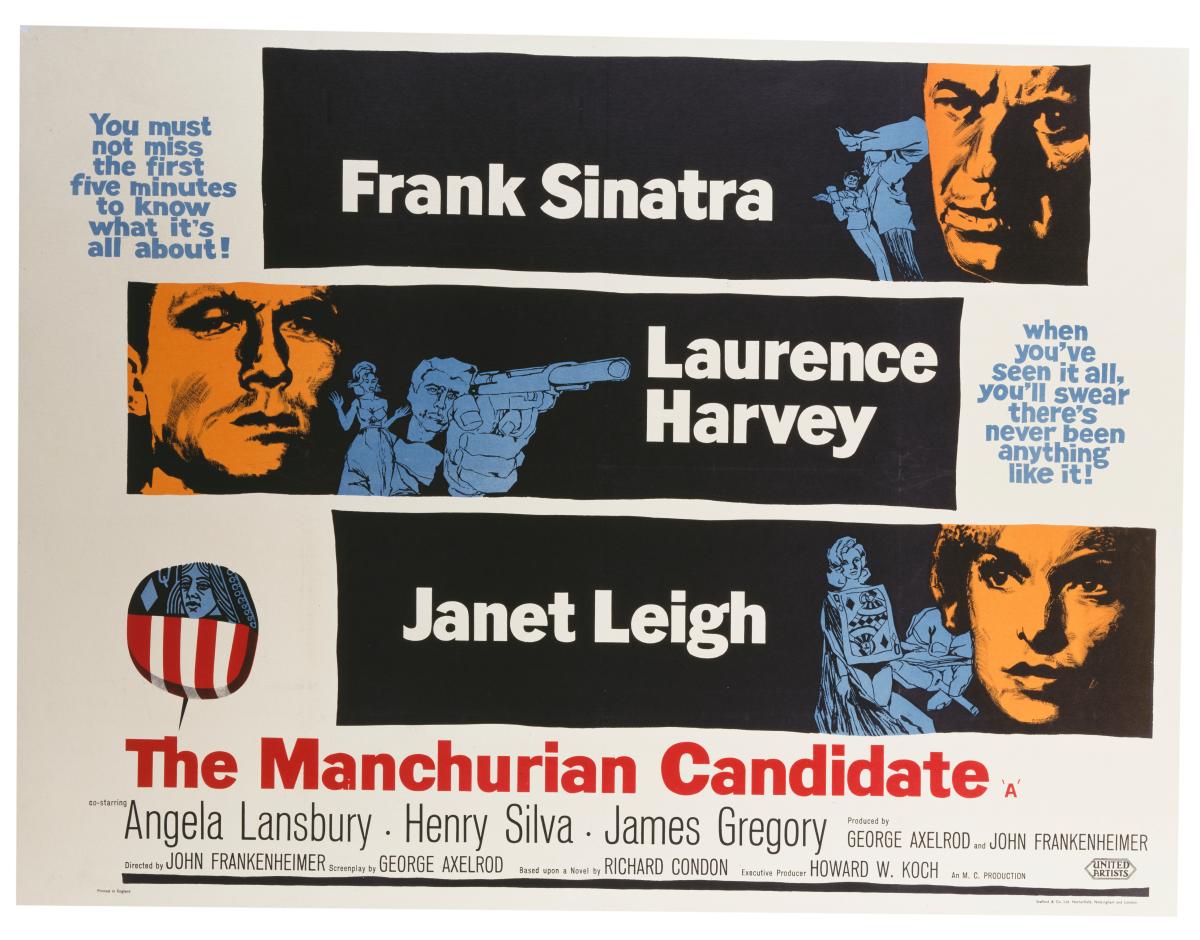
A poster for the film

…it feels as if it were made yesterday. Not a moment of “The Manchurian Candidate” lacks edge and tension and a cynical spin. And what’s even more surprising is how the film now plays as a political comedy, as well as a thriller.

-Roger Ebert

I love this movie & find it disturbing. It’s a thriller but at times it even seems a satire.

Sinatra is so great here, you hardly notice how good Laurence Harvey is.

#TCMParty (selected tweets)

I keep telling you not to think! You’re very, very good at a great many things, but thinking, hon’, just simply isn’t one of them. -Mrs. Iselin explains to her husband

There is something timeless, yet also eerily timely about this classic film (in Trump’s America). Though it was released in 1962, it is set in 1952 in New York and DC; the use of black and white makes it look older. I think the novelist (Richard Condon) was influenced by Hamlet; note Sgt. Raymond Shaw’s (Laurence Harvey) deep hatred for his stepfather, Senator John Iselin (James Greogory), who married his domineering mother, Eleanor Shaw Iselin (Angela Lansbury). We are NOT told anything re: Raymond’s birth father; I imagine that he was a wealthy/intelligent/influential man. In the youthful romance of Raymond and Jocelyn Jordan (Leslie Parrish), there is an echo of the feud between noble families as in Romeo & Juliet

TMC_train_mtg
Maj. Bennett Marco and Rosie chat on the train in a mysterious manner.

Janet (Psycho) Leigh plays a shady, Robert Walker-like femme fatale whose cryptic language may or may not indicate she’s a member of the Communist Ring… The most celebrated (and widely discussed) meet-cute in film history occurs aboard a train, as Janet Leigh and Sinatra whisper sweet-somethings in the most roundabout, I’ve-never-heard-people-talk-like-this way imaginable. 

-Stanford Arts Review

Women are (in several scenes) depicted as capable, smart, and active agents in their romantic lives. Obviously, Mrs. Iselin is the power behind her loud-mouthed/dim-witted husband. A young Josie comes to Raymond’s rescue after he’s bitten by a snake. Rosie (Janet Leigh) approaches Maj. Bennett Marco (Frank Sinatra) during their train ride, shows him that she’s VERY interested, then tells him her address and phone number.

TMC_raymond_mother
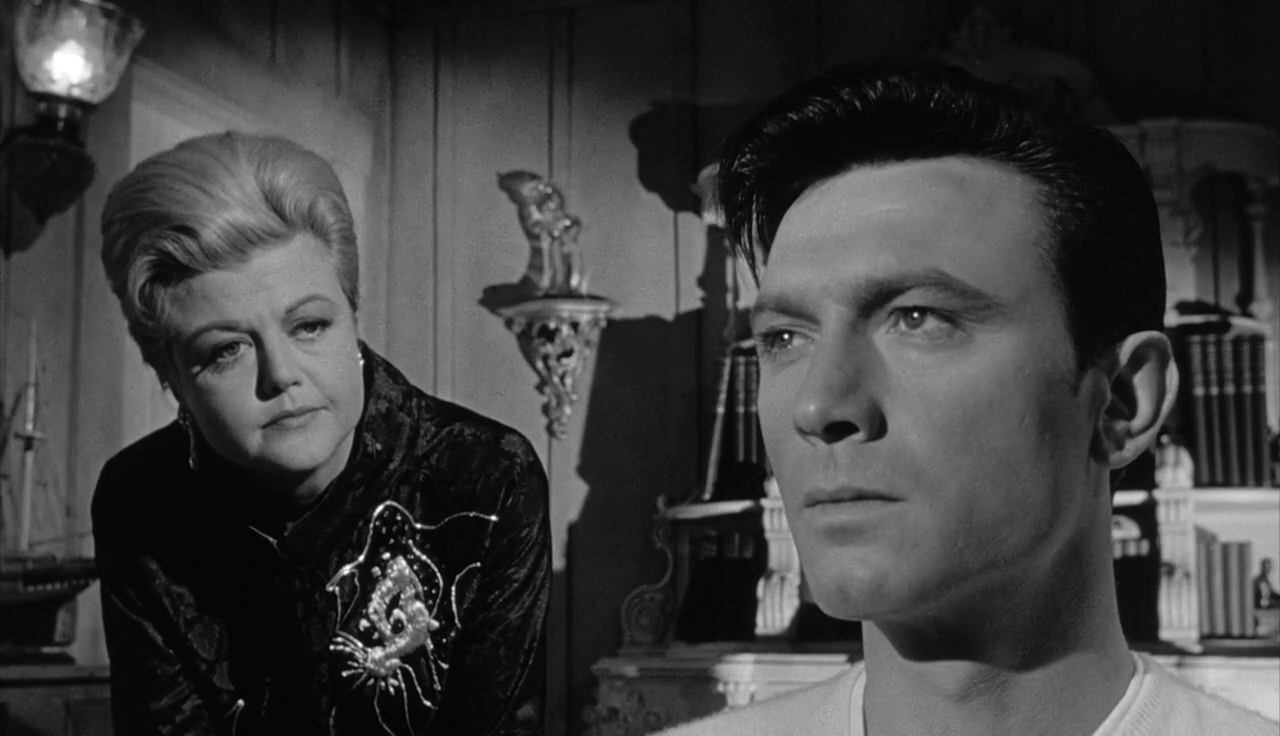
Mrs. Iselin (Angela Lansbury) and Raymond (Laurence Harvey)

It’s a terrible thing to hate your mother. But I didn’t always hate her. When I was a child, I only kind of disliked her. -Raymond explains to Bennett Marco 

This is the type of film that you MUST pay attention to, or you’ll miss something! It showcases Sinatra’s acting range; many critics/classic movie fans consider this performance to be the best of his career. The Manchurian Candidate proves us just how scary Lansbury can be, if the script calls for it; I wished there was more of her performance. The way that she controlled Raymond’s life has contributed to how his life is like at that start of the story: humorless, friendless, and loveless. He attempts to get away by taking a job w/ a newspaper editor he admires, BUT alas, his life is NOT his own. 

TMC_costumeball
Mrs. Iselin (Angela Lansbury) faces off against Senator Tom Jordan (James McGiver).

There are people who think of Johnny as a clown and a buffoon, but I do not. I despise John Iselin and everything that Iselinism has come to stand for. I think, if John Iselin were a paid Soviet agent, he could not do more to harm this country than he’s doing now. -Senator Jordan says to Mrs. Iselin

Little details add to the richness of the story. There is a scene where an African-American soldier is having a nightmare/flashback (VERY similar to that of Marco), BUT we see that the ladies in the tea party are African-American. That’s b/c it’s happening w/in the context of his life, NOT that of a white man. There are two supporting East Asian characters, including Dr. Yen Lo (Khigh Dhiegh) and Korean translator-turned-cook, Chunjin (Henry Silva- of Puerto Rican heritage). In one exciting scene, Marco and Chunjin fight using karate. 

Detective Story (1951) starring Kirk Douglas & Eleanor Parker

[1] The writing is a bit too well-structured, almost like clockwork, the characters are a bit too symbolic and easy to categorise. The comic relief kicks in just on schedule. The psychological diagnosis is too precise. And yet, this is one of the greatest films ever made. It has a sense of respect for the totality of life, and makes tragedy almost poetic. 

[2] Kirk Douglas carries the burden of McLeod and makes the tormented policeman painfully believable–it is almost a nonstop, swirling performance… 

[3] The abortion angle of the original play was taken to the screen, partly because of censorship, and partly because the close-up, immediacy of the camera requires rage to be clearly more explained than on the stage…

-Excerpts from various reviews (Amazon & IMDB)

detective story poster.jpg
A poster for the film

Evil’s got a smell of its own. A child could spot it. -McLeod says, before giving some info re: his father/parents’ relationship

In this film, abortion is sinful, criminal, horrifying (personally and socially)- a tragedy. It appears from different angles: the Dutch abortion doctor (w/ his clever lawyer), the detective’s wife, her ex-boyfriend (who got her pregnant), and eventually, the detective. When Mary (Eleanor Parker) finally tells her husband (Kirk Douglas) about it, his worldview is too black and white to handle it. He calls her a “tramp”- she’s wasn’t expecting that reaction. All that matters is that she was intimate with someone before being married to him. She says she’s leaving him forever. He doesn’t go after her, as his fellow detectives urge. Mary gets her freedom.

detective4-620x350.jpg

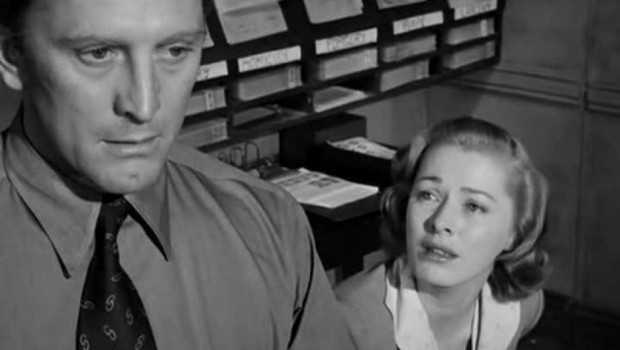
Mary (Eleanor Parker) begs and cries, but McCleod (Kirk Douglas) doesn’t see her virtues.

This may be one of the early “typical day” genre- several different stories occurring over one day in the same location, but melded into a whole (as on the TV shows, Hill Street Blues and Barney Miller). A key ongoing side plot involves an unlikely/lovelorn first offender and the younger sister of his former girlfriend. He stole from his employer to win back his (model) girlfriend who has moved on to a different circle. McCleod’s partner, Det. Brody (William Bendix) is more gentle/understanding; this man reminds him of his dead (WWII hero) son.

Oscar nominations were given out for William Wyler’s direction, the screenplay, and for Parker and Lee Grant, lead and supporting actresses respectively. At a little over 20 minutes, Parker’s performance in this movie is the shortest to ever be nominated for a Best Actress Oscar.

I built my whole life on hating my father. All the time he was inside me, laughing. -McLeod finally realizes the truth about his personality 

Since it was impossible to film the movie without portraying the killing of Detective McLeod, so this movie resulted in another amendment to the Production Code. From December 20, 1938 to March 27, 1951, there was a rule forbidding the display of law enforcement officers (EX: detectives, security guards, etc.) dying at the hands of criminals. From March 27, 1951 onward, the Production Code allowed such portrayals, if they were “absolutely necessary to the development of the plot” (as noted in the book The Dame in the Kimono by Leonard Jeff and Jerold Simmons).