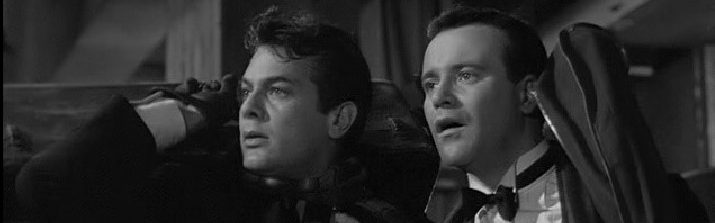
“Until They Sail” (1957) starring Jean Simmons, Joan Fontaine, Paul Newman, & Piper Laurie

The genuine tugs at the heart are few and far between in this bittersweet but basically restrained chronicle. Robert Anderson’s adaptation… is honest and straightforward… Unfortunately there is a good deal of introspective soul-searching before this narrative arrives at its sad and happy endings. -Bosley Crowther (New York Times)

The film opens in a Christchurch, New Zealand courtroom, where testimony prompts Barbara Leslie (Jean Simmons) to flashback to the events that led to the trial. In 1939, Barbara and her sisters: Anne (Joan Fontaine), Delia (Piper Laurie), and Evelyn (Sandra Dee- just 14) live in a cottage in Christchurch. Most of the men, incl. their brother Kit and Barbara’s new husband Mark, are preparing to leave for WWII. Some time later, Delia announces her engagement to Phil “Shiner” Friskett (Wally Cassell); he is one of the city’s few remaining bachelors, though word of Kit’s death dampens the mood. Anne disapproves of the marriage, but Barbara defends Delia’s decision. Shiner is eventually drafted for war; Delia moves to Wellington to work for the navy. In 1942, several hundred U.S. Marines are shipped to New Zealand.

The film has moments of genuine tenderness and truth. -William K. Zinsser (New York Herald Tribune)

The screenplay was by Robert Anderson, based on a story by James A. Michener included in his 1951 anthology Return to Paradise. As fans of classics know, there are limits (and conventions) to the Hollywood studio system. The 1st thing you’ll need to ignore are the (wildly varied) accents of the sisters; we learn that Anne and Barbara attended school in England. The hairstyles and clothing worn by the women reflect the mid-1950s, NOT the early ’40s. There are a few scenes that come off as TOO melodramatic; others can drag on a BIT too long. However, the look of the film is lovely; it was shot in Cinemascope (or extra widescreen). The musical score by David Raksin suits the events V well.

This [pulls out a bottle of whiskey from glove compartment] is what I spend the night with… and no regrets. Oh, I get a gentlemanly hangover in the morning, but no regrets. And nobody gets hurt. -Jack explains to Barbara

U.S. servicemen married over 15,000 Australian and New Zealanders they met while stationed overseas in WWII. The War Brides Act of December 1945 required only proof of marriage to ensure legal migration to the US. Some modern sources est. the total war bride migration was one of the largest migrations to the country since the 1920s. Paul Newman (before fame; 3rd billed) accepted a supporting role only b/c Robert Wise was directing. I heard about this movie (via a Facebook post); I’d recommend it esp. to fans of Newman and Simmons. You can rent it on VOD; I saw it last week.

Newman plays Capt. Jack Harding, an alcohol-dependent/cynical/divorced Marine investigating prospective brides of soldiers. From the choices that Newman makes, you can see that acting is becoming more subtle in this time. As Barbara, Simmons is caring and empathetic to her sisters; she’s trying to live a “decent” life. One astute viewer noted that modern viewers (who’ve recently lived through the COVID-19 pandemic) may esp. relate to the loneliness experienced by the sisters in this movie. As Barbara tells Jack when they reconnect, her countrymen have been gone 3 yrs so far (1939-1942). I esp. liked how their connection grew (so it seems gradual/natural- NOT rushed); Newman and Simmons project intense chemistry!

[1] Not the best role of any of the principal actors’ careers, but definitely worth seeing, especially if you are drawn to WWII era dramas.

[2] Jean Simmons… is the counterpart for Paul Newman, who is the point man for the American presence (and the introduction to American men). […]

…even if this movie seems to follow some ordinary romantic path, you can’t help but feel, individually, for the four women wanting to not be alone. (It has some echo of “Little Women,” to me.) That’s the reason to hang in there. It takes time to get invested in the characters and their needs. Paul Newman is very good as usual, but more restrained than you might expect. Handsome, but without some kind of edge that made him bigger than life.

-Excerpts from IMDb reviews

“The Verdict” (1982) starring Paul Newman, Charlotte Rampling, Jack Warden, & James Mason

Frank Galvin Has One Last Chance At A Big Case. -Tagline

An outcast, alcoholic Boston lawyer sees the chance to salvage his career and self-respect by taking a medical malpractice case to trial rather than settling. -Synopsis

The Verdict was ranked #4 on the AFI’s list of the 10 greatest films in the genre of “Courtroom Drama.” The movie was nominated for 5 Academy Awards (Best Picture, Best Director, Best Actor, Best Supporting Actor, and Best Adapted Screenplay); it didn’t win any Oscars. One of Paul Newman’s closest friends, Robert Redford, was originally involved w/ this film. David Mamet delivered his draft of the screenplay; Redford felt uncomfortable w/ how Frank Galvin was characterized (alcoholic, opportunistic, and mostly unlikeable). He hired another writer to work on a draft, and so on and on, until Redford decided NOT to tackle the role. Sidney Lumet was offered the project; he read all the drafts and identified the original Mamet version as the one he wanted to make. Newman agreed to star and received a Best Actor Oscar nom!

James Mason was eager to work w/ Lumet again; he was 1st offered the part of Mickey Morrissey (eventually played by Jack Warden). The director didn’t think that Mason wanted the role; at the advice of his wife, Mason called Lumet. Burt Lancaster (originally set to play Ed Concannon) dropped out, so the role was available. Edward Binns (who plays Bishop Brophy) and Warden played jurors in 12 Angry Men (1957), the 1st feature film directed by Lumet. Although the film was set in Boston (and looks like it), most of it was shot on sound stages in NYC. The actors rehearsed for 3 wks prior to filming (as was part of Lumet’s process); the studio also allowed the director to have final cut (which is rare).

I recall a LOT of ppl commenting that they 1st watched this movie in their HS (Social Studies/History) class. I suggest taking a 2nd look, esp. if you’re a fan of courtroom dramas and/or Newman. Wow, even at age 57, the iconic actor (purposefully de-glamorized) shows that he can still stretch himself! In one interview, Lumet comments that Newman “put a lot of himself into that role.” I think it’s his most impressive role, aside from Hud.

[1] Newman is a wonder with his loser posture and hyperventilation and his desperateness. It’s in his voice, it’s on his face, it’s in his smile, it’s in his shaking hands.

[2] And I found the direction by Sidney Lumet to be, once again, outstanding. Lumet has such a long list of great movies that you wonder why he has never won an Oscar or been given an AFI Lifetime Achievement award.

This is a riveting movie — about the law, but mainly about the flawed nature of the human beings who are entrusted with it.

[3] Production design: as good as it gets. Everything looks old, as if it has been used and lived in for years, not shabby but burnished with age, all mahogany wood and scarlet carpets. Lighting and photography: up there with the best. Most scenes are dark — it’s midwinter in Boston — but not too dark, cleverly lighted. The snow in the streets is literally blue, as if it had just leaped out of an impressionist landscape. Tree branches glisten with moisture on slick night-time streets. Tinsel draped along a bar ceiling twinkles with fraudulent joy.

-Excerpts from IMDb reviews

Paul Newman’s 1st Movie: “The Silver Chalice” (1954)

A young Greek artist, Basil (Paul Newman), is commissioned to cast the cup of Jesus in silver, and sculpt around its rim, the faces of the disciples and Jesus. He travels to Jerusalem, then eventually, to Rome to complete the task. Meanwhile, a magician, Simon (Jack Palance), is trying to convince Caesar and the Romans that he is the new Messiah. James Dean was offered the role of Basil, but he and his agent thought the script was poor. Newman, who was a finalist for the role of Cal Trask in East of Eden (1955) that eventually was played by Dean, and made him a star, took the role, which Newman later regretted. While shooting East of Eden, Dean went over to visit Newman on the set of this film, where he met the love of his short life, a young Italian actress- Pier Angeli (Deborra, a Jewish merchant’s daughter/convert to Christianity).

I had a cocktail dress. Nero had a cocktail gown. -Newman (joking re: costumes in this movie)

Let’s begin with the good points; it got 2 Oscar noms- one for William Skall’s color cinematography and the other for Franz Waxman’s musical score. A teen Natalie Wood makes a brief appearance. That’s it- sorry to say! The story is boring, it drags b/c of its long running time, and the dialogue is bad (which caused some viewers to laugh). There are some sad-looking (minimalist) sets which were obviously built on a soundstage. No one can call a movie “epic” w/ sets like that! Newman is looking gorgeous (as usual); his legs aren’t “too skinny for a toga,” as he later commented. You can tell he had no direction; he doesn’t seem to know where to turn or how to say a line! As a young actor, Newman said that he was “cerebral, rather than intuitive.” I’ve never heard of this director, Victor Saville, so maybe he left Hollywood? Mayo seems to be sleepwalking, while Palance is SO campy at times (that some viewers admitted they were entertained). Of course there are worse movies than this, BUT you don’t need to watch!


[1] The Silver Chalice is best remembered for a Variety ad that Paul Newman took out after he got famous and apologized for, not only his performance in this film, but also the film itself. Of course, doing something like this is only going to get people interested in the film, so I’m sure many people have watched this because of Newman’s plea for you not to.

[2] They [actors] are hindered by very sketchily written characters and as dreary and stilted a script as you can get… Victor Saville’s direction never comes to life and the story feels overlong, stodgy and over-stretched with scenes that are either stagey, superfluous or unintentionally funny…

[3] Mayo looks as though she just left the chorus line of The Goldwyn Girls and had the artists paint her eyebrows in what someone must have assumed would resemble women of antiquity. She saunters around in her veiled costumes as though she is about to break out into a burlesque queen’s rendition of a bump and grind song number.

-Excerpts from IMDb reviews

Hitchcock’s 50th Film: “Torn Curtain” (1966) starring Paul Newman & Julie Andrews

Prof. Michael Armstrong (Paul Newman- the hottest scientist ever) is heading via boat to Copenhagen to attend a conference w/ his assistant/fiancée, Sarah Sherman (Julie Andrews). Once they arrive, Michael informs her that he’ll be staying for a while and she should go home. Sarah follows him and realizes Michael is actually going to East Germany (behind the Iron Curtain). She is shocked when Michael announces that he’s defecting; the U.S. government cancelled his project after 6 yrs. In truth, Michael is there to get info (which a professional spy couldn’t understand) from another nuclear physicist!

I did not have to act in ‘Torn Curtain’. I merely went along for the ride. I don’t feel that the part demanded much of me, other than to look glamorous, which Mr. Hitchcock can always arrange better than anyone. I did have reservations about this film, but I wasn’t agonized by it. The kick of it was working for Hitchcock. That’s what I did it for, and that’s what I got out of it. -Julie Andrews

The idea behind this film came from the defections of British diplomats (Guy Burgess and Donald Maclean) to the Soviet Union in 1951. Sir Alfred Hitchcock was very intrigued re: Maclean’s life in the Soviet Union, incl. about Melinda Marling (his wife) who followed her husband a year later w/ their three children. In the end, Hitch was so unhappy w/ this movie that he didn’t make a trailer w/ his appearance in it (as was his habit). Bernard Herrmann (composer) wrote an original score, but Universal execs convinced the director on something more upbeat. Hitchcock and Herrmann had a big fight and never worked together again! Steven Spielberg admitted on Inside the Actors Studio (1994) that as a young man he snuck onto the soundstage; he was there for 45 mins. before an assistant producer asked him to leave.

I think Hitch and I could have really hit it off, but the script kept getting in the way. -Paul Newman

The working relationship between Hitch and Newman was problematic; the actor came from a different generation than Cary Grant and James Stewart. He questioned the director re: the script and his characterization, which Hitch later said he found “unacceptable and disrespectful.” As a Method actor, Newman consulted Hitch about his character’s motivations; Hitch replied that his “motivation is your salary.” Also, no romantic chemistry developed between Newman and Andrews (another disappointment to the director). Though the screenplay drags along, the colorful Eastern European supporting actors do fine w/ what they are given. Many critics/viewers recalled the (memorable) killing scene where Gromek fights Armstrong and a housekeeper in the farmhouse.

[1] Pity. I love Hitchcock. There is a detachment here never seen before in a Hitch flick. As if the master was tired or uninterested.

[2] The main thing about Torn Curtain is the photography. It’s full of pretty pictures- one of the most beautifully filmed of all Hitchcock’s films, with lots bold swaths of primary colors and attractive and constantly changing locations…

[3] This was Alfred Hitchcock’s last star vehicle. At the time this was made Julie Andrews was fresh from Mary Poppins and had all kinds of roles offered her. …she and Newman really have no chemistry at all.

-Excerpts from IMDB reviews

The Rack (1956) starring Paul Newman

Capt. Edward Hall, Jr. (Paul Newman)- the son of an Army colonel (Walter Pidgeon)- returns to the US (San Francisco) after 2 yrs in a Korean War prison camp. For 6 mos, he was isolated from the other prisoners and psychologically tortured. His younger brother (Paul) died in combat during this time. Ed is quickly charged w/ treason, assigned a JAG lawyer- Lt. Col Frank Wasnick (prolific character actor Edmond O’Brien)- and put on trial. Paul’s widow Aggie (Anne Francis) is empathetic and a willing ear for Ed, though his father is embarrassed (even refusing to come to court). He pleads “not guilty,” but had he reached a personal breaking point during his capture? 

This is a must-see if you like intelligent, sensitive, serious, and well-acted l films! The teleplay was written by Rod Serling (creator of the original Twilight Zone TV series). Paul Newman (then 30 y.o.) is able to keep the viewer’s attention in the quiet and intense moments; he slowly reveals the layers of his character. Newman creates terrific chemistry w/ his co-stars, most notably Pidgeon and Francis. The theme of the distant/unemotional father and son yearning for acceptance and love isn’t rare for Hollywood, though it’s handled very well here. When Ed leaves home and goes to stay in a hotel, a concerned Aggie goes to check on him. In a more obvious story, they may have become a romantic pair; here they become good friends.

The prosecution of a (previously decorated) war hero isn’t an easy thing to handle; it falls upon Maj. Sam Moulton (Wendell Corey), who isn’t too happy w/ the assignment. Lt. Col. Wasnick sees that Ed is full of self-pity, so has to boost his spirits and prep him to tell his story on the stand. O’Brien gets some of the best lines (during the courtroom scenes). Even the soldier who testifies against Ed, Capt. John Miller (character actor Lee Marvin), isn’t a one-note  character. It turns out that he also suffered tortured, though his was physical. Aggie confides her worries in a neighbor played by a very young (and pretty) Cloris Leachman; she later became an iconic character actor in comedy.

[1] This is fascinating drama… The ending is ambiguous and may well lead to a heated debate…
 
[2] …the theme is relevant today as it was when it was made.
 

[3] Paul Newman’s second film… [his acting] demonstrates that, even then, he was the truly finest screen performer around. But the very nature of his style has always placed him behind –or to the side of– more “bravura” actors of the time. Unlike Brando and Clift and Dean- he is much less self-centered; in other words he is a sharing actor. This puts the SCENE in focus more than the performance…

[4] I thought the acting was sincere and I was draw to this character that seemed to feel he lost his way by being human.
 
-Excerpts from IMBD reviews