Blindspotting (2018) starring Daveed Diggs

Daveed Diggs was one of the actors in the ensemble of Hamilton; he played BOTH the Frenchman Marquis de Lafayette and founding father Thomas Jefferson. He also recently played Jonah Johnson, the younger brother of Rainbow on the ABC family comedy Black-ish. With this funny, smart, and VERY thoughtful indie film, he carves out a new space for himself-  leading man (as well as writer, poet and shrewd social commentator). Diggs (who is biracial and raised Jewish) is tall, muscular, w/ large expressive eyes- assets to ANY male actor. However, unlike the men of typical Summer action films, he’s NOT afraid to show (messy) emotions. 

Blindspotting, co-written by Diggs and his long-time friend, Rafael Casal (a white Hispanic poet), is about working-class best friends in Oakland, CA. Urban life has rarely been shown like this; it has layers and depth that reflect reality. Diggs is Collin, a young-ish black man working as a mover, living in a halfway house, and waiting for his probation period to end. He has ONLY three days to go when the film starts; he is cautiously hopeful, BUT also somewhat anxious/nervous about what lies ahead. Casal is Miles, Collin’s mouthy/hot-headed white best friend/co-worker who is known for getting into trouble. Collin and Miles have always had each other’s backs, or so it seems; we learn more as the story goes on. Miles (who can be charming) lives w/ his long-time girlfriend- Ashley (Jasmine Cephas Jones)- and their biracial/pre-school age son, Sean. Ashley desperately wants to send Sean to a better school, BUT she needs a BIT more money each month. Miles, w/ Collin in town, sets out to work his hustle (being quite good w/ words). 

Police (and the quickly gentrifying community) do NOT see Miles and Collin in the same way. Though Miles is deeply loyal to his Oakland roots (w/ MANY tattoos as proof), he’s still a white man. In one of the early scenes, Miles finds a gun in a friend’s car and plays w/ it, laughing and joking. Collin (who is more of a thinker/quieter than Miles) can’t believe Miles’ nonchalant attitude. While driving the moving van home late one night, Collin witnesses a shooting. This event alters his life in ways that he never expected, BUT he has to stay out of trouble, and NOT give into anger. Miles doesn’t make things easy, though. Collin’s wise mother and his concerned ex-girlfriend/psychology student Val (Janine Gavankar- hailing from a prominent Indian film family) tell him to distance himself from his friend. Tensions brim w/in the community and between the two men, who come to realize that there are limits to even the tightest bonds.  Watch the trailer below! 

Daveed Diggs and Rafael Casal’s 10-Year Journey to Get Sundance Opener ‘Blindspotting’ to Big Screen

She’s Gotta Have It (2017)

WARNING: This review contains SPOILERS for the Netflix comedy series. 

[1] The soundtrack to this series is amazing! Spike really did his thing with the song selection. Second, the shots and cinematography were great. Spike and his crew really make Brooklyn come alive in this series. 

[2] Nola is getting a steep discount from her godmother to stay in the gentrified neighborhood she grew up in, and she still doesn’t manage to get the rent on time. They constantly talk about her hustle, yet she really isn’t ever truly desperate or truly hustling.

Gentrification is a legitimate issue, and I see the commentary Spike was going for, but it fell quite short. 

[3] The characters remain mostly undeveloped and the story, while it has its high points, is largely pointless and unresolved. 

[4] The infamous American director and producer always stood strong by telling the stories of minorities in all his films. Nola Darling doesn’t like labels and she doesn’t like to be owned…

-Excerpts from IMDB reviews

Do you remember the black and white 1986 film of the same title directed by 29 y.o. unknown Spike Lee? I saw it about 10 yrs ago, and wasn’t that impressed; lead actress (Tracy Camilla Johns) looked rather uncomfortable in front of the camera. Lee (who also played Mars Blackmon- to save money on actors) was memorable; he had the catchy phrase: “Please baby, baby, baby, please!” Lee refers to Mars as “the original sneakerhead” (someone who collects, trades, or admires sneakers as a hobby). Critics complained that the film was too much from a man’s POV (which Lee admitted; he was inspired by male friends who dated several women at the same time).

As a more mature man, as well as a husband and father, Lee re-imagined the story of Brooklyn artist Nola Darling (the gorgeous DeWanda Wise, recently seen on Shots Fired and Underground). Lee is aided by a cadre of strong, successful African-American women: his wife Tonya (a producer), his sister Joie (who plays Nola’s supportive mom), Pulitzer Prize winner Lynn Nottage, as well as other female writers and directors. Wow, this is an impressive group! And I MUST note how well Joie Lee is aging, too. 

The three men in Nola’s life (NOT to be referred to as “boyfriends!”) are played by some fine (and fine looking- LOL) up-and-coming actors, most notably Anthony Ramos (Mars), who was in the original cast of Broadway’s Hamilton. Ramos (who is of Puerto Rican heritage) brings an innocence, sense of fun, and lightheartedness to his part of the story.  Though he still lives w/ his older sis in the projects, Mars has a job fixing bikes at a hipster coffee/bike place. I was also impressed by Lyriq Bent (who plays the slightly older/wealthy/married father- Jamie Overstreet); this actor hails from Canada and is very believable in the heavier/emotional scenes. Without Jamie’s (financial) support, Nola wouldn’t be able to support herself as well as she does. We also get a sense that Jamie is the one that will fall for Nola in the end; he’s in a (now loveless) marriage, but a good role model for his preteen son.  Rounding out the main male leads is Cleo Anthony (biracial, French-speaking, model/photographer Greer Childs). This seems like the man that gets Nola’s lifestyle the best; he is focused more on his career and playing the field, not finding a serious relationship (unlike Mars and Jamie). But wait, there aren’t ONLY men involved w/ Nola!

Opal Gilstrap (Ilfenesh Hadera) plays a slightly older woman, who is also an entrepreneur (running a nursery) and single mom (by choice). Nola (who is in her late 20s) looks up to Opal, feels close to her emotionally, and is very attracted to her as a person. As their relationship goes on, we see how Opal has her life together; Nola is a BIT of a mess in many regards. They make a great couple, though ONLY for a short time. The other women in Nola’s life are her close friends: artists’ rep/yuppie Clorinda Bradford (Margot Bingham), cocktail waitress/single mom Shemekka Epps (Chyna Lane). and the redheaded/Afrocentric white woman Rachel (Elise Hudson).

Nola decides to go to therapy w/ Dr. Jamison (Tony winner Heather Headley); this is someone who can be objective re: Nola’s (complicated) life. Not ONLY does Nola juggle lovers, she has several jobs (incl. a dog-walker and part-time art teacher at a junior high school). I esp. liked the scenes w/ the school kids and their no-nonsense/loving principal, Raqueletta Moss (De’Adre Aziza); I used to sub in NYC area. She has to hustle (though some viewers felt NOT too much) b/c she doesn’t want to end up like her high school friend/war vet, Papo (Elvis Nolasco). This man also grew up in Fort Greene, had a LOT of potential, and fought in the Middle East for Uncle Sam. Papo was never the same after he came back; he still creates art, BUT out of trash (which annoys Nola’s gentrifying/new white neighbors). The long-time residents of the block call him “The Mayor” of the neighborhood (this is a call-back to the iconic Ossie Davis’ role in Do The Right Thing).  Nola’s understanding landlady/godmother is played by Pauletta Washington (wife of Denzel); I can’t believe that it took me a few mins to figure that out! 

There are MANY things to admire, such as the color (the hairstyles, costumes, and accessories are really cool), diversity (of black individuals and their experiences), and the tacking of MANY timely issues (hmmm, maybe too much?) Yet, there are also disjointed things, such as the use of hashtags for ep titles (after all, Nola is NOT much of a social media user or internet dater, unlike MANY millennials). This is NOT a show for everyone, BUT I’d recommend it for Spike Lee fans.
The Problem with Apu (2017) starring Hari Kondabolu

Last WED night, Hari Kondabolu was in DC (Baird Auditorium at The Smithsonian Natural History Museum) to discuss his first documentary film w/ NPR reporter Elizabeth Blair and a diverse audience (which included MANY South Asian immigrants and 1st gen adults in their 20s-40s). This was a free event; I signed up 2 weeks ahead of time (and got a kick out of seeing /chatting w/ MANY familiar faces attending). This film is NOT only funny, it’s smart and thought-provoking (delving into issue of South Asian representation in the media). You can watch this film on truTV  tonight (SUN, 11/19). 

So, what’s the big deal re: Apu here? Well, he’s a stereotype of an immigrant Indian man who runs a convenience store, and voiced by a white actor (Hank Azaria, who refused to appear in the film). The Simpsons is a nearly 30 y.o show on the FOX network which is watched/loved by millions. As Maryland-raised actor/musician Utkarsh Ambudkar (Pitch Perfect; The Mindy Project) summed it up: “The problem is- we didn’t have any other type of representation.” Hari interviewed MANY people incl: his parents, Aziz Ansari (Master of None), Kal Penn (Designated Survivor), Hasan Minhaj (Homecoming King), Aasif Mandvi (best known from The Daily Show), Maulik Pancholy (Star Trek: Discovery),  Aparna Nancherla (stand-up comic/actor/writer from Virginia), Sakina Jaffrey (House of Cards), Noureen DeWulf (Anger Management), Dr. Vivek Murthy (former Surgeon General under Pres. Obama), W. Kamau Bell (Hari’s friend/collaborator on various projects), Dana Gould (a producer of The Simpsons) and Hollywood trail-brazer Whoopi Goldberg (who speaks on America’s minstrel era, featuring “blackface”).

The audience was laughing all through the film. They were pleasantly surprised to see Whoopi and Dr. Murthy (a trailblazer in his own right). I esp. enjoyed the Q&A afterwards; Hari mentioned his idea for a future doc- focusing on Bengali filmmaker Satyjit Ray. 

Watch the trailer for The Problem with Apu below:


Mudbound (2017) starring Carey Mulligan, Garrett Hedlund, Jason Clarke, Jason Mitchell, & Mary J. Blige

NOTE: This review contains MILD spoilers for the film (which opens in theaters on NOV 17th).

I was lucky enough to attend a pre-screening of this film (produced by Netflix Studios) at Landmark E St in DC last week. I ran into two friends/movie fans there; we ALL liked it (though it contains some dark, gritty, and violent moments). It will stay in your mind for some time, no doubt. The director is Dee Rees, an openly gay African-American woman, who made the critical indie coming-of-age drama, Pariah. (I read about this film, BUT haven’t seen yet.) At Sundance, Mudbound received a standing ovation. 

The story is one part fiction (based on a novel w/ a white female protagonist) and one part fact (based on real events in the life of a black family). In the hands of another screenwriter, two different films would’ve been made from this material- one focusing on genteel/educated Tennessee spinster turned wife/mother, Laura McAllan (British actress Carey Mulligan) and her straight-talking/stubborn husband, Henry (Jason Clarke, an Aussie); the other on the African-American family farming part of the McAllan’s ancestral land in Mississippi, headed by Hap Jackson (Rob Morgan) and his wife, Florence, Mary J. Blige (the R&B singer). What ties these two threads together is the unlikely (and potentially dangerous) friendship between Laura’s charming/handsome brother-in-law, Jamie (Garrett Hedlund, giving a strong/layered performance), and the Jackson’s eldest son, Ronsel (Jason Mitchell, a fresh/compelling young actor recently in Straight Outta Compton).

Both Jamie and Ronsel, though of different ages and races, are WWII vets suffering through symptoms of PTSD after returning home to rural America. Jamie takes to drinking and wasting time, which greatly disappoints Henry, the responsible older brother and family man. Laura has strong feelings for Jamie, though she has long repressed them. Unlike his father, Ronsel can’t quietly acquiesce to the white people in town (whether it be Henry, his blatantly racist father- Pappy, shop owners, or even the sheriff). Hap and Florence worry about their son, who quietly seethes upon realizing the (very limited) role he will have as an adult black man in the segregated South. 

Shots Fired (Fox): First Impressions

DOJ prosecutor Preston Terry (Stephan James) and investigator Ashe Akino (Sanaa Lathan)

NOTE: This review contains MILD SPOILERS for the first three hours of the series.

[1] Shots Fired is at its best when raising legitimate questions about the criminal justice system and attempting to answer them. But I don’t know if there is an answer. The dark overtones that envelope the show at times feel real and appropriate. For a topic this serious, darkness may be the only way to truly shed light on the gravity of the situation.

[2] …I am not surprised by the haters in the reviews here. To me, these are people that are stuck in their ways and are not trying to see the world through different sets of eyes. Blacks and others have had to watch MOST TV through white people’s eyes and they expect us to be happy for it. Now you have a show like this that is finally putting Black people in a humane and more realistic light and they can’t handle it.

[3] I’m Asian male [Vietnamese] that grew up in a working class neighborhood and episode 1 gave me goosebumps because it aligns so much with our reality. You probably thinking how can I say that when I’m an Asian male. Truth is, many of our struggles are similar to blacks in America. You may not know, but there is an Asian gang culture in every major cities in America due to the same reasons that make it hard for blacks to succeed in America. Any law enforcement officers in major cities can confirm this.

-Excerpts from various IMDB reviews

Deputy Joshua Beck (Mack Wilds) is the young cop and family man who becomes an outcast on the police force.

Unnecessary police violence, particularly white cops against black offenders, is a topic that has everyone on edge. But, what happens when it’s a black cop that shoots an unarmed white kid based on racial profiling? 

The show centers on junior DOJ prosecutor, Preston Terry (Stephan James- who is Canadian and just 25 y.o.), and investigator, Ashe Akino (Sanaa Lathan- daughter of a prolific Hollywood producer), who are sent to a small North Carolina town to investigate a police shooting. It’s much better, if a black officer (Deputy Joshua Beck- played by 28 y.o. Mack Wilds)  is investigated and convicted by a black prosecutor, as one of Preston’s superiors in DC says in the first scene. Ashe and Terry dig deeper and find that an unarmed black kid was shot by a white officer not too long ago in the “houses”(projects) of this same town. 

Critics (and viewers) see a lot of potential in James; he definitely has that “It” factor (which an actor needs to get to leading man status). Don’t forget that a very young Blair Underwood played an attorney on L.A. Law in the ’80s. Wilds is doing pretty well in this role (never seen him before); the actor admitted that he never imagined himself in the shoes of a police officer before. He’s got an innocence and freshness about him- key for his role. What to say re: Sanaa Lathan?  Hmm… well, she’s got youthful looks (even at age 45); her acting is not terrible, but pretty one-note.

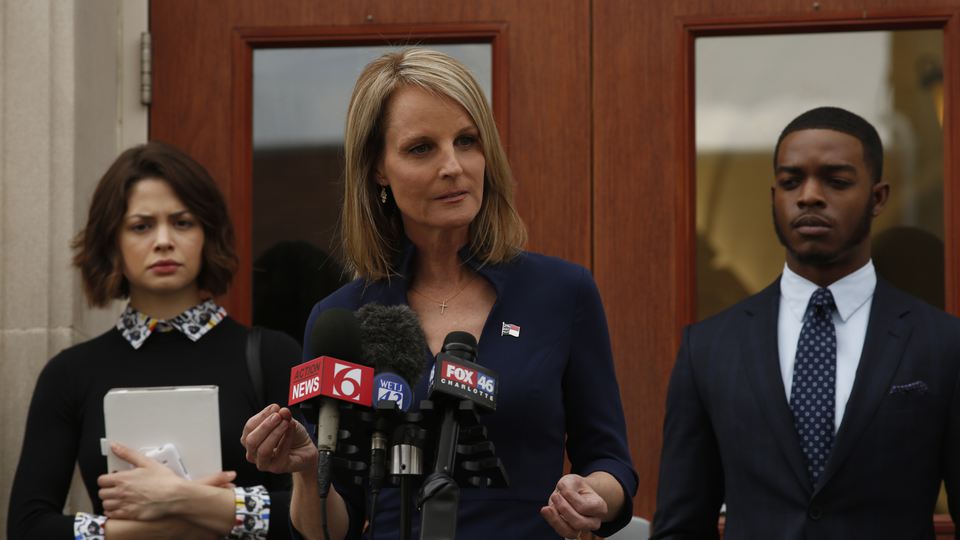
Governor Eamons (Helen Hunt) talks to press while her aide Sarah (Conor Leslie) and Preston (James) look on.

Patricia Eamons (Helen Hunt) is the first female governor of the state; she was the one who decided to bring in the DOJ.  Local pastor Janae James (Aisha Hinds) points out, after all the shootings of unarmed black men, why is this the case where the feds decide to get involved? Hinds’ outspoken activist, yet also spiritual, character is unlike most preachers we’ve seen on TV- female, youthful, and putting faith into action. 

Richard Dreyfus is introduced (near the end of the second hour); he is a 1st gen American businessman looking to advance a new prison/educational complex. I’ve seen three hours so far, but  may keep w/ it (if the writing gets stronger and the veteran actors get more to do). So far, British actor Stephen Moyer (who plays Lt. Breeland) has just been a jerk. He may have brought some fans along w/ him from True Blood (never seen that show, so can’t judge).  I’m waiting to see more of Will Patton (who plays the sheriff); he has a way w/ ambiguous characters.  

Jill Hennessy at the Sundance premiere of “Shots Fired.” I was very happy to see her back on network TV!

We get to see Ashe and Preston in their private lives, unlike what you’ve seen in most Law and Order-type series. Speaking of that iconic TV show, the still stunning Jill Hennessy plays Alicia Carr, the heartbroken mother of the white college student. She gets a chance to shine in the third hour. Preston, who could’ve been a professional baseball player, is trying to earn the respect of his father (Dennis Haysbert) and older brother, (a pro football player). Ashe is a woman with serious anger issues, trying to keep primary custody of her daughter. Her Latino ex-boyfriend is planning to marry (a younger Latina woman) and raise their daughter full-time.