Each season of Game of Thrones has been an exercise in selective adaptation, but its fourth season has been a feat of adaptive engineering. Working primarily with material from the third book but leaning heavily on the fourth and fifth in certain storylines, it is the season that has emphatically taken the “book-to-season” adaptation comparison off the table.
At the same time, though, the season has been organized around key climaxes taken directly from the third book in the series. Moreso than in other seasons, you could tell the writers were having to stretch storylines to maintain the timing they had established, creating material to flesh out the scenes on The Wall to justify the Battle of Castle Black taking place in episode nine or finding things for Arya and the Hound to do so that their scenes in…
“Blackwater” was about convergence. It was the inevitable collision between Stannis’ claim to the throne and the Lannister powers controlling it. In truth, Stannis’ side of the battle was pretty thin, sketched in without a whole lot of detail beyond Davos and his son. It was really about how Stannis’ attack changed the power dynamics at King’s Landing, whether through Cersei’s steely resolve, Tyrion’s ingenuity and intelligence, or Joffrey’s cowardice. At a stage when this was still ostensibly a show with the Stark family as its protagonist, it was an early example of the richness of stories in King’s Landing, capable of carrying an entire episode on its own.
“The Watchers On The Wall” wants to be “Blackwater.” Neil Marshall has returned as director. Mance Rayder’s not dissimilar to Stannis, in terms of development at this stage in their respective narratives, an…
“Traditions are important – what are we without our history?”
One of the perils of being a book reader watching Game of Thrones has been the fact that so many of the biggest moments have been “surprises” in the context of the narrative. We look to events like the Red Wedding, or the Purple Wedding, or Ned Stark’s fate on the Steps of Baelor as key events in the narrative, but we can’t necessarily share the anticipation of those events with viewers who have no idea they’re coming.
This is why “The Mountain and the Viper” is such a fun episode as a reader writing about the show. For once, the show has built in its own hype machine, setting up the trial by combat and building suspense for it over the past two episodes. The week off for Memorial Day…
SPOILERS: Don’t read this (reblogged) review if you have not yet seen or don’t want to know details from the most recent episode of Game of Thrones (Breaker of Chains).
…this gentle and thoughtful director shows human nature running a very natural course.
It had humor, seriousness, lessons, insight, beauty, love, family, decision-making, sadness, reflections, invisibleness, self-doubt, invention, perseverance, respect, aging, determination, coming to terms when enough is enough and genuine affection in how feelings grew by words alone…
Here is the perfect film (from a first-time director) for smart/sensitive viewers who want an alternative to Bollywood. Neglected middle-class housewife/mother, Ila (Nimrat Kaur), yearns to win back the attention and love of her husband Rajeev, one of the many strivers in the new India. Rajeev barely looks at Ila, is glued to his cell, and often comes home late at night. With the help of her (unseen) upstairs neighbor, she creates delicious (vegetarian, as she’s Hindu) recipes, and packs them in his tiffin (lunchbox).
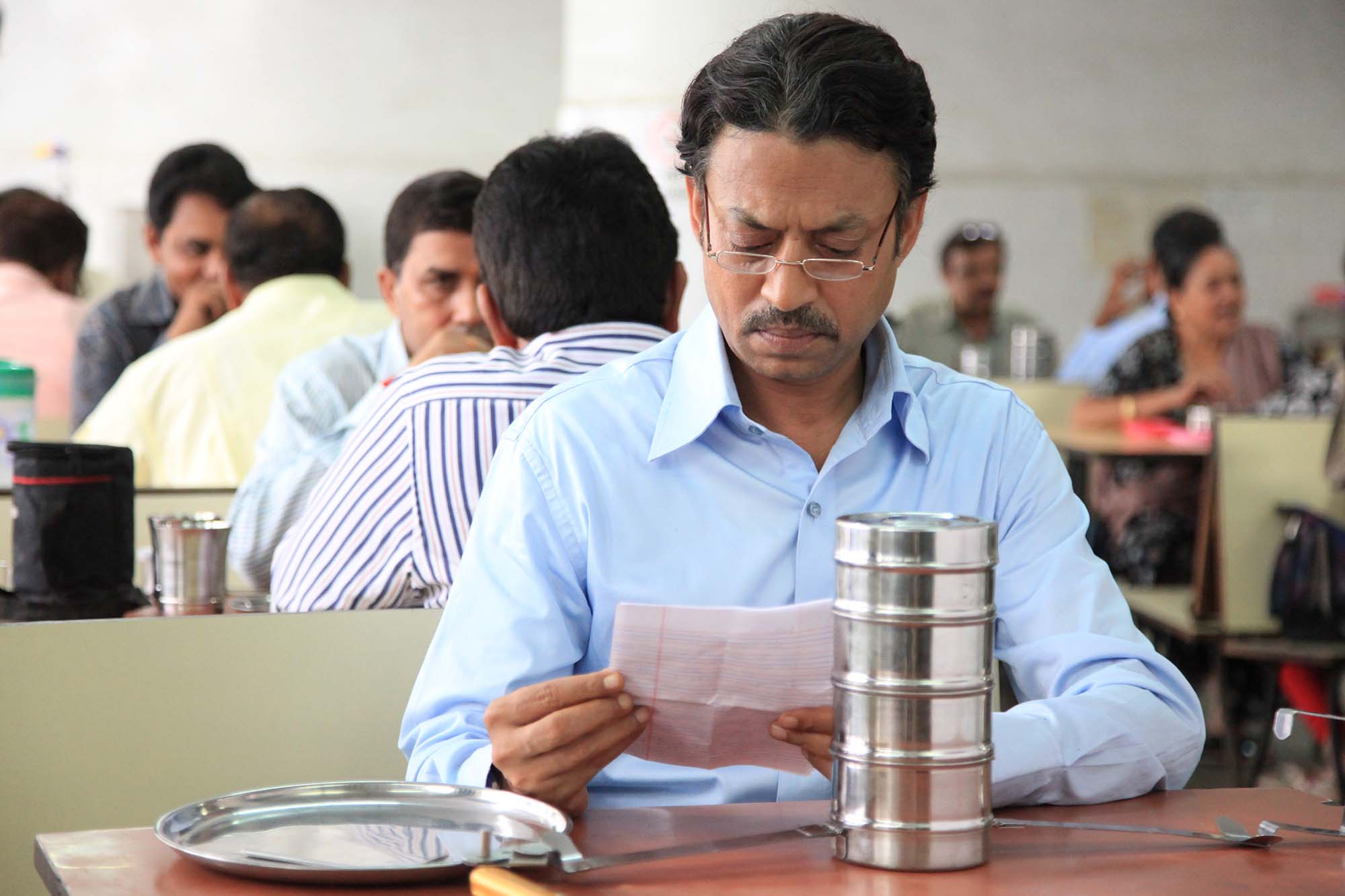
This lunchbox is supposed to be picked up each afternoon and delivered (via rickshaw, truck, and bus) to his office. However, it goes to a Sajaan Fernandes (Irrfan Khan from The Namesake, Life of Pi, etc.), a lonely/Christian government accountant just a month away from retirement. He likes the food, so an empty lunchbox is delivered back to Ila. Feeling appreciated, she decided to write him a thank-you letter.
The two lonely people begin a correspondence, bringing (much-needed) hope and optimism into each other’s lives. They share thoughts in their letters that no one else knows, from the mundane to the deeply personal. Are they just pen pals? Or is there possibility for more?
Saajan is dreading retirement, and postpones the training of his replacement, Shaikh (Nawazuddin Siddiqui), a younger Muslim man eager to learn/succeed. I enjoyed the slow reveal of Shaikh’s life- he’s got a fascinating story under that big grin. His character’s struggles and yearnings embody that of many modern, urban men. Siddiqui (still in his 30s), played a pivotal role in Midnight’s Children, and is an actor to watch. Nimrat Kaur is very easy to relate to; I’d never seen her before. She had a make-under for this role; she’s a very glamorous woman in real life. Irrfan Khan continues to (quietly) create magic- he simply becomes the character! He still has a long career ahead (only in his mid-40s). This is a must-see!