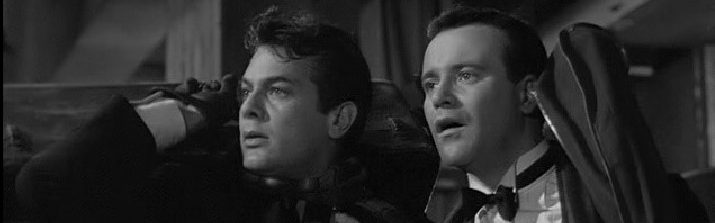
“His Kind of Woman” (1951) starring Robert Mitchum, Jane Russell, Vincent Price, & Raymond Burr

The hottest combination that ever hit the screen! -Louella D. Parsons

Nick Ferraro (Raymond Burr), a crime boss deported to Italy, needs to re-enter the US. His plan involves “honest” gambler, Dan Milner (Robert Mitchum), who’s subjected to a series of “misfortunes,” then bribed to take a trip to Mexico. On the way, Dan meets a lounge singer, Lenore Brent (Jane Russell), who calls herself one of the “idle rich.” Upon arrival at the resort (Morros Lodge) in Baja, Dan finds the guests all playing roles, except- maybe- actor Mark Cardigan (Vincent Price). What does Ferraro want w/ him? Can he trust anyone?

Myron Winton, an American banker: [after he & other guests have viewed Mark’s latest films] Yes sir, I agree with those folks: that was one of the finest movies I’ve ever seen. They oughta’ make ’em ALL like that. None of this nonsense about social matters. People don’t go to the movies to see how miserable the world is – they go there to eat popcorn and be happy!

Mark: [Addressing Mr. Krafft] What did you think of it?

Mr. Krafft, an European writer: [Dourly] It had a message no pigeon would carry.

Mark: [Slightly amused, turning to Myron] At my studios, all messages are handled by Western Union.

Myron: You know, you can’t take his opinion on anything: he’s an intellectual.

[Mark responds with a look of mild alarm.]

There is much drama BTS of this film noir, which pokes fun at the genre. John Farrow finished the film, BUT Howard Hughes (a well-known control freak) brought in Richard Fleischer to add a few shots. Hughes co-wrote the ending w/ Fleischer, who ended up reshooting the entire movie. Lee Van Cleef was cast as the crime kingpin before Hughes suddenly decided he wanted Burr instead. All of Ferraro’s scenes had to be reshot w/ Burr. During his RKO days, Mitchum referred to himself as “a tall dog on a short leash.” In his memoirs, Fleischer wrote that the actor’s alcoholism caused a LOT of problems for the production. One day, Fleischer told the actor that he “was making a fool of himself.” Mitchum then pushed the stuntmen off and destroyed the set! The next morning, a sober Mitchum was V remorseful and apologized to the director for his behavior.

Mark: [Preparing to go out and rescue Dan] Now might I drink hot blood and do such bitter business the earth would quake to look upon.

Helen, his estranged wife: [Rolling eyes] Hamlet again…

Gerald, his manager: Mark, this is no time for histrionics.

Mark: [Scoffing] What fools ye mortals be.

This movie is rather long for its day; the running time is 2 hrs. There are scenes which could’ve been edited better. Mitchum and Russell do look hot together (as the ads claimed); they’re both tall, laconic, and project ease/confidence. They went on to become V good friends IRL. Russell was “discovered” by Hughes. I’d read (on a film noir Facebook group) comments re: how funny Price was here. There are several LOL moments, which is NOT common for noirs! Some careful viewers noticed that Price is often slumping, wearing oversized costumes, and has makeup (which makes his face look rounder). This was (obviously) done to make him appear less imposing/attractive than Mitchum (the hero).

[1] Price quotes Shakespeare, critiques his performance, and is amazed by his own heroics, and he has never been funnier, onscreen.

[2] In a way, the film can be seen as three films in one. The opening scenes are shot in the dark, menacing film noir style. […] When Milner arrives in the resort the mood becomes lighter, and the film resembles more one of those “sophisticated” comedies about divorce and adultery… When the villains arrive and the nature of their plans becomes clear, the mood of the film changes again.

[3] …a great example of a film where the dialog is so snappy that the plot itself is secondary. Now this does NOT mean the plot is bad- the film is very well-written, as the WHAT and WHY turn out to be pretty interesting. But when Mitchum talks, he is the ultimate in ’50s cool- with a wonderful world-weary style and sarcasm... In addition, his scenes with Russell are great- with a nice mixture of romance, sarcasm and heat!

-Excerpts from IMDb reviews

“Black Widow” (1987) starring Debra Winger & Theresa Russell

She mates and she kills. No man can resist her. Only one woman can stop her. -Tagline

A tall/blonde/early 30s woman, Catharine Petersen (Theresa Russell), marries older (50-something) millionaires, waits until they’ve changed their wills (to leave all of their money to her), and murders them using clever methods. With each relationship, Catharine changes her appearance (hair/makeup/clothes) and personality to suit the man. Alexandra Barnes (Debra Winger) is a DOJ data analyst who finds links btwn several mysterious deaths. The more she learns of this woman, the more Alex becomes fascinated; she does field work on her own time (her co-workers and supervisor are V skeptical). Taking a wild chance, Alex flies to Hawaii to track the “black widow” (on her own)!

This (lesser known) neo noir was released about 6 mos. prior to the hit Fatal Attraction (1987). The director (Bob Rafelson) hadn’t worked on a movie since The Postman Always Rings Twice (1981); I’m NOT a fan of that remake (see the original B&W ver. instead). This movie could be a BIT shorter; there are also odd editing choices (some critics called it “choppy”). The dialogue is pretty good; the screenplay is by Ron Bass (Rain Man; My Best Friend’s Wedding). Winger (who had prior success w/ An Officer and a Gentleman and Terms of Endearment) was given the choice of the 2 co-leads; she chose Alex, b/c she didn’t understand why Catharine kills. One of the men in the poker game is David Mamet (in his 1st film); he’s best known as a director. Dennis Hopper has a small role (5 mins.) in the 1st act. We also see theater/movie veterans (Lois Smith and James Hong) in supporting roles.

Black Widow gives us a look into the (pre-internet) world of investigations; there was no facial recognition tech yet. Alex uses a slide projector to examine newspaper photos. Catharine borrows a VCR player (which is quite large) from the fancy Seattle hotel where she’s staying to watch a videotape. (I don’t think my family had a VCR then; we’d immigrated to the US in the Fall of 1986.) There is a LOT that is unsaid; there is “erotic tension” (as one astute reviewer said) btwn. the two women. Does Alex envy Catharine (who can get any man she wants)? Are the women attracted to each other? Early in the story, Alex shut down advances (gently) from her “right hand” (D.W. Moffett); there is also concern from her boss (Terry O’Quinn) who tells her (explicitly) to get a man. As Roger Ebert (who didn’t recommend it) said: “The acting is good. I expected more from this movie.” Gene Siskel liked it a LOT; he said: “Alex realized that Catharine could do something that she couldn’t- love!”

“Raw Deal” (1948) starring Dennis O’Keefe, Claire Trevor, & Marsha Hunt

Bullets! Women! –Can’t Hold a Man like This! -Tagline

This is one of only a few noir films narrated by a woman – Claire Trevor (the “Grand Dame” of film noir). -Eddie Muller (TCM) in intro to movie

After a year behind bars, Joe Sullivan (Dennis O’Keefe), is anxious to get out and “breathe” again. He took the rap for a San Fran gangster, Rick Coyle (Raymond Burr), who owes him $50,000 (which would equal about $615,000 today). Rick sets up a jail break for Joe, thinking he’ll be caught escaping, locked away for many yrs, or killed. However, w/ the help of his street-wise/loyal gf, Pat (Claire Trevor), and a young/ idealistic social worker, Ann (Marsha Hunt), Joe gets a LOT further than he was supposed to. Is Joe a cold-hearted criminal, or is there still goodness under that tough exterior? Will Joe stay w/ Pat or fall for Ann?

Joe: [being visited in prison by Ann] Next time you come up, don’t wear that perfume.

Ann: Why not?

Joe: It doesn’t help a guy’s good behavior.

This (cult classic) film noir was directed by (NOT yet famous) Anthony Mann; he is more known for Westerns. The screenplay was written by John C. Higgins; there is memorable dialogue packed into 80 mins. The cinematographer is John Alton (one of the best); he can do a LOT w/ a little (low budget). O’Keefe (a leading man in B-movies) does a good job; he’s tall, traditionally masculine in looks, yet the acting is subtle. We sense that there are strong emotions coiled inside Joe. Rick (a V nasty villain) throws a tureen on fire at a woman- yikes! Burr is shot from the waist up, so he looks like a menacing “heavy.” Rick’s dressing gown is a silk and he smokes w/ a solid gold Cartier cigarette holder. It is the two women who shine in this film; they’re more complicated than we expect! Trevor (who usually had many glam outfits) mostly wears one suit and hat here. Trevor and Hunt play off each other V well. As one thoughtful viewer said: “They act like a devil and an angel on Joe’s shoulders.”

Joe: You’re wonderful, baby. I don’t know what I’d do without you.

Pat: Remember to tell me later, with gestures.

Some viewers commented on the “dream-like” tone; others were reminded of tropes common in “fairytales.” Pat has a sorrowful tone to her narration; underneath, a theremin plays (which has an unusual sound). Alton makes it look like “stars” are shining in her eyes when Pat visits Joe; she’s in love and goes along w/ his plans. Looking for another ally, Joe sneaks into Ann’s apt through her bedroom window. We know he is (potentially) dangerous, though he awakens her w/ a gentle kiss (as we’d expect from a fairytale prince). Joe and Ann share a pivotal/romantic scene in the woods (which could symbolize a place of knowledge and fear). This is a must-see for noir-istas; you can rent it on Amazon.

[1] Some of the characters may be losers but the movie is a true winner.

[2] manages to seem authentic all the way through because it doesn’t hold back on the violence or the threat of violence.

[3] Mann & Alton move the tight screenplay thru a shadowy world of half-lit images and high contrast brutality. Jittery cameras are supplemented by unbalanced angles…

-Excerpts from IMDb reviews

“The Dark Corner” (1946) starring Lucille Ball, Clifton Webb, William Bendix, & Mark Stevens

Kathleen Stewart [to Bradford Galt]: I don’t play for score, I play for keeps.

PI Bradford Galt (Mark Stevens) has moved to NYC from San Fran after serving a jail term (manslaughter) on account of a barrister/former business partner, Tony Jardine (Kurt Kreuger- an Austrian actor). When Galt sees a white suited man (William Bendix) tailing him, Galt believes Jardine is behind it. As he discovers more, Galt is V glad to have his loyal secretary/love interest, Kathleen Stewart (Lucille Ball), around for support. You can watch this movie for free on YouTube.

Kathleen: I’ve never been followed before.

Galt: That’s a terrible reflection on American manhood.

I think Mark Stevens was the only man my dad was jealous of. [The audience laughs.] Hey, they [the actor and her mother, Lucille Ball] had some good love scenes! -Luci Arnaz, at a pre-screening talk hosted by TCM

At the time this film was made, Lucy was suing to get out of her contract w/ MGM; they loaned her to Fox (where she had to take a big pay cut). In later years, Lucy said she hated the experience of shooting The Dark Corner. She resented director Henry Hathaway, whose bullying reduced her to stuttering (he then accused her of being drunk)! As Eddie Muller (TCM) commented: “Hathaway was NOT known for being a woman’s director.” Hmmm… some guys just can’t deal w/ strong gals!

Hardy Cathcart: Lovers of beauty never haggle over price, Tony.

This is a tightly edited/efficient B-picture that is fun to watch (even if you aren’t a noir-ista)! The snappy dialogue incl. some fun/memorable lines. This is considered to be the best of Lucy’s roles; she has top billing. Another great ensemble film that I enjoyed w/ her is Stage Door. Lucy’s character here is smart, loyal, and brave. Lucy can do it all; she went on to her (iconic) TV show and producing Star Trek. Stevens (on the other hand) only made a few small movies in his brief career. The art gallery owner, Hardy Cathcart (Clifton Webb), is V similar to the character of Waldo Lydecker (also played by Webb) in the hit noir Laura (1944).

Re-Watch: “Jagged Edge” (1985) starring Jeff Bridges, Glenn Close, Peter Coyote, & Robert Loggia

When a murder case is this shocking, which do you trust… your emotions or the evidence? -Tagline

Jack: You still think I’m guilty? How can you defend me if you think I’m guilty?

Teddy: It happens all the time. It’s the way our legal system works.

San Fran publishing heiress, Page Forrester, is brutally murdered in her luxurious beach house. Her husband, Jack (Jeff Bridges), seems devastated by the crime; he is soon accused of her murder. He hires Teddy Barnes (Glenn Close) to defend him, despite the fact she hasn’t handled a criminal defense case in several years. There’s chemistry between them; the lawyer soon finds herself falling hard for her client.

The movie is about layers and layers and layers of truth. It’s like peeling an onion down to the core. Here we have a very intelligent, very attractive, very warm, very modern mother/career woman who has made a definite commitment to a moral standard, and makes one more moral stand when she says that she will only defend the man who is accused of a terrible crime, if she is convinced of his innocence. The rollercoaster begins. Is he innocent? Is he guilty? Is he lying? Or is he not? It’s a classic high-tension psychological thriller. -Richard Marquand, director (when asked re: the movie during promo)

This movie is the 1st of screenwriter Joe Eszterhas’ San Fran thriller trilogy; the later films are Basic Instinct (1992) and Jade (1995). Eszterhas originally titled the screenplay Hearts of Fire. Columbia disliked the title and decided it had to be changed; they assigned a secretary to go through the script. She came upon “jagged edge” (in description of the murder weapon: “a knife with a jagged edge”). Kevin Costner turned down the role of Jack (thank goodness)! Jane Fonda was originally attached to play Teddy. When she demanded that changes be made to the script, the studio sided w/ Eszterhas and replaced her w/ Close. Fonda and Bridges co-starred in another thriller- The Morning After (1986)- directed by Sydney Lumet.

Who did it? Tom Krasny, the district attorney with political aspirations, is quick to make a case against Forrester. But there is reason to believe that Krasny is as eager to ride this case into a senate seat as he is to convict the right man. Teddy is sharp. She launches her own investigation with the help of a crusty gumshoe named Sam Ransom. She finds what she is looking for: the holes in Krasny’s case and the fact that Forrester is not the only suspect. But she also finds something she wasn’t looking for: emotional and romantic involvement with her client. -Martin Ransohoff, producer

Martin Ransohoff (who went on to produce the movie) took the story idea to Columbia president (Guy McElwaine) in 1983; McElwaine was interested in a courtroom piece (an intense story that’d raise some pressing Qs about the legal system). According to Eszterhas’ book Hollywood Animal, Ransohoff was against the casting of Glenn Close (saying she was “too ugly” for the part). Close heard about this; she said she didn’t want Ransohoff on set during her scenes. The director (Richard Marquand- best known for Star Wars: Episode VI – The Return of the Jedi) supported Close and sent Ransohoff away. The producer was so mad that he went to studio heads trying to get them both fired! The studio later denied this happened (of course). Teddy has 2 young kids (David and Jenny); in their bedroom is a poster of The Return of the Jedi.

This tension between Krasny and Forrester is intense. There is history between them. The courtroom begins to take on the feeling of the O.K. Corral. -Jeff Bridges, actor

This is one of the earliest movies of the erotic thriller genre (and it’s quite effective). Now, there are some problematic elements (esp. when viewed through modern eyes). The acting is quite strong; Robert Loggia received a Best Supporting Oscar nom! Loggia plays Sam Ransom (former investigator in the DA’s office/Teddy’s trusted friend) who curses, drinks (a LOT), and looks rumpled. Teddy and Sam still regret what occurred on one of their past cases. At first, you may wonder if the DA (Teddy’s former boss), Thomas Krasny (Peter Coyote), will be the lead; he’s the focus of the opening 10 mins. To lend to the authenticity, the exteriors of the courtroom were San Fran’s City Hall.

Teddy: Sam! He didn’t do it!

Sam: Yeah? Is that your head talking, or another part of your anatomy? [Teddy gives him a sour look]

Sam: Hey, ok, what the hell, f**k me! [runs for the door]

Today’s viewers may NOT 100% buy into Teddy getting into a relationship w/ Jack; this is crucial for the plot. Teddy is recently divorced; her (nice/bland) ex-hubby doesn’t get much screen time (though the kids want their parents together). She desperately wants to believe that this client is innocent, BUT there are doubts. Here we have the (common) trope of the professional woman who makes a mess of her personal life. She leads w/ her heart, NOT her head. It doesn’t seem like Jack would be ready for romance after the recent tragedy. Jack works his charm on Teddy (w/o her suspecting); he takes her horseback riding, they walk on the beach, and have wine w/ takeout. Jeans, cozy sweaters, business suits- y’all know Bridges looks FAB in all the outfits. Close and Bridges are V well-matched; they create good chemistry together. In the tense/revelatory courtroom scenes, they convey much w/o dialogue.

[1] Bridges and Close show why they’re among the greatest stars of their generation. I can pretty much guarantee that you won’t find this movie boring. 

[2] This courtroom thriller was one of the films that spawned a huge wave of copycats through the mid ’80’s and early ’90’s. […]

…the film works very well on a visceral level, providing twists and shocks along the way (including one startling break-in near the end which is jarring no matter how many times it is seen.) The film’s greatest strength is the acting, notably Close. […] She brings great conviction to her poorly conceived role. Bridges does well also as the perfectly moussed, tan dreamboat who might be a savage murderer. Loggia brings a welcome salty edge to the film with his foul-mouthed portrayal of Close’s investigator friend.

The discordant music by Barry is very unsettling and his use of low piano keys doubtlessly inspired Jerry Goldsmith for “Basic Instinct.” It’s the same type of sound. Folks expecting a watertight story will be disappointed. Those who just want to be entertained and spooked should love it.

[3] The ending was cause for much discussion back in the day, and viewing it now it still feels like a moment of cheek mixed in with some form of clarity, but rest assured it works well, as does, funnily enough, the whole film. No world beater here, but highly accomplished and worth the time of any thriller obsessed movie fan. 

-Excerpts from IMDb reviews