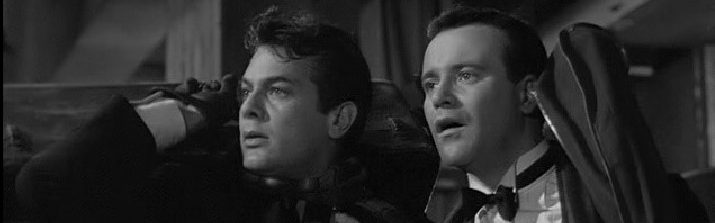
“Nightmare Alley” (1947) starring Tyrone Power, Joan Blondell, Colleen Gray, & Helen Walker

Pete Krumbein: Throughout the ages, man has sought to look behind the veil that hides him from tomorrow. And through the ages, certain men have looked into the polished crystal… and seen. Is it some quality of the crystal itself, or does the gazer merely use it to turn his gaze inward? Who knows? But visions come. Slowly shifting their forms… visions come. Wait. The shifting shapes begin to clear. I see fields of grass… rolling hills… and a boy. A boy is running barefoot through the hills. A dog is with him. A… DOG… is… with… him.

Stanton Carlisle: Yes… go on… his name was Jib. Go on!

Pete: [Choked laughter] Humph. See how easy it is to *hook* ’em!

Twentieth Century-Fox bought the film rights to William Lindsay Gresham’s novel in 1946 for $50,000 at the request of star Tyrone Power, who wanted to change his image and show his range. The studio built a carnival set on the backlot covering 10 acres; it hired 100+ sideshow attractions and carnival workers. Studio head Darryl F. Zanuck hated this movie so much that he eventually took it out of circulation. Zanuck ordered the happy scene to be added (no shock there). The movie was re-released in 1956-1957 and did good business, esp. in drive-ins. It received wide distribution (on TV) after Power’s premature death in 1958. The DVD release (2005) brought Nightmare Alley back into wide circulation. According to Eddie Muller, con men/grifters in the new age movement would ask “Are you a friend of Stan Carlisle?” to confirm that the person they were talking to was in the same line of business.

Stan: You’ve got a heart as big…

Zeena Krumbein: Sure, as big as an artichoke, a leaf for everyone.

The movie opens at a carnival offering a muscle man, young women in skimpy outfits, a mind-reader, and the “geek” (a freakish man who supposedly bites the heads off live chickens). Among the crowd is a new worker, Stanton Carlisle, who is esp. interested in Zeena (Joan Blondell), the mentalist who was successful w/ her mind-reading act (before her hubby/partner, Pete, became an alcoholic). Stan is observant and ambitious, so he sets out to charm Zeena and learn her secrets. Stan’s true nature is revealed when he bluffs the sheriff (who has come to shut down the carnival); he’s good at manipulating others’ emotions (and enjoys it)!

Stan [to Molly]: Listen to me, I’m no good. I never pretended to be. But, I love you. I’m a hustler. I’ve always been one. But, I love you. I may be the thief of the world, but, with you I’ve always been on the level.

There are scams, swindles, deceptions and betrayals; we see the exploitation of people who are gullible or vulnerable. Stan’s rise from the seedy carnival to classy nightclub is captivating to watch! Stan is that rare homme fatale who uses his looks and sex appeal; near the end, he undergoes a de-glamorization that may shock some viewers. This is an obscure film, but much praised by noir fans. As Muller commented, even by film noir standards, this is a dark tale. I learned that both the director (Edmund Goulding) and writer eventually committed suicide!

The film wisely always plays to Power’s performance as charming and affable. It only hints at sinister intent, and so we’re on the ride with him seeing him as almost a heroic figure despite his cynical and insidious approach towards the world. For Stan, money is almost secondary to his desire to prove that he’s smarter than everyone else, which is why the film casts Lilith in his path to show us someone who’s not only potentially more dangerous, but also someone who’s more ingratiated with society. -Matt Goldberg (Collider)

The black and white photography by Lee Garmes is very well-done; it was perhaps too dark for audiences of that day. There are 3 interesting women characters- a rarity even today in Hollywood! Blondell (buxom and still good-looking in middle-age) is clever, jaded, but also good-hearted. Colleen Gray (in an early role) is “girl next door” pretty and sweet; her character falls hard for Stan. Helen Walker is smart, sophisticated, yet chilling as psychologist Lilith Ritter. She’s smarter and more ruthless than Stan; notice how her eyes shine w/ joy when she makes a fool of him!

[1] It was a raw, exposed nerve of a film. Instead of the Hollywood diction we had come to expect, this film expressed itself in 1940’s carny colloquialisms. And nobody in the cast was soft – they were all hard knocks characters, almost down for the count, but still fighting.

[2] Power, Blondell, Gray, Helen Walker, and the marvelous Ian Keith turn in great performances in a gritty film somewhat ahead of its time for its unrelenting toughness, its hard view of alcoholism, a look inside the world of mentalists and carnival life, and its theme of the supernatural.

[3] Nightmare Alley is a remarkable film- it hardly blinks in showing a cynical, scheming “preacher” doing his thing. Given the norms of Hollywood at the time, or almost at any time, it does give you a lot to consider. Tyrone Power is brilliant…

-Excerpts from IMDB reviews

“Gentleman’s Agreement” (1947) starring Gregory Peck, Dorothy McGuire, & John Garfield

Philip Schuyler Green (Gregory Peck) is a writer/novelist from California recently hired by a national magazine (Smith’s Weekly) in NYC for a series of articles. Phil is a widower w/ a young son- Tommy (Dean Stockwell- best known for Quantum Leap and Battlestar Galactica) – and a mother (Anne Revere) who is facing health challenges. He’s NOT too keen on the topic his editor John Minify (Albert Dekker) chooses- antisemitism. He wishes he could talk w/ his best pal, Dave Goldman (John Garfield), but Dave (who is Jewish) is serving overseas w/ the Army Corps on Engineers. For a week, Phil isn’t sure how to tackle it, then it comes to him- he’ll pretend to be Jewish! Of course, it takes little time for him to start experiencing bigotry. Phil’s anger at the way he’s treated starts affecting all aspects of his life, including his growing romance w/ his editor’s niece, Kathy Lacey (Dorothy McGuire).

Tommy: What’s antisemitism?

Phil: Well, uh, that’s when some people don’t like other people just because they’re Jews.

Tommy: Why not? Are Jews bad?

Phil: Well, some are and some aren’t, just like with everyone else.

Tommy: What are Jews, anyway?

Phil: Well, uh, it’s like this. Remember last week when you asked me about that big church, and I told you there are all different kinds of churches? Well, the people who go to that particular church are called Catholics, and there are people who go to different churches and they’re called Protestants, and there are people who go to different churches and they’re called Jews, only they call their churches temples or synagogues.

Tommy: Why don’t some people like them?

Phil: Well, I can’t really explain it, Tommy.

I re-watched this Oscar-winning movie (directed by Elia Kazan) last week; I saw it a few times over the years. Though there are things to admire, there are scenes which will look quite dated (and insensitive) to modern viewers. After he decides on his angle, Phil looks into the mirror and assesses his own features (“dark hair, dark eyes”) as being consistent w/ the Jews. This reveals that he has been influenced by the stereotype of there being a “Jewish look.” You may find Phil’s talks w/ his (Jewish) secretary, Elaine Wales (June Havoc), to be cringe-worthy (as the young people say). Of course, June herself says some self-hating/prejudiced stuff re: her people.

Phil: I’m going to let everybody know I’m Jewish.

Kathy: Jewish? But you’re not! Are you? Not that it would make any difference to me. But you said, “Let everybody know,” as if you hadn’t before and would now. So I just wondered. Not that it would make any difference to me. Phil, you’re annoyed.

Phil: No, I’m just thinking.

Kathy: Well, don’t look serious about it. Surely you must know where I stand.

Phil: Oh, I do.

Kathy: You just caught me off-guard.

I thought it was refreshing that the main love interest was smart (teacher), posh, and divorced; this is rare for a woman in a ’40s movie! (BTW, both Peck and McGuire were only in their early 30s.) However, Kathy is a part of her time and (high) society, so she doesn’t always know what to say (much less do) when her man is faced w/ prejudice. Admit it, we all know some “nice” WASP lady like this! There’s a lot of emphasis (too much for many viewers) on the romance between Phil and Kathy; it also happens very fast. I thought that the actors had good chemistry, though I preferred Anne Dettrey (Celeste Holm) over Kathy. Anne also works at the mag, enjoys single life, and has a bubbly personality; we can tell she greatly respects and likes Phil.

I enjoyed all the family stuff; Phil has a great relationship w/ his mom (who was only 12 yrs older- wow) and son, who both get some good character development. Stockwell is not just adorable (w/ his dark curls), but also a natural kid actor (rare in that time)! The first act will seem slow to many viewers; Phil suffers from writer’s block (which doesn’t equal great drama). It takes some time for Garfield (who was Jewish) to show up; he took a supporting role b/c he felt this was an important story to tell (but was paid his star’s salary). I loved how he played Dave; it was a subtle performance which holds up well even today! This was also the year when a (smaller) movie also tackled antisemitism- Crossfire.

[1] Green is adamantly and unwaveringly sure of himself and woe betide any who do not share his abhorrence at any manifestation of discrimination, starting with Kathy.

The romance between Green and Kathy is as back-and-forth as any Hollywood potboiler, the difference being that their arguments and falling-outs revolve entirely over Kathy’s inability to grasp the absolute righteousness of her fiance’s crusade. The dispute is artificial and wearying to some degree and I rooted for Celeste Holm’s lovely, witty and totally tolerant Anne, a fashion editor with attitude, as the top gal in the film.

[2] Peck’s crusading writer who masquerades as a Jew is simply too zealous and unswerving for his own good. He has no faults, no inner conflicts and no doubts about himself. […]

She symbolizes the hypocrisy and passiveness of the everyday American on anti-Semitism, and he points it out to her every chance he gets-and that’s all.

[3] As John Garfield’s character in the movie showed: discrimination and racial intolerance can be eliminated if we fight it. Garfield’s willingness to take a supporting role in this movie because of the power of its message should compel the skeptics to watch this movie.

-Excerpts from IMDB reviews

Proto-Feminist Western/Melodrama: “Johnny Guitar” (1954) starring Joan Crawford, Sterling Hayden, & Mercedes McCambridge

Sam: [to the two men in the kitchen] Never seen a woman who was more of a man. She thinks like one, acts like one, and sometimes makes me feel like I’m not.

Vienna (Joan Crawford- 50 y.o.) has spent nearly 5 years to built a saloon outside of Southwestern town. She hopes to build her own town once the railroad comes through, but most of the locals want her gone. When four men hold up a stagecoach and kill a man, the sheriff and community leaders, led by Emma Small (Mercedes McCambridge- 38 y.o.) come to the saloon to grab four of Vienna’s friends, incl. their leader- Dancin’ Kid (Scott Brady- just 30 y.o.) This was the time when when Ernest Borgnine (aged 37) was playing tough/villainous guys; he’s the hot-headed Bart Lonergan. Royal Dano is Corey, the ailing man true to the Dancin’ Kid, who will get a lot of empathy w/ his performance. Veteran character actor John Carradine (aged 48) plays the loyal caretaker of the saloon- Old Tom. Vienna stands strong against the posse of haters; she is aided by a newcomer- Johnny Guitar (Sterling Hayden- 38 y.o.)- who is NOT what he seems.

Vienna: Down there I sell whiskey and cards. All you can buy up these stairs is a bullet in the head. Now which do you want?

A proto-feminist hero is a female who usually fights against society’s expectations of her; this is a term from the 20th c. As some viewers have noted, Vienna stands for progress and new ideas; the wealthy ranchers- Emma and Mr. McIvers (Ward Bond)- are trying to stop that progress which threatens their way of life. While Vienna and her friends are dressed in bright colors (a rarity for Western movies), the posse is dressed in black. The posse is led by the (repressed/petite) Emma; her voice is full of with fire and brimstone. We learn that Johnny met Vienna when she was working in an Oklahoma City saloon years ago; also from other lines, there is no doubt to her being a former prostitute. Jealousy and rejection compel Emma to destroy both her rival Vienna and her unrequited love- the Dancin’ Kid. Hayden does a fine job here; he and and Crawford have good chemistry in their scenes together. Crawford seems to be in control at all times; she tells Johnny when to play and the Dancin’ Kid when to dance. Even when there is a noose around her neck, she stays strong and the men refuse to hang her (until Emma steps in). As one astute viewer commented: “Emma is also a woman in control, but of external forces; on the inside, emotions, fears, and frustrations dominate.”

Vienna: [to Johnny Guitar bitterly] A man can lie, steal… and even kill. But as long as he hangs on to his pride, he’s still a man. All a woman has to do is slip – once. And she’s a “tramp!” Must be a great comfort to you to be a man.

According to director Nicholas Ray, he began shooting the younger actress’ scenes in the early morning before Crawford got on set, as Crawford was very jealous of McCambridge. Ray was quite unhappy during the filming and later admitted: “Quite a few times, I would have to stop the car and vomit before I got to work in the morning.” Crawford, who had bought the rights to the novel and sold it Republic Pictures, initially wanted Claire Trevor or Barbara Stanwyck (her friend) to play Emma. The actresses fought both on and off camera; one night (in a drunken rage) Crawford threw the costumes worn by McCambridge along an Arizona highway! McCambridge (who also played a strong woman in Giant) later claimed that Crawford attempted to blacklist her. Hayden said: “There is not enough money in Hollywood to lure me into making another picture with Joan Crawford. And I like money.” Crawford referred to Hayden as “the biggest pill in Hollywood.” Francois Truffaut said it reminded him of The Beauty and the Beast w/ Hayden being the beauty- LOL! Check out this film if you want to see a unique Western and don’t mind a big dose of melodrama.

[1] …I think Nick Ray and Phil Yordan decided the story was so ridiculous that they would just concentrate on the emotional elements, also bringing out the pure fantasy (going behind the waterfall to find a hidden fortress, the heroine running from the fire in her white satin dress, etc.) that is the best element of all great film.

[2] Weird and hysterical Western with Freudian touches, dreamlike emotionalism and magnificent dialogue in which is blended domination, humiliation and a deadly confrontation- resulting to be a fascinating and melodramatic film.

Love and hate are woven into two protagonists, the fallen angel Joan Crawford and the spinster landowner Mercedes McCambridge; both of them share a mythical confrontation.

[3] The film starts as a western, but it simply doesn’t conform to that genre, instead it is a weirdly matriarchal piece where the traditional roles are almost roundly reversed and the whole film has an otherworldly feel to it. […] The western clichés become secondary to these relationships and the director seems to prefer these to any lynching or shoot out.

The full colour of the film gives it a gaudy, otherworldly appeal that is very enjoyable. Fires range in terrible, hellish reds, while shadows divide scenes of emotional complexity.

[4] A western without savages, cavalry, rodeos, and the usual John Ford stuff. A different western, ahead of its time, and very misunderstood by the public then, but, fortunately, reborn from the limbo and forgiveness, rediscovered by new generations, and still alive, fresh as in its first day, and always inmortal.

-Excerpts from IMDB reviews

Iconic & Problematic: “Fatal Attraction” (1987) starring Michael Douglas & Glenn Close

Erotic thriller (perhaps a guilty pleasure for some of us in quarantine life) is a subgenre of film which is defined as a thriller w/ illicit romance or erotic fantasy. Most erotic thrillers contain scenes of sex and nudity (though the frequency and explicitness varies). Erotic thrillers emerged as a distinct genre in the late 1980s, as a result of the success of this film. As some critics/viewers have noted, erotic thrillers are connected to film noir of the 1940s and ’50s which explored the dark side of life in post-WWII America.

A one-night fling, with no strings attached. That’s what she said. That’s what he believed. -A tag line for the film

Most of you already know the plot, as Fatal Attraction is considered iconic, yet problematic (when viewed by our modern eyes). Dan Gallagher (Michael Douglas) is a successful NYC attorney, and on a weekend when his wife and daughter are away from home at his in-laws’ house, he has a work meeting that includes Alex Forrest (Glenn Close), an editor for a publishing company. This leads to a drink at a bar, and that leads to a passionate one night stand that turns into a weekend when Alex attempts suicide when Dan tries to leave. Dan thinks it’s over, as Alex has seemed to come to her senses. Suddenly, Alex tells him she is pregnant, and she is having this baby b/c (at age 36) it may be her last chance. Dan insists he isn’t leaving his wife for her and that he doesn’t love her; he is feeling indifferent (not hating her). Alex stalks Dan and gradually turns up the heat until his family is at risk!

Alex Forrest: [to Dan] Well, what am I supposed to do? You won’t answer my calls, you change your number. I mean, I’m not gonna be ignored, Dan!

I was surprised how good the film actually was; it’s an intense stalker-drama. The three lead actors (Douglas, Close, and Anne Archer as the wife) do a great job. Douglas was also working on Wall Street (1987) at the same time. When Close’s agent first called to express her interest in playing Alex Forrest, he was told, “Please don’t make her come in. She’s completely wrong for the part.” Director Adrian Lyne also thought that she was “the last person on Earth” who should play the role. I was impressed by Close, esp. in the first act of the movie; she plays it sophisticated, cool, and has obvious chemistry w/ Douglas. Of course, her transformation to stalker later is scary. The white dress she wears at the end of the movie resembles a straightjacket. Kirstie Alley, who was under consideration for the role of Alex, provided a tape of a woman who had been stalking her then-husband, actor Parker Stevenson, in which she was begging to be part of his life. The woman’s exact words were used for the tape Alex sends to Dan in the film- wow!

I would read that script totally differently. The astounding thing was that in my research for Fatal Attraction, I talked to two psychiatrists. Never did a mental disorder come up. Never did the possibility of that come up. That, of course, would be the first thing I would think of now. -Close in a 2013 CBS News interview

During the Trump era, SNL did a parody of it w/ actors playing WH advisor Kellyanne Conway and CNN reporter Jake Tapper. Though many enjoyed it, others were offended by how Conway was portrayed. There are elements in this movie that are outdated; recall Alex’s line re: her not likely to have another baby (she is only aged 36). The filmmakers also skip over the mental health issue- yikes! The original ending was changed (b/c preview audiences hated it), though it sounds a lot more interesting. The ending we see is quite brutal; at one point, Close suffered a concussion and was rushed to the E.R. While examining her, doctors discovered that she was several weeks pregnant w/ her daughter! A young female comedian recently commented that Alex needed therapy and also some girlfriends who supported her- quite valid points. I’ve been listening this Summer to a podcast focused on the erotic thriller genre (Fatal Attractions) hosted by UK and French cinephiles.

[1] Glenn Close who had only played the nice girl roles blew everyone’s mind when she played Alex Forrest. What passion she put into the role and part of you couldn’t really hate her. She brings up a great point to Dan “Because I won’t allow you to treat me like some slut you can just bang a couple of times and throw in the garbage?” Your heart does break for her, but at the same time you want to scream at her to let go of Dan and not hurt his family. Michael Douglas as Dan plays the role extremely well. He gives Dan a sense of realism, he’s not a major jerk… Ann Archer as Beth was not only beautiful, classy, but incredibly intelligent. She makes Beth so real…

[2] Aside from the moral problems of adultery, doesn’t Alex have a point ? Isn’t she entitled to something besides simply being used for a night or two? The tension in this film is constant, although a lot of it seems too easily foreshadowed.

[3] The impact and influence of this great box office success has continued to be significantly stronger than would normally be expected, as it has successfully maintained its popularity over the years and even been responsible for the term “bunny boiler” becoming a universally recognised part of the language.

-Excerpts from IMDB reviews

“Obsession” (1943): Italian Adaptation of “The Postman Always Rings Twice”

In Fascist Italy, Gino Costa (Massimo Girotti), a young/handsome tramp, stops at a humble restaurant (trattoria) run by Giovanna (Clara Calamai) and her husband Bragana (Juan de Landa). Giovanna is unhappy w/ her older/controlling husband, who she married for security/money. Gino does some work around the place and he and Giovanna quickly fall in love. She refuses to run away w/ him and lead the life of a poor wanderer. Gino leaves for another town and becomes friends w/ a street artist, Lo spagnolo (“the Spaniard”); they work together for a few weeks. One day, Gino sees Giovanna and Bragana at a street fair; it is obvious that they haven’t gotten over each other. After a day of fun (w/ plenty of drinking on Bragana’s part), Giovanna comes up w/ a plan to finally be rid of her husband! Gino (though reluctant) goes along w/ the plan.

The film’s negative was destroyed by the fascist government of Benito Mussolini during WWII, but (first-time director) Luchino Visconti managed to save a print. In Italy, some priests sprinkled theaters w/ holy water after this film was shown- LOL! Obsession wasn’t seen in the U.S. until 1976, as James M. Cain’s publishers fought the release. Cain is perhaps best known for Double Indemnity, though The Postman Always Rings Twice was quite a popular work also. I heard about it recently (from a Facebook film noir group); it caused quite a controversy and was way ahead of it’s time.

The original actress cast for Giovanna was the glamorous/diva-like Anna Magnani, but she became pregnant before shooting. Unlike some other femme fatale, Giovanna isn’t glamorous or evil; she is more like a spoiled girl-next-door (too good to cook and clean). Bragana isn’t totally a bad man either, but (like many husbands of his day) has to “wear the pants” in the family. He is short, stout, and unattractive (though he can be jovial at times). Gino is down on his luck, not that educated, but also handsome w/ a strong physical presence. Lo spagnolo (Elio Marcuzo) brings a sense of lightness/fun into the film; I really liked his character. The young dancer/part-time prostitute, Anita (Dhia Christiani), is only in the film for few minutes, but she made a big impression. The director and actress were able to do a lot w/ this character- I thought she was heartbreaking!

Most of the people behind the film were still in their 20s and willing to take risks. Let us compare these two scenes where the (would-be) lovers first see each other. In the ’46 American film noir (starring Lana Turner and John Garfield), we first see Cora (the object of desire) from the POV of Frank. Here we first see Gino’s face from the POV of Giovanna (making the man the object of desire)! While the American version gets more into the world of cops and lawyers, Obsession concentrates more on the psychological effects of the crime on the lovers. If you’d like to know more re: the neo-realism movement, check this film out.

[1] Ossessione is a very complex film with complex characters. It’s always fascinating, but it does go on a bit too long. This is partly due to the neorealist stylistics that Visconti was inventing within this film. It was, after all, the first film that won that label. We see a lot of the action prolonged as it would be in real life, without any hurrying to the next plot point.

[2] The movie is brilliantly filmed, and the acting by the three leads are first rate. You really get a genuine insight into 1940s Italian working class life. The character of The Spaniard adds an interesting touch to the story with a possible homosexual relationship between Gino and himself. It’s very subtle but it’s there if you look. […] The movie is surprisingly frank for the time and period (Mussolini’s Italy), much more realistic and earthy than Hollywood movies of the same period.

[3] …such graceful camera movements, such beautiful composition, such wonderful faces, such terrific characters, such a great story development, the first movie adapted from James M. Cain’s “The Postman Always Rings Twice.”

…I can’t believe this was made in ’43, eight years before Brando was supposed to have introduced realistic acting to the world with “A Streetcar Named Desire” (1951). The actors in this may not have used The Method technique… but they’re some of the best, most genuine and realistic performances up to this date in cinema.

-Excerpts from IMDB reviews