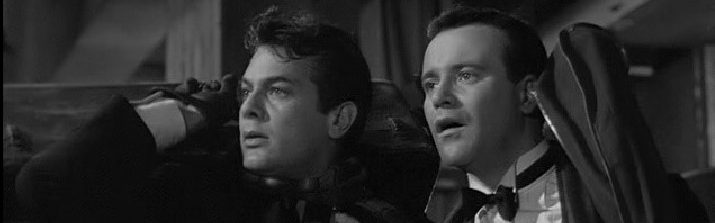
“The Glass Menagerie” (1987) starring Joanne Woodward, John Malkovich, & Karen Allen

Tom [in the opening]: Yes, I have tricks in my pocket, I have things up my sleeve. But I am the opposite of a stage magician. He gives you an illusion that has the appearance of truth. I give you truth in the pleasant disguise of illusion.

In Tennessee Williams’ memory play, Tom Wingfield (an aspiring writer working at a shoe warehouse) longs to escape from his stifling apt. in St. Louis, where his genteel/Southern-bred mother, Amanda, worries about the future prospects of his older sister, Laura (who walks w/ a limp and is mentally fragile). While Tom escapes to the movies, Laura has created a world of her own w/ her collection of glass figurines. The original Broadway stage play opened at the Playhouse Theatre on March 31, 1945 and ran for 563 performances. The play has autobiographical elements, featuring characters based on Williams (named Thomas), his mother, and his sister (Rose). Growing up, I saw the 1973 TV version starring Katherine Hepburn (Amanda), Sam Waterston (Tom), Joanna Miles (Laura), and Michael Moriarty (Jim- the gentleman caller) on PBS. All 4 actors received Emmy noms; Miles and Moriarty won. Waterston and Moriarty (who started in the theater) are best known for their roles as ADAs on Law and Order.

Amanda: Rise and Shine! Rise and Shine!

Tom: I will rise but I will NOT Shine…

This movie was directed by Paul Newman (who was married to Woodward); they were an iconic pair in front of and behind the camera. The New York Times reviewer wrote (in part): “starts stiffly and gets better as it goes along, with the dinner-party sequence its biggest success; in this highly charged situation, Ms. Woodward’s Amanda indeed seems to flower.” Amanda (Joanne Woodward) is a survivor who has to be practical; she works at a department store and sells magazine subscriptions on the side. Her charming/alcoholic husband (whose portrait hangs in a prominent place in the apt.) abandoned the family long ago (“a telephone man who fell in love with long distance”). Amanda speaks often of the comforts of her youth and the admiration she received as a young woman (“17 gentlemen callers on one afternoon”).

Amanda: You are the only young man that I know of who ignores the fact that the future becomes the present, the present becomes the past, and the past turns into everlasting regret if you don’t plan for it!

Tom (John Malkovich) chafes under the boring routine of his his life, longing for “adventure.” Is he really going to the movies (even Amanda is suspicious), or is this cover for something Williams couldn’t reveal in the 1940s? As one viewer commented: “Malkovich etches a remarkable portrayal of Tom- defiantly unafraid of the character’s possible gay subtext- that grows in poignancy to a heartbreaking final monologue.” Malkovich had better clothes (and a nice hairpiece) than Waterston, who dressed more like a working-class man.

Amanda becomes obsessed w/ finding “a gentleman caller” for Laura (Karen Allen), who dropped out of business college and has no job. Allen conveys a lot of vulnerability in her characterization. I esp. liked the scenes w/ Tom and Laura; they are very close (though of differing personalities). Under pressure from his mother, Tom invites Jim (James Naughton), a shipping clerk/friend from work, to dinner. In one of his monologues, Tom explains that “the gentleman caller” represents “something that one hopes for.” I really liked how Moriarty played Jim, but I think Naughton did a good job also.

It turns out that Jim is the boy who Laura had a crush on in HS; he was a popular athlete, singer, and actor. Now, he is a confident/positive-thinking young man seeking to improve his position. Jim tries to get Laura to overcome her “inferiority complex” and they dance and even share a kiss. Even though I knew the story, I felt disappointed when Jim (considered the most “normal” character) revealed that he was engaged. Tom goes off to the Merchant Marines, but he always regrets that he couldn’t help Laura (just as Williams couldn’t prevent the lobotomy that was performed on Rose).

[1] Paul Newman shows much respect for Williams’ play (some will say “too much”), but when you deal with first class actors, who cares?

His wife Joanne Woodward displays of the nuances of an over-possessive mother, beyond good and evil; deserted by a man whose picture is still hanging on a wall, she tries to help her children avoid her sad life… […Wearing a horrible grey wig, she still thinks she’s attractive and puts on her coquette act before Jim. A great performance by an actress.

[2] Under-rated beautifully realized version of a famous play – everything is just right and Karen Allen’s work as the tragic Laura is deeply moving… 

[3] Joanne Woodward shines in a multi-layered, brilliant turn as one of the most interesting characters in modern literature, Amanda Wingfieid. She gives just the right touch to small moments that give the viewer an enlightening peek at the desperate condition of the fading southern belle…

John Malkovich also turns in a terrific performance…

[4] I think John Malkovich did an amazing job as Tom. His monologues at the beginning of every scene were especially well-done. He gave the movie a really dream-like quality.

-Excerpts from IMDB reviews

“The Object of Beauty” (1991) starring John Malkovich & Andie MacDowell

A romantic comedy about the fine art of thievery. -Tag line

Two Americans living the good life in London find their romantic relationship challenged by a sudden lack of funds. Jake (John Malkovich), a commodities broker, is unable to pay the bills (b/c of a strike that holds up a cocoa shipment). So, he suggests that Tina (Andie MacDowell) file an insurance claim on her little Henry Moore statue. This statue is the only item of value that she owns- her sense of security. One day, the statue suddenly disappears from their posh hotel room! They are begin to doubt each other and the strength of their love.

Tina: You’ve always said when it comes to food, shoes, and sex, price is no object.

Jake: Good shoes are important!

I cam across this on IMDB TV when I was looking for movies w/ John Malkovich (after seeing Dangerous Liaisons). The writer/director is an American, Michael Lindsay Hogg, who worked on music videos, TV (incl. Brideshead Revisited), as well as movies. Tina’s best friend, Jenny (Lolita Davidovich), is also American; she was married to Cint Eastwood and is the mother of Scott Eastwood. The hotel’s investigator Victor Swayle (Bill Paterson) goes on a little power trip. Paterson is a veteran character actor who recently appeared as the father in the hit TV show- Fleabag.

Jake: I am on the verge of something very lucrative, so for you to even be talking about dishonoring one of my checks, really puts me in a very sweaty mode.

The statue is taken by the deaf/mute hotel maid- Jenny (Rudi Davies). She knows this is wrong to do, but later explains that the statue “spoke to me.” Jenny (only in her 20s) lives in a tiny flat w/ her teen brother (who is in danger of becoming a criminal). As some viewers noted, Jenny is at the heart of the story and the only likeable character. It’s also rare to see a (working-class) person have a well-developed arc in a movie.

This movie is for those of you who enjoy character development and quirky humor. There is fun chemistry between Malkovich (who loves fashion) and MacDowell (who looks great in all the fashions as a former model); they joke around and seem to have fun together. If you like fashion, you may notice the Armani suits and Manolo Blahnik shoes. Siskel and Ebert both liked this movie (two thumbs up). I really liked the ending- it was sweet and funny!

[1] The film is an underhanded, cynical, satirical poke at American materialism…

[2] The chemistry between the two of them reminds one of William Powell and Myrna Loy. If they had picked up the pace a bit, they would have had a real classic comedy here. This film is highly watchable, though.

[3] My favorite not-to-be-missed extremely funny scene? John Malkovich’s “Jake”, in a moment of depressed exasperation, talking aloud to himself composing his own obituary.

[4] You will enjoy this film much more if you pay attention to the irony of the value placed by different characters upon this Henry Moore sculpture. It is worth nothing to some, only money to others, an emotional commitment to another, and an object of aspiration to one other. All of these perspectives speak to each other, and it is a very interesting conversation.

-Excerpts from IMDB reviews

“Dangerous Liaisons” (1988) starring Glenn Close, John Malkovich, & Michelle Pfeiffer

Vicomte de Valmont: I often wonder how you manage to invent yourself.

Marquise de Merteuil: Well, I had no choice, did I? I’m a woman. Women are obliged to be far more skillful than men. You can ruin our reputation and our life with a few well-chosen words. So, of course, I had to invent, not only myself, but ways of escape no one has every thought of before. And I’ve succeeded because I’ve always known I was born to dominate your sex and avenge my own.

The novel Les Liaisons Dangereuses by Choderlos de Laclos was first published in 1782; it was considered so scandalous that when Queen Marie Antoinette commissioned a copy, she had to have it bound in a blank cover. Many of you may already know the plot of the story; it came out just before the French Revolution. In late 18th c. France, the Marquise de Merteuil (Glenn Close) and the Vicomte de Valmont (John Malkovich in his star-making role) play a dangerous game of seduction. Valmont is someone who measures success by his female conquests. Merteuil challenges him to seduce the young/virginal, Cecile de Volanges (Uma Thurman in one of her early roles), and provide proof in writing of his success. Cecile is engaged to the man who broke up w/ Merteuil (the first one to do so, allegedly). Valmont’s reward will be to spend one night w/ Merteuil; they were once lovers years back. Valmont wants to seduce the happily-married/devout Madame de Tourvel (Michelle Pfeiffer) who is staying w/ his elderly aunt, Madame de Rosemonde (Mildred Natwick in her final role). It turns out that Valmont falls in love w/ Tourvel!

Valmont: You see, I have no intention of breaking down her prejudices. I want her to believe in God and virtue and the sanctity of marriage, and still not be able to stop herself. I want the excitement of watching her betray everything that is most important to her. Surely you understand that. I thought “betrayal” was your favorite word.

Merteuil: No, no…”cruelty.” I always think that has a nobler ring to it

I watched this movie many years ago; I didn’t recall a lot of the details. I re-watched it recently and was blown away- this is must-see for any film fan! You don’t have to be a big fan of period pieces or costume dramas; the funny/clever dialogue will pull you in. As some viewers noted, almost every line has a double entendre; I recommend seeing it twice to take it all in. In the opening, we see the two leads getting dressed in fine clothes and made-up (powdered faces; wigs) by several servants. To save money, some of the costumes were created from sari material- how cool!

Merteuil: One of the reasons I never re-married, despite a bewildering range of offers, was the determination NEVER AGAIN to be ordered about.

Dangerous Liaisons opened in theaters in 1988, a year before Valmont (1989) starring Annette Bening and Colin Firth. According to screenwriter Christopher Hampton, the director of Valmont- Milos Forman- attended several performances of the play in London, then decided to film his own version. Hampton offered to have dinner w/ Forman to discuss the project, but the director never showed up. The competing film convinced the studio, Lorimar, to rush this movie into production, in order to beat Valmont into theaters. Dangerous Liaisons won 3 Oscars, was a critical success, and had moderate box office success. Bening auditioned for the role of Merteuil in this movie also. Pfeiffer was offered the role of Merteuil in Valmont. Alan Rickman made the role of Valmont famous in London and on Broadway. Since the producers wanted to cast a more established actor in the role, Rickman wasn’t considered.

The movie should appeal to everyone. It’s sleazy, elegant, vicious and mean, and it’s about people doing hideous things to each other. If that weren’t enough, it has a tragic end. What more could people ask for? -Malkovich in a 1988 interview

Malkovich (in his first romantic role) shows that men like Valmont get by w/ wit, charm, and style (not physical beauty). In some of the (dimly lit) scenes w/ the long/brown wig, he looks esp. intense and a bit mysterious. There are little character moments where he smirks or does something w/ his body language, showing the audience that Valmont is having fun (just like us). Some viewers preferred Firth as Valmont, perhaps b/c he was more handsome and light-hearted. Thurman (only 17 y.o. and standing at 6′ tall) isn’t intimidated to go toe-to-toe w/ much older/experienced actors. I finally realized that Cecile’s mother, Madame de Volanges (Swoosie Kurtz), has a dislike for Valmont b/c they were once lovers (whoa)! Not even the (wooden) acting of a young Keanu Reeves can detract from the viewer enjoying this movie. Some viewers said that he’s supposed to be naive; luckily, he doesn’t have much to do. Fans of Doctor Who will get a kick out of Peter Capaldi (30 y.o.) as Valmont’s loyal servant Azolan; he uses his Scottish accent. The 5 American actors speak using their natural accents; this is rare for a period film.

We filmed in France and I had given birth to Annie 7 weeks before we started preparing for the film. For the first time in my life, I had these great breasts. It’ll never happen again, but for one brief, shining season, I had the most incredible breasts. James Acheson, the costume designer… …I just loved it because they pushed my breasts up and made me have cleavage. I guess I should be saying something more intellectual about the film, but I just remembered how great it felt to have those breasts. -Close in a 1996 interview

It was tough for me to decide, but Close (then 41 y.o.) was the most fascinating of the characters. Close (who didn’t appear in the movies until she was already 35 y.o.) and Malkovich (who comes from the theater like Close) make a strong duo; they have fantastic chemistry together. Close came up w/ her character’s final scene- wow! Director Stephen Frears gave her the line: “her soul was on her face,” Close thought for a minute and stated: “I know how to show that.” The score (which flows perfectly w/ the story) was composed by George Fenton; we also hear the music of Bach, Handel, and Vivaldi. I think the music will really carry the viewer away! Speaking of which, I learned that Malkovich (35 y.o.) and Pfeiffer (30 y.o.) had an affair during the filming; his wife (actress Glenne Headley) filed for divorce soonafter.

[1] The first thing that strikes you is how well the film is lit and shot. The period locations and costumes are visually sumptuous and perfect. Better yet, the acting entirely matches the skill of the direction that takes its method from the theatre – emotions are conveyed by expression and not dialogue. Glenn Close gives her best performance on celluloid as the scheming Madame de Merteuil, amorally hellbent on bending everyone to her will, no matter the method or the cost, and John Malkovitch is her perfect foil as the cynical hedonistic but world-weary Valmont. Michelle Pfeiffer engages our empathy as the tortured and manipulated target of Malkovitch’s desire and Close’s plotting.

[2] Stephen Frears, in his American film debut, creates a lush visage of restrained yet swooning passions, icy stares, and hushed, measured speeches against the backdrop of the Ile-de-France…

The dark comedy that pins two bored aristocrats against each other as they play God with other people’s lives without realizing the devastating consequences that will result from this has been the stuff of legend and allure. Glenn Close, John Malkovich, and Michelle Pfeiffer all are beyond awards in their exacting and multidimensional portrayals of three very different people caught in a web of deceit. However the star of this adaptation has to be Christopher Hampton who immortalizes Laclos’ vision in a subtle, yet powerful story filled with subtext and restrained cruelty.

-Excerpts from IMDB reviews

“Thelma & Louise” (1991) starring Susan Sarandon & Geena Davis

Louise [to Thelma re: her controlling/uncaring husband Darryl]: Well, you get what you settle for.

Louise (Susan Sarandan, 45 y.o. and looking fab) is working in a diner as a waitress and has some problems with her bf Jimmy (Michael Madsen), a musician who is usually on the road. Thelma (Geena Davis, looking youthful at 35 y.o.) is a housewife to Darryl (Christopher McDonald), who takes his wife for granted. He wants her to cook/clean/stay quiet, so that he can watch football. Even though they have been together since HS days, Darryl isn’t ready to have kids. One day, the two girlfriends decide to break out of their boring routines and take a road trip. Their relaxing vacation turns into a dangerous flight from the cops/FBI, after Louise (who may have a past) shoots a man who threatened to rape Thelma (who starts off the story as quite naive). They decide to go to Mexico, but the police are hot on their trail!

Thelma: You’re a real live outlaw, aren’t ya?

J.D.: Well, I may be an outlaw, darlin’, but, uh, you’re the one stealin’ my heart.

Wow, can you believe this movie is 30 yrs old!? Or how controversial it was (esp. the ending) upon first release? I saw it many years ago; I forgot that it was directed by Ridley Scott. He was open to collaboration and allowed the actors to improvise; as a Brit, he wasn’t familiar w/ the accents/culture of the American South. Screenwriter Callie Khouri (whose father was of Lebanese heritage) grew up in Kentucky; she was in her mid-30s when she won the Oscar for Best Screenplay in 1992. Many will recall it as when they first saw Brad Pitt (the hottie hitchhiker who Thelma falls for, J.D.)

Louise: Damn, Jimmy. What’d you do, take some kinda pill that makes you say all the right stuff?

Jimmy: Yeah. I’m chokin’ on it.

I don’t understand why some viewers thought this was a “man-bashing” story! Jimmy is (obviously) deeply in love w/ Louise; he goes out of his way to bring her the money she saved up. Sarandon said that she and Madsen (who looks pretty good, too) were also supposed to have a love scene, which would be intercut w/ the one between Davis and Pitt. However, Sarandon suggested another option to Scott- a serious/heartfelt discussion- and this is what we see in the movie! The lead detective on the case, Hal Slocumb (Harvey Keitel), is a good man trying to do the right thing. While he interviews the people in the women’s lives, he stays calm, humble, and respectful. Hal wants to get the women to surrender and come out alive, instead of being killed by a cop w/ a quick trigger finger.

State Trooper: [sobbing] Please! I have a wife and kids. Please!

Thelma: You do? Well, you’re lucky. You be sweet to ’em, especially your wife. My husband wasn’t sweet to me. Look how I turned out.

This is a road movie, but w/ women as the leads (which is rare even nowadays); Sarandon said she was so happy to work w/ another actress. As the journey goes on, you will notice that Thelma and Louse look more and more natural (w/ their hair and makeup). I watched some interviews w/ both leads; they seem to be friendly and supportive of of each other- very cool.

[1] I loved this movie from the first time I saw it, but it wasn’t until I sat through it the third time that I figured out why. It is clever, exciting, and funny and is shot in the middle of the breathtaking scenery of the American Southwest. However, the thing that makes it special is its illustration of pure friendship.

[2] I feel sad that this movie received claims of being anti-male. The reality is that there are a lot of challenges women face just for being female and this movie shows that. The shock factor that this movie portrays is that Thelma and Louise feel that they must take drastic measures to empower and free themselves from the challenges they face as women. It was an incredible movie and definitely a must-see.

[3] Both leads – Geena Davis as Thelma and Susan Sarandon as Louise – give fine performances. Thelma and Louise become fully realized human beings who share a powerful and authentic friendship. Their transformation into two outlaws is also made entirely believable by the actresses.

-Excerpts from IMDB reviews

“Romancing the Stone” (1984) starring Michael Douglas & Kathleen Turner

Joan Wilder (Kathleen Turner), a romance novelist in NYC, receives a treasure map in the mail from her recently murdered BIL. Her sister, Elaine (Mary Ellen Trainor- one of the co-writers of the screenplay), is kidnapped in Colombia. Two sleazy criminal cousins, Ralph (Danny DeVito) and Ira (Zach Norman), demand that Joan travel to Cartegena to exchange the map for her sister. Joan, despite the warnings of her editor, Gloria (Holland Taylor), flies to Colombia. Joan (who doesn’t know Spanish) becomes lost in the jungle after being fooled by the mysterious Zolo (Manuel Ojeda). Joan meets an irreverent fortune-hunter, Jack Colton (Michael Douglas), who agrees to help her out for a price. They embark on an adventure that could be straight out of one of Joan’s novels!

Gloria: [observing men in a bar] Wimp. Wimp. Loser. Loser. Major loser. Too angry. Too vague. Too desperate. God, too happy. Oh, look at this guy. Mr. Mondo Dismo. I actually used to date him. Total sleaze bucket. Wait a minute. Wait a minute. Hold everything. Get a load of this character. What about him?

Joan Wilder: No, he’s – he’s just not…

Gloria: Who? Jessie?

Joan: Maybe it’s silly, but, I know there is somebody out there for me.

This was the only produced screenplay for writer Diane Thomas; she was a waitress in Malibu when Douglas optioned her script for $250,000 – wow! Thomas (only 39 y.o.) died in a car accident, while working on a new project w/ Steven Spielberg the following year; her bf has been driving the Porsche that Douglas had bought her as a gift. Director Robert Zemeckis was able to go forward on his own project, Back to the Future (1985), since this movie was a hit. Alan Silvestri was hired to do a temporary score, but Zemeckis liked his work so much that he kept him on as composer. Romancing the Stone was to be filmed in Colombia; the country suffered an increase in kidnappings of Americans, so production was moved to Mexico. After the film’s original cut rated very low w/ preview audiences, Fox feared it would be a flop and Zemeckis was fired from Cocoon. Zemeckis made substantial changes, incl. to the prologue and ending; the scene w/ Gloria and Joan to the bar was added and scene in the crashed plane was re-shot (6 mos. later).

Joan: [after Jack cuts off the heels of her shoes] These were Italian.

Jack: Now they’re practical.

If you’re in a cranky mood, or just want to watch a fun movie, check this out! Yes, this has elements of the rom com (NOT my fave genre), BUT the twist is the action/adventure (which drew me in). There is also humor, incl. some LOL moments (even IF feeling V low/tired)! The chemistry between Turner (who came from the theater) and Douglas (who was already a box office draw) is terrific; Douglas said: “I don’t know what it was. Somehow, we just got along right from the start.” I’m NOT a big fan of Douglas (though I love his dad’s work), BUT I found him to be a charming guy here. Turner admitted that it was tough to work w/ Zemeckis, as she was still new to movies and didn’t understand much re: directing for the screen. We know DeVito is very funny, but Juan (Mexican actor/director Alfonso Arau) provides humor also. At first, Juan (a drug lord) becomes a fanboy upon meeting Joan (his fave writer), then he takes her and Jack on a wild ride on his “mule” Pepe (a tricked-out truck). Arau directed two of the most (visually) appealing movies I’ve ever seen- Like Water for Chocolate and A Walk in the Clouds.

Joan: What is all this?

Jack: All this? About five to life in the States, a couple of centuries down here.

Joan: Oh, marijuana.

Jack: Oh, you smoke it?

Joan: [defensively] I went to college.

The music goes along so well w/ the film- it just carries you into the adventure. The scenery is beautiful, esp. the brief scene where Juan, Jack, and Joan come upon the valley w/ “The Devil’s Fork.” The hair and costuming also helps tell the story. At the start of the story, Joan has her hair up in a bun and wears a puffy jacket over conservative/tight business suits. Later on, her hair is down and she’s wearing a flowing top and skirt w/ bold/bright flowers. The dance scene is sweet and also reminiscent of classic Hollywood; Douglas said that they didn’t realize that cameras were rolling (so were just enjoying themselves dancing w/ the locals/extras).

In the prologue depicting Joan’s latest novel, the music used is the theme from How the West Was Won (1962). In the fight scene, Zolo asks Joan: “How will you die? Slow like a snail? Or fast like a shooting star?” This is a call-back to the opening when the villain tells Angelina: “You can go quick like the tongue of a snake, or slower than the molasses in January.” At the end, Jack and Joan “sail off” down the street in Jack’s yacht Angelina (the name of the character in the book Joan is writing at the beginning of the film).