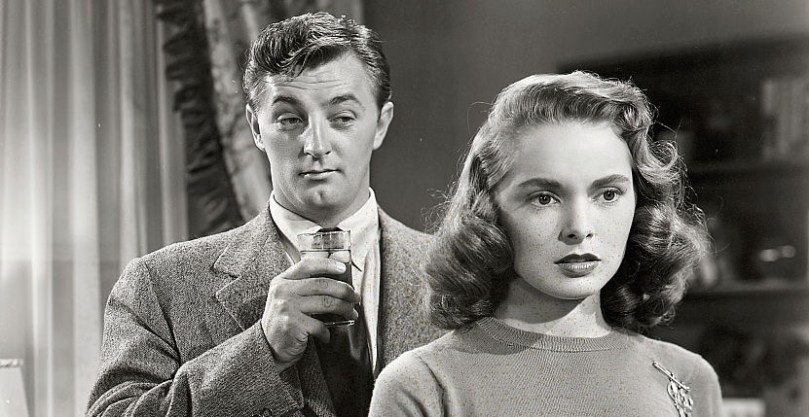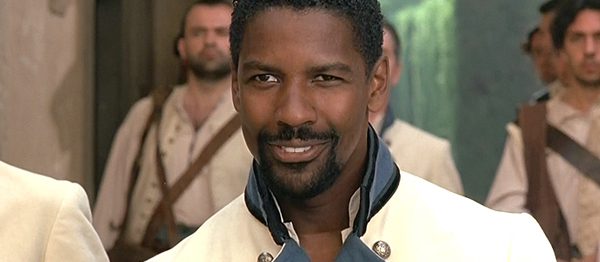
White Christmas (1954) starring Bing Crosby & Danny Kaye

My dear partner, when what’s left of you gets around to what’s left to be gotten, what’s left to be gotten won’t be worth getting, whatever it is you’ve got left. -Phil comments (re: Bob’s bachelorhood).

When I figure out what that means I’ll come up with a crushing reply. -Bob says, confused.

Having left the Army following WWII, Bob Wallace (Bing Crosby) and Phil Davis (Danny Kaye) team up to become a successful song-and-dance act. Phil (playing matchmaker) introduces Bob to the talented/beautiful sisters of an Army buddy, Betty (Rosemary Clooney- aunt of George) and Judy (Vera Ellen) Haynes, who are an up-and-comers in show business. When Betty and Judy travel to a Vermont to perform during the holidays, the men follow (Phil convinces Bob- he saved his life during a bombing raid). The men find their former commander, General Waverly, is the owner of Pine Tree Inn; w/ the lack of snow and guests, he’s losing hope. A series of romantic mix-ups ensue as these performers try to help him out.

It’s cozier, isn’t it? Boy, girl, boy, girl? -Phil asks the Haynes sisters re: his seating plan.

This is a holiday classic (now streaming on Netflix) that my family and I watched almost every year growing up. There is singing (Crosby and Clooney focus on this aspect more), dancing (Kaye and Ellen are more involved in this), fabulous clothes (esp. the gowns chosen for Clooney- IMO), comedy (wordplay, physical humor, Mary Wickes’ as the inn’s housekeeper, etc.) and romance. Irving Berlin composed the music, which is quite memorable. Things get complicated b/c Phil (and later- also Judy) plot to throw Bob and Betty (who are BOTH concerned re: their careers and “slow movers” in romance) together.

Imagine a girl in show business today wanting to settle down and raising a family. It’s so refreshing, isn’t it? -Phil asks Bob, while Betty and Judy look on.

Pushing, pushing. -Bob mumbles into his glass of water.

There is some cool trivia behind this film. According to Clooney, the “midnight snack” scene in which Bob Wallace expounds on his theory of what foods cause what dreams was almost entirely improvised. She said that the men’s “Sisters” performance was not originally in the script. Crosby and Kaye were clowning around on the set, and director (Michael Curtiz) thought it was so funny that he decided to film it. In the scene, Crosby’s laughs are genuine and unscripted, as he was unable to hold a straight face due to Kaye’s comedic dancing. The filmmakers had a better take (where Crosby didn’t laugh), BUT test audiences liked the laughing version better. I noticed this a FEW years ago- one of the background dancers is George Chakiris, who later won the Best Actor in a Supporting Role Oscar for his role as Bernardo in West Side Story (1961). Bob Fosse was one of the choreographers (though he is uncredited).

Below is a video of one of the BEST dance numbers from the film.

Alias Grace (2017) starring Sarah Gadon & Anna Paquin

Hollywood may still be a (dysfunctional) man’s world, BUT this Canadian 6 episode miniseries (streaming on Netflix) puts women in the forefront; they’re also behind the camera. The screenwriters are Sarah Polley (who started out as an actress, BUT garnered critical acclaim w/ her writing and directing) and Margaret Atwood (who wrote the historical novel upon which this series is based). Polley, who is also an executive producer, first tried to acquire the rights when the book came out in 1996. If you liked The Handmaid’s Tale (Hulu), check out Alias Grace; they share many common themes. I looked up the veteran director (Mary Harron); she was at the helm of American Psycho, as well as eps of two of my favorite shows (Homicide; Oz). The star of the series, Sarah Gadon, is a 30 y.o. actress who I’ve seen in a few films (A Royal Night Out, Maps to the Stars, and Belle). She is one of those women who can easily pass as a teen girl, if the role demands. And yes, ALL the women mentioned so far are Canadians!

The story focuses on a retelling of the events leading up to the (real-life) murders of Thomas Kinnear (Paul Gross from Due South and Slings and Arrows) and Nancy Montgomery (Oscar winner Anna Paquin). An Irish immigrant maid in Victorian era Toronto, Grace Marks (Gadon), is questioned many years after her conviction at the Kingston Penitentiary by a young psychoanalyst, Dr. Simon Jordan (Edward Holcroft). Grace (along with stable-hand James McDermott) was convicted of murder, but doubts surrounding her guilt remain. Dr. Jordan (who was created by Atwood for this series) was brought to town by a Spiritualist society, headed by Rev. Verrenger (famed director David Cronenberg). 

I started watching Alias Grace after an acquaintance posted about it on Facebook; she has written for TV herself. When some people watch period dramas, they’re looking for an escape (Downton Abbey is a popular example from PBS). However, Alias Grace is NOT all stiff upper lips, spotless clothing, and nice scenery; it has troubling (and sometimes bloody) scenes. This show is also providing  commentary on contemporary times; issues such as immigration, abortion, and harassment come up. 

[1] Sarah Gadon manages to simultaneously convey purity and malevolence with a single glance, and the dynamic between she and Dr. Jordan is laden with wonderful tension. 

[2] The main character, Grace, is a complex study in not only the human mind and its darker recesses, but also the power of the survival instinct in all of us. 

[3] Grace’s inner voice is strong and true. Also, she has no control over her life, but she is not broken. I often think that is the greatest sin of woman of her kind in the eyes of society.

[4] …the filmmakers here really paint a visceral picture of what life likely consisted of for women (and men) of that time period.

[5] The directing is precise and shows you what you need for the story. The horrific and painful parts of the story are such that it could not have been shown in such detail if it was adapted many years ago. What a perfect balance of beauty and horror.

–Excerpts from IMDB reviews


Page 3 (2005) starring Konkona Sen Sharma

Delving below the glitz and glamour of celebrity lifestyle to touch upon such dark subjects… Page 3 doesn’t shy away from tackling controversial issues. -Excerpt from BBCi Films

[1] Clever writing, skillfully incorporated songs, able performances and a genuine feeling of sincerity are what make this film worthy in spite of its lack of finesse and poor production values. 

[2] The movie defines so many characters who are completely with completely different priorities and different ideologies and yet they are all a part of the system which is all the more apathetic. …one of the most mature films of the recent times.

-Excerpts from IMDB reviews

This is currently streaming on Netflix; it’s worth a look (esp. if you’re looking for intelligent, thought-provoking Hindi cinema). If you’re bored w/ (or NOT a fan of) Bollywood, check this out. The dialogue is written with great attention to detail; characters from different social classes are represented (and get their own voices). Kareena Kapoor Khan was offered the lead role, which she turned down (thank goodness)!  

I don’t know what has happened to journalism. -Madhavi comments in the newsroom

Who told you that you are a journalist? This is what you write in the page 3 column, isn’t it? Who went in whose party, with whom who went… And with whom who came back… What one wore, ate and drank what… And what one didn’t wear. Miss Madhavi Sharma, this is called entertainment, not journalism. -Vinayak retorts

Madhavi Sharma (Konkona Sen Sharma- one of my fave actresses) is a 22 y.o. journalist living in Mumbai who covers page 3 (gossip, celebs, parties) for Nation Today (an English language newspaper). After just 6 mos, she’s disillusioned w/ her beat; she wants to do something more meaningful. Madhavi admires the work of crime reporter, Vinayak Mane (Atul Kulkarni), who rides around town on his motorcycle, meeting w/ snitches, and embedding himself w/ cops. This movie is not only about Madhavi, BUT also about her editor- Mr. Suri (veteran character actor Boman Irani), disillusioned socialite- Anjali Thapar (Soni Razdan from Monsoon Wedding), and her two roommates- tough-taking air hostess- Pearl (Sandhya Mridul) and naive aspiring actress- Gayatri (Tara Sharma), as well as others. 

Nothing can be achieved w/o being a former Miss India/Miss World or being connected to a somebody, Pearl explains to Gayatri. Madhavi thinks that a Bollywood hero she knows, Rohit Kumar (Bikram Saluja), can help Gayatri get an audition w/ a famous producer. A male model, Tarun (Jai Kalra), notices Madhavi while she’s sitting in the audience of a fashion show. They keep running into each other, so decide to start meeting up more. Rohit discusses show biz w/ Gayatri; they become romantically involved. Pearl meets an older NRI businessman who could be her ticket out of singlehood and working for a living. 

Mudbound (2017) starring Carey Mulligan, Garrett Hedlund, Jason Clarke, Jason Mitchell, & Mary J. Blige

NOTE: This review contains MILD spoilers for the film (which opens in theaters on NOV 17th).

I was lucky enough to attend a pre-screening of this film (produced by Netflix Studios) at Landmark E St in DC last week. I ran into two friends/movie fans there; we ALL liked it (though it contains some dark, gritty, and violent moments). It will stay in your mind for some time, no doubt. The director is Dee Rees, an openly gay African-American woman, who made the critical indie coming-of-age drama, Pariah. (I read about this film, BUT haven’t seen yet.) At Sundance, Mudbound received a standing ovation. 

The story is one part fiction (based on a novel w/ a white female protagonist) and one part fact (based on real events in the life of a black family). In the hands of another screenwriter, two different films would’ve been made from this material- one focusing on genteel/educated Tennessee spinster turned wife/mother, Laura McAllan (British actress Carey Mulligan) and her straight-talking/stubborn husband, Henry (Jason Clarke, an Aussie); the other on the African-American family farming part of the McAllan’s ancestral land in Mississippi, headed by Hap Jackson (Rob Morgan) and his wife, Florence, Mary J. Blige (the R&B singer). What ties these two threads together is the unlikely (and potentially dangerous) friendship between Laura’s charming/handsome brother-in-law, Jamie (Garrett Hedlund, giving a strong/layered performance), and the Jackson’s eldest son, Ronsel (Jason Mitchell, a fresh/compelling young actor recently in Straight Outta Compton).

Both Jamie and Ronsel, though of different ages and races, are WWII vets suffering through symptoms of PTSD after returning home to rural America. Jamie takes to drinking and wasting time, which greatly disappoints Henry, the responsible older brother and family man. Laura has strong feelings for Jamie, though she has long repressed them. Unlike his father, Ronsel can’t quietly acquiesce to the white people in town (whether it be Henry, his blatantly racist father- Pappy, shop owners, or even the sheriff). Hap and Florence worry about their son, who quietly seethes upon realizing the (very limited) role he will have as an adult black man in the segregated South. 

State of the Union (1948) starring Spencer Tracy, Katharine Hepburn, & Angela Lansbury

Introduction

This classic film’s screenplay was adapted from a Broadway play which opened in NOV  1945 and ran for almost 2 yrs. The play won the Pulitzer Prize in 1946. The themes present w/in this tale are a perfect fit for optimistic, first gen Italian-American director, Frank Capra, though I consider it more sophisticated than some of his (more famous) films. The first choices for the leads were Gary Cooper and Claudette Colbert, BUT those actors didn’t work out, so Capra brought in Spencer Tracy. Once Colbert was fired (for refusing to work nights), Tracy suggested Hepburn (who has some of the best lines). For ALL of who realize that politics is personal, this is the movie for you

Synopsis

The only heir to a publishing house, Kay Thorndyke (Angela Lansbury- then ONLY 24 y.o.), desperately wants to fulfill her dying father’s ambition of putting a man in the White House. So what if the one who may fit the bill, successful airplane manufacturer Grant Matthews (Spencer Tracy), is VERY reluctant? Kay convinces political strategist Jim Conover (Adolphe Menjou) to groom Matthews for their (Republican) party’s bid. A wise-cracking writer, Spike McManus (Van Johnson), comes along on the trail. It turns out that Grant and his wife, Mary (Katharine Hepburn), have been separated for some time; this is something that the public must NOT know. Mary is more than willing to play the supportive wife, IF this is truly what will help Grant. Does Mary still love Grant? Does Grant  love Kay (their behavior is far from platonic) or Mary? Will Grant accept the party’s nomination? 

Review of the Film

He’s beginning to wonder if there is any difference between the Democratic Party and the Republican Party. -Kay reveals to Jim (seriously) / Now that’s a fine question for a presidential candidate to ask. There’s all the difference in the world. They’re in and we’re out! -Jim replies (w/ exasperation)

This is the type of film you need to see twice to get all the jokes, looks, and little moments (which make it a fine piece of cinema). The straight-shooting Grant is “a man of the people” who is hesitant to water-down his message to fit into the mold of a typical politician. Jim comes to realize that some of Grant’s ideas are too liberal for the party. Mary is NOT only hoping to reconnect w/ her husband, she is disappointed when he gives in to pressure from Jim. 

Kay probably has respect and affection for Grant, BUT what she truly loves is the power that she can yield on a national stage. Lansbury admitted that no special aging makeup was placed on her; she “simple had an air of sophistication” which makes her believable as a confident, strong, middle-aged woman. (She also has the best outfits in the film.) Notice the way Kay orders around her (all-male) editors? Of course, she has to be tough in typically male worlds- publishing and politics. Mary comments that men first admire Kay, then start following her around, and eventually fall in love w/ her. 

You politicians have stayed professionals only because the voters have remained amateurs. -Mary comments to a group of political strategists (during the radio broadcast at the Matthews’ home)

Grant and Mary share a special spark, though disappointed w/ how their relationship turned out. (They have two cute school-aged kids, BUT we don’t hear/see much of them until the big climax scene.) The way that Mary talks about Grant, you realize that she is still crazy about him! She admits to Jim (a cynical old bachelor) that she set up fake dates to make Grant jealous. Jim reminded me a BIT of Tobey from The West Wing. Mary finds a sympathetic ear in Spike, who gains a lot of respect for her, and ends up rooting for the couple to end up together. Spike is an youthful man who likes to act nonchalant, flirting and cracking jokes, BUT also has a good heart (something you see in Capra films). 

Real-Life Politics Behind the Film

At the time the film was released, President Truman had NOT made his political comeback and was considered a sure loser in the 1948 election by many, which is why both the Republican presidential nomination is considered so valuable in the movie. It’s also why Spike McManus is amused when a young secretary tells him (at the start of the film) that she thinks Truman will be elected President in his own right in November.

Menjou was an ultra-right-wing political conservative who had co-operated with the House Un-American Activities Committee (HUAC), named names of persons he considered to be Communists and was a strong proponent of “blacklisting.” Hepburn was decidedly more liberal and had been an outspoken critic of the blacklist. Menjou had made several comments accusing Hepburn of being a Communist sympathizer, and possibly a Communist herself, which angered Hepburn and her co-star/romantic partner Tracy. Capra was so concerned about the tension that he closed the set to the press.