The Taming of the Shrew (Folger Theater)

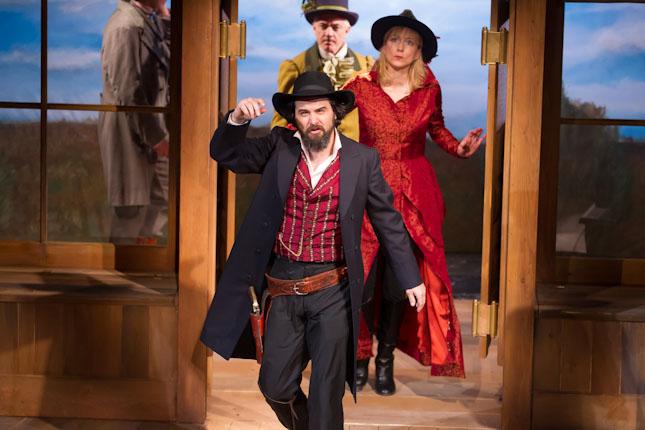
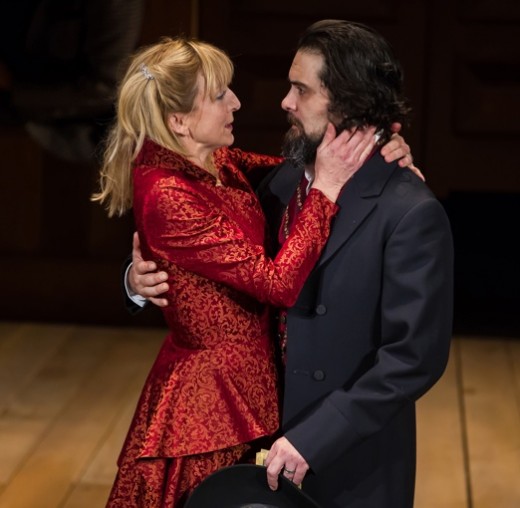
Real life husband and wife Cody Nickell and Kate Eastwood Norris starred in the Folger’s recent adaptation of Shakespeare’s The Taming of the Shrew.  As you can guess from pic above, the comedy was set in the Old West (director Aaron Posner was inspired by HBO’s Deadwood).  There was original music played onstage by the composer.  Also, two of the traditionlly male characters (Baptista and  Tranio) were turned into women.

At the start of the play, Kate is angry, bitter, and fights w/ her little sister, Bianca, and the suitors who constantly mill about her.  Of course, she is only masking her disappointment and loneliness. 

When he first arrives in town to see his old buddy Hortensio, Petruchio is a bold, brassy golddigger; he’ll marry ANY woman if she’s rich.  Bianca’s suitors (Gremio, Lucentio,  Hortensio) can’t believe their luck, b/c once Kate’s married off, they can court Bianca. 

There are a LOT of laughs in this production, BUT at the heart, it’s love story of two VERY strong-willed individuals.  If you know the text, you probably noticed that some lines were switched from Kate to Petruchio.  The final scene showed that the couple were on equal footing; the audience REALLY enjoyed the twist!

Othello (Folger Theater)

Ahh, Othello, one of my favorite characters created by the Bard!  He’s right up there with Hamlet.  He’s the ultimate outsider-insider: an African (Moor; former Muslim who converted to Christianity) in world of whites (Venice, Italy) who commands respect for his military victories.  Then he marries a white girl (the noblewoman Desdemona) and all hell breaks loose.  Well, it’s not quite that simple…

He is a contradictory man- a great speaker who is also capable of great violence.  Othello is a military man who sees things in black and white (this has a double meaning), unlike Iago, who deals in shades of gray.  Being such, he sees killing Desdemona as an act of justice.  My favorite professor said that though he was a skilled warrior, Othello probably had very little experience with love.  He relies too much on Iago’s judgment, because he knows more about the ways of white women.

The current production at the Folger is pretty good, with creative and gorgeous sets, costumes, and music.   The action, including swordplay, was exciting.   For the isle of Cyprus, Middle Eastern clothes and belly dancing is probably not accurate though.  I went to a preview show last Sunday.  The matinee audience was mainly elderly and college-aged, aside for a few who were around my age.

There were a couple of scenes where I got lost in the drama- good to have!  Back in high school and college, I saw Othello (played by Owiso Odera) as more heroic/larger than life; this play cut him a bit down to size.  He wasn’t such a big presence; Iago (Ian Merrill Peakes, who was in Henry VIII last year) was the star and better actor.  Merril Peakes spoke the language with ease and conviction.  Othello, who’s slight accent seemed to drift in and out, spoke the lines, but was not quite there when it came to feeling the words. Othello’s first crucial scene (in front of the Duke of Venice and other important nobles) was not as strong as I’d have liked.  But he did have good chemistry with Iago in their one-on-one scenes.

Emilia (Karen Peakes; also wife of Ian Merrill Peakes) did a great job; her character has some great lines.  Emilia is cynical, experienced, and wise- a contrast to the naive Desdemona.  The actress who played Desdemona got better throughout the play, but was too much of a lightweight.  She was too bubbly in her depiction, which created a tone that I didn’t think was fitting for a very young woman who had recently been disowned by her father.  Rodrigo (Luis Butelli; also in Henry VIII) was the spurned suitor who followed Desdemona to Cyprus.  He provided the comic relief without being over the top.  Cassio was the naive, young lieutenant who fell from Othello’s favor because he couldn’t handle alcohol.

As pointed out above, this production emphasized religion and violence (Othello has these bursts, escalating as we go on).  Othello wore a noticeable gold cross around his neck.  In early scenes, the soldiers, including Cassio,  wore outfits like the Knights Templar- chain mail and white tunics with large red crosses.  (I don’t know if that is accurate, but think it’s possible.)  Also, characters often crossed themselves when they were fearful, worried, etc.

Broadway on DVD

The Glass Menagerie (1973)

You are the only young man that I know of who ignores the fact that the future becomes the present, the present becomes the past, and the past turns into everlasting regret if you don’t plan for it.


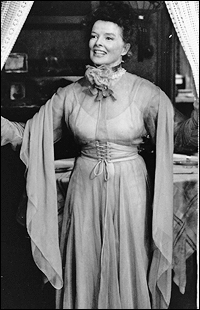
Katherine Hepburn stars as Amanda Wingfield, vivacious Southern belle turned struggling single mom and shop assistant in Tennessee Williams’ autobiographical memory play.  The narrator, Tom, is recounting the story from the distance of some years.  Amanda, who’s hubby ran off years ago, has two grown children (somewhere in their 20s) who live w/ her in a humble St. Louis rowhouse.  Tom (Sam Waterston- best known for Law & Order) grudgingly works at a shoe factory, but desperately longs for adventure and time to concentrate on his writing.  Laura (Joanna Miles), his older sister, lives in the world of her own mind- playing w/ little glass animal figures and listening to old records.     

Into their little world comes factory clerk Jim O’Conner (Michael Moriarty- also of L&O fame).  Jim is a positive, enthusiastic, well-mannered guy who’s quite happy w/ life.  Amanda is VERY eager to please him, seeing Jim as a potential hubby for Laura. 

Amanda, though she often revels in tales of her fabulous girlhood (servants, gowns, lots of gentlemen callers), has BIG hopes and fears for her children.  Tom REALLY hates his job, so he doesn’t try to move up the ladder, like someone w/ his brains could do.  Laura, VERY sensitive and shy, has left secretarial school and has not had any bfs.  And don’t forget the bills!  As a teen, I related more to Tom and Laura.  I didn’t like Amanda much, but when I watched the film again recently, I  was surprised to find that I had sympathy for her as a woman and a mother!  I guess I’m getting wiser…


A Moon for the Misbegotten (1975)


This version of Eugene O’Neill’s autobiographical play stars veteran theatrically-trianed greats Jason Robards, Colleen Dewhurst (mother of Campbell Scott) and Ed Flanders (St. Elsewhere).  It’s a sequel to A Long Day’s Journey Into Night; the main character is the older son of the VERY dysfunctional Tyrone family.  The setting is an old farmhouse in rural Connecticut in the 1920s, where Irish immigrant tenant farmer Phil Hogan (Flanders) lives w/ his VERY sassy, yet hardworking, daughter Josie (Dewhurst).  His three sons ran off to make their own way. 

One of Hogan’s friends and drinking buddies is also his landlord, Jim Tyrone, a brooding, middle-aged, and faded Broadway actor.  Whenever Jim is in town, they talk, drink, and hang out.  Josie is also friendly w/ Jim, though she doesn’t like his dark moods.  She speaks whenever and however she likes, BUT Jim doesn’t seem to mind like other men!  He even likes her looks, though she calls herself an ugly cow.  Seeing their affection for each other, her dad hatches a plan to get them together, BUT Mr. Hogan’s plan is badly conceived.

I’d never seen this play before, or even heard of it, so was pleasantly surprised by it.  Though it is dark in tone, it’s very compelling.  Dewhurst (known to MANY young people as Anne’s adoptive mom in the Green Gables series) just inhabits the role of Josie, a complicated woman w/ smarts, humor, and LOT of compassion.  Check it out!

“Henry VIII” (now playing)


If you know me, you know I LOVE the theater!  So last Sunday, I went to the Folger to see Shakespeare’s history play, Henry VIII.  (I got a reduced price ticket last Friday.)  Since it was a weekend matinee, there were all ages present, including a little guy who’d come with his grandfather.  

The set was interesting and unusual (with a large overhanging  piece in the shape of a crown).  The costumes were elaborate, beautiful, and period-accurate (unlike in the recent production of Hamlet that I saw at the Folger).  The music was used well- not too loud or overly dramatic. 

The actors were quite strong and spoke some VERY tough/long lines with ease.  Cardinal Wolsey (Anthony Cochrane) and Queen Katherine (Naomi Jacobsen) stand out in my mind.  Using the fool Will Sommers (Louis Butelli), who served as narrator and participant, was a good choice.  It got the audience smiling and feeling less intimidated by the material.  I also liked how the actors would go into the aisles and up on the balcony to do some scenes. 

In the first act, the language (dense; winding) took time to get accustomed to.  (No, this isn’t like the modernized dialogue you hear on the Showtime drama The Tudors!)  The first act was not very exciting or emotional; the second act was much better.  

I felt for Katherine (portrayed as a very bright, strong woman) when she was in court arguing against  the divorce.  Being Spanish, Katherine was seen as a “stranger” in England when she was married off to Henry.  Over time, many people grew to respect and admired her, because she endured many hardships with great dignity.     

Henry (Ian Merrill Peakes) fell in love with Anne (Karen Peakes), one of Katherine’s ladies in waiting, very soon after she arrived at court.  He had a necklace set with many jewels sent to Anne- something NOT to be taken lightly coming from a king.  I liked Anne Boleyn’s little (foreshadowing) speech about “not wanting to be a queen for all the world.”  I wanted to hear more from Anne.   

As for Henry, he came off as a level-headed solid leader who had crisis of conscience.  Henry made the mistake of giving the cunning Wolsey (who secretly promoted French interets) too much money and power.   Though he wanted Anne, Henry regretted divorcing his loyal wife after 20 years.  He desperately wanted a male heir. 

The strongest scene came at the end- after the birth of Henry and Anne’s daughter, Elizabeth.  There are fine speeches about how prosperous and important her time will be (foreshadowing the “golden age” of England).  Henry is full of fatherly pride and hope at the end.          

My 1st Broadway play!!!

That’s my first love- the theater.  Denzel Washington 

INTRODUCTION

This past Saturday, I went to NYC to see my first Broadway play, the Pulitzer Prize winning Fences by August WilsonFences is part of Wilson’s Pittsburgh Cycle, a collection of ten plays.  Each drama explores a different decade in the 20th century, and each examines the lives and struggles of African Americans.  The 13-week limited engagement of Fences is at the Cort Theater (138 W. 48th St. btwn 6th Ave & Bdwy).

Playwright August Wilson

Fences is a powerful family drama set in the late ’50s starring Denzel Washington (twice an Oscar winner) and Viola Davis (recent Oscar nominee).  This is a character-driven story with one simple set (action takes place on the front porch of a humble little house).  I was lucky enough to get a ticket for the 9th row (close to stage). Once I got over the “Wow, I’m seeing Denzel in person!” feeling, I really got involved in the play.  The (diverse) audience enjoyed it very much, too.  We laughed, we got teary-eyed, and… WE SAW DENZEL!!!

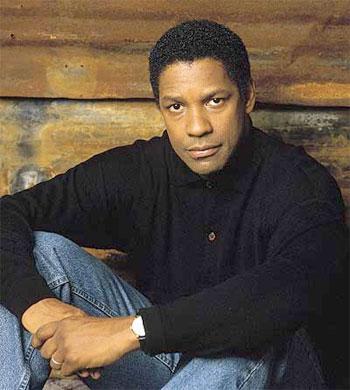
Denzel Washington (Troy)

At one point, Denzel’s character enumerated all that he had to give before exiting the stage.  One elderly woman called out: “I’ll take it!”  LOL!  And yes, he is JUST as handsome up close as onscreen. 

As expected, Denzel stopped traffic in front of the theater for some minutes while people hovered about seeking pictures or just a glimpse before the limos set off.   Unfortunately, he didn’t stay for autographs, but I noticed the young actor who played his son (Chris Chalk) signing playbills.

PREMISE

At the start of the play, Troy Maxon (Denzel Washington) is a 53 yr. old former Negro League baseball player who hauls trash in the Hill District of Pittsburgh w/ his best pal Jim Bono (actor/theater educator Stephen McKinley Henderson).  Troy lives in an old house w/ his 2nd wife Rose (Viola Davis) and their 17 y.o. son Cory (Chris Chalk).   Though Troy is illiterate, he is a hard-worker hoping to get a promotion.  Troy and Rose seem to have a solid (yet passionate) relationship after 18 yrs. together.  Cory works at the A&P (grocery store), but hopes to attend college on a football scholarship.

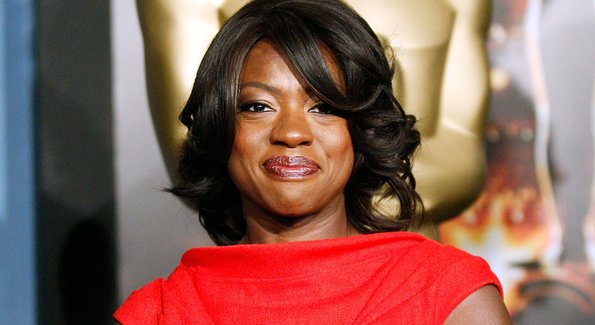
Viola Davis (Rose)

When Lyons (Russell Hornsby), Troy’s 34 y.o. son from a previous marriage, drops by on a FRI (payday) to ask for $10, Troy is NOT too amused.  He tells Lyons that he’s a married man now, and needs to take care of himself and his wife.  (Lyons’ wife works as a laundress, though she has trained as a nurse.)  Troy advises him to “learn a trade,” but Lyons insists that he’ll stick to music.  “I’m not like the rest of you- I’m a musician,” Lyons says with bravado.  Rose and Bono persuade Troy, and he grudgingly allows Rose to loan out the $10.  (Rose, a practical AND caring woman, is the keeper of the family purse.)  As Lyons picks up his horn to leave, the disappointment is evident on Troy’s face.  “He’ll be back,” Troy concludes.

While Lyons was visiting, Troy’s younger brother Gabe (Mykelti Williamson) dropped by.  Gabe, a WWII vet, has a “metal plate in his head” and is now mentally handicapped.  We learn that the Maxon house was bought w/ money from Gabe’s veteran’s benefits.  But Gabe recently moved out of the house to live in a boarding house.  “I got two rooms!” he enthusiastically tells Rose.  Gabe sells fruit in the neighborhood to earn a bit of money for his room/board.  

Though Rose is patient/kind with Gabe, his presence is an irritation to Troy.  “I done everything I can for the boy,” Troy exclaims w/ exasperation when Rose worries about Gabe’s health/habits.  Being in the hospital wasn’t right for Gabe, Troy rationalizes, b/c “what did he go over there and get his head blown off for” (if he can’t have freedom).

Troy has been waiting for Cory to help him finish the fence around the yard.  But Cory has been practicing football after school.  Cory announces to his parents a recruiter is coming to see him soon, and needs his Troy’s signature to sign him up (to play for a college in North Carolina).  Rose is very proud of her son, but Troy is skeptical.

Chris Chalk (Cory)

We learn that Troy has gotten a position as a driver, so he won’t be working in the back of the garbage truck w/ Bono anymore.  (Driving positions usually went to white men.)  When Bono points out that Troy can’t drive yet, Troy shoots back: “Everyone doesn’t gotta know my business!”  He’ll learn how to drive before it’s time for him to take up the new position.  Lyons comes by w/ good news- he has a steady gig at a good club.  Troy’s surprised when Lyons offers to give him back the $10 he borrowed.   When he invites his father to come hear him, Troy refuses by saying “I’m too old to be going to clubs.”           

Cory is desperate for his father to understand; he names different athletes (including blacks and Jews) who have excelled in baseball.  Troy bitterly tells Cory that he’s more stupid than he thought, and that there’s no future in sports for a black man.  Troy is enraged when Cory tells him that he’s quit his job at the A&P to concentrate on football.  Father and son square-off, and it looks like they will come to blows!

To learn what happens, go read (or see) the play! 


THEMES

Baseball is one of the themes of the play.  On stage right, a ball of rags is tied to a branch.  Both Troy and Cory practice swinging at the ball at the start of the play.  Later on, when the father and son argue, the bat will be turned on Troy – though Troy will ultimately win in that confrontation.  At the end of Act One, he warns his son: “You swung and you missed. That’s strike one. Don’t you strike out!”

Troy was a great baseball player, at least according to his friend Bono.  Although he played for the Negro Leagues, he was not allowed to on the white teams.   The success of Jackie  Robinson and other black players is a touchy subject for Troy.  He never earned the recognition or the money which he felt he deserved – and discussion of professional sports will often send him into a tirade.  Though Rose insists that “you were too old,” Troy feels it was solely racism that kept him shut-out.

During Act Two of Fences,  he uses a baseball metaphor to explain why he had an affair:

I fooled them, Rose.  I bunted.  When I found you and Cory and a halfway decent job . . . I was safe.  Couldn’t nothing touch me. I wasn’t gonna strike out no more.  I wasn’t going back to the penitentiary.  I wasn’t gonna lay in the streets with a bottle of wine.  I was safe.  I had me a family.  A job.  I wasn’t gonna get that last strike.  I was on first looking for one of them boys to knock me in.  To get me home.  …then when I saw that gal . . . she firmed up my backbone.  And I got to thinking that if I tried . . . I just might be able to steal second.  Do you understand after eighteen years I wanted to steal second?

Father-son relationships are very crucial in Fences.  On the stage, the emotionally strained relationship between Troy (who’s based on August Wilson’s stepdad) and Cory is highlighted.  At one point, Corey asks “Why don’t you like me?”  Troy is amused by this question, and retorts w/ “I don’t have to like you!”  Troy goes on to say that he gives his son food, a roof over his head, and provides for his life.  But Cory wants more from his father, but Troy is incapable of expressing that.     

But the unseen relationship of the play is the one between Troy and his father, who was a sharecropper in early 20th century Alabama.  Troy reveals secrets from his youth to Bono and Lyons in one (quietly powerful) scene.  After noting some of his father’s brutish behavior, Troy (who fled from home at 14) flatly calls him “The Devil.”  (Denzel really shines in this scene!) 

Freedom is another theme in Fences.  Several times Troy exclaims that he “needs to be free.”  But from what?  To the audience, he seems to have a lot going for him (at the opening of the play).  He has a supportive wife, talented sons, and a loyal best friend.  He’s struggling to make ends meet, but he’s NOT alone.  Everyone in the community is (of course) dealing w/ ingrained racism.  

As Troy’s character is revealed, we realize that he can NEVER be free of the one man he hates- his father.  Though Troy says he doesn’t behave like his old man, Troy is very hard on Cory.  When Cory gets angry and obstinate, Rose says w/ frustration: “You’re just like him!”  Perhaps we can never be free of our past, parents, and mistakes- they make up our character.     

THE ACTING

With such a stellar cast, the acting could NOT be anything but top-notch!  Denzel hit JUST the right notes w/ his role; he made Troy a believable (yet flawed) character.  With this type of character, some actors could go over-the-top, but Denzel keeps it grounded.  Troy is a complicated man, though HE would never admit to that.  He is charming, funny, sarcastic, hard-headed, etc. just like all of us.  But he DOES NOT analyze his actions; that’s just NOT his way.

Viola Davis’ role grows as the play goes on.  She does a terrific job in portraying Rose, a woman of great character and integrity.  We sense that Rose could’ve done much better for herself, given her sensibility and sensitivity, but she stuck with Troy out of love/passion/loyalty.  She invested a lot in their relationship, and is DEEPLY hurt when it breaks.  But, above all, Rose is a survivor, and Viola Davis suits this role to a tee.  There is no sense of acting.      

Related Links

Official site (w/ a GREAT NYT video interview)

http://www.fencesonbroadway.com./index.html

Denzel finds his “voice” in Fences

http://www.npr.org/templates/story/story.php?storyId=126195963

About playwright August Wilson:

http://en.wikipedia.org/wiki/August_Wilson

2 short interviews w/ Denzel:

http://www.youtube.com/watch?v=RKsDRcuePnk

http://www.youtube.com/watch?v=edtA7NapVKY