Movie Review: “Enemy at the Gates”

Action, friendship, romance- this film has it all!  This war/suspense drama (unfortunately) didn’t do well at the box office in 2001.  When you see it you’ll wonder:  Why the heck not!?  It has an all-star international cast, great cinematography, and a very compelling story (based on true events).  The setting is Stalingrad in Fall/Winter 1942.  Stalin and Hitler are no longer buddies.  The German army has been mounting a large scale attack on Stalingrad, but the Red Army will not give up so easily! 

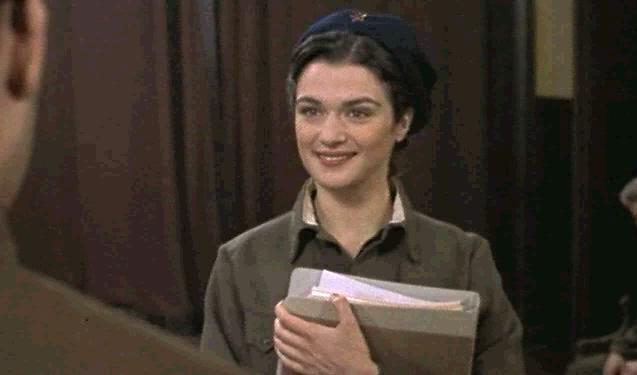
The film opens with the arrival of a group of rag-tag soldiers from all over Russia, including wide-eyed Vassili Zaitsev (Jude Law) to the big city.  We learn later that he is a shepherd from the Ural Mountains.  The soldiers traveling with Vassili are not all men- a young woman reading a book is in the same car as him.  He is struck by her beauty.

The action of this film comes at you from the start- huge crowds, gunshots, explosions, etc.   Many men fall around the newcomer, but when Vassili gets his hands on a rifle, he takes down 5 German officers!  Danilov (Joseph Fiennes), a political officer, is amazed by the young soldier’s skill.  They become fast friends.
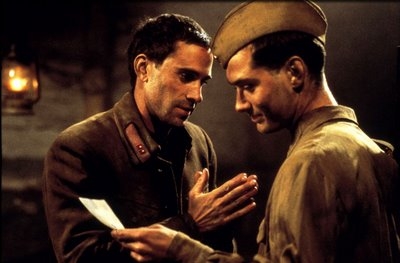
The educated, idealistic Danilov makes Vassili into a larger-than-life war hero; he writes about his deeds in the army newspaper.  Soon, the quiet, simple man is promoted to the sniper division, meeting politicians like Krushchev (Bob Hoskins), and a legend in his own time.  

Danilov: “Here, the men’s only choice is between German bullets and ours. But there’s another way. The way of courage. The way of love of the Motherland. We must publish the army newspaper again. We must tell magnificent stories, stories that extol sacrifice, bravery. We must make them believe in the victory. We must give them hope, pride, a desire to fight. Yes… we need to make examples. But examples to follow. What we need… are heroes.”

Khrushchev: “Do you know any heroes around here?”

Danilov: “Yes, comrade. I know one.”


People write him letters, greet him warmly in the streets, and a local shoeshine boy, Sacha, invites Vassili home for dinner.  There he meets the boy’s mother and their close friend/neighbor, Tania (Rachel Weisz), the woman who captivated him on the train.  She was at university in Moscow recently; she volunteered to be part of the militia.  Danilov can’t keep his eyes off her.  But Tania is interested in Vassili; a love triangle is formed!
 

Vassili becomes so famous that the Germans send for their best sniper, the cool, aristocratic Major Konig (Ed Harris) to kill him.  This is the heart of Enemy at the Gates– a duel between two men (both with intense blue eyes) who are the best in their field.  The large-scale war is brought down to these two snipers- to the human level.  Vassili tells the adoring Sacha that you have to face a man to kill him, and that stays with you.
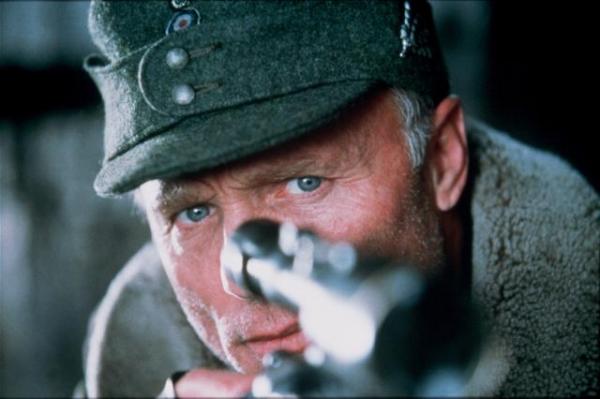
A battle between two nations became a conflict between two men.

Vassili: He [Konig] shot him [another expert sniper] on the run. It was an impossible shot.”

Danilov: “Vassili… ”

Vassili: “You’ve promised people a victory I can’t deliver. I don’t stand a chance against this man.” 

Will Vassili conquer his doubts and defeat Konig?  Which man will get the girl?  Find out for yourself!
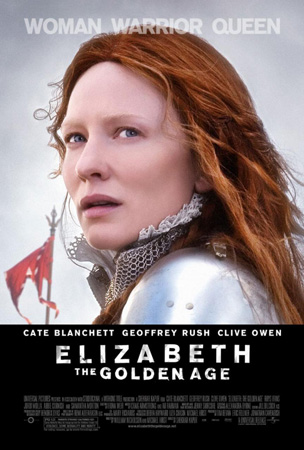
“Elizabeth: The Golden Age” (2007)

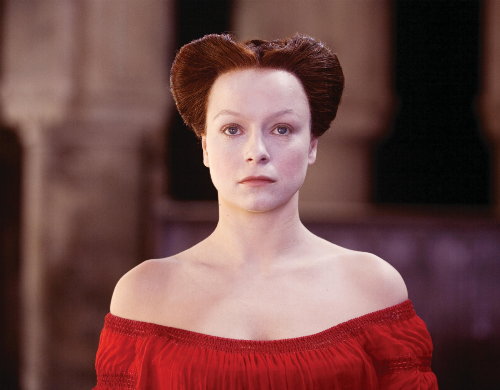
The “definitive” Queen Elizabeth of modern film (Cate Blanchett), director Shekhar Kapur, and the Queen’s “master of intrigue” Lord Walsingham (Geoffrey Rush) return to create a strong sequel.  The costumes, especially those of Elizabeth, are some of the MOST beautiful, intricate things ever seen!  The unusually high camera angles often used reminding the viewer of bigger forces at play in the world (God?  Destiny?) than the machinations of rulers.  There are new chracters to explore as well: sailor/adventurer/privateer, Walter Raleigh (Clive Owen); beautiful, sweet, young lady of the court (Abbie Cornish); the religiously fanatical King Phillip of Spain (Jordi Molla); the steely Mary, Queen of Scots (Samantha Morton).

This is my second viewing of the film; I saw it in the theater this past winter.  It’s the kind of film you MUST see in the theater to appreciate fully.  Kapur envisions this film as light (Elizabeth) vs. dark (Philip); he explains this in the Special Features of the DVD.  Elizabeth is now a mature woman and a confidant ruler, but her country is in trouble.  Spain has an incredibly strong navy (the Armada had more than 2,000 ships), the Inquisition (which Elizabeth says will take away “freedom of conscience and thought”), and a ruler who seeks to glorify God by conquering Britain.

At home, the Virgin Queen must deal with cousin Mary, who has many Catholic supporters plotting for Elizabeth’s demise.  Mary is imprisoned, but still sending out letters to the world.  England is about 50% Catholic, but the queen vows “I will not punish thought- only action.”  Elizabeth stood for religious tolerance, even when her Privy Council said that she should be more tougher on disloyal subjects (speaking/writing against her).

One day, while walking with her ladies from church, Elizabeth meets Raleigh.  He gallantly drops his cloak in order to cover up a puddle.  She is definitely amused and intrigued by the man, as is Beth (her favorite lady-in-waiting).  Raleigh is handsome, bold, and has been to the New World; he presents to the court Native Americans, potatoes, tobacco, and gold (captured from Spanish ships, of course).  You may know that Virginia was named in honor of Queen Elizabeth.

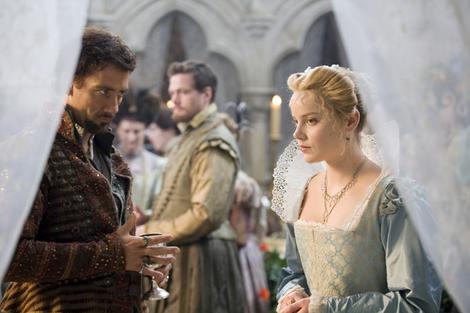
Raleigh speaks with Beth Throckmorton, one of Elizabeth’s closest ladies.

Raleigh was known to be one of Elizabeth’s “favorites” in real life.  In this film, Elizabeth is drawn NOT only to the (very charming) man himself, but to the life of adventure her leads.  She has never been away from British shores, and yearns to see more of what is “beyond the court.” 

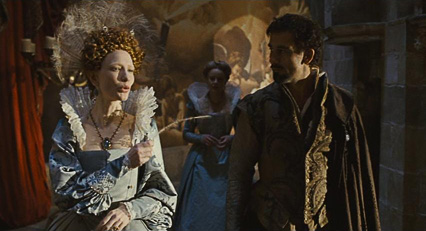
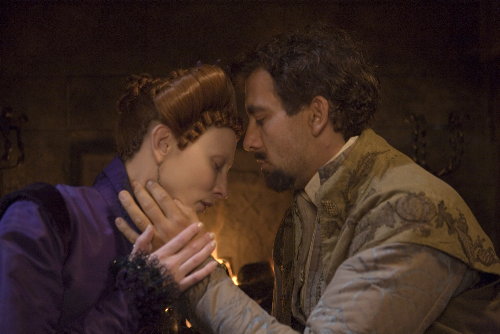
In the above picture, Elizabeth is enthralled as she listens to Raleigh’s account of life at sea.  This section of the film reminded me of Shakespeare’s tragic play, Othello.  (Desdemona fell in love with Othello because of his stories.)

Raleigh wants the Queen’s favor; however, he also shows concern for her as a person and friend.  Though the hair, make-up, and clothes (obviously) proclaim him the “hero” character, the acting is mostly in Clive Owen’s eyes.

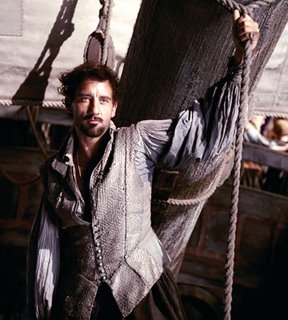
Sir Walter Raleigh (he was knighted by the Queen) aboard his ship, The Tiger.

Some people have complained about the (big) show of emotion in one scene involving the Queen, Beth and Raleigh.  (I understand that, because I thought it was a BIT too much as well.)  But who among us is always in control?  The Queen is NOT ONLY a ruler, she is a woman (who probably would’ve liked to have a husband and family- like most other women of her day).

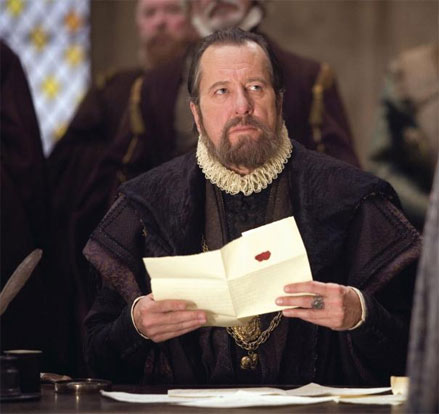
The dialogue was pretty good, but there were a few places where I thought it could’ve been more subtle.  Modern audiences are NOT as dim as MANY screenwriters think!  The acting, especially by Cate, is VERY good.  In my opinion, this actress can play ANY role.  Geoffrey Rush is strong (as always) but low-key.  He was known as “the spymaster” who had eyes and ears all over Europe; his main concern is the Queen’s safety.

What struck me the most was the beauty of the locations (especially the many different cathedrals), the visual effects, and the scenes between Cate and Clive.  They had a good connection that was based on respect, I feel.  The music was not overly dramatic, unlike in many “epic” scale films.  Check out this film ASAP!