FanstRAvaganza 4: Re-watching North & South (Episode 1)

Introduction

For Richard Armitage Week on the Web, I’m re-watching my favorite miniseries, North & South (BBC, 2004).   As I wrote before, I learned a little about it from the (many) YouTube fan videos created by its loyal fans.  Wow, I guess something about this film really touched people!  I saw it first in 2009 (Spring), not long after I’d moved to a city I didn’t know and had no local friends/connections (just like Margaret’s predicament at the start of Episode 1). 

The Backstory

Margaret Hale (Daniela Denby-Ashe) is looking back on the London wedding of her vivacious/blonde cousin, Edith, as she takes the train from Helstone (her home in the rural South- Hampshire) to Milton (a growing industrial city modeled after Manchester by novelist Elizabeth Gaskell).  We meet Aunt Shaw (a wealthy widow who was married to a much older man) and Margaret’s parents, the Hales (married for love).

You know, sister, sometimes I envy you your quiet country parsonage.  Now, Edith can afford to marry for love.

Daniela Denby-Ashe as Margaret Hale and John Light as Mr, Lennox
Henry picks a rose for Margaret

The older brother of the groom, Captain Frederick Lennox, Henry (John Light), chats with Margaret and compliments her looks, but she doesn’t notice.  (We can tell that he’s interested in her.)  They talk of the perfect wedding and Margaret’s love of her hometown.  Soon after she goes back to Helstone (bright/green/peaceful), Henry comes for a visit, much to Margaret’s surprise.  She is shocked when he proposes to her in the church yard.  Margaret (age 18) insists that she’s “not ready to marry anyone!”  Henry leaves, very disappointed, as he thought that she cared about him (as more than a friend).

Arrival in Milton

There will be no people like us there.

Mrs. Hale (Lesley Manville) is very upset and worried about going to live in such a strange place.  (It’s dark, gray, smoky, and bustling with people and activity.)  The Hales’ loyal housekeeper, Dixon (Pauline Quirke), empathizes with her mistress (who is in poor health).  Why can’t they stay “by the coast” (seaside) while Mr. Hale (Tim Pigott-Smith) looks out for a house?  But her husband insists that she come along.  Margaret tells her father that they should both go see the properties- it’s faster. 

Maragret is visibly annoyed when she overhears Mr. Thornton’s overseer (Williams) and another man (property agent) talking about Mr. Hale in a disrespectful way.  Williams doesn’t want to discuss rent of the townhouse with her, so she insists upon seeing Thornton.  She’s a bit surprised that Mr. Thornton’s house is right beside his mill.  After some minutes, Margaret gets tired of waiting, and walks into the mill.  

Meeting Mr. Thornton

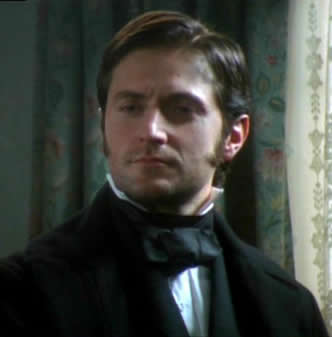
Richard Armitage as Mr. Thornton
Margaret sees Mr. Thornton for the first time

There is cotton fluff going all around- Margaret has never seen such a place!  The workers are busy, aside from one man, who is trying to smoke.  Mr. Thornton (Richard Armitage) sees him before he can light up and chases him across the floor.  In one corner, he gets hold of the man (Stephens), and starts punching him (very hard), while shouting about the danger of fire in a mill.  Margaret is horrified to be witnessing such a fight; she yells “Stop!”  Stephens begs for his job and cowers on the floor (with blood on his face).  Thornton kicks him and yells over at his manager: “Get that woman out of here!”  Margaret chastises the master for his behavior before she’s urged away by Williams.

I was angry.  I have a temper.  Fire is the greatest danger in my mill aside from-
Richard Armitage as Mr. Thornton
Meet Mr. Thornton

I love how Thornton stands up straighter and puffs out his chest before Mr. Hale introduces him to Margaret!  (He wanted to make a good impression.)  She’s not happy to see him- her expression is one of disgust and disappointment throughout the scene.  But she is surprised when he (passionately) tells the story of the burning of a mill in Yorkshire the previous year.  And the voice- WOW!

Introduction to the Higgins & Thorntons

They don’t much like strangers in my house.

There is some class and culture clash when Margaret meets the Higgins.  (Class difference is still a common theme, even in modern TV/films from the UK.)  They will become close friends, though the Higgins are working folks and she’s a gentleman’s daughter.  Bessie (Anna Maxwell Martin) admires how Maragaret stood up to Thornton.  We learn it was her father, Nicholas (Brendan Coyle), who helped Margaret in the stampede in an earlier scene.

Our Milton craftsmanship can compare with the very best.

Well, that was an awkward tea!  Mrs. Thornton (Sinead Cusack) is very stern and humorless.  She says that her son is “sought after by all the ladies” in town. When Margaret smiles and gives a little laugh at that, she is offended.  Fanny (Jo Joyner) is hilarious (without knowing it). 

The Masters’ Dinner
Mr. Thornton at the mill owner's dinner
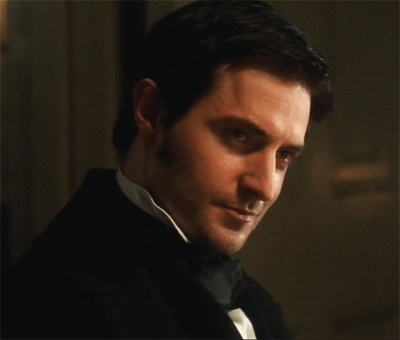
Mr. Thornton at the mill owner’s dinner

I do not run a charitable institution.  My workers expect me to be hard. 

This is an especialy well done scene!  The director and cinematographer work with light, shadow, and angles to cast Thornton as an ambiguous character.  We don’t yet know if he’s a good or bad guy.  We also learn a bit about the other mill owners, too, as they discuss “the wheel” and how they deal with their workers.

Tea with the Hales
Mr. Thornton admires Margaret

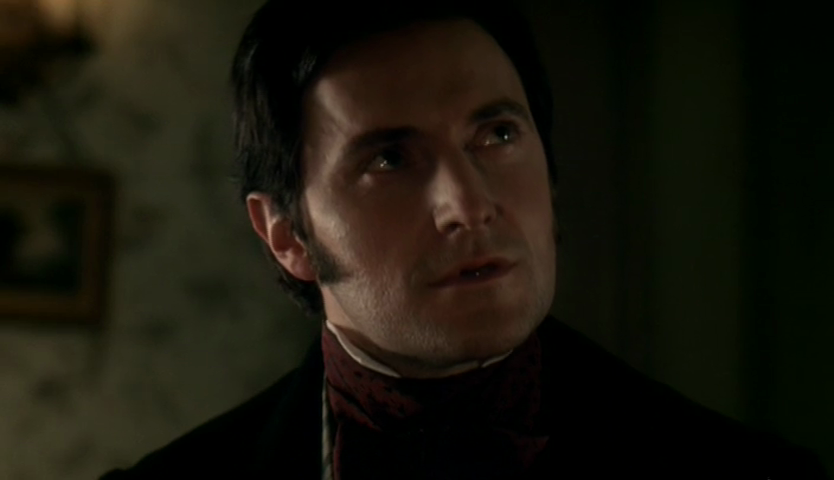
Margaret is ironing the curtains.  Thornton smiles when he comes to the door of their house- love that!  He admires (checks out) Margaret as she pours him tea, but she remains stand0ffish. He tries to connect with her in this scene, but fails.  When Mrs. Hale talks about the new decor, he makes a comment on “Milton taste” and smiles over at Margaret. Again, no positive response from her.  But when he mentions the South, she gets ticked off, saying he “knows nothing about the South” and there being “less suffering” there than in  his mill.  Look at the (obvious) disappointment on his face! 

I do know something of hardship…

But things really get serious (we are more drawn in) when Thornton tells the story of his past.  Notice the change in his posture, voice, and expression with each sentence- just subtle/superb acting!  The Hales are silent and admit to being taken aback by his (emotional/forthright) disclosure.  Mr. Thornton is reading the great books and discussing them with Mr. Hale to improve his education (which was abruptly halted as a boy). 

Margaret, the handshake is used up here in all forms of society. 

Mr. Thornton is offended when Margaret refuses to shake his hand.  He wanted to leave her with a positive impression. 

The Meeting of the Millworkers

Nicholas rallies the men (from different mills) at the Lyceum Hall for the first time.  (Mr. Hale said they could meet during his lecture time.)  Boucher, who has a wife and six young children, speaks his concerns.  The strike fund can’t help men like him, he thinks.  They millworkers are not striking yet, but need to be ready for the future.

Conclusion of Episode 1

Stephens comes back to Marlborough Mills to beg for his old job, saying he can act as a spy and find out what the other workers are up to.  Thornton yells a him and shoves him out.  Part of this encounter is witnessed by Margaret and her father, who don’t approve of such harshness.  Margaret wishes she could tell Edith how she really feels- she’s “lonely” and Milton is “hell.”
Richard Armitage Week on the web

The Company Men (2010)

company-men-poster

This is a slice-of-life indie film (set in the mid-sized city of Gloucester, MA) centering on several executives working for GTX, a fictional manufacturing company that has had some heavy lay-offs.  It was written/directed by John Wells (ER, Mildred Pierce, The West Wing, etc.); Maria Bello (also from ER) has a role in the film as a shrewd businesswoman.  Though it focuses on white, upper-middle class men, I could relate to it on several levels.   

Discussion of lay-offs in the boardroom
Glen McClary (Tommy Lee Jones), Sally Wilcox (Maria Bello), and others discuss lay-offs

Old friends James Salinger (Craig T. Nelson) and Glen McClary (Tommy Lee Jones) have built GTX from the ground-up, but Salinger, the president, wants to trim costs in order to raise profits.  McClary feels like he’s going about it the wrong way; he also feels guilty for benefitting from the rise in company stock.  Sally Wilcox (Bello) handles the lay-offs, which come as a shock to Robert Walker (Ben Affleck), a top sales exec (w/ MBA) who’s worked for the company for 13 years (all of his career).

Bobby and Maggie
Bobby (Ben Affleck) & his wife Maggie (Rosemarie DeWitt)

Bobby drives a Porshe, lives in a beautiful house (beside a golf course), and has a lovely family.  However, he’s reluctant to share the bad news with his family (including parents), or rely on them for support.  Bobby thinks that he can get a job right away, but turns out to be wrong (you’ve been there).  Bobby’s understanding wife, Maggie (Rosemarie DeWitt), goes back to work as a nurse.  She urges him to cut back on costs, but he exclaims: “I need to look successful!”  When you don’t have a job, you feel anxious, depressed, irritable, and- perhaps this is more so for males- useless.

Tommy Lee Jones as Gene McClary and Chris Cooper as Phil Woodward
Gene McClary (Tommy Lee Jones) & Phil Woodward (Chris Cooper)

Phil Woodward (Chris Cooper, one of my favorite character actors) is let go in the second round of lay-offs; he takes it very hard.  He worked his way up from the factory floor (where he installed parts on ships) and is pushing 60.  One of his daughters is in college (Brown, no less) and the other is eager for her school’s senior trip to Italy.  His wife suffers from headaches and doesn’t seem like much of a helpmeet.  Phil tells Gene: “My life ended and nobody noticed.”

Jack Dolan (Kevin Costner) and Bobby (Ben Affleck)
Jack Dolan (Kevin Costner) & Bobby

When his brother-in-law Jack Dolan (Kevin Costner, in a low-key but pivotal role) offers Bobby a job with his small carpentary business, Bobby quickly rebuffs him.  That’s not the type of work he sees himself doing (been there, too).  After a few months of disappointment, Maggie reminds him that they can’t pay the mortgage.  Bobby has to swallow his pride and make some uncomfortable decisions. 

What drew me to this film is it’s ensemble cast.  I thought Cooper, DeWitt, and Jones performed their roles especially well.  Affleck and DeWitt have good chemistry in their scenes.  Most of the situations are very relateable.  Bobby is still a lucky guy, even without the trappings of success. 


Game of Thrones: The Dothraki Culture & People

The Dothraki were actually fashioned as an amalgam of a number of steppe and plains cultures… Mongols and Huns, certainly, but also Alans, Sioux, Cheyenne, and various other Amerindian tribes… seasoned with a dash of pure fantasy.  So any resemblance to Arabs or Turks is coincidental. Well, except to the extent that the Turks were also originally horsemen of the steppes, not unlike the Alans, Huns, and the rest…

In general, though, while I do draw inspiration from history, I try to avoid direct one-for-one transplants, whether of individuals or of entire cultures.  Just as it not correct to say that Robert was Henry VIII or Edward IV, it would not be correct to say that the Dothraki are Mongols.

-George R. R. Martin, creator of  A Song of Ice and Fire series of books

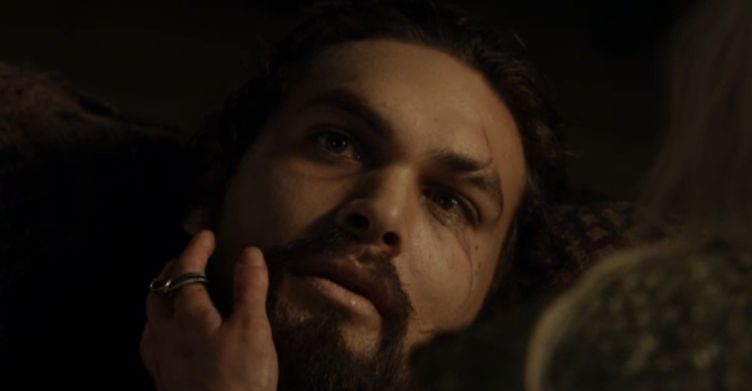
Jason Momoa as Khal Drogo

In Season 1 of GoT, we hear about the Dothraki when Ilyrio (a very wealthy/respected merchant in the city of Pentos on the island of Essos), brokers a marriage between “the great Khal Drogo” (played by American actor Jason Momoa) and the exiled princess from Westeros, Daenerys Targaryen (played by a British newcomer, Emilia Clarke).  Her older, controlling, brother Viserys (Harry Lloyd, a British actor best known for Doctor Who and Robin Hood) presents his sister with a diaphanous (almost see-through) gown which she’ll wear for the bride viewing.  The girl has no say in the matter, as it’s all been strategically arrranged by her benefactor (Ilyrio) and brother.   

Drogo sees Dany

Khal Drogo, with his bloodriders (men closest to him/sworn to protect him), ride up to Ilyrio’s house (the palace of the president of Malta) and take a look at (the very scared/worried) Daenerys.  “See how long his hair is? Khal Drogo has never been defeated in battle,” Viserys explains to his sister.  Daenaerys hesitantly walks closer; Drogo says nothing and rides off just as quick as he came.  That is a good sign, Ilyrio reassures the Targaryens.

Drogo and Dany's wedding

Drogo and Dany’s marriage is not only the marriage of two people (strangers), but two very disparate cultures, languages, belief systems.  Dany hails from Westeros, though she was born in exile.  Drogo’s people are horse-worshipping nomads, living in tents, never staying in one place too long.  They travel in large packs (khalasars); Drogo commands about 40,000 total (which Viserys thinks will be a great asset to him).  Though Dothraki fear “any water that a horse cannot drink,” Viserys thinks he can get 10,000 of these warriors to cross the Narrow Sea and retake the Iron Throne (which he says is his right by birth).

Vaes Dothrak

Drogo gives his new wife a beautiful white stallion as a wedding gift.  After Ser Jorah Mormont (veteran Scottish actor Iain Glen) reveals the wine merchant’s deadly plan in Ep 7 (You Win or Die), Drogo says he can have any horse he wishes.  (Glen appeared on Downton Abbey in its second season as one of Mary’s beaus.  You may have seen him in the 1999 miniseries Wives and Daughters.)  The Dothraki don’t build, but have one sacred city (Vaes Dothrak), where bloodshed is forbidden.  “Don’t let them see you carrying a sword here,” Jorah warns Viserys in Ep 6 (A Golden Crown).

Daenerys-Ser-Jorah

At the wedding (by the seaside), Dany watches the dancing, violence, and other acts w/ horror.  In Ep 1 (Winter is Coming), Ilyrio comments: “A Dothraki wedding without at least 3 deaths is considered a very dull affair.”  Dany’s face brightens a bit when she meets Jorah, who presents her with some books (“songs and stories from the Seven Kingdoms”).  Jorah is a very important character (esp. in S1)- acting as guide/translator/friend to Dany.  After he was exiled from his homeland by Lord Eddard Stark for selling slaves, his “expensive” wife went off w/ another man, and Jorah traveled all over.  The knight knows the Dothraki language and culture very well.

Doreah

Daenaerys has other allies on her journey in S1, including a clever young handmaiden named Doreah (played by Roxanne McKee, a Canadian-British model/actress), who Viserys freed from a “pleasure house.”  Doreah advises Dany to be more assertive with Drogo in Ep 2 (The Kingsroad).  She reassures the hesitant khaleesi: “If he wanted the Dothraki way, he would’ve married a Dothraki.”

irri_rakharo

The young “bloodrider” Rakharo (Elyes Gabel) and handmaiden Irri (Amrita Acharia) are very loyal to/protective of their khaleesi.  When he lashes out at Dany, Viserys is choked and nearly killed by Rakharo, and  forced to walk back to camp in Ep 3 (Lord Snow).  Rakharo knows some of the “common tongue” and has an interest in other cultures, as we learn in a nice scene w/ Jorah in Ep 3.  “Dothraki do not wear steel dresses,” Rakharo proudly says, referring to armor.  Irri is very blunt-spoken, but caring.  (Yes, these actors have South Asian roots, as I suspected!  Gabel is British Asian and Acharia is Indian/Norwegian heritage. Love to see my desis onscreen…)

Dany eats heart

In time, Dany learns Dothraki and accepts (most of) her new people’s ways.  (She insists on saving the Lhazareen women.)  Dany manages to eat the heart of a horse during a crucial ceremony.  Drogo is very proud of his wife.  Viserys becomes angry b/c he feels she’s getting the respect and love that has been denied to him for so many years.  Even after Drogo falls off his horse, and most of the khalasar ride away, Doreah, Irri, and Rakharo stay close to Dany. Jorah tells Dany that “the Dothraki do not honor blood,” like the people of Westeros. She assumed that her child would be their leader once Drogo died.

 drogo1

The Dothraki culture seems like a favorite of many GoT fans, from what I’ve seen!  They are violent (“barbarian” seems as apt word), yet straightforward.  We see how love grows between Drogo and Dany (Momoa and Clarke had terrific chemistry).  They are not ambitious (like a lot of the people in Westeros) and “have no use for money.”  They exchange gifts with the merchant society.  They take slaves; the Lhazareen (“lamb people”) are looked down upon by the Dothraki, as they are shepherds. We get the sense that Dothraki don’t mix too much with outsiders, which keeps their traditions strong.  Dany accepts their ways, because there is no other choice at first, but she grows to admire them, too.  Viserys, on the other hand, saw nothing to admire in these people (felt he was superior since he was a Westerosi).

Les Miserables (2012)

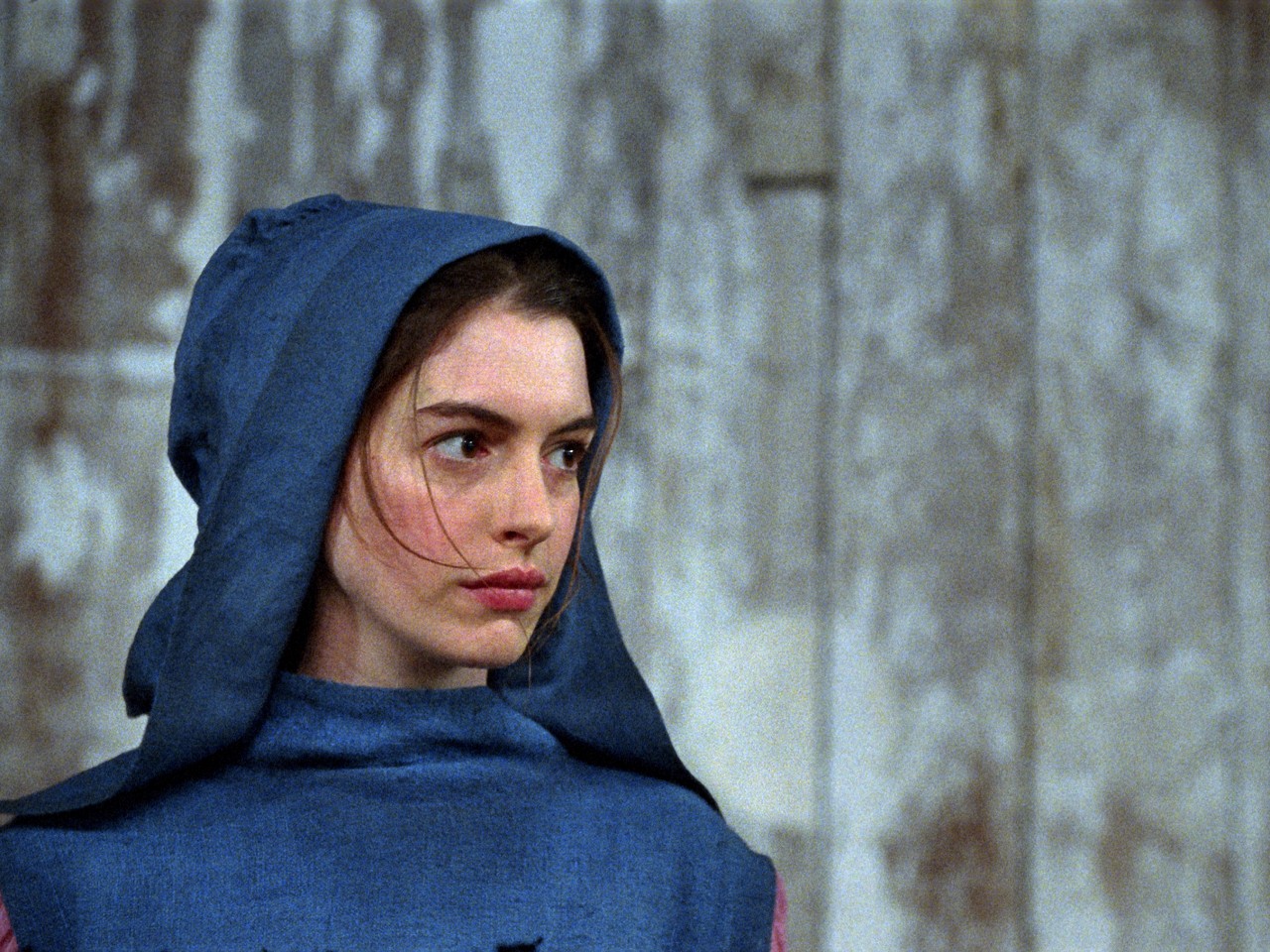
Anne Hathaway as Fantine

Tom Hooper (just 40 years old) is the British director who brought us these compelling/gorgeous miniseries: John Adams (2008), Elizabeth I (2005), and Daniel Deronda (2002).  Though I haven’t seen it yet, he made a big mark with The King’s Speech (2010), which won 4 Oscars.  He brings a very well-known, large-scale tale down to a (small) human level.  No doubt, the star of Les Mis is American Anne Hathaway, who shed not only 15 lbs., but almost all of her long hair, for the role of Fantine.  Oh, and Hathaway can sing, too!  Wow…  Viewers will want to see more, but she appears in the first third of the film only.

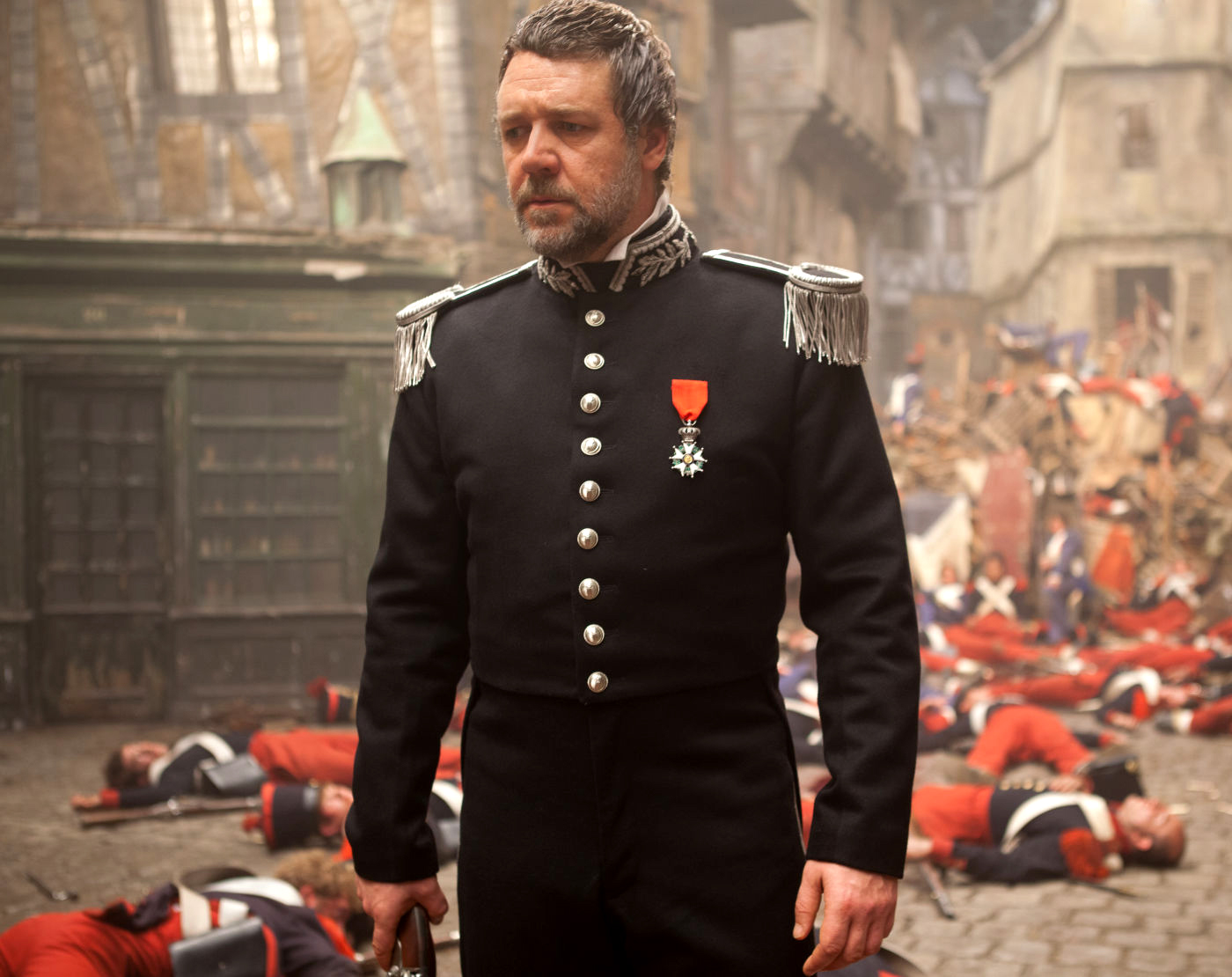
Russell Crowe as Javert

One person who defininitly should not sing is Australian Russell Crowe, I’m sorry to say.  His songs are tolerable (unlike that of Gerard Butler in The Phantom of the Opera), but he doesn’t have a strong voice, and is clearly not very comfortable with this element of the film.  (I love Crowe-a fabulous actor-but the producers/studio should’ve looked for a more suitable voice.  Everyone can’t do any job.)  The film seemed to slow down when Javert came onscreen, aside from the swordfighting scene.

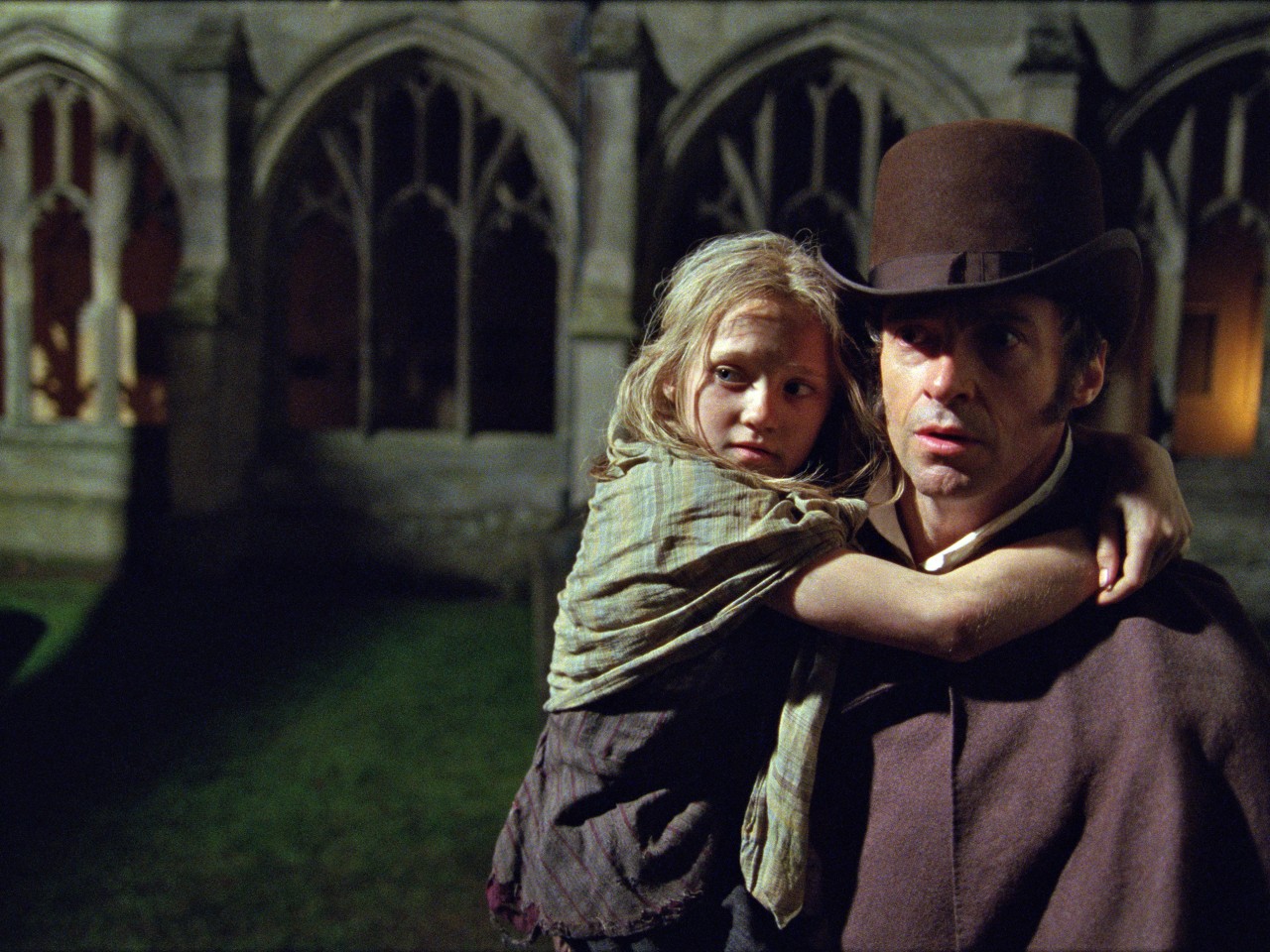
Hugh Jackman as Jean Valjean carrying young Cosette

Hugh Jackman (another Australian; got his start in theater) stars as Jean Valjean, a man who transforms his life by taking Fantine’s young daughter, Cosette, into his care.  Jackman can sing (but you probably knew that already).  In the many close-ups, you can see his emotional range.  I was pleasantly surprised, and feel that he needs to challenge himself even more with his next film roles (no offence to X-Men fans).

The Thenadiers with young Cosette

Students protesting on the streets

The film gets a jolt of energy when we meet the money-grubbing Thenardiers (played by Brits Sascha Baron-Cohen and Helena Bonham-Carter) and young, idealistic men who call for revolution (led by Enjolras, American Aaron Tveit).

Amanda Seyfried as Cosette and Eddie Redmayne as Marius

Then the love-at-first-sight thing happens between the teenage Cosette (American Amanda Seyfried) and idealistic Marius (Brit Eddie Redmayne).  A few in the audience wanted to see more of Eponine (British newcomer Samantha Barks).  Her voice was lovely!  (She also worked in theater.)

Samantha Barks as Eponine

I felt that Cosette and Marius had good chemistry together; their singing was pretty good, too.  However, the film is too long; editing a bit wouldn’t have hurt.  Why draw things out that most of the audience already knows about?

Colm Wilkinson as The Bishop

Long-time fans of Les Mis are in for a treat- Colm Wilkinson plays The Bishop, the man who gives Valjean the “gift of silver” to “become an honest man.”  Wilkinson, an Irishman, played Valjean onstage for many years; his voice is amazing!

Richard Armitage & Ori’s Slingshot: Celebrating Creative Exchange

fedoralady's avatarthe armitage effect

This came up on Twitter yesterday, an excerpt from the Chronicles book that someone had posted on Tumblr. In the snippet,  Adam Brown (Ori) is describing how his signature weapon for The Hobbit came about:

“. . . . I recall being in a weapons meeting and the others were all going crazy over their weapons. It was Richard [Armitage] who said to me ‘You should have a slingshot’ and it just kind of stuck . . .”

Adam Brown fromThe Hobbit: An Unexpected Journey Chronicles: Art and Design by Daniel Falconer and Weta Workshop

hobbit-ori-adam-brown-600x450

He’s so adorable.  You just want to give Ori a big hug. 😉

I added “Armitage” to the above as there was some confusion over whether it was Weta Design and Special Effects Supervisor Richard Taylor or actor Richard Armitage who made the comment, but Adam Brown himself confirmed in a tweet that it was indeed RA who…

View original post 371 more words