




Hey all!
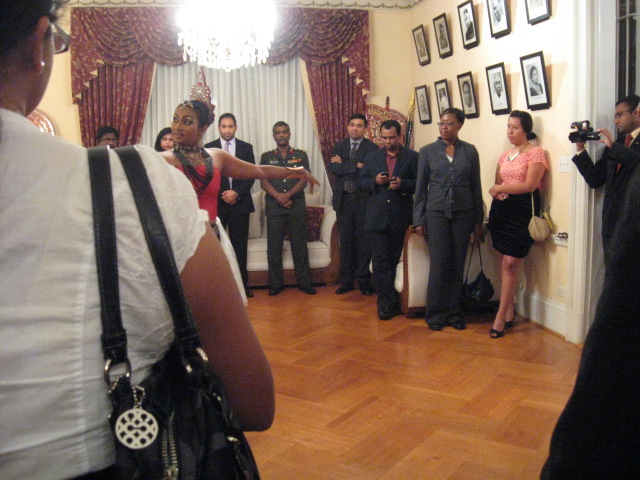
Every once in a while, you have a “fish out of water” moment. One such moment happened to me last SAT when I attended the ISNA Matrimonial Banquet (basically speeddating on steroids w/ chaperones) here in DC. I didn’t take my camera along, so I don’t have pics to share. My dad wanted to see some pics! I wore a dressy beige pleated blouse with small white dots (H&M), white capri pants (The Loft), dressy metallic silver-colored flats w/ silver decorations (Anne Klein), and some coordinating jewelry (small pearl earrings, beaded necklace, and rings). It was a very hot/humid day, but I was very comfortable in this outfit. I wore make-up (which I usually don’t do), but it was very natural.
Though most of the talks/seminars/etc. were held in the Walter Washington Convention Center, the banquet was held in a large ballroom a block away at the Renaissance Hotel. I didn’t know what to expect! Before the event, I noticed a petite young lady (also w/ glasses) on the metro; she was wearing a dressy salwar suit. I guessed (correctly) that we were headed to the same place. Also on the same train were 2 college gal pals who chatted happily in both English and Arabic; they wore badges around denoting that the were volunteers at ISNA.
When I got inside the convention center, it was about 3:45PM. I’m running late, I thought! I walked for a while, then finally got to the registration booth. I had to wait in line to find out where exactly the event was being held; I wasn’t alone, there were several others w/ slightly confused expressions. The gal from the metro walked over to the hotel w/ me and we chatted. She was in her late 20s, very sweet, and Pakistani-American. She decided to come upon the recommendation of a close gal pal (who attended ISNA in Chicago last year). “How else are you going to meet people?” she commented. We got our badges from the college-age volunteers, then talked/joked for a while. She commented that there were so many beautiful outfits. I realized that I wasn’t that nervous after all.
The environment seemed a bit tense (and disorganized) to me, at first, since so many people were gathered around in the hallways and corridors. A few people were in groups, either w/ their family members or friends who were at the event. It seemed like almost every woman had some sort of designer purse! Hardly anyone was wearing jeans; it was all dresses, salwar kameezes, suits, and glamorous make-up. There was some wait time (15 mins.) before we could go into the room, so I went off to wash my hands and brush my hair. Several young gals were getting ready, all dressed to the nines (according to their tastes). There were 2 sisters (one wearing a headscarf, the other not) fixing their makeup while their mom and grandma waited to another side.
When it was time to go into the event, there was some confusion. Should we line up or just file in? The volunteers ushered us in; I noticed that some of these folks were older women. There were many long tables; the few round small tables were for the parents/relatives. There was just water to drink at this time. As with speeddating events I’d attended in the past, the women were on one side and the men were on the other side of the table. The men rotated; the women stayed seated. We were seated according to our age group, I learned from one of the guys. (The gals in my group were aged 30-35; the guys were 32-37.) I think the largest group consisted of the 25-30 age group; they had more rows of tables, we had 2 rows.
The lady sitting on my right was Pakistani-American (raised overseas), very petite, quiet (at first), serious, and wore a cotton salwar suit of black and white. The white embroidery was really intricate/pretty; she got it from the old country. She didn’t wear a headscarf, but covered her hair with her dupatta (the long cloth that coordinates with salwar suits). Unlike most of the other gals, she wore no makeup, but I though she had a nice face w/ very small features. She looked a bit worried, so I decided to chat w/ her. She was studying for her Masters (CRN) and lived in a small Michigan town. She had never been to this type of event either, so she asked me more about it. I didn’t know many details, but we soon learned (from one of the guys sitting nearby) that the event was 4 hours long! He showed us a folder with a schedule inside; some people had them, but most of us didn’t.
The guys sitting across from us were very nice and easy to talk to. Since it took quite a long time for everyone to take their seats, and for the moderators/volunteers to get started, we had time to get to know each other. The lady on my left was petite and very pretty; she wore a beautiful teal-colored blazer, jeans, and very high-heeled shoes. She was wearing a lot of makeup, even though she didn’t need it. She was from Memphis, TN, and had attended this event twice before. She talked mostly with the gal on her left.
Once we got started, we talked with each guy for 3 minutes. Few people commented that 4 or 5 mins would’ve been better. I was pleasantly surprised to see that most of the men were born/raised in the West (US, UK, and Canada). A good segment of the guys (perhaps 50%) were Pakistani-American. I was disappointed that hardly anyone brought their business cards! (ISNA should’ve been more clear about that.) I had my networking cards; I gave them out to the (few) guys who were living in the DC area. (FYI: ISNA doesn’t store any info on anyone in any database, so you have to be proactive.)
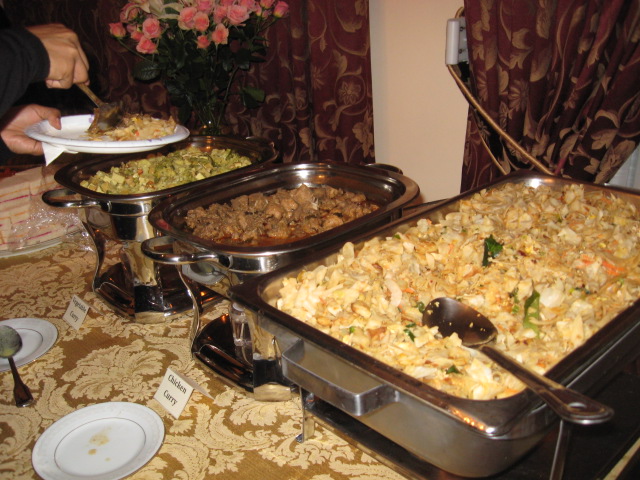
A little after 6PM, we got a short break. This was the time to get some fresh air, food, etc. I called my dad and mom to give them my impression. The food was not what I expected! (Hey, we paid $79 for a “banquet,” didn’t we?) There were a few tables outside the ballroom with bread, cheeses, crackers, 2 types of pasta, 2 types of sauce, cookies, brownies, tea, and coffee. I grabbed a bit of food before it was time to go back in around 6:30PM.
A couple who met at ISNA back in 2010 said a few words. Well, the wife (American desi) spoke a bit, the hubby (immigrant) not so much. (He looked nervous.) An imam from the ADAMS Center (from Sterling, VA) did his speech and recited a brief prayer. I didn’t understand all of what he was saying b/c of his thick accent; he was an African immigrant with a fluffy salt and pepper beard. I had heard of his center from some Bangladeshi American acqaintances of mine. One guy rudely mumbled: “I didn’t sign-up for this!” That was unnecessary, if you ask me. Then we had the 2nd round of mini-dates, followed by the social hour (started at 8PM). This was the time to get some more food and talk to anyone you chose. By 8:30PM, I was pretty tired, as were many others. Some were waiting around for their friends or family to call or pick them up. Overall, it was a good experience! (Some of the men thought so, too.)
Below are my notes on the single guys I met, starting w/ where they were from, profession, etc.
1) Chicago, business analyst, very handsome, great hair & personality, friends volunteered at ISNA & encouraged him to attend, dad is a food scientist who verfies halal food products/businesses, got to know a lot about him (b/c it took long time for event to start)
2) MD, airport shuttle bus driver, fluffy beard, socially awkward (didn’t say much & complained about the ISNA set-up), was the only African guy I noticed at the event (surprisingly)
3) Not sure where he was from, balding, glasses, lawyer (went to Cooley, like I did for 2 terms); I had a “foot in mouth” moment when I said “I didn’t go to a good law school” (but he didn’t mind).
4) Small town MN, finishing training to be cardiologist, raised outside Liverpool, England, great smile/personality, came w/ mom & younger sister, really enjoyed talking w/ him
5) Philly, orthopedic surgeon at St. Luke’s
6) Philly, bald, light-colored eyes (bluish), software engineer & owns a car dealership, very confidant
7) Chicago, MSU, dr.
8) Charlotte, same name as famous Bollywood actor, business analyst & web designer, very handsome, very confidant, really liked talking w/ him
9) Philly, pharmacist (like my little sister), his sister lives in Indiana (like my mom)
10) Philly, healthcare IT PM
11) Toronto, accountant, short hair, nice looks, dressed very well in tweed jacket (his dad’s), confidant, very easy to talk to, told me about R.I.S. conference (held each year around X-mas in his town)
12) NJ, family dr.
13) MD, raised in Kuwait until college, family originally from India, works as a web developer for small Arlington-based company (will look up, since I need a job), nice hair, glasses, pleasant (but a bit shy), was a little overwhelmed my the number of people & noise, talked w/ him later during social hour, asked him to keep in touch (since we’re both local)
14) VA, dentist, balding, serious demeanor, grew up in Pakistan (I assumed), at social hour he talked w/ the woman who had been sitting on my right (they exchanged cell #s and spoke a bit in Urdu)
15) DC, grew up in Washington state, neatly trimmed little beard, diplomatic job w/ State Dept (gave out his business card), while talking he was sending text messages (not cool)
16) Fresno, CA, engineer, easygoing, chatty (we mainly talked re: movies)
17) Small town AK, Comp Sci PhD student planning to stay in US & teach, from Turkey, pleasant but reserved (didn’t reveal much)
18) TX, works for internet start-up
19) VA, works at IBM (contractor to DOD), we talked re: jobs
20) NYC, internet communications (own business)
21) VA, lived all over the world, pleasant, has his own consulting business, wrote down his email for me (when I mentioned looking for a job)
22) MD, bald, works in construction management, family all in MD also, easy to talk to, gave me his business card
23) Calgary (Ontario), Pakistani immigrant, shy, barely said anything (was shuffling some papers)
24) St. Louis (but moving to San Fran), dentist, loves traveling, originally from Egypt, too excited (IMO)
25) Chicago, really into sports, sys mgr in transportation industry
26) NYC (Brooklyn), was sitting at the end of my table at start of event, dressed more casually than others (black T & dark-colored jeans), very confidant, great smile, talked w/ him after break and at social hour.
27) TX, dressed up (dark suit w/ charcoal shirt), financial analyst, nice eyes, cofidant (but in easygoing way), very easy to talk w/ him
28) Ontario, had a good convo w/ him (but can’t recall it- LOL)
29) TX, expressive, anesthesiologist
30) Chandler (AZ), small beard, works for Amazon, got his BS, MS, & PhD from UA (Tucson), has been in US since 1993, knows many of the same Bangladeshi Americans that my family & I knew back in our Tucson days (prior to 2002), also knows acqaintance of mine from NYC (who recently married a woman from Tucson), very reserved/conservative (didn’t shake hands)
31) Chicago suburb, Chase project manager, didn’t say much
Wow, that was a long post! (FYI: About 400 singles came to this event.)
Thanks for reading,
Emma
P.S. For a single guy’s take, read Looking for Love and Finding Awkwardness at ISNA.
Here is a Washington Post article re: the event.
P.P.S. Since I NEVER learn the first time, here’s my account of the second convention!
NOTE: The following information comes from a February 2012 report (A Demographic Snaphot of South Asians in the United States) by the Asian American Federation
Between 2000 and 2010, the South Asian American population became the fastest growing major ethnic group in the United States and has emerged in new areas of the country.
Over 3.4 million South Asians live in the United States.
Comparing only the four South Asian groups for which there is Census data from both 2000 and 2010 (Bangladeshi, Indian, Pakistani, and Sri Lankan), the South Asian community as a whole grew 78% over the past decade. The Bangladeshi community experienced the most significant growth, jumping 212%. [On the 2010 census, 41,280 individuals reported that they were Bangladeshi. In 2010, the number jumped to 128,792.]
Bangladeshis, Nepalis, Sri Lankans, and Bhutanese each rank among the top twenty Asian American ethnic groups.
Over the past ten years, the Washington, DC metropolitan area overtook the Los Angeles metropolitan area as the area with the third largest South Asian population.
The Detroit and Philadelphia metropolitan areas appear in the top five locations for the Bangladeshi community.
The South Asian population grew the most in Charlotte, NC, increasing 187% over the past ten years. This was followed by Richmond, VA; Raleigh, NC; San Antonio, Seattle, and Stockton CA; Jacksonville, FL; Harrisburg, PA; and Las Vegas.
http://dcentric.wamu.org/2011/05/osama-bin-laden-is-dead-d-cs-south-asian-muslims-react
By Anna John
May 4, 2011
Afshan Khoja, a Muslim of Pakistani descent who lives in the DC area, was in tears after President Obama announced the death of Osama bin Laden.
“It wasn’t because I was happy about bin Laden’s death, it was because suddenly all the things that September 11th have done to me, my religion and my country, came back to me: The fear of being asked questions while traveling; the immediate requirement to defend my religion not only when people asked why Muslims hate America, but also when terrorists did anything that could remotely be associated with Muslims; the feeling that somehow, I’ll always be ‘the other’ in America.”
Mou Khan, a Bangladeshi-American, also found herself reflecting on September 11th, after learning of bin Laden’s death.
“I remember exactly where I was when I first heard that a plane had struck one of the towers of the World Trade Center. My memories are deeply personal, like when a schoolmate I didn’t know called me a terrorist…now, confronted with the news that Osama bin Laden, the man behind the tragedy, has been killed, I find myself conflicted.
“I cannot find it within myself to celebrate violence and extrajudicial killing, no matter how strong an urge for vengeance the trauma of September 11th left me,” said Khan, in reference to the celebration that took place in front of the White House as news broke of bin Laden’s death.
“I find myself deeply uncomfortable with the unbridled nationalistic celebrations that broke out across the country. Was it all worth it now that we know bin Laden’s blood has been shed? Is speaking up and asking questions during this fervor unpatriotic?”
Khan was not the only one with questions. News outlets like NPR asked, “Is It Wrong To Celebrate Bin Laden’s Death?”
Khoja wondered about the aftermath of such public displays of patriotism.
“When I heard the chants of “U-S-A, U-S-A” I felt fear. I don’t understand why, but I wanted to lock my doors. This morning I heard about vandalism and graffiti at a mosque. Between yesterday and today, three people have already asked me why the Pakistani government didn’t know that Osama was in Pakistan for years – I don’t know!
“The fact is, regardless of this news, none of that has stopped. This may be a significant blow to a terrorist network, but for a Pakistani Muslim living in the US, I’m not sure if it changes anything.”
Emma Khan (no relation to Mou Khan) whose family is originally from Bangladesh, said she thought all the singing and shouting was understandable. “Sometimes, people want to get together for huge events like this; it’s a victory for the US.”
Ibrahim Hooper, the National Communications Director for the Council on American-Islamic Relations (CAIR) wasn’t surprised at the public celebrations.
“That is almost inevitable in situations like this. I think it’s a temporary phenomenon based on the ten years it took to track down Osama bin Laden. I hope it doesn’t spill over in to hyper-patriotism.”
Shahid Buttar, a local performance artist and civil rights lawyer worried that other issues were being obscured by the focus on bin-Laden’s death.
“While it’s an exciting national security development, it does very little to address the ongoing constitutional crisis that emerged after the 2001 attack. I hope it allows the restoration of sanity here in the U.S. I’m glad (President) Obama is achieving gains in the war on terror, but the idea that we’d meet the death of any individual with chants of ‘USA, USA!’ reflects a shallowness in our understanding of these events and their implications.”
When the President addressed the nation, he emphasized that the war on terror was not a war on Islam:
As we do, we must also reaffirm that the United States is not –- and never will be -– at war with Islam. I’ve made clear, just as President Bush did shortly after 9/11, that our war is not against Islam. Bin Laden was not a Muslim leader; he was a mass murderer of Muslims. Indeed, al-Qaeda has slaughtered scores of Muslims in many countries, including our own. So his demise should be welcomed by all who believe in peace and human dignity.
Ibrahim Hooper said, “I think he struck the appropriate tone and clearly said we’re not at war with Muslims. I think he hit it just right.”
But Khoja said it will take more than Presidential words to address how Muslims are treated in post 9/11-America.
“While the administration did make specific statements supporting Islam, I feel like there’s a lot more work to be done. Ten years of dealing with hate crimes, backlash, alienation and “otherization” will not just go away. But I do think that this is an opportunity for us to take a step back, learn from our mistakes, and perhaps revisit some our values – of tolerance, diversity, acceptance, justice and peace. I hope that we’ll find a space and forum to do that.”
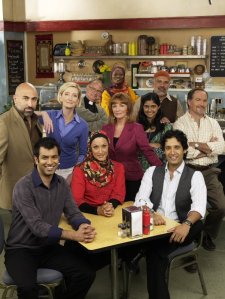
The Canadian TV series Little Mosque on the Prairie (its 3rd season recently wrapped up) caused a bit of controversy BEFORE it aired; CNN even ran a segment on it! But when you watch it, you realize that it’s simply a family comedy (almost a throwback to the ’50s) w/ little bits of Muslim culture tossed in. You can watch this show w/ your entire family… and even learn something new! LMOTP is a little show (small budget, simple sets, no big name actors) that became a SURPRISE hit all over the world; it’s seen in over 60 countries. The comedy focuses on a small, yet VERY diverse, group of Muslims and their white neighbors living in the fictional town of Mercy in Saskatchewan. (In case you wondered- the show is filmed in Regina, the capital of the province, and in the little town of Indian Head.)
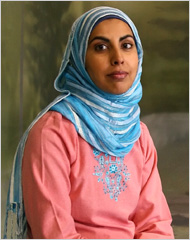
My mother didn’t wear it. I’ve always felt empowered by the veil. -Zarqa Nawaz
The show’s creator, Zarqa Nawaz, was born and raised in Toronto; she later moved to Regina in Saskatchewan. She is a wife, mother, former journalist, AND practicing Muslim. Zarqa (age 40) writes some of the shows and advises the producers on Islamic issues. But her main goal is to make people laugh. Currently, one of her duties is advising the producers of a (future) US version of LMOTP!
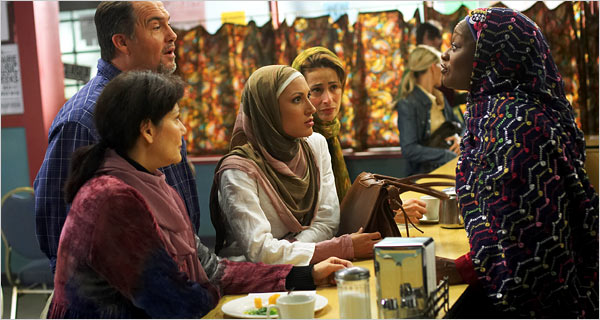
The show came about when Nawaz wondered what would happen to a Muslim community if it had an imam (the prayer leader of a mosque) who was born and raised in Canada. He would know the Koran AND be able to relate to the younger, more forward-thinking, Canadian-born congregants. There aren’t many mosques in North America with imams like this, Nawaz noted in one interview.
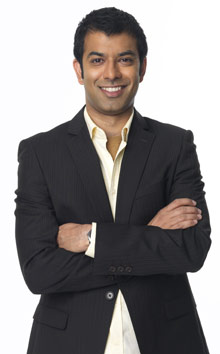
The imam in LMOTP is Amaar Rashid (Zaib Shaikh: a Pakistani-Canadian)- a young/handsome/upper-class/ex-lawyer from Toronto. Amaar gave up practicing law (at his dad’s big firm) b/c he felt like “there had to be something more out there.” What he lacks in experience, he makes up for with enthusiasm (and a willing ear). When he first comes to Mercy, the former imam exclaims: “He’s the new imam!? He doesn’t even have a beard!” (Shaikh was raised Muslim and can recite in Arabic; Nawaz commented that this was “luck” b/c “not many Muslims go into the entertainment business.”)
The comedy arises from misunderstandings between the town’s white residents and the Muslims. But there are also misunderstandings BETWEEN Muslims of different ages, races, and experiences. Amaar often serves as the go-between.
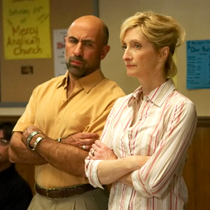
One of the first to welcome Amaar is fast-talking Lebanese contractor Yasir Hamoudi (Carlo Rota: a Brit of Italian descent). Yasir advertised for a new imam b/c the former one wasn’t addressing the needs of the community. Yasir was also instrumental in getting space for Mercy Mosque (which occupies a section of the Anglican church building). Though he cares deeply about his family and the Muslims in town, business usually comes first w/ Yasir.
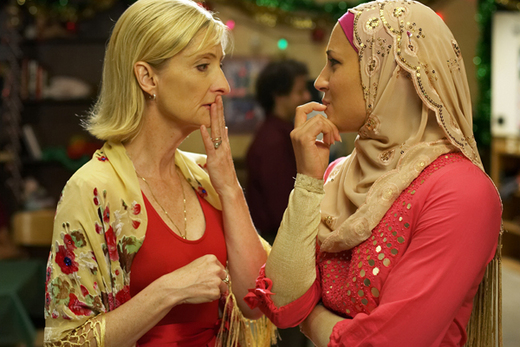
Sarah (Shelia McCarthy), Yasir’s bubbly blonde wife, is a Muslim convert who does PR work for the mayor. Sarah and Yasir are a very affectionate married pair. They have a beautiful daughter who runs a small clinic, Dr. Rayyan Hamoudi (Sitara Hewitt: a Canadian of Welsh/Pakistani background). Rayyan is a devout Muslim (unlike her parents); she wears the hijab and is a feminist. In Season 1, Rayyan is furious when some men suggest putting up a barrier between the genders in the prayer area of the mosque. She exclaims: “The women already pray behind the men!”
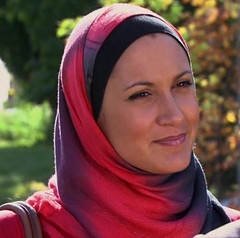
I’m not a Muslim in real life, but for 22 minutes each week, I guess I am. I’d be honored if people looked up to me as a role model. –Sitara Hewitt
One of the main arcs in the story is the platonic relationship between Amaar and Rayyan, two progressive young individuals who are trying to build a bridge between Islam’s teachings and the everyday world. You wonder if they’ll eventually become MORE than friends. (But unlike other TV pals, you won’t see these two hugging or touching!)
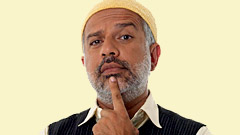
One of the more quirkier characters of LMOTP is Econ prof Baber Siddiqui (Manoj Sood: an Indo-Candian). Baber speaks w/ an accent, wears salwar kameezes (w/ coordinating caps), and considers himself “an expert in Islam.” He’s also a divorced single dad raising a sarcastic teenage daughter, Layla (Aliza Vellani: an Indo-Candian).
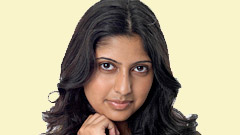
Layla attends high school, doesn’t cover her hair, and is often embarrassed by her dad. (What teenager isn’t?) But she’s also smart, sociable, and respectful of Islam. Baber loves her deeply, though he can be cranky and judgmental w/ the rest of the town. This keeps him from being a stereotype.
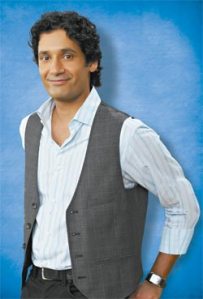
People have come up to every cast member on the show and thanked us, he says. A woman wearing a hijab, for example, went up to [actress] Sitara [Hewitt] and said thank you because she felt she was being treated differently since the show started. –Stephen Lobo
In Season 2, the show added more episodes and new characters. An old family friend of the Hamoudis, JJ (Stephen Lobo: a Canadian of Iranian and Indian parentage) comes to work on a big project alongside Yasir. He’s an engineer who’s handsome, single, and VERY wealthy. When he was a boy, he had a crush on Rayyan. Yasir notices that the she and JJ are drawn to each other and suggests they go on “a series of arranged dates” that could lead to marriage. (It gets MORE interesting from there!)
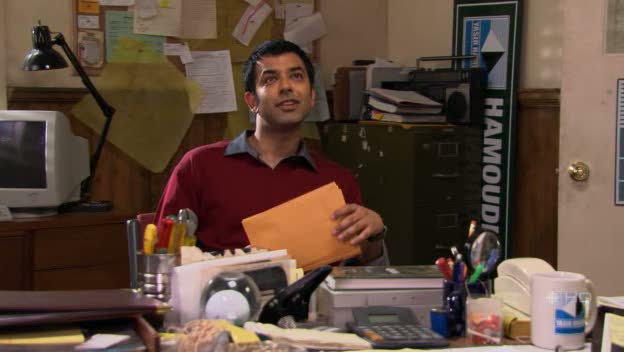
Since Amaar is a newbie in “the imam business,” he gets some friendly advice from the older, experienced Reverend McGee (the head of Mercy Anglican). In one enlightening ep, Rev McGee outshines Baber in the Islam IQ contest held by the mosque. “Islam and Christiantiy have a lot in common,” Amaar points out to a frustrated Baber.
There are other characters and issues than the ones I’ve pointed out, so check it out (search on You Tube under MydienMusic or LMOTP ). If you liked shows like Ballykissangel or Monarch of the Glen, you might especially enjoy Little Mosque on the Prairie. Islam is presented as a good, simple, inclusive religion on the show; it’s part of MANY people’s everyday life. It’s exciting to see a show like this succeed!
 Knightleyemma