Holiday Affair (1949) starring Robert Mitchum & Janet Leigh

HolidayAffair_poster

[1] The story as well is told with such maturity and wit for those days… Here we see REAL people as it were. Real people with real problems. Especially in Leigh’s character…

[2] The dialogue is among the best and the long string of coincidences make this film charming, not clichéd. 

[3] Surprisingly quirky film isn’t the least bit obvious or clichéd, and Janet’s sceen-relationship with Gordon Gebert, the likable youngster playing her son, is very well handled. 

[4] Wendell Corey is excellent as the fiancé; he turns this very practical character into a sympathetic one and there are times you’re not sure who you want to win — or lose — Leigh’s hand.

HolidayAffair_gifts.jpg

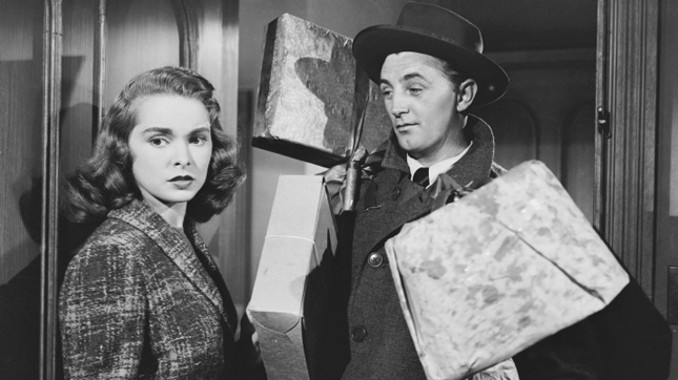
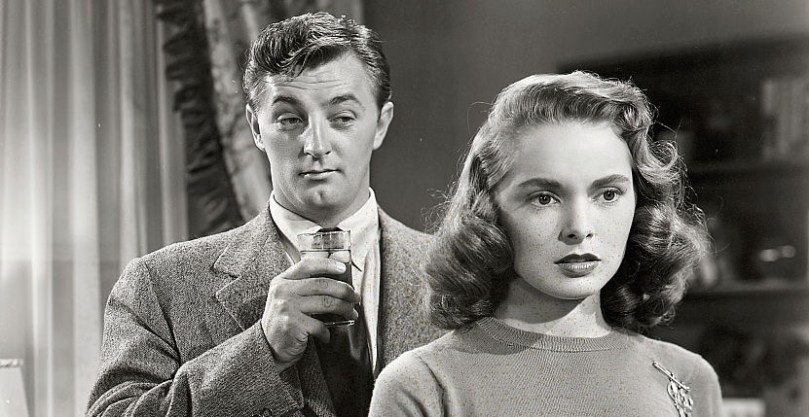
This is one of my (new) holiday faves; I discovered it (thanks to TCM) about 5 yrs ago. A few days before Christmas, comparison shopper Connie Ennis (Janet Leigh) buys a train for work, BUT her 7 y.o. son Timmy (Gordon Gebert) finds it and assumes that it’s for him. When Connie goes back to the department store to return the train the next day, clerk Steve Mason (Robert Mitchum) quickly figures out her real purpose. He doesn’t turn her in to management, which gets him fired. They end up spending most of the day together, which Connie doesn’t reveal to her suitor of 2 yrs, Carl (Wendell Corey), a divorce lawyer.  Romantic complications follow. Also, look out for Harry Morgan (best known for M.A.S.H.) who plays a bemused police lieutenant.

HolidayAffair_drink

In the kitchen scene, Mitchum gives Leigh a sudden, passionate kiss. Leigh said: “The expression that is on my face of being overwhelmed was for real.” Mitchum explained: “I wanted to make the kiss memorable, as though the characters were never going to see each other again. The perks of being an actor are, at times, not bad.” Leigh enjoyed working with both Mitchum and Corey; the set was a relaxed and happy one (where BOTH men were full of practical jokes).

White Christmas (1954) starring Bing Crosby & Danny Kaye

My dear partner, when what’s left of you gets around to what’s left to be gotten, what’s left to be gotten won’t be worth getting, whatever it is you’ve got left. -Phil comments (re: Bob’s bachelorhood).

When I figure out what that means I’ll come up with a crushing reply. -Bob says, confused.

Having left the Army following WWII, Bob Wallace (Bing Crosby) and Phil Davis (Danny Kaye) team up to become a successful song-and-dance act. Phil (playing matchmaker) introduces Bob to the talented/beautiful sisters of an Army buddy, Betty (Rosemary Clooney- aunt of George) and Judy (Vera Ellen) Haynes, who are an up-and-comers in show business. When Betty and Judy travel to a Vermont to perform during the holidays, the men follow (Phil convinces Bob- he saved his life during a bombing raid). The men find their former commander, General Waverly, is the owner of Pine Tree Inn; w/ the lack of snow and guests, he’s losing hope. A series of romantic mix-ups ensue as these performers try to help him out.

It’s cozier, isn’t it? Boy, girl, boy, girl? -Phil asks the Haynes sisters re: his seating plan.

This is a holiday classic (now streaming on Netflix) that my family and I watched almost every year growing up. There is singing (Crosby and Clooney focus on this aspect more), dancing (Kaye and Ellen are more involved in this), fabulous clothes (esp. the gowns chosen for Clooney- IMO), comedy (wordplay, physical humor, Mary Wickes’ as the inn’s housekeeper, etc.) and romance. Irving Berlin composed the music, which is quite memorable. Things get complicated b/c Phil (and later- also Judy) plot to throw Bob and Betty (who are BOTH concerned re: their careers and “slow movers” in romance) together.

Imagine a girl in show business today wanting to settle down and raising a family. It’s so refreshing, isn’t it? -Phil asks Bob, while Betty and Judy look on.

Pushing, pushing. -Bob mumbles into his glass of water.

There is some cool trivia behind this film. According to Clooney, the “midnight snack” scene in which Bob Wallace expounds on his theory of what foods cause what dreams was almost entirely improvised. She said that the men’s “Sisters” performance was not originally in the script. Crosby and Kaye were clowning around on the set, and director (Michael Curtiz) thought it was so funny that he decided to film it. In the scene, Crosby’s laughs are genuine and unscripted, as he was unable to hold a straight face due to Kaye’s comedic dancing. The filmmakers had a better take (where Crosby didn’t laugh), BUT test audiences liked the laughing version better. I noticed this a FEW years ago- one of the background dancers is George Chakiris, who later won the Best Actor in a Supporting Role Oscar for his role as Bernardo in West Side Story (1961). Bob Fosse was one of the choreographers (though he is uncredited).

Below is a video of one of the BEST dance numbers from the film.

State of the Union (1948) starring Spencer Tracy, Katharine Hepburn, & Angela Lansbury

Introduction

This classic film’s screenplay was adapted from a Broadway play which opened in NOV  1945 and ran for almost 2 yrs. The play won the Pulitzer Prize in 1946. The themes present w/in this tale are a perfect fit for optimistic, first gen Italian-American director, Frank Capra, though I consider it more sophisticated than some of his (more famous) films. The first choices for the leads were Gary Cooper and Claudette Colbert, BUT those actors didn’t work out, so Capra brought in Spencer Tracy. Once Colbert was fired (for refusing to work nights), Tracy suggested Hepburn (who has some of the best lines). For ALL of who realize that politics is personal, this is the movie for you

Synopsis

The only heir to a publishing house, Kay Thorndyke (Angela Lansbury- then ONLY 24 y.o.), desperately wants to fulfill her dying father’s ambition of putting a man in the White House. So what if the one who may fit the bill, successful airplane manufacturer Grant Matthews (Spencer Tracy), is VERY reluctant? Kay convinces political strategist Jim Conover (Adolphe Menjou) to groom Matthews for their (Republican) party’s bid. A wise-cracking writer, Spike McManus (Van Johnson), comes along on the trail. It turns out that Grant and his wife, Mary (Katharine Hepburn), have been separated for some time; this is something that the public must NOT know. Mary is more than willing to play the supportive wife, IF this is truly what will help Grant. Does Mary still love Grant? Does Grant  love Kay (their behavior is far from platonic) or Mary? Will Grant accept the party’s nomination? 

Review of the Film

He’s beginning to wonder if there is any difference between the Democratic Party and the Republican Party. -Kay reveals to Jim (seriously) / Now that’s a fine question for a presidential candidate to ask. There’s all the difference in the world. They’re in and we’re out! -Jim replies (w/ exasperation)

This is the type of film you need to see twice to get all the jokes, looks, and little moments (which make it a fine piece of cinema). The straight-shooting Grant is “a man of the people” who is hesitant to water-down his message to fit into the mold of a typical politician. Jim comes to realize that some of Grant’s ideas are too liberal for the party. Mary is NOT only hoping to reconnect w/ her husband, she is disappointed when he gives in to pressure from Jim. 

Kay probably has respect and affection for Grant, BUT what she truly loves is the power that she can yield on a national stage. Lansbury admitted that no special aging makeup was placed on her; she “simple had an air of sophistication” which makes her believable as a confident, strong, middle-aged woman. (She also has the best outfits in the film.) Notice the way Kay orders around her (all-male) editors? Of course, she has to be tough in typically male worlds- publishing and politics. Mary comments that men first admire Kay, then start following her around, and eventually fall in love w/ her. 

You politicians have stayed professionals only because the voters have remained amateurs. -Mary comments to a group of political strategists (during the radio broadcast at the Matthews’ home)

Grant and Mary share a special spark, though disappointed w/ how their relationship turned out. (They have two cute school-aged kids, BUT we don’t hear/see much of them until the big climax scene.) The way that Mary talks about Grant, you realize that she is still crazy about him! She admits to Jim (a cynical old bachelor) that she set up fake dates to make Grant jealous. Jim reminded me a BIT of Tobey from The West Wing. Mary finds a sympathetic ear in Spike, who gains a lot of respect for her, and ends up rooting for the couple to end up together. Spike is an youthful man who likes to act nonchalant, flirting and cracking jokes, BUT also has a good heart (something you see in Capra films). 

Real-Life Politics Behind the Film

At the time the film was released, President Truman had NOT made his political comeback and was considered a sure loser in the 1948 election by many, which is why both the Republican presidential nomination is considered so valuable in the movie. It’s also why Spike McManus is amused when a young secretary tells him (at the start of the film) that she thinks Truman will be elected President in his own right in November.

Menjou was an ultra-right-wing political conservative who had co-operated with the House Un-American Activities Committee (HUAC), named names of persons he considered to be Communists and was a strong proponent of “blacklisting.” Hepburn was decidedly more liberal and had been an outspoken critic of the blacklist. Menjou had made several comments accusing Hepburn of being a Communist sympathizer, and possibly a Communist herself, which angered Hepburn and her co-star/romantic partner Tracy. Capra was so concerned about the tension that he closed the set to the press.

Vertigo (1958) starring James Stewart & Kim Novak

Hitch was quite upset at he failure of the film when it was first released; he blamed this on James Stewart for “looking too old” (nearly 50 y.o.) to attract large audiences. Bernard Herrmann’s musical score was inspired by Wagner’s Tristan & Isolde which is also about doomed love. This film was the first to use computer graphics. The second-unit cameraman (most likely) invented the famous zoom/out and track/in shot to convey the sense of vertigo to the audience. 

Let’s not probe too deeply into these matters, Kim. It’s only a movie. -Director Alfred Hitchcock explained to actress Kim Novak (when she asked for more info on her character’s motivation during a scene)

John “Scottie” Ferguson (Stewart) is a middle-aged/retired/detective who suffers from acrophobia. He is a bachelor who is still good friends w/ his former fiance, Midge Wood (Barbara Bel Geddes), who works in fashion merchandising (being an artist). An old friend from college, Gavin Elster (Tom Helmore), calls Scottie to his office (in the San Francisco shipyards) and asks him to follow his wife, Madeleine (Kim Novak). Gavin explains her unusual behaviors and fears she is losing her mind, though he hasn’t discussed the matter w/ any medical professionals. Scottie is skeptical, BUT agrees after seeing the beautiful Madeleine. 

Stewart would NOT be one you would think of portraying a voyeur and a stalker, yet he pulls it off so well. As one viewer commented (see #TCMParty on Twitter): “Vertigo shows how versatile Jimmy Stewart could really be. That’s the sign of a great actor.” Another movie fan tweeted: “This is where Jimmy’s ‘nice guy’ persona becomes so effective. It’s esp. painful to see him reduced to this.” He enables viewers to sympathize w/ him, even as we cringe at his character’s actions and decisions. 

Hitchcock set his film in San Francisco, a city well known for its unique topography and hilly landscape, in order to add a further torment to Scottie’s life and emphasize the debilitating nature of his vertigo. Location shoots were done at the Big Basin Redwoods State Park and the Spanish mission at San Juan Bautista. Hitch spent a week filming a brief scene where Madeleine stares at a portrait just to get the lighting right. After Judy has been made over into Madeleine, she and Scottie kiss; the actors were on a revolving circular platform (a la Gone with the Wind). 

Vertigo is full of scenes where the colors have been saturated or changed to create a special feeling. Hitchcock even went so far as to openly dye some frames is bright unnatural colors. He played around with colors in all his color films, but never as much as in this one. -Excerpt from IMDB review

Much is done with color and light in this film; you will notice it (even upon first viewing). I noticed more tonight- my second time viewing it fully. An astute viewer noted: “Am noticing for the first time that each scene is pretty monotone – yellow, red, redder, green, blue.” The lighting changes when important events occur. Here are some examples: 1) When Scottie first sees Madeleine in the restaurant, the light around her becomes unnaturally bright. 2) While Scottie is listening to the story of Madeleine’s ancestor in the bookstore, it gets very dark; once he exits, it brightens again. 3) When Scottie first sees Judy made over as Madeleine, she is lit by a ghostly green light (the reflected light from the neon sign outside). On this point, a viewer tweeted: “Bathed in the color green… the ghost of Madeleine is wiping out Judy’s identity.”

There’s a dark sexiness to the film that lends the film an air of mature and serious art. Barbara Bel Geddes’ tragic Midge practically throws herself at Stewart’s Scottie Ferguson, while Novak’s “Madeleine Elster” seems rather matter of fact when she realized that Ferguson had completely undressed her after saving her from death. Later, as Judy Barton, her real identity, she shows a frank knowledge of pickups, sizing Ferguson up as a masher. Judy, it seems, has been around the block once or twice. Where earlier Hitchcock movies played coy with sex, here he tackles the subject head on, and it adds to the film’s mature atmosphere. -The Hitchcock Report blog

The words “power” and “freedom” are repeated three times in the movie: 1) In the beginning, Gavin longs for the old San Francisco b/c there was more power and freedom. 2) At the bookstore, the elderly history buff explains that, in Carlotta Valdes’ time, a man could just throw a woman away b/c he had more power and freedom. 3) During the climax, John suggests that after the murder was completed, Gavin left Judy b/c he had more power and freedom (w/ his wife’s fortune). 

[1] Vertigo is Alfred Hitchcock’s most discussed, dissected and critically reappraised film…

[2] This movie is so deep that you could write a thesis on it and keep adding to it from time to time… Hitchcock really gave his all in this picture… it’s about the ultimate love… wanting to achieve the ultimate love, and, as happens in life, never having love turn out to be the way we want it to be…

[3] If a flaw is to be found, I would say that the script developed for the film was probably not the most friendly for the audience. This film is certainly not for everyone, as it’s slow pace and heavy darkness in the subject may turn off people familiar with Hitchcock’s lighter films as his usual dark humor is not present here…

[4] Hitchcock is in his very best form creating hypnotic scenes and a general sense of unease and dread in even the most banal of situations. A particular favourite of mine is the extended (largely silent) segment where Stewart follows Novak for the first time. Nothing much happens, but the atmosphere of these scenes is enough to keep you on the edge of your seat!

-Excerpts from IMDB reviews


Rear Window (1954) starring James Stewart & Grace Kelly

This month (July) TCM has been showing Hitchcock’s films every MON & WED; Rear Window is probably my fave of his films. (Strangers on a Train would come in second, b/c WHO could resist the devilish Robert Walker!?) This is a simple story, BUT there is a LOT going on (once you watch it a few times)! Most of you know the synopsis (below from IMDB): 

Professional photographer L.B. “Jeff” Jeffries breaks his leg while getting an action shot at an auto race. Confined to his New York [Chelsea] apartment, he spends his time looking out of the rear window observing the neighbors. He begins to suspect that a man across the courtyard may have murdered his wife. Jeff enlists the help of his high society fashion-consultant girlfriend Lisa Freemont and his visiting nurse Stella to investigate.

When two people love each other, they come together – WHAM – like two taxis on Broadway. -Stella tells Jeff her view of relationships

The relationship between Jeff (James Stewart) and Lisa (Grace Kelly) is a BIT complicated; they are VERY attracted to each other, BUT have different lifestyles and personalities. Jeff thinks that Lisa is TOO good for him; you can tell by the way he describes her (to others and also during their evening dates at home). Lisa is (obviously) waiting for him to settle down (note the comment about the art gallery) and ask for her hand in marriage (b/c she loves him a LOT, putting up w/ his quirks). Straight-talking Stella (Thelma Ritter- always a delight) bemoans the fact that courtships have become SO complicated (LOL- a LOT of modern/single people would agree).

Stewart gets to flex his acting muscles in this darkly comic role. You can’t help but laugh at a LOT of Jeff’s lines, the way he looks, and generally expresses himself. He doesn’t have the luxury of much movement, being confined to a wheelchair (though is still VERY effective). Lisa is willing to make their lives work together, though he has doubts. And when she faces danger, Jeff realizes just how much he loves her! 

[1] Alfred Hitchcock is considered by most to be the master of suspense. I believe he was also a master of understanding human nature. He intuitively understood that human beings are voyeurs by nature, not in the perverted sense, but in the curious sense. 

[2] The acting is superb in this film. Jimmy Stewart is unabashedly obsessed as the lead character. Photographers have an innate visual perceptiveness and the ability to tell a story with an image and Stewart adopts this mindset perfectly. Grace Kelly has often been accused of being the “Ice Maiden” in her films, yet in this film she is assertive and even reckless. Though cool at times, she is often playful and rambunctious. 

[3] The main characters are wonderfully portrayed and full of life. The apparently simple setting in an apartment complex is developed into a world filled with intriguing and sometimes unsettling possibilities, and this apparently average neighborhood comes to life with a wealth of lavish visual detail and interesting minor characters.

-Excerpts from IMDB reviews