2015 New African Film Festival – Triangle: Coming to America

This film (released in Ethiopia in 2012) was the centerpiece of the festival; the theater was almost full when I went to see it on a Saturday night.  The audience included viewers of Ethiopian and Eritrean heritage, particularly in their 20s and 30s.  My friend had seen it the previously and raved about it.  Writer/director Theodros Teshome (who held an after-show Q&A w/ two of the lead actors) was inspired to write this film after hearing the story of a fellow Ethiopian man’s dangerous/illegal journey to the U.S.  Teshome then performed some research, and discovered hundreds of similar stories of immigration.  He quickly realized that this story had to be told. 

Kaleab (Solomon Bogale, dubbed “the Denzel Washington of Ethiopia”) is part of a small group of Ethiopians being led through the desert by an Arab guide (who is dressed traditionally in a white jilbab and turban).  The Arab carries a rifle for protection, but he also uses it to threaten the group.  We learn that Kaleab’s good friend, Jemal, and his young wife are leaving b/c they eloped against her parents wishes.  Jemal provides some well-needed humor, but he can also fight (though short and wiry). 

Along the way, this group merges with a small band of Eritreans, which includes a young woman named Winta (Mahder Assefa).  Unlike some of the others, Winta doesn’t have a relative or friend traveling w/ her, so Kaleab watches out for her.  Jemal and his wife urge Kaleab to speak to Winta, though he is shy/reluctant.  There’s more than love in the air- they must deal w/ a sand storm, then another storm at sea (on the way to Italy).  One man (who used to be a soldier/lived overseas) is heartbroken when he loses his lovely young wife to pneumonia after landing in Italy. He wails and says he doesn’t have the desire to go on, leaving her body buried in a strange land.  The others, particularly Jemal, convince him to forge ahead.   

On the journey, Kaleab helps Winta, then she returns the favor (in a big way) when they reach Mexico.  Shared hardship, respect, and kindness between them grows into love.  I think this theme of the story helped the viewers deal w/ the hardships- a bit of hope, silver lining, and such.  I was surprised that such a serious tale could be told w/ bits of (real-world) humor.  The audience enjoyed the film a LOT- I could tell from reactions during and comments afterward.  

In the Q&A session, Teshome said that there will be a part two of this story, which will be about these characters’ lives in America. He explained that it’s very difficult to make a film in Ethiopia, though there is a wealth of acting talent and a great interest in movies from the general public.  The special effects had to be created in LA, which took up most of the (VERY modest, even for an indie film) $650,000 budget.  The cast and crew spent four days shooting in the desert.  It takes a good chunk of money to get theaters to screen films, but after two shows at AFI, more were added at the Columbia Heights Educational Center.  One woman said that she came all the way from Ohio to attend this festival-WOW!            

Two Films from The Washington Jewish Film Festival

WJFF_2015

Apples from The Desert

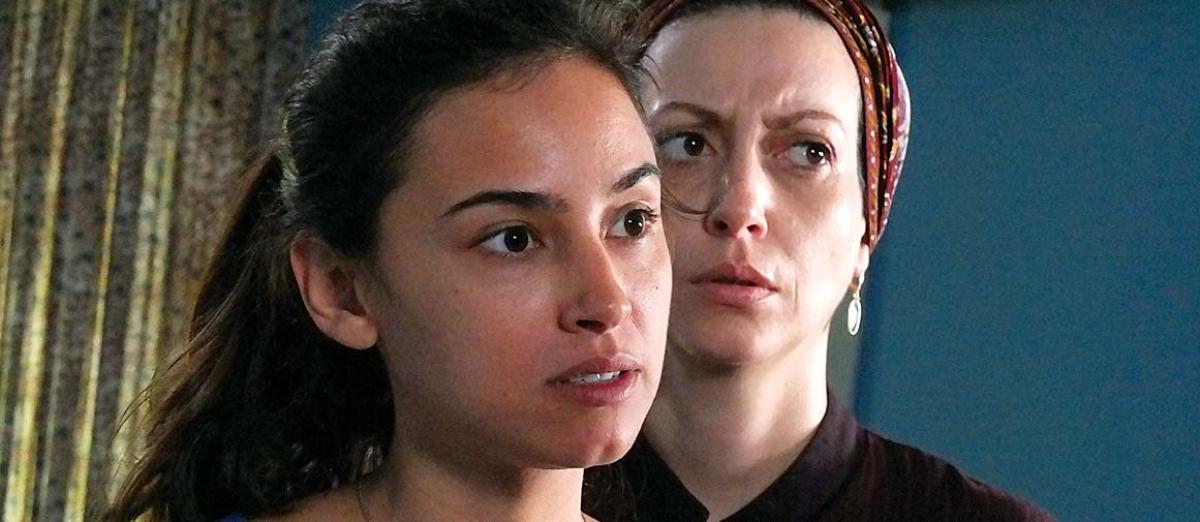
This is a coming-of-age story (one in a shory story collection- Apples from the Desert by Sayvon Leibrecht) about Rachel, a 19 y.o. ultra-Orthodox Jewish girl, who lives in Jerusalem w/ her parents.  Unlike most families in their community, she’s the only child of her parents.  Rachel yearns for a different life than the one of her housewife mother.  Rachel’s unmarried aunt lives down the street, w/ her cat, and seems content to be single/celibate.  We learn from her father that people in the community still whisper about the time Rachel drank bleach (in an attempt to kill herself). 

Still_ApplesDesert_02

At a community center, Rachel watches young secular men and women doing folk dances.  This is forbidden in her sect, of course.  She eventually gets the courage to joins the class, taking some time off from her job.  A red-headed college boy in this class tells her about his life on a kibbutz, and they develop a friendship.  Her father, worried about Rachel’s changing attitude and future, plans a different future.  Her mother sees that she’s unhappy, but fears losing her only child to the world.

The Dove Flyer (AKA Farewell to Baghdad)

The Dove Flyer

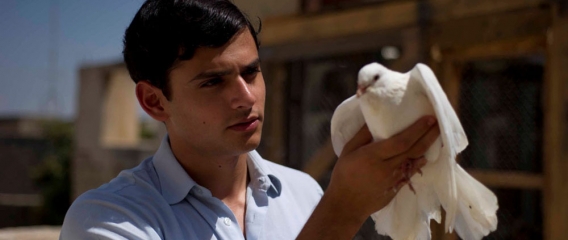
This film (based on the novel by Eli Amir) tells the story of the last years of the Jewish community in Baghdad, Iraq, before their expulsion in 1950 and settlement in Israel. The teen narrator, Kabi, watches as the members of his extended family each develop different dreams/fears: his father wants to emigrate to the promised land, his uncle Hizkel (a Zionist) is suddenly arrested; his Muslim teacher, Salim, believes in the equality of Arabs and Jews; and his other uncle just wants to raise his doves.  World War II draws closer, houses are ceased, Jews are beaten in the streets and hung in public.  Kabi is watchful of Hizkel’s spirited young wife, who turns heads w/ her blonde hair, blue eyes, and revealing dresses. 

Trailer:


Spoiler Free Review: Maps to the Stars (NOW PLAYING)

maps4
Jerome (Robert Pattinson) is a chauffer/struggling actor & screenwriter.

This film is NOT for everyone- it certainly made me and my gal pal think “WTF!?”  The small audience (perhaps 15 ) we saw it with were nearly silent, aside from a few awkward/small laughs.  One woman sitting close to me looked at her watch, asking “How long is this movie?”  It contains material that could be VERY offensive, but that’s not a shocker in a David Cronenberg film.  I think MANY folks want to see Julianne Moore, BUT don’t go if that’s the ONLY reason! 

This is the latest from the veteran Canadian director who brought us Dead Ringers (disturbingly good- mainly for Jeremy Irons), The Fly, Crash (somehow I got through it), A History of Violence (which I REALLY liked), and Eastern Promises (read my review).  His style is “cold, mechanical, and detached” (as one of the critics on the 3/22/15 ep of The Film Stage podcast noted).  This is a scathing portrayal of Hollywood celeb types, w/ VERY few laughs and an (almost) soundless score, which adds to its disturbing nature.

maps1
Agatha (Mia Wasikowska) gets a job as an assistant for has-been actress Havana (Julianne Moore)

I was confused as to the purpose of Robert Pattinson’s chauffer/actor/screenwriter character, Jerome.  At first, he seems genuine in his interactions with the mysterious Agatha (Mia Wasikowska), but then he comments to Havana (Julianne Moore): “Isn’t it all just research?”  I learned that the screenwriter used to be a chauffer in Hollywood.  As for Havana, she’s like a teen girl in the body of a middle-aged/insecure/overly medicated/selfish woman.

maps2
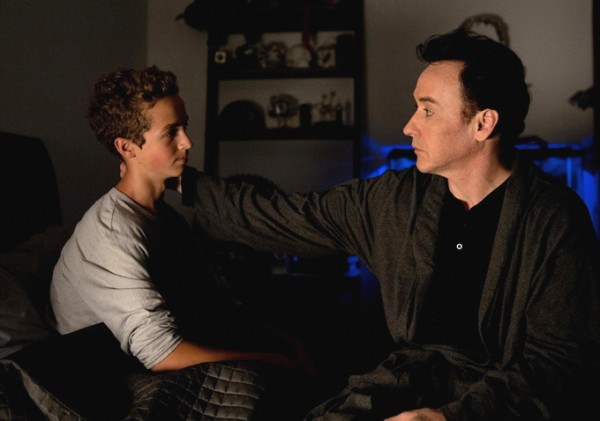
Teen actor Benji (Evan Bird) w/ his dad (played by John Cusack)

Agatha is supposed to be a disfigured young woman, but she doesn’t look THAT bad; one of The Film Stage critics thought that Cronenberg was showing “the difference between what’s on the page and what’s on the screen.”  Perhaps the most irritating character, Benji (Evan Bird), hangs out with a small group of teen celebs “who are supposed to be pretty people, but are really not that beautiful” (The Film Stage).  Where fame, beauty, youth, and money are so valued, there is “a sort of moral decay” (The Film Stage). 

There is one (badly done CGI) scene that several commentators (on IMDB) wrote was “laughable.”  Perhaps the director didn’t think this was a big deal?  Or maybe it was intentional?  VERY little of this film made sense to me, so I had to look up what critics/reviewers thought- that’s a BAD sign!

From the Terrace (1960) starring Paul Newman & Joanne Woodward

terrace_boating

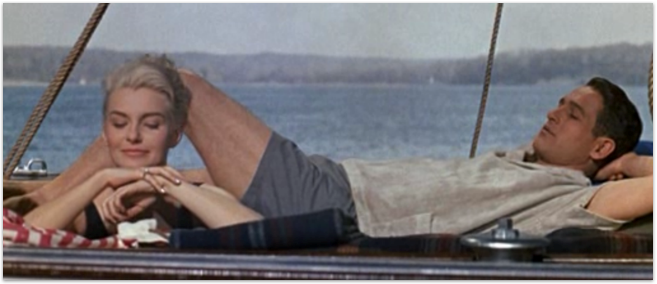
Alcoholism, dysfunctional families, romance, infidelity (w/ its gendered double-standards), and America’s obsession w/ money and power are  the main themes in this (ahead of it’s time) melodrama.  I watched it last night (on Netflix); of course, Paul Newman and Joanne Woodward (who were married for 2 years at that time) were the draw.  Wow, if you want to see some HOT onscreen chemistry, check out their scenes together (first half of the film)!  As for Newman, he’s the definition of Hollywood’s total package (looks, presence, talent, the ability to be both humorous and serious, etc.) 

terrace_driving

In 1946, Aflred Eaton (Newman) returns to suburban Philly after serving in the Navy (WWII) to the loving arms of… his household staff.  His parents checked out long ago.  His father (Leon James) puts all his heart into his steel mill and mourning someone who will never return.  His mother (Myrna Loy) has turned to alcohol and another man.  A private nurse lives with her- a great shock to Alfred.  As his best pal, Alex Porter (a young and dapper George Grizzard), says he “needs to get out of that house” and their expectations.  Like many young folks, Alfred heads to NYC.

In a few months time, Alfred falls in love with Mary St. John (platinum-haired Woodward), a blue blood from Delaware.  She is engaged to another man and her parents would not approve of Alfred’s “qualifications,” Alex quickly explains.  “There are all types of qualifications,” Alfred slyly retorts.  After winning Mary’s hand, he starts working with Alex on designing/selling small planes on Long Island, but grows tired of being left out of the decision-making.  (The business was financed by the Porter family.)  An accident of chance propels Alfred into the society, then business, of one of the wealthiest financiers on the East Coast.  Alfred throws himself into his work, repeating his father’s mistake, and neglects Mary (not content to sit at home alone in their fancy Manhattan apartment). 

The Catered Affair (1956)

This is a great little movie filled with real life heartache and genuine emotion. Bette Davis gives a strong performance as the matriarch of the family determined to give her only daughter a proper wedding even though the family can’t afford to do so.  Ernest Borgnine is perfectly cast as the slovenly, hard working taxi cab driver.  In fact, everyone is up to par in this film, but it’s the real life situations that tug at your heart strings.  IMDB review

catered1

The trick is not to become somebody else.  You become somebody else when you’re in front of a camera or when you’re on stage.  There are some people who carry it all the time.  That, to me, is not acting.  What you’ve gotta do is find out what the writer wrote about and put it into your mind.  -Ernest Borgnine on his method of acting

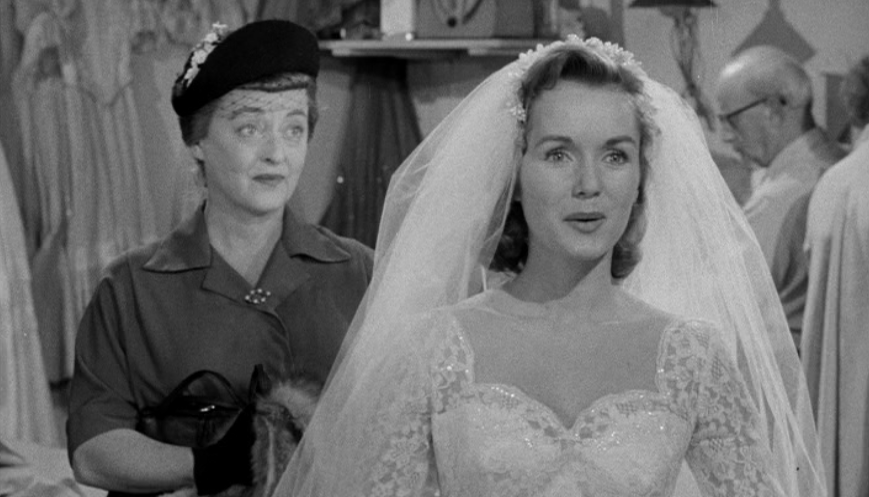
I watched this film, written by Paddy Chayefsky (Marty), last weekend w/ my parents; they had seen it before and really liked it.  It took me a FEW minutes to realize that the mother was Bette Davis- LOL!  She is totally transformed; they gave her a “make-under,” as we’d say today.  Tom (Borgnine) and Agnes Hurley (Davis) are working-class/devout Irish-Catholics living in a small apartment in the Bronx with a daughter, son, and Agnes’ older brother.  Tom, a taxi driver, has been saving money for many years to buy a cab and license (medallions don’t come cheap nowadays either).  They both become concerned when their eldest child, daughter Jane (Debbie Reynolds in an early role), announces that she’s getting married to her long-time beau, a teacher- Ralph (Rod Taylor). 

catered2

Jane, who has an office job, insists that she wants a very small wedding and no reception.  Agnes thinks that’s not good enough, lamenting to Tom: “We never did anything for that girl!”  Agnes knows what she missed out on, and now wants those experiences for her daughter.  In no time, Jane’s wedding planning gets out of hand, thanks to the wishes of Agnes and Ralph’s parents (who are more better off financially).   Jane tells Ralph she doesn’t want to end up like her parents.  We learn more about the Hurleys (strained/seemingly loveless) marriage.  Agnes awkwardly tells Jane that marriage is not like dating; there will be sacrifices and compromises (mostly made by women).