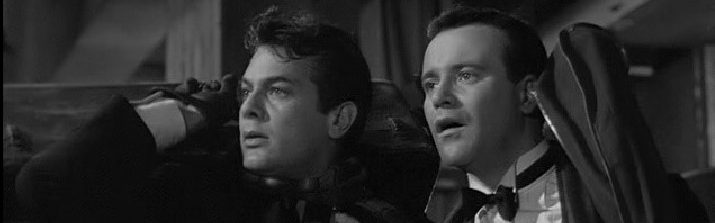
Remember the Night (1940)

Introduction

I think Christmas is almost a “device” in this movie. It isn’t a “Christmas” movie, although Christmas certainly helps.  Rethink it as MacMurry taking Stanwyck home for the Fourth of July parade and picnic. I think it almost works, although there is nothing like the atmosphere that Christmas conjures up.

-IMDB comment

Stanwyck and MacMurray in Double Indemnity

I saw this secular Christmas-themed film (at AFI Silver) with my parents, who are also fans of Double Indemnity, which also stars Barbara Stanwyck and Fred MacMurray.  This film was made 4 years prior to that film noir.  Once again, the theme is redemption- a thief who realizes what she’d been missing in her childhood, falls in love (with a man and his family), then faces the consequences of her crime.  (Don’t you think Benedict Cumberbatch resembles a young MacMurray?  )

Remember the Night (1940)

Lee Leander: Now there’s nothing as dangerous as a square shooter. If all men were like you, there wouldn’t be any nice girls left.

On the night before Christmas Eve, up-and-coming ADA John Sargeant (MacMurray), decides to bail out Lee Leander (Stanwyck), the thief (with tree strikes) whose case was postponed for the holidays.  The bail bondsman takes her over to John’s apartment, much to his confusion/shock.  John, being a decent guy (see above quote), decides to take Lee out for dinner.  They run into the judge who presided over their trial- oops! 

John wonders how a normal person like her can turn to crime, and she tells him her way of thinking.  They get to know each other a bit- turns out their both from small towns in Indiana.  Every Christmas, John drives home for the holidays, and he offers to take Lea along with him.  Lee’s tough gal façade fades, and she becomes very emotional.   She doesn’t even know if her mother is alive, since she’s “never” been back home after coming to NYC.      

Lee and John in a cow field

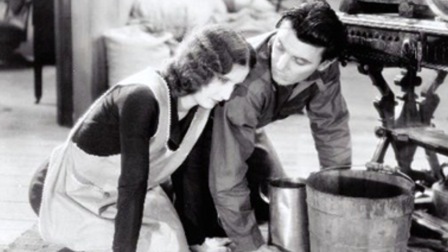
There are some funny/wacky scenes in small-town Pennsylvania, after they (unknowingly) trespass on a very angry/gun-toting farmer’s land.  They end up at the justice of the peace’s office, but John is not very adept at lying, but Lee is an old hand.  Lee creates a little fire in a small wastebasket, enabling them to get away.  John is shocked, yet also impressed, by her quick thinking.  

When they reach Lee’s hometown, her mother (remarried) wants nothing to do with her.  It’s a dark, well-done scene- not what you’d see in the cloying/unrealistic Hallmark holiday movies of recent times.  While Lee tries to explain her side to her mother, John is quietly/calmly supportive. 

The scene at Lee’s childhood home when John takes her back home to her mother’s house is such a chilling scene…  Listening to her mother’s “good riddance” speech and Lee’s comments in the yard afterward… it’s just such a creepy, lonesome moment, filled with utter rejection…

But when he asks Lea’s mother her name and she responds “The name doesn’t concern you.”  His delivery of “It certainly does not” gives me the chills.  It just says so much of his character.

-IMDB comments

With John's loving family
With John’s loving family

There’s a moment when John is playing the piano and his family is gathered around when Lee looks around her in wonder.  Barbara Stanwyck did a brilliantly subtle job of expressing the thought “What would it have been like to have grown up in a home like this?” in that brief moment.

-IMDB comment

Jack’s family includes his level-headed mother Mrs. Sargeant (played by Beulah Bondi, Ma Bailey from It’s a Wonderful Life), doting Aunt Emma, and (comic relief) farm boy, Willy.  They rush about getting everything perfect for John’s arrival.  (John explained earlier that he grew up quite humble, but in the past few years, has been able to provide well for his family.)  Lee is happily surprised by their lovely farmhouse and friendly demeanor.  They gather about the piano (John plays some) and sing songs. 

Being the honest man, John admits to his mother that Lee is a thief with no family to go to, not his “special lady.”  His mother is still sympathetic toward Lee.  The next morning, they even give Lee a few presents!

John and Lee embrace

Over the next few days, Aunt Emma sees that Lee and John are falling in love.  At the barn dance, she beams with happiness as she watches the couple dance and kiss.  Mrs. Sargeant is worried, so she  has a serious (yet gently worded) talk with Lee the night before they leave for NYC.  She explains exactly how hard John worked to get to where he is in his life.  Lee says she’d never ruin his life, but admits that she’s in love with her son.  

On the way back, they take a road through Canada, and end up in Niagara Falls.  They admit their love for each other.  John tells Lee that she can get away now, if she wants.  She refuses, because she wants to face up to her sentence.  John feels guilty, since the jury was about to acquit her (before the holiday recess).  

Back in the courtroom, John begins to treat Lee in such a harsh manner, garnering her sympathy from the jury.  After a few questions, Lee realizes what he’s doing, and begs the judge to allow her to plead guilty.  In the final scene, before Lee is taken away by the prison matron, John explains that her sentence probably won’t be too long.  Lee’s ready to face anything (now that she’s loved).        
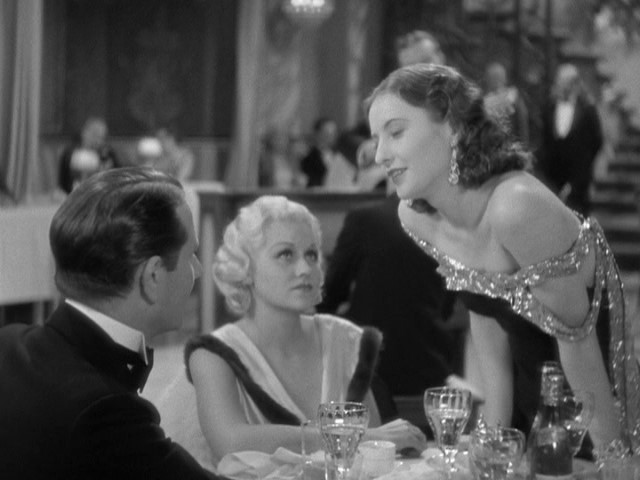
The Purchase Price (1932)

Introduction

Iconic American director Frank Capra called her “the greatest emotional actress the screen has yet known.”  Barbara Stanwyck was Brooklyn-raised, not conventionally pretty (to many producers), but very confident in her skin (onscreen).  She was very accessible, yet enigmatic, at the same time.  Her appeal came from within- those sharp eyes and unmistakably husky voice.  Stanwyck was not stuck to the prototypical “good girl” roles (early in her career, nude photos surfaced, though she denied it was her in those images).     

AFI Silver recently had a Stanwyck film retrospective.  One weekend, Victoria Wilson (author of A Life of Barbara Stanwyck: Steel-True, 1907-1940) gave introductions to the films and had Q&As afterward.  She also signed books for classic movie fans.  Wilson, a former book editor, took 15 years to write the biography, though she conducted “decades of research.” 

 The Purchase Price (1932)

Joan (Stanwyck) sings in a nightclub in NYC

Joan Gordon (AKA Francine La Rue): I’ve been up and down Broadway since I was fifteen years old.  I’m fed up with hoofing in shows.  I’m sick of night clubs, hustlers, bootleggers, chislers [scam artists], and smart guys.  I’ve heard all the questions and I know all the answers.  And I’ve kept myself… fairly respectable through it all.  The whole atmosphere of this street gives me a high-powered headache. I’ve got a chance to breathe something else, and boy, I’m grabbing it.

Joan (Stanwyck, just aged 25) seems to lead a glamorous life, wearing fancy gowns and singing at a posh nightclub.  Too bad her dapper, small-time hood boyfriend Eddie (Lyle Talbot) is already married.  One night, she decides to give it all up.  Joan takes a new name and begins working at a lounge in Montreal, Canada.  Though he acted like the break-up was no big deal, Eddie has two men tail Joan!  Then her busybody maid gives her an idea- going as a “picture-bride” (akin to a mail-order bride) for a lonely farmer in North Dakota.  Eddie will never find her there, right?  The maid already sent in Joan’s picture, thinking that the farmer would prefer it to hers.  Joan gives the maid $100 and gets on the train to her new home.  

Jim Gilson (George Brent) and Joan marry

When Joan gets to small-town North Dakota in late Fall, she discovers that her new husband Jim (George Brent) is very handsome, yet quite serious.  They get married in town in a brief, yet funny, ceremony.  They drive (horse cart, not car) many miles to his wheat farm.  But after she rejects him on the wedding night, Jim becomes very cold toward her.  He sleeps in one corner of the living room; she takes the bedroom.

There is a role reversal- she has to win him over!  This is very rare for early Hollywood, Wilson noted.  Joan cooks, cleans, and entertains their wild neighbors without complaint.  A wealthy/divorced landowner hits on her several times, making things even more tense with Jim.  Her husband has money problems, Joan learns after a few weeks; they could lose the house/farm.  Jim suggests she go back to Montreal, but Joan refuses.   She wants this marriage to work, because she now loves her husband.  One wintry/dangerous day, Joan helps another farmer’s family after a baby is born, showing how capable Joan has become as a farmer’s wife.

Joan tries to get close to her husband

One night, Eddie shows up, seeking refuge from a terrible snowstorm.  Jim overhears them talking, and realizes that they have a past.  He is furious at Joan, shouting “I thought you were decent!”  Joan tells Eddie they are done, but he isn’t convinced, deciding to stay in town for a while.  Joan tells Jim about her relationship with Eddie, then breaks down in tears. 

Jim goes to the bank, hoping to get an extension on his mortgage ($800).  Boldly, Joan goes to the saloon to talk to Eddie, and gets the money from him.  Jim and Eddie get into a fistfight (no stuntmen used back then), while Joan takes the money over to the banker.  Jim soon receives a letter stating he has the extension until next season. 

Joan and Jim work side by side to plant and harvest their crop, but are still living like roommates.  Their wheat turns out very well, invoking jealousy from that landowner.  One night, fire consumes most of their crop, though Jim and Joan try to stop it.  (Stanwyck did that herself, and her ankles got singed.  Her stand-in didn’t look right in the scene).  Joan collapses due to the smoke, and Jim finally realizes that he loves her, too!    

This is a small film, but you can already see the star potential in Stanwyck (her teeth weren’t yet fixed), especially in the emotional scenes.  (Not unlike Brando, Stanwyck is unafraid of revealing messy emotions, even if it looks unattractive.)  Joan redeems herself with her hard work and (unselfish) love for her husband, a stranger at the start of the film.  But what about the lack of romance?  This viewer has a good take on it:

I think she sees and appreciates the authenticity of, and the genuine goodness in, Jim, and that those qualities (not to mention he’s very handsome!) are what she falls in love with.  Also, feeling bad that she shut down his decidedly awkward, abrupt, unpolished wedding night advances, but realizing it isn’t his fault that he so totally lacks finesse with women… and that he’d meant no offensiveness, she is eager to make things right with him, and falls in love with him in the process.  -IMDB comment

Short reviews of recently viewed films

Admission

Admission

This is an above average rom-com, starring Tina Fey (who doesn’t love her!?) and Paul Rudd  (ditto), but w/ some unexpected twists and some smart/funny dialogue.  The young characters performed pretty well, I thought.  It was cool to see Michael Sheen (has own Showtime series now) and Gloria Reuben (ER), who plays Fey’s rival co-worker, after a long time! 

The Butler

Lee-Daniels-The-Butler-

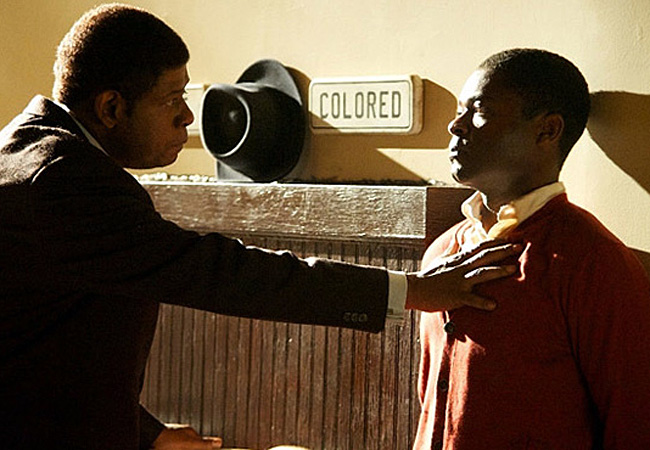
Director Lee Daniels said that he envisioned this film (based on a true story) primarily as “a love story between a father and son.”  Forest Whitaker, who plays apolitical/humble/hard-working butler Cecil Gaines, is flawless (as usual).  Oprah has an unique air/look about her (in the role of bored/troubled housewife); she does a good job.  English actor David Oyelow0 does a fine job as Louis, the older son in the family, who becomes immersed in Civil Rights movement after going off to college.  Louis’ strand of the story is the most interesting part of the film. It’s a good film, but not great (as several viewers agreed).  It didn’t evoke much emotion from me, aside from the shocking early tragedy and the lunch counter/protest scenes.  Something (intangible) is missing!

Diana (NOW PLAYING)

Diana - 2013

It’s refreshing to see a South Asian man, English actor Naveen Andrews (who plays Dr. Hasnat Khan, a brilliant Pakistani surgeon/PhD student), on the big screen.  And portrayed as a love interest to Naomi Watts (Diana, Princess of Wales)- pretty neat, right?  No, sadly, this film is a bore.  Maybe it’s the pedestrian dialogue?  Or the slow pacing?  It looks like a TV movie, as one journalist and many viewers commented.  Watts gets Diana’s mannerisms and girlish vulnerability right, but she has little else to work with here.  What a waste of talent! 

Django Unchained

Django-Unchained-Tarantino

django-unchained-ld

django-unchained-3

Oh, it’s well produced, filmed and edited. But that can’t save the totally bizarre banality of the story and the plot – never mind the gratuitous violence. 

Exactly- the (bloody/brutal) wrestling scene between the two men in Candie’s private club was almost too much to take! 

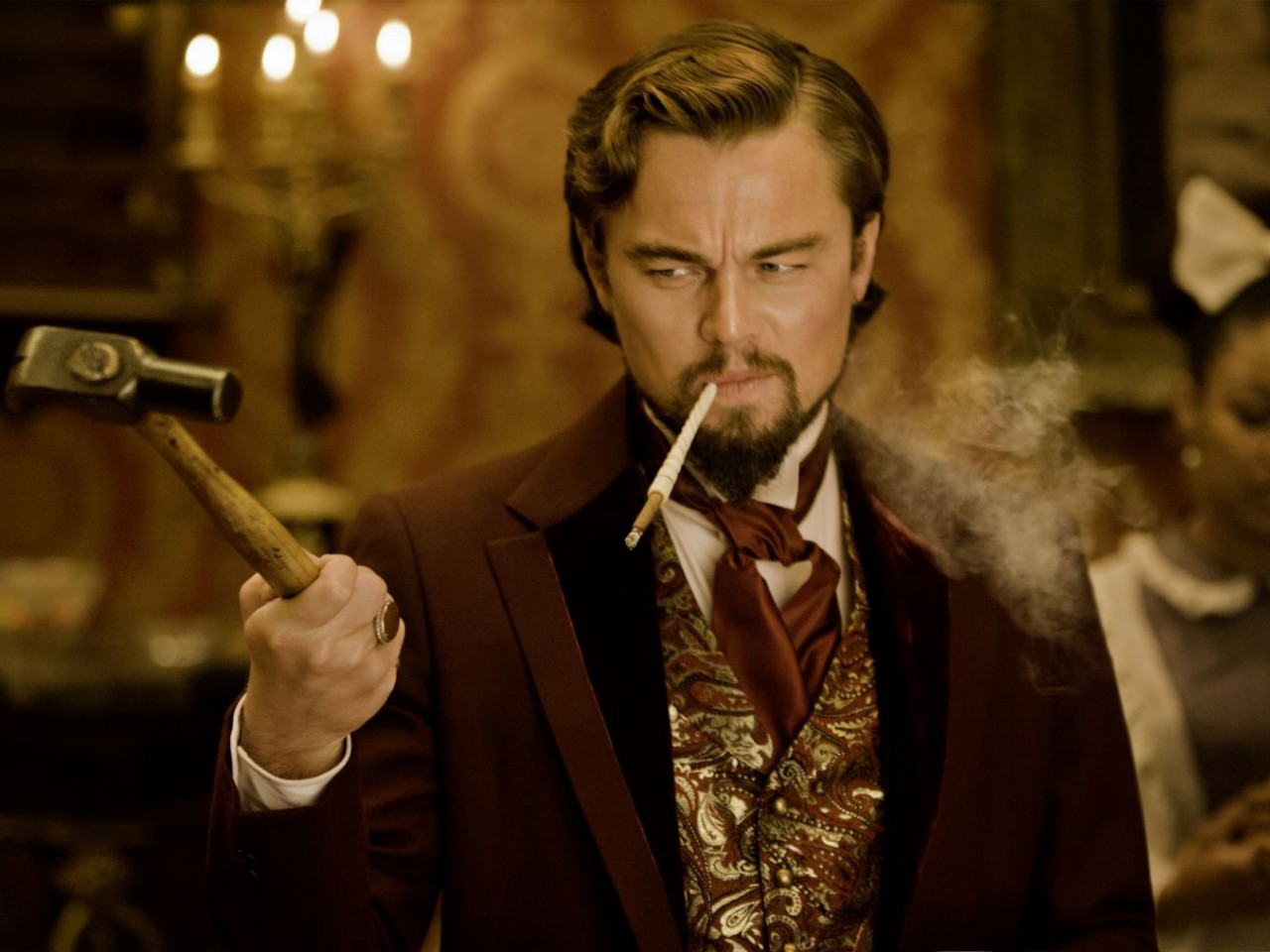
I thought DiCaprio and Waltz were brilliant, but brilliant performances can’t save a bad film. 

Christoph Waltz did a fine job (as in Inglourious Basterds).  It’s a difficult task to act in one’s second language, also.  And DiCaprio gets better with age. 

I liked the father/son symbolism when Schultz told Django the Brunhilde Story.  It was tender and touching…

Django wasn’t the hero- Dr. Schultz was, I was surprised to discover.  Tarantino’s direction/writing and Foxx’s acting turned the lead man into the sidekick.  Oops!   

What was that scene with the masked vigilantes even there for?  The scene was a complete waste if footage… comic relief that fell flat on its face.

There is not much to laugh at in this disjointed film.  If you can’t deal respectfully with a topic like slavery… I don’t know what to say.  And talk about self-indulgent- Tarantino has a distracting cameo and the film clocks in close to 3 hours!   

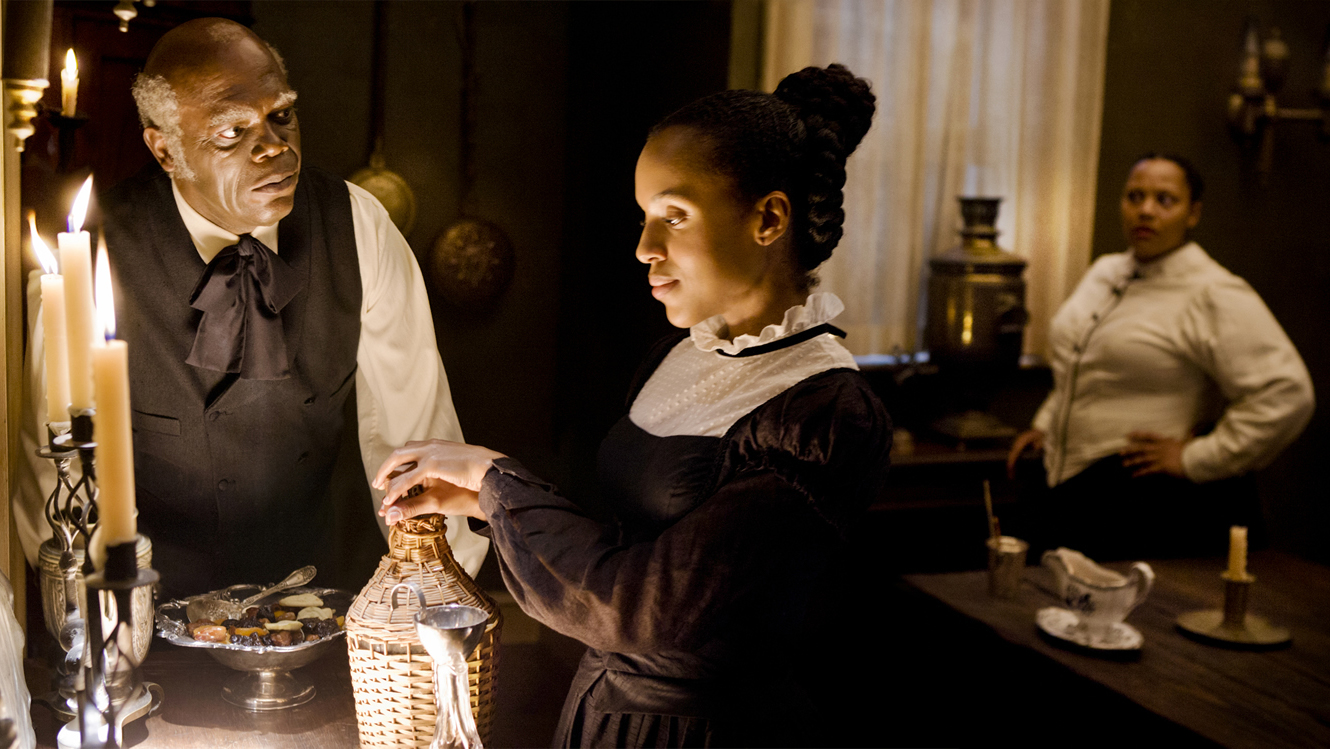
Candie is fascinated by Django, and sees in him, possibly, the ability and will to do what Old Ben could not.  Django can see that Candie is captivated, even when Schultz cannot.  The change that Django represents is not the kind of change that Candie will accept.

One journalist wrote that the “love story in the film is between Django and Candie,” not his wife (played by Kerry Washington, star of Scandal).  Kerry’s fans won’t have much to applaud- Broomhilda is merely a damsel in distress in the film.  What a waste of a multi-faceted actress!   

-Viewer comments from IMDB (with my analysis)

Absolute Power (1997)

absolute_power_poster

I recall first seeing this film, based on the book by David Baldacci (a former lawyer), a few months after it came out (with my mom).  We liked it a lot- the acting (it has a fantastic cast), pacing (editing), and  even soundtrack (which enhances the film, but isn’t invasive).  It’s directed by Clint Eastwood, who also plays the lead role of master thief Luther Whitney. 

ovaloffice_mtg

While robbing one of the homes of billionaire philanthropist Walter Sullivan (E.G. Marshall; one of the 12 Angry Men), Luther witnesses the brutal assault and murder of the elderly man’s young wife, Christie.  The cover-up involves the President’s cold-blooded Chief of Staff, Gloria Russell (Australian Judy Davis) and two Secret Service agents- stoic Vietnam vet Bill Burton (Scott Glenn) and sadistic eager beaver Tim Collin (Dennis Haysbert).  This was one of Haysbert’s first movie roles, but you can sense the strong screen presence- something that can’t be taught. 

seth_luther

Do you know what it was like to be the only kid in class that got to talk about visiting day? -Kate bitterly comments to Luther

I love true crime.  -Luther works his charm on Det. Seth Frank

To make things more complicated, Luther’s daughter Kate (Laura Linney, also in one of her first big roles), is an ambitious young DA!  At first, she wants nothing to do with him, but then learns of the gravity of what her father has experienced.  This is the movie that made my mom a fan of Linney.  Kate’s a very relatable young lady, trying to do the right thing.   

Since Luther is such a skilled thief, the cops decide to question him about the crime.  The lead investigator on the case, Det.  Seth Frank (Ed Harris), seems to admire Luther a bit (he was a war hero).  He also develops a big crush on Kate-  a (needed) sweet/humorous aspect to the story. 

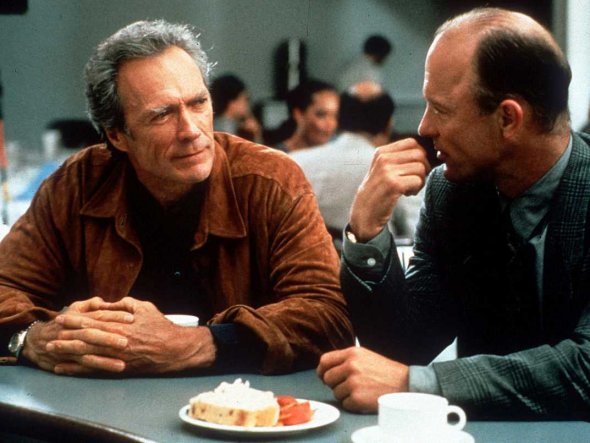
Every time I watch this movie the highlight for me is the scene between Clint and Ed Harris.  Their little cat and mouse is not only fun to watch, but they both genuinely seem to be enjoying the scene.  Eastwood’s line about being the star of his AARP meetings is priceless, as are Ed Harris’s reactions.  -IMDB comment

press conf_ap

…despite his criminal behavior he’s an “honorable” thief…  -IMDB comment

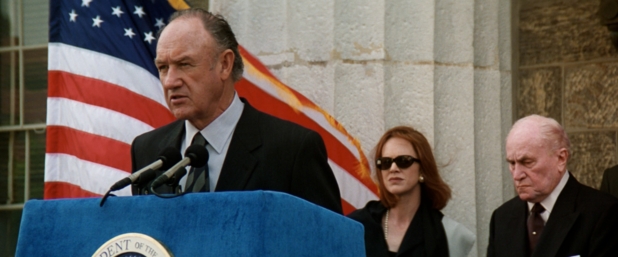
One of the scenes that stands out in my mind is the dance/talk between Davis and Gene Hackman, who plays President Alan Richmond.  It’s especially well done, and fun to watch.  Davis’ character is a source of humor in a few moments, too. 

Oops, I almost forgot to say how great Glenn (one of Eastwood’s close friends) is in this movie!  Now you have it.  His character is very conflicted- a good guy who takes a terrible turn at the end of his career. 

luther_kateI couldn’t have my daughter thinking I was a murderer.  -Luther explains to Kate

I also enjoyed all the father-daughter scenes in the film; Luther and Kate’s strained relationship grew and changed over the movie.  After all, it’s very difficult (perhaps impossible) to turn your back on family.  When Kate tries to help the police peacefully arrest her father, she puts her own life in danger.  This kicks Luther into high gear- he has to protect his little girl and clear his name.  After all, he’s a thief, not a murderer!       

The Bad and the Beautiful (1952)

Lana Turner
Georgia Lorrison (Lana Turner)

NOTE: This review contains MAJOR spoilers! 

This film takes some time to get going, but when it gains momentum- yowza!  Near the start of the film, ambitious movie producer Jonathan Shields (Kirk Douglas) notices potential in young actress Georgia Lorrison (Lana Turner).  Boldly, he goes over to her ratty apartment very late at night.  Georgia stumbles home drunkenly and finds him just sitting in her armchair.  Georgia is a bit shocked, but then hits on Jonathan.  (That’s how she gets parts, after all.)  He’s disgusted, letting her know that she needs to quit drinking and sleeping around, if she ever hopes for a real career.

Kirk Douglas and Lana Turner
Jonathan talks (show) biz w/ Georgia

It turns out that both of them had successful fathers.  Georgia keeps a little shrine to her father, a Hollywood legend, in one corner of her place.  At first, it’s all (show) business: Jonathan boosts up Georgia’s confidence by standing up to her detractors,  believing in her potential, and promoting her for a juicy part. 

Jonathan and Georgia have a falling out

Georgia falls deeply in love with Jonathan, but he can’t return her feelings.  They have a tremendous fight instead of celebrating their mutual success.  Georgia never works with Jonathan again, but she becomes one of Hollywood’s most sought after leading ladies.

The professor (Dick Powell) and his wife (Gloria Grahame)

A Southern academic, James Lee Bartlow (Dick Powell) writes a novel which becomes very popular.  Jonathan wants the author to write the screenplay for a feature film, so he invites the unassuming professor and his devoted/lovely wife, Rosemary (Gloria Grahame) to Hollywood.  To ensure that Bartlow has time to write, Jonathan plans a weekend getaway for Rosemary and a suave actor.  It goes tragically wrong, but compels Bartlow to write a book about Rosemary.  Bartlow feels that only Georgia Lorrison is capable of bringing his wife to life onscreen. 

b&b_final

In the last scene, we see a director (one of Jonathan’s business partners), actress (Georgia), and writer (Bartlow) come close to the phone to listen in on Jonathan and a studio head. They all want to be in his light (literally) once more.  Jonathan used them to get ahead in his career, but their own careers were improved because of him

Kirk Douglas is impressive as a complicated anti-hero.  Jonathan feels alive when he’s working, but after that, he goes through a troubling time.  Douglas is more than up for the challenge of this role- you can’t see the acting!  Lana Turner is much more than a (very) pretty face.  Her character goes through a transformation- from troubled B-movie actress to headliner.  Gloria Grahame’s role is small, yet pivotal.  She’s a Southern belle who loves her husband, believes in his talent, yet is awed by the glamor of Hollywood.