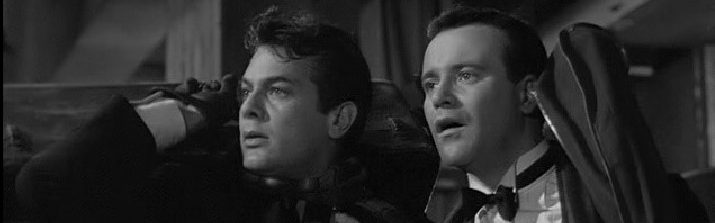
“Cry of the City” (1948) starring Victor Mature & Richard Conte

In NYC, thief turned cop killer- Martin Rome (Richard Conte)- arrives in the hospital badly wounded. A slimy lawyer, W.A. Niles (Berry Kroeger), tries to convince him to confess to another crime- a jewelry heist and killing the shop owner. Marty’s young girlfriend, Teena Riconti (Debra Paget), secretly visits him while he’s asleep. Later, Niles threatens Marty by saying he’ll find Teena and force her to confess in aiding w/ the robbery (as its known a woman was involved). When Marty is moved from the hospital to the jail, he escapes. Lt. Candella (Victor Mature) and Lt. Collins (Fred Clark) are on his trail. This case is personal for Candella (who is also Italian-American), knows the Rome family, and grew up in the same poor/immigrant neighborhood as Marty.

I had enough of that when I’m a kid. Crummy tenements, no food, no clothes. -Marty explains why he chose a life of crime

Oh, save it for the jury, Marty. Who do you think you’re kidding? l was brought up in the district too. I’ve heard that dialogue from you poolroom hotshots ever since l was ten years old. Get hip… only suckers work… don’t be a square… stay with the smart money. Let the old man get the calluses digging the ditches. No food… no clothes… crummy tenements. You’re breaking my heart, Marty. -Lt. Candella replies

You shouldn’t miss this gem of a film noir from director Robert Siodmak! I had tears in my eyes at the end; it’s captivating from its start to the (powerful) finish. Not only is it very well-made, it has a moral message (which is not dealt w/ in a pedantic manner). The characters (many of whom are European immigrants and first generation Americans) are fleshed out nicely, even the minor players. Veteran film noir-writer Ben Hecht worked on the script, though he is uncredited; this is a common practice in Hollywood even today. Quentin Tarantino is known for punching-up dialogue on several movies from different genres.

Victor Mature is surprisingly competent in the lead in what must be surely one of his best roles. Richard Conte is simply superb in a complex and tricky role. His method is one of economy and subtlety and a lesson to screen actors.

-Excerpt from IMDB review

I’ve haven’t seen Mature before; he’s 6′ 2″ and muscular w/ a striking profile, dark hair, and thick eyebrows. To modern audiences, he resembles Law and Order and SATC actor Chris Noth. Candella is usually on the move; he is a man who commands attention w/ his body and voice. In contrast, Conte (star of the lesser-known noir Thieves’ Highway) is much shorter w/ a slighter build. He is also handsome and has a strong screen presence. Marty is often confined, wounded by cops’ bullets, though his mind and eyes are always moving. There are many fine supporting characters (few who also speak in Italian), adding to the strength of the film. Classic film fans will notice a young Shelly Winters, one of the many ladies Marty has charmed.

Siodmak was a master of noir, as he blended German Expressionism w/ contemporary styles found in American film. He created atmospheric and memorable movies, perhaps most notably The Killers (1946), starring Burt Lancaster and Ava Gardner. Though born in Memphis, Tennessee to Jewish parents who were visiting on business, Siodmak spent his youth in Germany, and even worked in banking (his father’s business) for a time. He also tried his hand at acting, which didn’t work out. When Hitler came to power, he joined his friend- Billy Wilder- in Paris and worked on editing and filming. In 1940, Siodmak was on the last ship leaving France for America on the eve of Germany’s occupation of Paris. His experience in France enabled him to create quality films which looked good on a low budget.

Getting Started with Noir: 10 Films to Watch

  1. The 39 Steps (1935) starring Robert Donat & Madeleine Carroll [https://knightleyemma.com/2019/11/16/the-39-steps/]

2. The Maltese Falcon (1941) starring Humphrey Bogart, Mary Astor, Peter Lorre, & Sydney Greenstreet

3. Laura (1944) starring Gene Tierney, Dana Andrews, Clifton Webb, Vincent Price, & Judith Anderson [https://knightleyemma.com/2008/10/15/classic-movie-review-laura/]

4. Notorious (1946) starring Cary Grant, Ingrid Bergman, & Claude Rains [https://knightleyemma.com/2019/10/30/notorious/]

5. The Big Sleep starring Humphrey Bogart & Lauren Bacall

6. The Killers (1946) starring Burt Lancaster & Ava Gardner [https://knightleyemma.com/2014/02/08/the-killers-1946/]

7. The Strange Love of Martha Ivers (1946) starring Barbara Stanwyck, Van Heflin, Kirk Douglas, & Lizabeth Scott [https://knightleyemma.com/2011/09/10/the-strange-love-of-martha-ivers-1946/]

8. Out of the Past (1947) starring Robert Mitchum, Jane Greer, & Kirk Douglas [https://knightleyemma.com/2009/08/05/out-of-the-past-1947/]

9. In a Lonely Place (1950) starring Humphrey Bogart & Gloria Grahame [https://knightleyemma.com/2009/08/23/in-a-lonely-place-1950/]

10. Strangers on a Train (1951) starring Farley Granger, Robert Walker, & Ruth Roman

“The Long Night” (1947) starring Henry Fonda, Vincent Price, & Barbara Bel Geddes

The opening credits fade onto a town square where a blind man, Frank (Elisha Cook Jr. – a staple in several film noirs) is tapping his way down the sidewalk. He enters a 4-story boarding house and hears a shot fired in one of the upstairs bedrooms. A door opens (from audience’s POV) and a man stumbles out of the door and falls down two flights of stairs. He is dead when he hits the bottom. This follows nearly 100 mins. of flashback (and flashbacks-within-flashbacks) about the unraveling of a WWII veteran/factory worker, Joe (Henry Fonda). Though it has some fine dialogue, the film lacks momentum and feels slow at times; it resulted in a loss for RKO Pictures ($1,000,000). This lesser-known movie (free on YouTube) is a remake of Le Jour Se Leve (1939) from France. Directed by Anatole Litvak, it is well-made and creates a noir-ish atmosphere in a seemingly normal Midwestern setting. Dmitri Tiomkin’s haunting music includes a rearrangement of a familiar piece by Beethoven.

Well, I never knew that Fonda did a noir picture! Over a few weeks, Joe falls in love w/ Jo Ann (Barbara Bel Geddes), a young woman who works in a floral shop. They are both alone, as they are orphans raised in the same home (though several years apart).When he mentions the idea of marriage, she is not too eager. Joe says that she’s free, as everyone should be, and goes to his truck. Joe then follows Jo Ann, curious why she’s going out so late (after 9PM). He ends up at a busy bar and sees her meeting w/ the performer- a magician named Maximilian (Vincent Price). Joe quickly learns re: this man’s character, thanks to his bitter/chatty assistant, Charlene (Anne Dvorak), Joe’s image of Jo Ann is shattered, and his thoughts get darker after he talks w/ Maximilian (an arrogant liar who has a way w/ words).

The dialogue will keep your attention, esp. the heated scenes between straight-talking Fonda and Price (both charming and creepy). Dvorak’s weary cynicism is in contrast w/ Bel Geddes’ youthful optimism. Fonda gets to show his range, in the flashbacks and in the present (where he is holed up in his small room w/ police surrounding the house). I didn’t think the characters were very fleshed out. The ending was not what I expected; it was too sentimental and unrealistic. Check it out if you like these actors and/or the noir genre.

[1] …I saw working class heroism, touches of popular justice, and just a hint of bourgeois deceit. The latter showed in the fantastic performance by Vincent Price as his character continued to try to sell a fantasy to Jo Ann by means of magic and falsehood.

[2] I never see anything that Fonda’s character has been put through as far as shock or emotional torment or even disillusionment that would justifiably cause him to kill a man.

I believe the production code is the reason any hard edges that seem to be just under the surface never appear. I’m almost positive the script would have gone further if the censors would have allowed it to be so.

-Excerpts from IMDB reviews

“Pickup on South Street” (1953) starring Richard Widmark, Jean Peters, Thelma Ritter, & Richard Kiley

This is considered one of the “essential noirs” for anyone interested in the genre. It was written/directed by a 1st generation Jewish-American, Samuel Fuller, a legend of the genre. As a teen, Fuller got into the newspaper biz, then worked as a crime reporter for several years. When WWII started, he served as an infantryman in several dangerous campaigns, and even shot one of the first docs inside a concentration camp! Later in his Hollywood career, Fuller was known for his prolific screenwriting (some of which were made into films), tacking controversial subjects w/ an unflinching eye (to the extent that censors allowed), and making the most of small budgets.

On a crowded subway, Skip McCoy (Richard Widmark) picks the purse of a streetwalker- Candy (Jean Peters). Inside the pocketbook is a piece of top-secret microfilm that was being passed by Candy’s ex-boyfriend, Joey (Richard Kiley), a Communist agent. Kiley (who is sort of handsome w/ his dark eyes) looked very familiar to me; it turns out he was the father in the famous ’80s miniseries- The Thorn Birds! Candy discovers that Skip is the thief who has the film through an older police informer/saleswoman- Moe Williams (Thelma Ritter).

[1] None of them are really good guys and they all of their flaws and weaknesses. Really humane. It also especially features a great performance from Thelma Ritter, who even received a well-deserved Oscar nomination for. It has really got to be one of the greatest female roles I have ever seen.

[2] ...even though the characters aren’t perfect, you do care about them — perhaps because they have been somewhat branded by their pasts in ways that are hard to escape: Skip as a “three-time loser” and Candy as a youngish woman who has “knocked around” a lot.

[3] It is hard to believe that when Widmark made this film he was already in early middle age. The 39-year-old star… plays the upstart Skip McCoy with the irreverent brashness of a teenager. 

Haunting urban panoramas and subway stations offer a claustrophobic evocation of the city as a living, malevolent force. Like maggots in a rotting cheese, human figures scurry through the city’s byways. Elevators, subway turnstiles, sidewalks – even a dumb waiter act as conduits for the flow of corrupt humanity.

-Excerpts from IMDB reviews

Pickup on South Street was selected for preservation in the National Film Registry in 2018, by the Library of Congress for being, “culturally, historically or aesthetically significant.” The film is about espionage, but in the French and German versions, the title was changed and all dialogue referring to spying was replaced by language about drug dealing. After seeing a preview of the film, FBI Director J. Edgar Hoover demanded a meeting w/ studio head Darryl F. Zanuck and Fuller. He objected to the unpatriotic nature of Skip, even when he realizes he’s dealing w/ communists. Surprisingly, Zanuck refused to make any changes to the film, backing Fuller! This ended the studio’s close relationship w/ the FBI and all references to the agency were removed from the film’s advertising.

Marilyn Monroe read for the role of Candy; Fuller liked her very much, but said her “overwhelming sensuality” was wrong for the story. According to The Hollywood Reporter, Shelley Winters was originally cast to play Candy, but due to pregnancy, the studio assigned the role to Betty Grable. She refused the part when she learned that she’d be playing a prostitute. Anne Baxter and Linda Darnell were also considered for the role. Fuller saw Peters in the studio commissary, thought the way she walked was perfect for the part, and cast her on the spot. Candy acts tough, but is also naive in some ways.

Ritter’s New York accent lends authenticity to the film, though it was not shot in that city. New Yorkers will be surprised when Candy refers to Houston Street (pronouncing it like the Texas city), though the correct way is pronounced “House-ton.” Classic film fans may have admired Ritter’s supporting roles in two great films- All About Eve (as Bette Davis’ friend/assistant) and Rear Window (as a nurse who gives Jimmy Stewart some good relationship advice). Actors of her caliber really add something extra to whatever movie they are in!

Much of this film is shot in extreme close-up, which (as Eddie Muller commented) was rare for its day. Character drives the plot here and the close-ups are used to support character. When Skip interrogates Candy, the close-up captures the sexual tension/energy between them. Peters is shot in soft focus close-ups, enhancing her beauty. The device is employed to heighten the tension. The opening has no dialogue; the drama relies entirely on close-up.

“Gaslight” (1944) starring Charles Boyer, Ingrid Bergman, Joseph Cotton, & Angela Lansbury

Named for this movie, “gaslighting” has become a recognized form of controlling and manipulative behavior. It involves an exploitative person manipulating those who suspect him/her into doubting themselves and questioning their own perceptions, so that they distrust their own suspicions of the manipulator. This behavior is now classified as a form of psychological abuse.

[1] The first scene establishes the dreary tone of the film. It is nighttime in London and a murder goes unsolved.

[2] Charles Boyer has in this film a thankless role, that of a devouring immoralist who has only two possible moods– brief burst of anger needing to be controlled and an exuded charm that must be slightly overdone at times.

[3] The actress – who would soon become blacklisted after her marriage to Italian director Roberto Rossellini – can convey every emotion and nuance of her character through her amazingly expressive eyes. 

-Excerpts from IMDB reviews

The original Broadway stage play and source for the screenplay was Angel Street by Patrick Hamilton, which opened at the John Golden Theater on December 5, 1941 and ran for over a 1,200 performances! The original stage cast included Leo G. Carroll, Vincent Price, and Judith Evelyn. After the death of her famous opera singer aunt/guardian, Paula Alquist (Ingrid Bergman), goes to study in Italy to see if she has any talent as a singer as well. She falls in love w/ a charming/older man who works as a composer, Gregory Anton (Charles Boyer), and they return to London and take up residence in her aunt’s townhouse. Gregory limits her having visitors and going out. He keeps saying that his wife is unwell to anyone who asks. She begins to notice strange goings-on: missing pictures, strange footsteps at night, and gaslights dimming. Paula feels like she may be going out of her mind!

Bergman (who won an Oscar for her role) spent some time in a mental institution to research her role, studying a woman who had suffered a nervous breakdown. This was a suggestion from Cukor, who is known for his ability to draw out fine performances (esp. from women). As my mom commented, this was rare type of role for Bergman. I learned that the actress was initially reluctant to take on this role, as she considered herself to be very strong/independent. She worried that she’d be unable to convincingly play a timid/fragile woman.

Dame Angela Lansbury was only 17 y.o. when she made this- her movie debut! Lansbury (who was nominated for an Oscar) had never acted before her screen test, but she impressed director George Cukor w/ her natural talent. The scene in which the sassy/flirty maid Nancy lights a cigarette, defying her mistress Paula, had to be postponed until near the end of production. The social worker who was monitoring Lansbury refused to allow her to smoke (while she was a minor). New scenes not in the original play were added to this version. Brian Cameron (Joseph Cotten) was changed from a stout, sardonic elderly man to a young, handsome one (as a potential love interest for Bergman). For his part, Cotten relished the chance to play a heroic role, as he had done shady/negative roles in the few years before.

Cukor asked producers (who were reluctant) to hire Paul Huldschinsky to design the Victorian sets. Huldschinsky was a German refugee who fled his native country because of WWII. He knew much re: upper-class European decor, b/c his family had grown wealthy through their newspaper business and his wife was the heiress of a railroad fortune. When he moved to the U.S. most of that money was gone and he got by working on smaller pictures. However, his luck changed w/ this picture, and Huldschinsky won an Oscar for set design.