“The Pacific” (Parts 4-10)

Part 4

Robert Leckie (James Badge Dale) sees one Marine shoot himself in the head, unable to take the rain, jungle, fighting, and mental pressure.  He gets a bladder problem and is sent to spend some time recuperating at a hospital facility on a nearby island.  Leckie, who’s family has a history of mental illness, is unsettled when he sees men with psychiatric problems at the facility.

He’s surprised to see Hanson (a man from his unit) when he asks for a smoke.  Hanson is put in a solitary cell away from the other beds.  The shrink explains that Hanson tried to run away and kill himself twice on the battlefield.  He needs to be out of the fighting.  “But most men you see here are just tired.  They just need a week or two to recuperate.”


Part 5

Eugene Sledge (Joe Mazzello) and Sidney Phillips (Ashton Holmes) are very happy/excited to see each other while at camp.  When Sledge asks about how the war was for Phillips, he explains that “there’s no way to describe it.”  When Sledge goes to the library tent to pick out a book to read, he has a chat with Leckie.  (I think some of the books are from Leckie’s own collection.)  When Sledge picks up the Bible, Leckie comments that he doesn’t believe in religion anymore.  “What do you believe in?” Sledge asks quietly.  “I believe in ammunition,” Leckie responds with a wry smile.  It turns out that Sledge doesn’t need the book, as he carries a tiny Bible in his pocket.
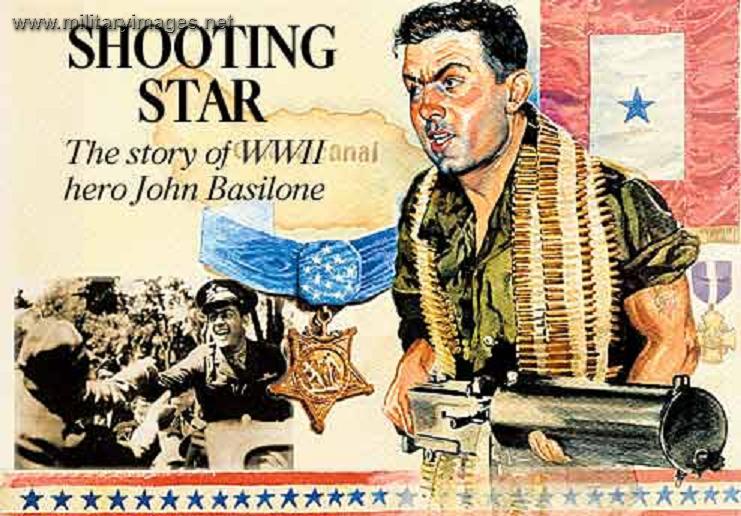
Back in the US, Congressional Medal of Honor recipient John Basilone (Jon Seda) is staying at the Biltmore and spending time with a blonde actress.  His actions are depicted in comic books- he’s famous.  His older brother (also a Marine) comes to visit him at the hotel.
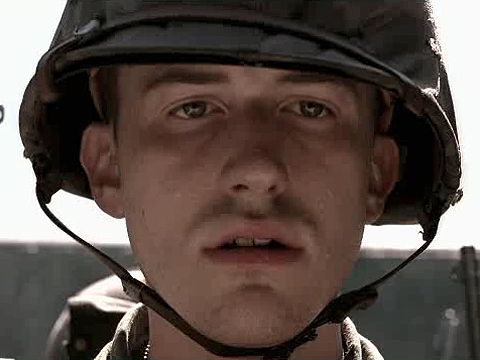
So far, this is the most visually stunning, frightening, and engaging ep of the series!  The viewer follows the teenage Sledge as he storms the beach at Peleliu, where the Marines faced some of the most dangerous fighting of the war.  He prays under his breath and his eyes fill with fear as men are blown up around him.  Sledge struggles to cross the beach, amid dead bodies, explosions, etc.  Simply riveting episode!


Part 6

Phillips (Sledge’s good friend/neighbor) goes home to Mobile, Alabama and meets with Sledge’s parents.  He says some consoling words to them, concluding that “He’s w/ a great bunch of guys.  I’m not worried for Eugene.”  “Mortar men” like him and Eugene are generally behind the most dangerous action, he explains.  However, Phillips’ eyes are heavy w/ concern.

Back on Peleliu, the men want one thing- water.  They find a poisoned pond.  They face tremendous fighting, but Sledge comes through it.  He even pulls up a fellow Marine, Merriell Shelton (Rami Malek) and assists him to cross a field.  When he admits that he’s “never been that scared in his life,” Captain Haldane comments that “Anyone who says he isn’t scared out here is either lying or dead.”  He earns the nickname “Sledgehammer” from the fellow he helped.


While lying in wait one night, a Marine has a terible nightmare and keeps screaming in his sleep.  The Japanese will hear them.  Two or three other guys nearby try to hold the disturbed man down to quiet him, but it doesn’t work.  Finally, one guy hits him w/ a shovel.  In the morning, he lies dead.  Shelton says: “Better him than us.”

Leckie, who has been wounded, meets with an old friend from an earlier battle, as they head away from the Pacific on a US carrier.


Part 7

The airfield on Peleliu was taken after 3 days.  But the Japanese weren’t going to give up.  There was an intricate system (w/ about 500 caves) on the island where they were hiding.  “The enemy was ruthless.  We were doing to have to dig them out one by one,” one WWII veteran said.  They were 30 days of heavy fighting w/ many Marines killed or wounded.

One night, Sledge shoots two men, thinking they are Japanese.  But in the morning, he realizes that one was an enemy soldier, but the other was a fellow Marine who’d gotten out of his foxhole.  An older Marine is very angry that this happened; they’re not allowed out at night from their foxholes.

Sledge hears some noise coming from a bunker that was said to be cleared by the 1st Division.  When the men go to check it out, they realize several Japanese are hiding inside.  They shoot, throw grenades, and bomb the bunker.  One Marine beside Sledge may be blinded by the impact from an enemy grenade.   Sledge kills one young enemy soldier w/ his bayonet when the man runs toward him.  He is a little stunned by what he has done.  The nest day, his Capt. Haldane says: “You can’t dwell on it- not any of it.”

A tough, older Marine is scared and unable to move after a sudden and terrible attack.  The younger men are surprised that “someone like him can break.”  Sledge hugs and consoles a fellow Marine when he breaks down in tears in the middle of the night.

The captain has been killed, Sledge and his men learn while on a patrol one sunny day.  As Haldane’s body comes by on a stretcher, several men have tears in their eyes.  Sledge is full of anger, and thinks about taking out a dead enemy’s gold teeth (as Shelton had done earlier).  But he takes off the insignia instead, crying at the loss of the captain who encouraged/motivated him when he needed it the most.

Sledge and the other Marines are stunned to see some pretty/young nurses handing out cups of lemonade when they finally reach camp.  They take a long-needed bath in the ocean.


Part 8

Peleliu was taken by the US, but  many people didn’t know about the horrible fighting that occurred there.  General MacArthur didn’t use that island for any future operations.     

Gunnery Sgt. John Basilone, who’s been selling war bonds for over one year, asks to train the new Marines.  His commander says: “You make me proud to be a Marine, son.”  (Basilone’s enlistment will soon be up, and he wants to make an impact before that.)

When he arrives at Camp Pendleton, Basilone is struck by a beautiful dark-haired nurse, Lena (Annie Parisse).  It turns out that Lina is also Italian and a Marine (there are 3 stripes the arm of her white uniform).  Unlike the young Marines and other nurses, Lena is not automatically impressed by Basilone (“the hero of Guadalcanal”) when he asks her for a dinner date.  She knows about his penchant for starlets.

But John keeps on trying and she invites him to have breakfast very early (before her KP duty begins).  B/c of this, he wakes the men up at 3:30AM for a 10K run- LOL!  Lena makes coffee and French toast in the mess and they talk about food, family, and their love of Marine life.  You can see John falling in love; Lena is intrugued my him.  “It’s amazing what can happen over a cup of coffee,” John comments.

John and Lena talk, spend time at the beach, and fall deeply in love.  Though he has re-enlisted, she agrees to marry him.  They marry in a little church near Camp Pendleton.  During their honeymoon, John says that he wants six kids.  Lena gives him her little gold cross necklace that she always wore around her neck.

Basilone enters the battle at Iwo Jima alongside the Marines he trained.  “If you want to live, get off the beach!” he shouts to those men who are falling behind.  The men watch in awe as he runs, bobs, and weaves away from danger.  Suddenly, Basilone is hit directly in the chest, and falls down.  His fellows watch with wide/disbelieving eyes as their hero dies.

Part 9

This ep may be difficult to watch for some viewers.  Sledge, Shelton, and their fellow Marines are having a terrible time on Iwo Jima.  There is thick mud everywhere.  They have to dig trenches around dead bodies.  The Japanese will not surrender, so they have to be dug out.

Sledge is angered when a belligerant Japanese prisoner gets in his way.  He shoves the man away and gets a reprimand from an intelligence officer.  At another point, he comtemplates pulling out a dead Japanese soldier’s teeth (as Shelton had done before).  Shelton, surprised to see Sledge behaving in such a way, talks him out of it.  “They have bad diseases,” he says.

In one touching scene, Sledge finds an elderly Japanese woman who is mortally wounded.  She gestures to him to come and touches the barrel of his rifle.  Sledge is unable to shoot her (to end her miser); he puts down his weapon and gently cradles her in his arms.  She dies soon after.

When it seems like they can’t take it anymore, the Marines hear that “some big new weapon” has ended the war in the Pacific.  The Japanese surrendered.  Sledge, Shelton, and their division stay behind to “clean up the mess.”

Part 10

Six months after D-Day, Sledge, Shelton, and another Marine travel on a train across the South.  One man gets off in a small, dusty Texas town.  He’s waiting for his Australian girlfriend to come and marry him.  Shelton gets off in bustling New Orleans quietly, as Sledge is fast asleep.  Finally, Eugene reaches Mobile (where he is greeted by best friend Sidney).

Sidney is now engaged to one of the prettiest girls of their circle.  Eugene’s older brother (who fought in Europe) is also back safe and a married man.  He’s surprised to hear that Eugene went through the whole war w/o losing his virginity.  “There weren’t any women where I was,” he replies.  “Except nurses- and they were off-limits.”  But if Eugene goes out to in his uniform, he can get any girl, his brother says.  “No, I don’t think I’ll ever wear an uniform again,” Eugene concludes.

Leckie goes home to his parents small house in suburban New Jersey.  He gets his old job (local sports writer) back at the North Bergen County Register (w/ a $7 raise).  While typing away one night, he hears his neighbor Vera coming home from a date.  Bob’s still interested in her, though she never showed interest in him while they were growing up.  He gets into his dress blue uniform and goes over to her house to ask her out (w/ some subtle encouragement from his mother).  When Vera accepts a date for the next night with Bob, the officer gets jealous and drives off in his fancy car.

Bob takes Vera to a nice local restaurant, but he’s nervous.  He can’t keep from looking at her pretty face.  She says “you’re doing fine.”  Vera asks why he wants to spend time with her; Bob replies it’s b/c she’s someone he knows.  “You don’t really know me, Bob,” Vera corrects him with a smile.

What happened to all those letters he wrote to her about the war?  Bob explains that he never sent them. “To be honest, I never thought I’d make it.”  The words were eventually washed away with the rains, but they were “the best stuff I ever wrote,” he says.

Lena goes to Raritan, New Jersey to see the Basilone family for the first time.  Mr. Basilone compliments her in Italian.  John’s brother asks about how she’s doing.  It turns out that Lena won’t get a widow’s pension ($10,000) b/c John forgot to sign the required papers.  But she’s okay with that; she’ll continue working in the Marines.  She presents a box (w/ John’s medal inside) to his father.   Lena and Mrs. Basilone share tears and hugs.

Early one morning, while out with his father, Eugene puts down his hunting rifle and breaks down in tears.  “I’m sorry,” he says.  His father says it’s okay; they don’t have to shoot doves.  He embraces his son, says “You never have to apologize to me, Eugene.”

Eugene doesn’t feel much in a dancing mood when he goes to a party at Sidney’s house.  Sidney understands and gives him space.  When Eugene tries to enroll at a local university, all he gets are inane questions.  He spends time doing nothing for a while.  This worries his mother, but his father understands.  “You don’t know what men like him went through over there.  Just let him be for a while.”

At the end of the ep (last of series), we get to see pics of the real Marines and what happened to them after WWII.  The casting directors did a GREAT job in matching up the actual individuals w/ actors!

Well, I wanted to see this series when I heard Jon Seda (above left) was in it.  His Latin looks (he’s Puerto Rican), easy-going confidence, and charisma were BIG assets in portraying the almost larger-than-life John Basilone.  Another asset- Seda’a ability for subtlety (even when playing men that the audience has preconcieved notions about).  As some critics have commented, Seda actually looks younger and fitter than in his earlier roles!

The character I most identified with was Robert Leckie, played superbly by James Badge Dale.  In real life, Leckie wrote over 40 books- WOW!  Leckie, in my opinion, is the volunteer who has NO CLUE what he’s going into.  When he joins up, it seems like he’s going in for the experience.  He says he wants to write about it.  Also, Leckie doesn’t have a lot of confidence in himself, so he uses humor.  But he’s also a smart, observant, and sensitive guy.

In real life, Eugene Sledge was better known as the soft-spoken biology professor who retired in 1990 from the University of Montevallo.  “He didn’t fit any of the (military) stereotypes,” said one of his sons, John Sledge of Mobile. “He was gentle, scholarly, loved birdwatching.  He didn’t care about golf, football, NASCAR, and watched almost no TV.  He was a great reader who listened to Mozart … and learned the classical guitar.”  -The Birmingham News

The viewer is instantly empathetic towards Eugene (played w/ ease and quiet dignity by former child actor, Joe Mazzello).   Eugene is lanky, baby-faced, sheltered, and has a (potentially deadly) heart murmer.  In a few scenes, it looks like he might crack under pressure.  But he comes through it w/ help from his fellow Marines (who become his friends).

Unlike Band of Brothers, this series focused more time on fewer characters.  It also brought in more personal stuff- family, romance, life after war.  I liked this approach, and wish there had been more personal development in Band of Brothers.  The action in The Pacific seemed more in your face (and scarier), though I think the earlier series had MORE fights.  All the minor characters, including some respected veteran actors, did great.  Watch this series- it’s great TV!
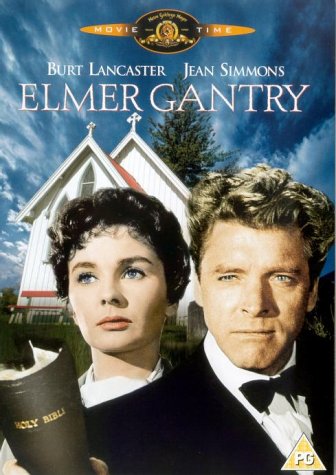
“Elmer Gantry” (1960)

The screen has never known a man like ELMER GANTRY!  (movie tagline)

At the opening, we meet Elmer Gantry (Burt Lancaster), a travelling salesman in a dusty little town in Prohibition era Midwest.  He drinks and tells stories at a rowdy bar on Christmas Eve.  All the while, he keeps an eye on the red-suited blonde in the corner.   (Women are one of his weaknesses.)  Some men comment that he “talks like a preacher” after Elmer convinces them to give money to women representing the Salvation Army.   At the end of the night, he takes home the blonde.  Well, it’s not really his home- it’s a tacky hotel room.


Something seems to shift in Elmer’s mind (and maybe his heart) when he goes to a tent revival and sees a beautiful, Evangelical preacher called Sister Sharon Falconer (Jean Simmons).  Earlier, he’d seen her posters; she’s kind of celebrity in small Midwestern towns.  When he briefly speaks to her, he realizes that she’s a no-nonsense gal.  Elmer is even more intrigued, so he cozies up to the group’s choir leader, Sister Rachel (Patti Page), to learn more about Sharon.  Rachel gets a huge crush on Elmer and invites him to join their entourage.  Never one to shy away from dramatics, Elmer hops onto the train at the last minute. 

Aboard the train, Elmer gets a seat by Sharon.  She finds him interesting; he’s a far cry from the “sanctimonious prigs” she usually meets.  Elmer also meets Jim Lefferts (Arthur Kennedy), a jaded Pulitzer Prize-winning journalist who’s been travelling w/ these Evangelicals and reporting on their movement.  Jim believes in evolution, not God.  Both Sharon and Jim quickly realize that Elmer is not a “true believer” in any cause (except maybe himself).

In no time, Elmer takes center stage at revivals, “warming-up” crowds for Sharon.  Her sober-minded manager doesn’t like the new direction.  But Sharon points out that Elmer’s “theatrics” are bringing in more lost souls yearning to be saved.  (Of course, some just want to be entertained.)  As Elmer (who was kicked out of his seminary) gains popularity, it appears that he’s finally found his calling- selling salvation.  Sharon starts to get close to him, too.  But wait, this isn’t the end of the story!       

Elmer Gantry explores some big issues: ambition, corruption (moral/political), faith, freedom of speech, forgiveness, hypocrisy, etc.   Even before this Oscar-winning film (based on a novel) was released, it was controversial.   Initially, no studio wanted to finance it.   Director (Richard Brooks) didn’t want Shirley Jones (pic above) in the role of Lulu, the young woman who unlocks Elmer’s past, but Burt Lancaster insisted. 

Though some viewers called his portrayal over-the-top, that is precisely what the character demanded!  Elmer is a bundle of energy, confidence (false or real), and words.  Not only does Lancaster make Elmer likeable, he makes him very fun to watch.  (There are MANY laughs in this film!)  But my fave scene is the one out in the woods where Elmer confronts Sharon about what men and women REALLY want from each other.  Elmer is not w/o redeeming qualities.  But does he deserve to be saved?  Watch this multi-layered film and decide for yourself!    

http://www.imdb.com/title/tt0053793/

What I watched recently…

Casa de los Babys (2003)

Motherhood can be one of life’s joys, but it is also fraught with trials and tribulations.  But what about the path to motherhood itself?  It’s not always smooth and easy.  This film (written, directed, & edited by indie filmmaker John Sayles) concerns a modern/controversial issue- foreign adoption.  As with Sayles’ other films, Casa de los Babys is for thinking people.  No character is one-sided.  Each actor gets a scene (or two) to shine.

Somewhere in Latin (or South) America, 6 women wait in the same hotel (nicknamed by locals as la casa de los babys) for their chance to be a mother.  (This film was shot in Acapulco, Mexico.)  The women don’t have much in common, hailing from different states and backgrounds.  But the women hang out at the beach, shop in the bazaar, see the sights, and share meals together.  They discuss future plans for their babies.  Who has the best ideas on how to raise a child?  Who has the most potential to be a positive/nurturing mother?

Skipper (Daryl Hannah) is a statuesque/serene woman from Colorado who works out often and speaks little.  Gayle (Mary Steenburgen) is a soft-spoken/born-again Christian/Southerner who seeks to mediate conflicts between the group members.  Jennifer (Maggie Gyllenhaal) is a wealthy 24 y.o. from DC who’s nervous and missing her husband terribly.  Eileen (Susan Lynch) is a sweet/thoughtful Irish immigrant to Boston who’s pinching pennies b/c her hubby is out of work.  Nan (Marcia Gay Harden) is a Kansan who holds strong (and often offensive) opinions.  She’s ticked off b/c she’s beein waiting longer than the rest (2 mos.) for her baby.  Leslie (Lily Taylor) is a single, 30 y.o. editor from NYC  who speaks Spanish and is brimming w/ sarcarstic humor.  Though still young, she’s “done the relathionship thing,” and wants to “get on with the kid thing.”

Besides the Americans, there are several other interesting characters.  Senora Munoz (Rita Moreno) is the tough/determined owner of the hotel who worries re: her ex-con son.  Senora Munoz’s brother Ernesto (Pedro Armendariz) is the forthright lawyer who helps the Americans w/ their adoption paperwork.  Asuncion (Vanessa Martinez; the teen Pilar in Sayles’ Lone Star) is the hardworking young maid at the hotel who supports her younger siblings; they are orphans who live in the mountaineous region above the beach.  Diomedes is a gentle/educated man who wants to go to the US b/c there is no work locally.  He gives Skipper and Jennifer a little tour, as he has nothing else to do.  A little homeless boy (around 7 or 8 y.o.) wanders the streets of the town washing windshields and looking to make money.  (To me, he is a sad reminder that older kids are rarely adopted.)

http://www.imdb.com/title/tt0303830/

http://en.wikipedia.org/wiki/Casa_de_los_Babys


Law & Order: UK (Season 1)

Dick Wolf has transported his successful NYC-based Law & Order TV series “across the pond” to London.  All of the Season 1 episodes (13 on 3 discs) were based on shown-on-TV L&O episodes.  (Long-time fans will recognize this right away!)  The producer took various scripts and modified them to fit UK law.  This show looks wonderful (high production value- like a big-screen movie), is fast-paced, and has top-notch (subtle) acting.  The veteran actors have terrific chemistry w/ their younger partners.  Some eps are more exciting than others, as w/ other L&O shows.

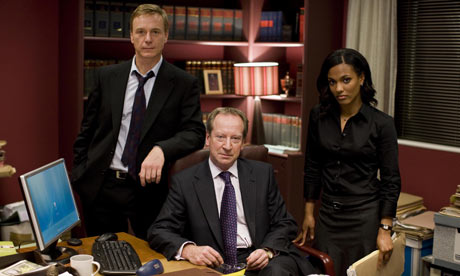
The Brit detectives are DS (Detective Sergeant) Ronnie Brooks (Bradley Walsh), “a gentle man and gentle cop” who’s a recovering alcoholic/street food lover.  Ronnie has a sympathetic ear, talks often re: his 2 exes, and is VERY likeable.  His partner is DS Matt Devlin (Jamie Bamber from Battlestar Gallactica), a young man of Irish parentage who worked his way up from humble roots.  He’s charming and eager to please.  While the experienced Ronnie sees a case from many perspectives, Matt is more quick to judge.

The lawyers (called Crown Prosecutors) are James Steel (Ben Daniels), a highly principled/sharp-dressed barrister from the upper crust (w/ posh accent).  His intensity, height, and sharp blue eyes may bring to mind actor Michael Moriarty, who played ADA Ben Stone.  James wears a wig in court, as is the custom.  Judges are referred to as “my lord” or “my lady.”  His is supported by Alesha Phillips (Freema Agyeman from Dr. Who), a young woman who has worked her way up from a council house (like the inner-city projects in US).  She performs research and goes through a mountains of paperwork (everything needs to be on hard copy).  Alesha is very passionate about the law, like her boss.

London is itself a character in this series.  Issues of class, race, and poverty are dealt w/ directly (perhaps more so than in the US).  One’s class is usually denoted by one’s accent.  (Not all English accents are the same!)

You will see a few British Asian (South Asian/desi) guest actors on L&O: UK.  In fact, the CPS barrister who consults on this show is British Asian- Nazir Afzal, director of CPS London South, is well-known for cracking down on “honor” crimes.  He has been awarded the OBE (Order of the British Empire).

http://en.wikipedia.org/wiki/Law_and_Order_UK

http://www.cps.gov.uk/london/


My 1st Broadway play!!!

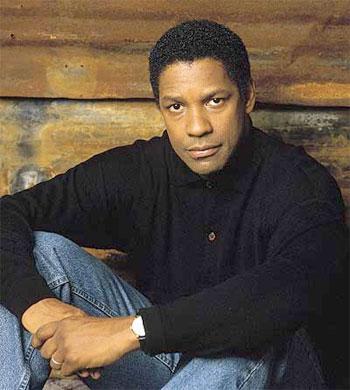
That’s my first love- the theater.  Denzel Washington 

INTRODUCTION

This past Saturday, I went to NYC to see my first Broadway play, the Pulitzer Prize winning Fences by August WilsonFences is part of Wilson’s Pittsburgh Cycle, a collection of ten plays.  Each drama explores a different decade in the 20th century, and each examines the lives and struggles of African Americans.  The 13-week limited engagement of Fences is at the Cort Theater (138 W. 48th St. btwn 6th Ave & Bdwy).

Playwright August Wilson

Fences is a powerful family drama set in the late ’50s starring Denzel Washington (twice an Oscar winner) and Viola Davis (recent Oscar nominee).  This is a character-driven story with one simple set (action takes place on the front porch of a humble little house).  I was lucky enough to get a ticket for the 9th row (close to stage). Once I got over the “Wow, I’m seeing Denzel in person!” feeling, I really got involved in the play.  The (diverse) audience enjoyed it very much, too.  We laughed, we got teary-eyed, and… WE SAW DENZEL!!!

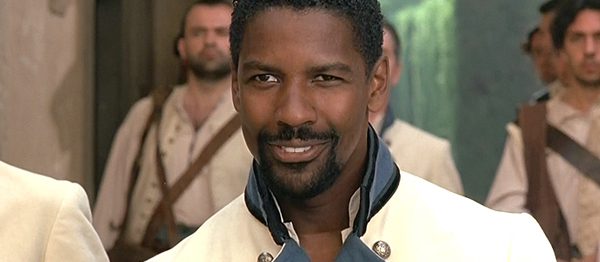
Denzel Washington (Troy)

At one point, Denzel’s character enumerated all that he had to give before exiting the stage.  One elderly woman called out: “I’ll take it!”  LOL!  And yes, he is JUST as handsome up close as onscreen. 

As expected, Denzel stopped traffic in front of the theater for some minutes while people hovered about seeking pictures or just a glimpse before the limos set off.   Unfortunately, he didn’t stay for autographs, but I noticed the young actor who played his son (Chris Chalk) signing playbills.

PREMISE

At the start of the play, Troy Maxon (Denzel Washington) is a 53 yr. old former Negro League baseball player who hauls trash in the Hill District of Pittsburgh w/ his best pal Jim Bono (actor/theater educator Stephen McKinley Henderson).  Troy lives in an old house w/ his 2nd wife Rose (Viola Davis) and their 17 y.o. son Cory (Chris Chalk).   Though Troy is illiterate, he is a hard-worker hoping to get a promotion.  Troy and Rose seem to have a solid (yet passionate) relationship after 18 yrs. together.  Cory works at the A&P (grocery store), but hopes to attend college on a football scholarship.

Viola Davis (Rose)

When Lyons (Russell Hornsby), Troy’s 34 y.o. son from a previous marriage, drops by on a FRI (payday) to ask for $10, Troy is NOT too amused.  He tells Lyons that he’s a married man now, and needs to take care of himself and his wife.  (Lyons’ wife works as a laundress, though she has trained as a nurse.)  Troy advises him to “learn a trade,” but Lyons insists that he’ll stick to music.  “I’m not like the rest of you- I’m a musician,” Lyons says with bravado.  Rose and Bono persuade Troy, and he grudgingly allows Rose to loan out the $10.  (Rose, a practical AND caring woman, is the keeper of the family purse.)  As Lyons picks up his horn to leave, the disappointment is evident on Troy’s face.  “He’ll be back,” Troy concludes.

While Lyons was visiting, Troy’s younger brother Gabe (Mykelti Williamson) dropped by.  Gabe, a WWII vet, has a “metal plate in his head” and is now mentally handicapped.  We learn that the Maxon house was bought w/ money from Gabe’s veteran’s benefits.  But Gabe recently moved out of the house to live in a boarding house.  “I got two rooms!” he enthusiastically tells Rose.  Gabe sells fruit in the neighborhood to earn a bit of money for his room/board.  

Though Rose is patient/kind with Gabe, his presence is an irritation to Troy.  “I done everything I can for the boy,” Troy exclaims w/ exasperation when Rose worries about Gabe’s health/habits.  Being in the hospital wasn’t right for Gabe, Troy rationalizes, b/c “what did he go over there and get his head blown off for” (if he can’t have freedom).

Troy has been waiting for Cory to help him finish the fence around the yard.  But Cory has been practicing football after school.  Cory announces to his parents a recruiter is coming to see him soon, and needs his Troy’s signature to sign him up (to play for a college in North Carolina).  Rose is very proud of her son, but Troy is skeptical.

Chris Chalk (Cory)

We learn that Troy has gotten a position as a driver, so he won’t be working in the back of the garbage truck w/ Bono anymore.  (Driving positions usually went to white men.)  When Bono points out that Troy can’t drive yet, Troy shoots back: “Everyone doesn’t gotta know my business!”  He’ll learn how to drive before it’s time for him to take up the new position.  Lyons comes by w/ good news- he has a steady gig at a good club.  Troy’s surprised when Lyons offers to give him back the $10 he borrowed.   When he invites his father to come hear him, Troy refuses by saying “I’m too old to be going to clubs.”           

Cory is desperate for his father to understand; he names different athletes (including blacks and Jews) who have excelled in baseball.  Troy bitterly tells Cory that he’s more stupid than he thought, and that there’s no future in sports for a black man.  Troy is enraged when Cory tells him that he’s quit his job at the A&P to concentrate on football.  Father and son square-off, and it looks like they will come to blows!

To learn what happens, go read (or see) the play! 


THEMES

Baseball is one of the themes of the play.  On stage right, a ball of rags is tied to a branch.  Both Troy and Cory practice swinging at the ball at the start of the play.  Later on, when the father and son argue, the bat will be turned on Troy – though Troy will ultimately win in that confrontation.  At the end of Act One, he warns his son: “You swung and you missed. That’s strike one. Don’t you strike out!”

Troy was a great baseball player, at least according to his friend Bono.  Although he played for the Negro Leagues, he was not allowed to on the white teams.   The success of Jackie  Robinson and other black players is a touchy subject for Troy.  He never earned the recognition or the money which he felt he deserved – and discussion of professional sports will often send him into a tirade.  Though Rose insists that “you were too old,” Troy feels it was solely racism that kept him shut-out.

During Act Two of Fences,  he uses a baseball metaphor to explain why he had an affair:

I fooled them, Rose.  I bunted.  When I found you and Cory and a halfway decent job . . . I was safe.  Couldn’t nothing touch me. I wasn’t gonna strike out no more.  I wasn’t going back to the penitentiary.  I wasn’t gonna lay in the streets with a bottle of wine.  I was safe.  I had me a family.  A job.  I wasn’t gonna get that last strike.  I was on first looking for one of them boys to knock me in.  To get me home.  …then when I saw that gal . . . she firmed up my backbone.  And I got to thinking that if I tried . . . I just might be able to steal second.  Do you understand after eighteen years I wanted to steal second?

Father-son relationships are very crucial in Fences.  On the stage, the emotionally strained relationship between Troy (who’s based on August Wilson’s stepdad) and Cory is highlighted.  At one point, Corey asks “Why don’t you like me?”  Troy is amused by this question, and retorts w/ “I don’t have to like you!”  Troy goes on to say that he gives his son food, a roof over his head, and provides for his life.  But Cory wants more from his father, but Troy is incapable of expressing that.     

But the unseen relationship of the play is the one between Troy and his father, who was a sharecropper in early 20th century Alabama.  Troy reveals secrets from his youth to Bono and Lyons in one (quietly powerful) scene.  After noting some of his father’s brutish behavior, Troy (who fled from home at 14) flatly calls him “The Devil.”  (Denzel really shines in this scene!) 

Freedom is another theme in Fences.  Several times Troy exclaims that he “needs to be free.”  But from what?  To the audience, he seems to have a lot going for him (at the opening of the play).  He has a supportive wife, talented sons, and a loyal best friend.  He’s struggling to make ends meet, but he’s NOT alone.  Everyone in the community is (of course) dealing w/ ingrained racism.  

As Troy’s character is revealed, we realize that he can NEVER be free of the one man he hates- his father.  Though Troy says he doesn’t behave like his old man, Troy is very hard on Cory.  When Cory gets angry and obstinate, Rose says w/ frustration: “You’re just like him!”  Perhaps we can never be free of our past, parents, and mistakes- they make up our character.     

THE ACTING

With such a stellar cast, the acting could NOT be anything but top-notch!  Denzel hit JUST the right notes w/ his role; he made Troy a believable (yet flawed) character.  With this type of character, some actors could go over-the-top, but Denzel keeps it grounded.  Troy is a complicated man, though HE would never admit to that.  He is charming, funny, sarcastic, hard-headed, etc. just like all of us.  But he DOES NOT analyze his actions; that’s just NOT his way.

Viola Davis’ role grows as the play goes on.  She does a terrific job in portraying Rose, a woman of great character and integrity.  We sense that Rose could’ve done much better for herself, given her sensibility and sensitivity, but she stuck with Troy out of love/passion/loyalty.  She invested a lot in their relationship, and is DEEPLY hurt when it breaks.  But, above all, Rose is a survivor, and Viola Davis suits this role to a tee.  There is no sense of acting.      

Related Links

Official site (w/ a GREAT NYT video interview)

http://www.fencesonbroadway.com./index.html

Denzel finds his “voice” in Fences

http://www.npr.org/templates/story/story.php?storyId=126195963

About playwright August Wilson:

http://en.wikipedia.org/wiki/August_Wilson

2 short interviews w/ Denzel:

http://www.youtube.com/watch?v=RKsDRcuePnk

http://www.youtube.com/watch?v=edtA7NapVKY

Classic Hollywood Trivia & Quotes

Dustin Hoffman and Gene Hackman roomed together in New York at Hackman’s one-bedroom apartment on 2nd Ave. & 26th St.  Hoffman slept on the kitchen floor.  Originally, Hackman had offered to let him stay a few nights, but Hoffman would not leave.  Hackman had to take him out to look for his own apartment.  (LOL!)

Another roommate of Hoffman’s in NYC was Robert Duvall.

They would often go to the apartment rooftop and play the drums.  Hoffman played the bongo drums while Hackman played the conga drums.

Gene Hackman worked as a doorman, soda jerk at a pharmacy, and moved furniture while he was a struggling actor in NYC.

Hackman (now retired) admitted that he took roles with money as the first consideration in some cases. 

Hackman said:

Dysfunctional families have sired a number of pretty good actors.

I wanted to act, but I’d always been convinced that actors had to be handsome.  That came from the days when Errol Flynn was my idol.  I’d come out of a theater and be startled when I looked in a mirror because I didn’t look like Flynn.  I felt like him.

I was trained to be an actor, not a star. I was trained to play roles, not to deal with fame and agents and lawyers and the press.


Hoffman said:

I wanted to be a jazz pianist, but I wasn’t good enough.

I started junior college in Los Angeles because I didn’t have the grades to go to university and I didn’t want to go into the military. So in my first year of junior college I’m failing and I don’t know what to do. I don’t want to get a job, I want to be a student, and a friend says, ‘Take acting, because they don’t flunk you – it’s like gym, nobody gets an F.’  I took it and suddenly it was the first thing I ever did that wasn’t painful. Where I held focus. And suddenly, rehearsing with somebody – learning lines – hours could pass by. And I begged my parents to let me go to this acting school, because I knew I couldn’t fail.


Laurence Olivier‘s ancestors were French Huguenots (Protestants) who fled to England in the 17th century because of persecution by the majority Catholics.  (That’s why his surname is French.) 

After he became ill, Olivier was replaced by Brando in The Godfather.

He  insisted that people call him “Larry” despite having several noble titles.


Olivier said:

Without acting I cannot breathe.

If I wasn’t an actor, I think I’d have gone mad. You have to have extra voltage, some extra temperament to reach certain heights. Art is a little bit larger than life – it’s an exhalation of life and I think you probably need a little touch of madness.

Surely we have always acted; it is an instinct inherent in all of us. Some of us are better at it than others, but we all do it.


Robert Redford lost his baseball scholarship and was expelled from The University of Colorado for drunkenness.  (His position had been pitcher.)

Some people have analysis. I have Utah.

I never did look like a 21-year-old just out of college who’d never been laid.  (On why he turned down the lead role in The Graduate– LOL!)

All my life I’ve been dogged by guilt because I feel there is this difference between the way I look and the way I feel inside.


Spencer Tracy served in the navy,  and worked as a bellhop, janitor, and salesman while doing stock theater.

Tracy didn’t like to rehearse and would read through a scene only once. He also never liked to shoot a scene more than once, and in most cases he didn’t have to.

He turned down Cary Grant’s role in The Philadelphia Story because he wanted to work on another film.

Tracy said:

It is up to us to give ourselves recognition. If we wait for it to come from others, we feel resentful when it doesn’t, and when it does, we may well reject it.

I couldn’t be a director because I couldn’t put up with the actors. I don’t have the patience. Why, I’d probably kill the actors. Not to mention some of the beautiful actresses.

Why do actors think they’re so God damn important? They’re not. Acting is not an important job in the scheme of things. Plumbing is.

This mug of mine is as plain as a barn door. Why should people pay thirty-five cents to look at it?