Movie Review: “Appaloosa”

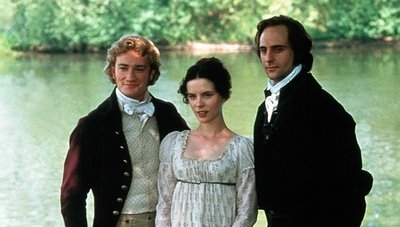
Ed Harris and Viggo Mortensen in France: WOW- talk about aging gracefully!!!

Last Sunday afternoon, I was feeling a little down, so I went to check out a new movie I was curious about.  (I wrote a previous post about Appaloosa.)  I would catagorize it as a subtle, low-key Western drama.  The small audience (mostly folks 50 and up) seemed to like the sly humor, in-depth characterization, and development of the female character (she’s not a one-dimensional woman like in traditonal Westerns).


The stars are: Ed Harris (lawman for hire Virgil Cole; he also co-wrote the screeplay and directed), Viggo Mortensen (Cole’s quiet, observant, long-time partner in “gun work” Everett Hitch), Renee Zellweger (young widow Allie French), and Jeremy Irons (rich bad guy/rancher Randall Bragg).

Cole and Hitch have been partners for many years.  They have traveled through little Southwestern towns enforcing the law whenever called upon.  Appaloosa is under siege by Bragg and his men; they drink too much, fight, don’t pay bills, and aren’t hesitant to use their guns.  The town leaders (scared stiff by the mention of Bragg) think he may have killed the former lawman of the town.  They quickly agree to the terms set by Cole (he carries his own list of laws), and he becomes marshall.  Hitch, who always carries a 12-gauge (a big gun), is his deputy.

Into the town comes Mrs. Allison French, a pretty, young, well-mannered widow.  She is cheerful and plays the piano, but hasn’t much money.  Cole takes an instant interest in her; he says she can stay in the town’s hotel as long as she likes.  Before you can say “Gunsmoke,” Allie is overseeing building a house and Virgil is helping choose curtains!  Everett is a bit surprised by his friend’s behavior.

Feelings get you killed.  (One of the taglines for the film)

Bragg, his men, and two newcomers to the town eventually use the budding romantic relationship to their advantage.


I liked the way that the film built things up, often in unexpected ways.  Issues that come across as simple in old Westerns are not so here.  (Remember that old Hollywood had to deal with stricter censorship codes.)  In those films, you had the bargirls/whores, married woman, and little girls- that’s all.  There weren’t many respectable single women hanging about.

Allie, who has an air of mystery, changes the dynamics (a little) between the two old friends.  She’s trying to survive in a man’s world, so she must rely on men (and all that comes with it).  Another woman in the town, a prostitute that Hitch sees, wonders if Allie “even knows how she feels.”  She can be sweet, bubbly, but is tough on the inside.  You’ll wonder about her past…

Viggo’s character, we learn in the opening narration, is a West Point graduate who served in the Civil War.  But his heart was not in “soldiering,” so he traveled West.  He helped Virgil out of a tough situation, and the men became partners.  Their friendship is very strong- almost like that of brothers.  In one great scene, Everett has to (physically) stop the older man from doing something rash.

There are humorous little moments, too.  Virgil has trouble with long, complicated words- Everett fills them in for him.  Jeremy Irons is pretty good as a evil guy, though I kept expecting him to revert back to his English accent!  (I guess we’re not used to seeing him as an American much.)  The scenery, music, and small characters all work well together, too.  Appaloosa is a very well-made, intelligent film with different layers.  It makes you think!

A Tribute to Paul Newman (1925-2008)


“There is a point where feelings go beyond words… I have lost a real friend. My life – and this country – is better for his being in it.”

-Robert Redford


 (You can purchase an art print of the above picture at Allposters.com.)

“He was my hero.”

-Julia Roberts, who served on the board of Newman’s Hole in the Wall Gang


“I was blessed to have known him. The world is better because of him. Sometimes God makes perfect people and Paul Newman was one of them.”

-Sally Field (starred with Newman in the legal thriller Absence of Malice.)

 “Paul was an American icon, philanthropist and champion for children. We will miss our dear friend, whose continued support always meant the world to us. Our prayers and thoughts are with Joanne and the Newman family and the many people who Paul impacted through his endless kindness and generosity.”

-A statement by Senator Hillary Clinton and former President Bill Clinton

 “If my eyes should ever turn brown, my career is shot to hell,” Paul Newman once joked.


“Why fool around with hamburger when you have steak at home?”

-Newman regarding his lasting marriage to Joanne Woodward


Yowza- domestic life looks smokin’ hot here!

“Sexiness wears thin after awhile and beauty fades, but to be married to a man who makes you laugh every day, ah, now that’s a real treat!”

-Joanne Woodward

“He learned to use that flawless face, so we could see the complexities underneath.”

-Manohla Dargis, New York Times web site 

Classic, elegant, engaging- words like these fit Paul Newman to a tee.  Not only remarkably handsome- striking blue eyes, chiseled face, athletic physique- he used the power of celebrtity to do many good works.  Like many great actors (that I admire), Newman started out in theater in his early 20s.  Quickly, Holywood noticed his gorgeous looks; he tried to go against the “sex symbol” image (not unlike protege and friend, Robert Redford). 

Brando and Newman at a civil rights rally (sometime in the early 1960s).

He was called “the next Marlon Brando”; both men studied at The Actor’s Studio.  Brando was known for his mercurial emotions (both on and off-stage); while Newman was subdued and cool.  But there was something under the surface, making him all the more interesting to watch! 

Newman realized that doing typical leading man parts (which hit big at the box office) would enable him to do projects (plays/small-budget films) which showcased his range of ability.

Above is a still from Cat on a Hot Tin Roof  with Elizabeth Taylor.  Wow, shouldn’t the set be on fire?  Seriously, Newman (who played depressed alcoholic Brick) is intriguing in this film, especially in scenes with Burl Ives (the overbearing Big Daddy).


In the eyes of mainstream Hollywood, Paul Newman took a risk with Hud- a memorable film where he played the swaggering, lay-about son of a Texan landowner.  Newman showed that charm can be dangerous.  Perhaps Hud’s anger towards his father affects his (bad) decisions?  Though he is a shallow character (not a tortured soul), Newman makes Hud very engaging.  Co-star Patricia Neal, the housekeeper that Hud hits on, does a great job also.  Noted film critic Pauline Kael wrote: there are some men who “project such a traditional heroic frankness and sweetness that the audience dotes on them, seeks to protect them from harm or pain.”

The Long Hot Summer is one of my mom’s favorite Newman movies.  The dialogue is terrific: fast, snappy, intelligent; the story was adapted from a novel by William Faulkner.  Newman and Woodward fell in love during the filming of The Long Hot Summer.  It’s an (unusual) love story involving two people who seem like total opposites.  Newman plays Ben Quick (great name for the character, you’ll see), a mysterious, charming, nearly-penniless man who is kicked out of one Southern  town.  He happens upon another town, and quickly makes himself useful to the wealthy patriarch of the community- Will Varner (Orson Welles).   


Mr. Varner’s daughter Clara (Woodward), a single, sensitive schoolteacher, has a strong dislike for Ben from the moment she meets him.  She feels that he can’t be trusted- an obvious opportunist in her mind.  Though he knows very little about Ben, Varner puts him in charge of the town’s general store.  Varner has a son (Jody) and daughter-in-law Eula (a very young Lee Remick) who also live with him in his mansion; they are newlyweds.   


But, the old man doesn’t see much of himself in his son, and soon thinks of Ben as family.  Varner’s lady-friend Minnie Littlejohn (a very funny Angela Lansbury) also seeks to be part of the family.  When her father (not so subtlely) suggests that Clara and Ben would make a good pair, she is horrified.  He wants grandkids to carry on his name, power, land, etc. To Clara, Ben represents heat, uncertainty, and other things that “nice girls” keep repressed.  Her blatant hostility doesn’t turn him off; he looks at her with unguarded interest.  “Miss Clara, you slam the door in a man’s face before he even knocks on it,” he says with disappointment.  During the picnic scene (see above photo), Clara clearly states what she is looking for in a husband.  She has not been saving herself up for a man like Ben, she insists.  Hmm, you shall see…  Below are some great lines from the film:

Ben and Clara discuss their (potential) relationship:

Clara: You’re too much like my father to suit me, and I’m an authority on him.
Ben: He’s a wonderful old man.
Clara: One wolf recognizes another.
Ben: Tame us. Make pets out of us. You could.


Varner talks about his youth:

Will Varner: I was young myself once. I used to hide in the greenery and hoot and bellow.
Clara: I’ll bet you did. I’ll bet you stayed longest and yelled loudest.
Will Varner: Your mama listened.


Varner confronts Ben about his past:

Will Varner: I got influence. I’ll dog you, boy, wherever you go. I’ll break you.
Ben: No, you won’t. You’ll miss me.  [Ah yes, very true!]

Movie Review: “Days of Heaven”

There is a pervading sadness to the movie, like a memory of something wonderful that could have been, that should have been, that almost was, and is all the more tragic because it was in your hands but slipped through your fingers. This is not a movie for everyone, but if you believe that film can be one of the highest forms of art, this is the film to see. 

–IMDB review

What is it really about?  Fleeting beauty. There aren’t any random shots in the film at all, each frame and edit is a word or period for thought and mood. What joys and disappointments to be found in life. The churning machines, the lighting, the chatter, the dialogue-free actions… 

–IMDB message board 


This is a very visually engaging and beautiful film that came out in 1978.  It was directed by Terrence Malick (mostly known for The Thin Red Line and The New World).  If you know his work, don’t worry, this movie is not overly long (only 94 minutes) and languorous!  The acting is subtle and the dialogue is simple, but you’ll be drawn in by the hopeful young characters and the natural beauty around them.  Oh, and the characters are beautiful, too!   

In the opening, Bill (Richard Gere- young and very striking), his girlfriend Abby (Brooke Adams- also youthful, but bright; wife of multi-talented Tony Shalhoub), and Bill’s pre-teen sister Linda (the narrator) are struggling to get by in pre-WWI Chicago. 
Bill, who has a short temper, gets into a fight (for no apparent reason) with an older man at his job; he unwittingly kills the man.  The self-made family travel (via train) to work on a wheat farm (during harvest time) in the Texas panhandle.  Bill and Abby, who are deeply in love and very comfortable with each other, pose as brother and sister in order to prevent “talk” about them.  

The Farmer (Sam Shepard- also a noted playwright; I think he resembled Viggo Mortensen as a young man) is wealthy, but looks sad and lives alone in his huge house (no relatives; single).  He becomes interested in Abby; Brooke Adams’ beauty is in her large expressive eyes.  The Farmer asks another employee about Abby, then one day, gathers up courage to speak to her.  After harvest, he suggests that she stay on to work on his farm.  The work would be easier, and it would be a more stable life.

When Abby mentions this idea to Bill, he doesn’t get jealous.  Bill overheard the doctor saying The Farmer doesn’t have long to live.  The family becomes friendly with the lonely man.  Very soon, we realize that The Farmer is in love with Abby.  The Farmer, who is kind and gentle, could give Abby a financially secure life.  But what will happen after she decides to marry The Farmer?  Will Bill be able to handle it?  (It’s not easy to be part of a love traingle!)  


I really like the shot below because it shows the harshness of their lives, though they are beautiful and young. 

The last 30 minutes are very interesting; the action picks up a lot!  Sam Shepard suits the role of a farmer very well with his tall, lean build and shy, quiet demeanor.  His character is easy to sympathize with!  Brooke Adams and Richard Gere look comfortable doing the hard labor of farmwork.  Gere grew up on a small farm in upstate New York.  You can believe that Abby and Bill are a loving couple, but their relationship is not (totally) secure.  I found her to be a very watcheable character.  It’s too bad that there wasn’t more dialogue- that’s what I like best in films.  However, you could see the conflict in the characters’ eyes, faces, body language. 


Check out this film when you’re in a reflective mood, or looking for something different from the ordinary.   

Classic Movie Review: “A Streetcar Named Desire”

Captivating, troubled, unpredictable, vulnerable- these words could describe Vivien Leigh, Marlon Brando, and the characters they played in this multi-Oscar winning movie. A Streetcar Named Desire was re-mastered and re-released in 1993; I have that 2-disc director’s edition of the film containing 3 minutes of extra/extended scenes and loads of special features.  (I love special features!)  

Blanche: I don’t want realism.  I want magic!

One of Hollywood’s most successful and controversial directors, Elia Kazan, was hand-picked by playwright Tennessee Williams for this film.  Kazan had directed the Broadway play, too; his body of work includes: A Tree Grows in Brooklyn, Gentleman’s Agreement (starring Gregory Peck), East of Eden (starring James Dean; Marlon Brando tested for the part, too), and On the Waterfront (also with Brando).  All the major actors (Brando, Kim Hunter, and Karl Malden) had worked in theater.  Though Jessica Tandy was on Broadway, she wasn’t a big enough star, according to Warner Bros.  So, Vivien Leigh, who’d done the play in London, was brought on-board.


Stanley: Be comfortable. That’s my motto up where I come from. You gonna shack up here? Well, I guess I’m gonna strike you as being the unrefined type, huh?

Well-bred, well-educated Blanche DuBois (Leigh) travels (via train and streetcar, of course) from small-town Mississippi to visit her younger sister Stella (Hunter) in hot, crowded New Orleans.  Blanche, a sensitive woman, almost can’t believe to what depths her sister has sunk.  Stella and her husband make their home in a stuffy, run-down apartment in the French Quarter. Their rowdy neighbors/friends drink too much, gamble, and make noise around the clock.  But most shocking of all- Stella has married Stanley Kowalski (Brando in a star-making role).  Stanley is a crude, volatile, working-class man of Polish descent.  (There are derogatory remarks about his background, denoting the prejudice of that time.)  Blanche is definitely not shy speaking about Stanley’s faults!


Stanley: That’s pearls, Stella, ropes of ’em. What is your sister – a deep sea diver?


We realize quickly that Stanley resents the presence of Blanche (with her fine clothes, jewels, perfume, and criticism).  Perhaps he sees her as a threat to his relationship with Stella?  Blanche is herself nervous and guarding secrets beneath her genteel Southern belle facade.  (I won’t give you too many details!)  Stella senses something is wrong.  Why has Blanche come to visit before the end of Spring term?  (She’s a high school English teacher.)  How did she lose their family estate?  But Stella mainly wants to keep the peace in her home, because who knows what will set off her husband?


Stella and Stanley’s relationship is based on lust; this repulses Blanche (she calls it brutal desire).  

Stella: I wish you’d stop taking it for granted that I’m in something I want to get out of. 


Stella seems happy about her life while Blanche is in a precarious situation: aging (over 30) and nearly penniless.  Then, tall and quiet Mitch (Malden) takes an interest in Blanche.  Could Blanche find some happiness with Mitch? 


Mitch and Blanche

Mitch: I have never known anyone like you.


Brando, though not yet 30, is simply amazing in this film; you won’t be able to take your eyes off him!  Brando was considered “naturalistic” and “realistic”- an actor who broke the mold of leading man in the 1950s.  And because of his penetrating eyes, brooding face, and muscular physique, Stanley is both attractive and repugnant to us.  Stanley is a drunken brawler one minute, then a contrite and confused little boy the next.  There is “ambivalence” in Stanley and in Brando, as Kazan said, that makes us wonder at his motivations.  “Brando was a genius,” says Malden in a behind-the-scenes interview on the DVD.  Check out this movie classic ASAP!


You showed me a snapshot of the place with them columns, and I pulled you down off them columns… 

Nate Parker

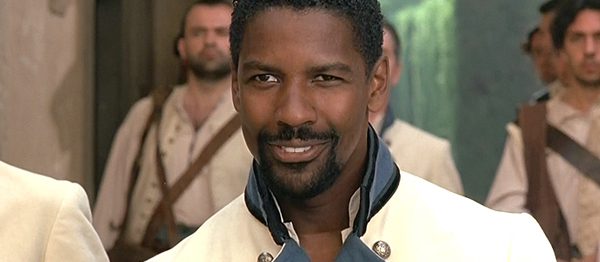
Isn’t it a BIT hard to believe that this hottie was a computer programmer!?  Nate Parker has the natural leading man qualities that will (hopefully) put him under the Hollywood spotlight.  If it’s been a while since you’ve been excited about a young actor (he’s just late 20s), check him out.

I first saw him on Oprah last November, and was wowed! You can watch him in The Great Debaters and Pride (both based on true stories).  It’s a tough job to go toe-to-toe w/ Denzel, but this young actor is up to the task.  And his smile- yowza!   


His co-stars Denzel Whitaker (still a teen, very sweet, and convincing in his role) and Jurnee Smolett (yes, Eve from the awesome Eve’s Bayou) are JUST as good!  You can check out part of the Oprah (she produced The Great Debaters) interview here: http://www.youtube.com/watch?v=8VgouaTuTXk