“Wives and Daughters” (BBC – 1999)

No character is one-dimensional in this miniseries (adapted from Elizabeth Gaskell’s novel) except the elegant and self-absorbed Mrs. Kirkpatrick (Francesca Annis).  A respectable and hard-working Scotsman, Dr. Gibson (Bill Paterson), marries the social-climbing former governess after living many years as a widower.  This surprises his devoted 17 y.o. daughter, Molly (Justine Waddell), and his friends/neighbors in their small southern English town.  Hyacinth Kirkpatrick has a daughter a bit older than Molly- Cynthia (Keeley Hawes). 

Though close in age, girl-next-door Molly is a total contrast to vivacious Cynthia.  When Cynthia arrives, “it’s as if Marilyn Monroe is has come to town,” comments Hawes on the special features of the DVD set.  Despite their obvious differences, the teen girls become good friends.  Cynthia and her mother don’t see eye-to-eye.   The new Mrs. Gibson doesn’ t want the girls to be “out” in society w/ those who are “course” to her eyes.       
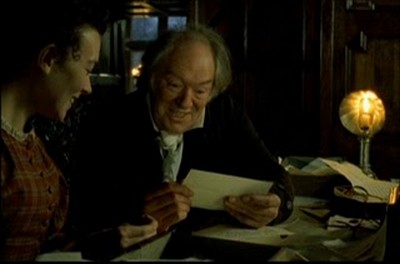
Molly is upset by her step-mother’s snobbish behavior.  She’s very close to the Hamleys, an unpretentious/good-hearted family in the neighborhood.  Squire Hamley (Michael Gambon) doesn’t have posh manners; he’s a country farmer who speaks with a broad local accent.  His well-born wife, Mrs. Hamley (Penelope Wilton), is very kind to Molly.  Both ladies are avid readers.

The Hamleys have two sons in their 20s, poetry-writing Osborne (Tom Hollander) and scientific Roger (Anthony Howell).  Molly thinks Osborne sounds very interesting at first, but becomes good friends with Roger.  She even becomes interested in his research.  But when Roger spies Cynthia, his passionate side comes out!   
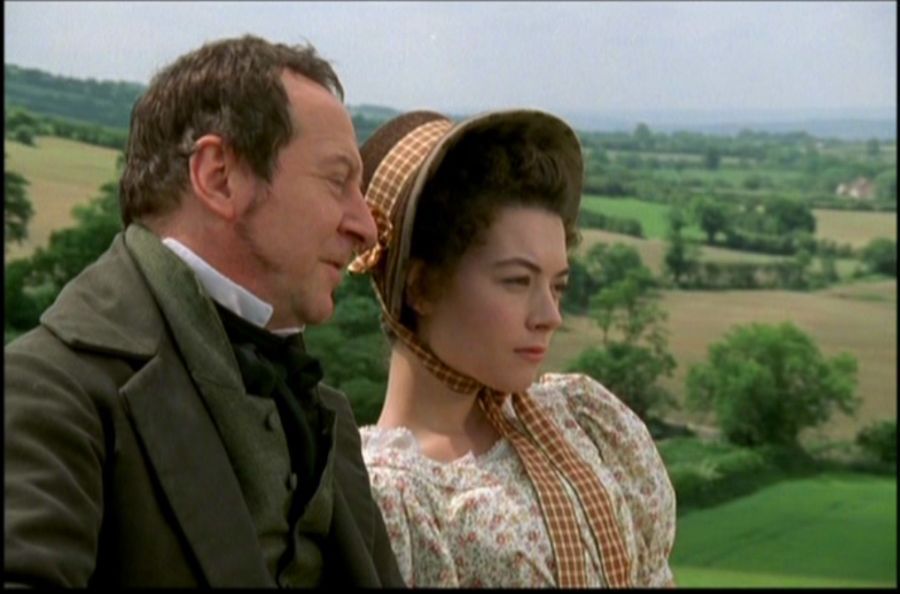
At the center of the story is the wonderful father-daughter relationship between the warm-hearted, yet protective, Dr. Gibson and Molly.  “I think she [Gaskell] got that right- the Scotsman,” comments Paterson (who is Scottish).  They have been on their own for so long, you can feel for Molly when a new woman enters the scene!  But the main reason Dr. Gibson remarried was to give Molly a mother.

Molly, like her father, is very concerned for her neighbors and speaks her mind.  Dr. Gibson rides off to see his patients at all hours; Molly checks in on the Hamleys when they’re having troubles. 

Though this is a Victorian story, there are dark undercurrents present.  The seemingly carefree Cynthia shares a secret with a handsome/mysterious land manager, Mr. Preston (Iain Glen).  Molly is puzzled by Cynthia’s strange reaction when he makes a social call at their house.  Her stepmother shares a past with Mr. Preston, some of the local gossips remark. 

Gaskell recognized that men and women (even in a quite conservative/corset-bound society) could become friends and share common interests.  Molly and Roger are both caring, observant, and intellectually curious individuals.  Out of such a friendship, a romance may develop.  These days, don’t many people hope to marry their best friend?
Recent views and more…

Films I’ve watched recently:

Leave Her To Heaven (1945)

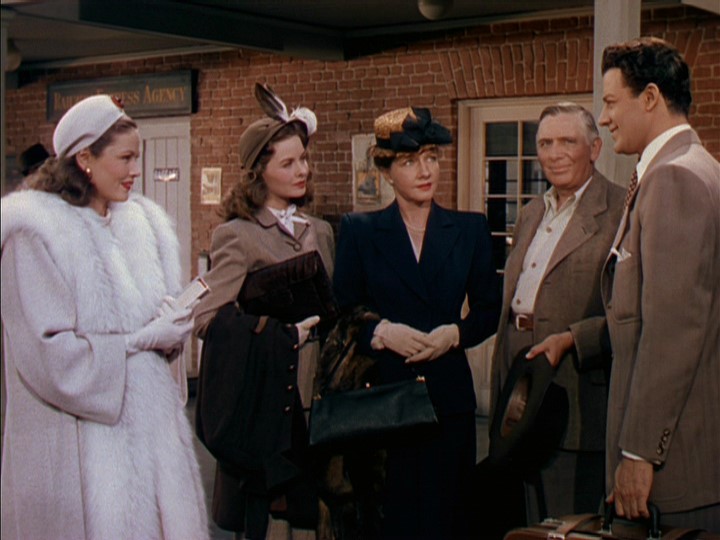
This drama about obsessive love (starring one of Hollywood’s most beautiful leading ladies, Gene Tierney) was considered controversial for its time.  Novelist Richard meets a socialite (daughter of a famous chemist) on the train to New Mexico.  He is instantly struck by her beauty.  Ellen (Tierney) is in New Mexico to meet-up w/ her mother and sister, then scatter the ashes of her beloved father.  Her family invites the well-mannered/charming Richard to spend time on their spacious vacation home. 

Ellen, a strong-willed/mysterious young woman, doesn’t hide her keen interest in Richard.  In the span of a few days, they fall deeply in love.  One night, her  former fiance (Vincent Price) drops in.  Russell is a self-assured prosecutor with his eye on politics; Ellen is very cold towards him.  Her family is surprised when Ellen suddenly proposes to Richard! 


The Last Time I Saw Paris (1954)

This drama, focusing on the joys and sorrows of marriage and sudden wealth, stars Van Johnson, Elizabeth Taylor, Walter Pidgeon, and Donna Reed.  In the exciting aftermath of WWII, a likeable/optimistic Midwestern GI named Charles (Johnson) shares a passionate kiss with a gorgeous young woman in a Paris crowd.  At a cafe, he meets a sophisticated woman, an American named Marion (Donna Reed).  It turns out that Marion is dating one of Charles’ old friends, a Frenchman named Claude.  Marion, who’s obviously interested in Charles, invites him to her house for a party.  

At the party, Charles is happily surprised to see the woman he kissed, Marion’s fun-loving younger sister, Helen (Taylor).  Though they seem like opposites, he’s down-to-earth while she lives for parties, they quickly fall in love.  The only problem is money; Helen’s father lives above his means and Charles is merely a struggling journalist/aspiring novelist.                 

I’m currently watching:

Equal Justice

This is an early ’90s courtroom drama deaing w/ ambitious/young Pittsburgh ADAs.  You can see it on Hulu; it ran for two seasons.  The cast includes a young Sarah Jessica Parker (then just 25 y.o.), former model Debrah Farentino, and several fine character actors: Jane Kaczmarek, Jon Tenney, and Joe Morton. 

The Tudors (Season 3)

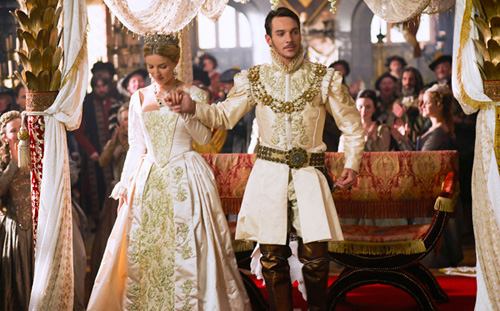
I have watched the first two episodes so far.  Henry (Jonathan Rhys Meyers) has started his married life (again) w/ Jane Seymour (Annabelle Wallis), a beautiful noblewoman who seems beyond reproach at first (b/c of her virginity, good breeding, and and mild personality).  Jane surprises and angers Henry when she speaks up for the banished Princess Mary (Sarah Bolger).  Jane quietly seeks to help women, who are “often put upon in this world.” 

There is unrest in the North (Yorkshire; Lincolnshire) as abbeys and churches (Catholic) continue to be looted and destroyed.  The clergy are disrespected and beaten, in many cases.  A group of “commons” (farmers, laborers, etc.) organize to voice their discontent.  A few nobles take on the cause.  Henry goes off on Cromwell (James Frain) when he realizes just how big the group has become.  These “pilgrims” starts marching to London, gathering more and more of supporters along the way. 

I’m currently reading:

How Starbucks Saved My Life – Michael Gates Gill

Fired after 25 yrs at one of NYC’s biggest ad agencies, the author (then in his early 60s) wonders what to do w/ his life while sitting at a Starbucks (78th & Lexington) near his childhood home.  He’s in dire need of health insurance.  Suddenly, a confident young black woman named Crystal, the manager of another Starbucks store (96th & Broadway) offers him a job.  With no other option at hand, he agrees! 


Update on me… and more!

Hey everyone,

How is your summer going?  Last week in DC was VERY humid (like Bangladesh, BUT not as extreme).  But I’m sure plenty of people were badly affected nonetheless!  I joined the pricy, but nice/clean Washington Sports Club (WSC) in downtown Silver Spring and plan to go to the group exercises classes Mon-Thurs.  Since I had a coupon, I bought some (comfy) gym clothes from Land’s End.


From eBay, I bought this (super cute) yoga bag and mat set.  These are made by Gaiam.   


On Thursday, a storm came in around 4 p.m. out all of a sudden.  The sky became unusually dark and threatening before the lightening, thunder, and heavy rainfall (for a short time).  There were electricity, Metro, traffic, and tree-falling problems.  But this time, power outages occurred mostly in Alexandria (NoVa), not so much in MoCo (where Dad and I live).

Dad is happy to have a new 40″ Samsung HD TV for the (upstairs) living room.  He bought a 32″ TV before, but thought that was a BIT too small.  Next up for the house- a backyard deck.     


What I’m currently reading:

Days of Obligation: An Argument with My Mexican Father by Richard Rodriguez

War Dances by Sherman Alexie


What I’m currently watching:

Horatio Hornblower (Collector’s Edition)

Bored w/ modern TV shows?  Check out this old-fashioned, British action-adventure series (which includes 8 full-length movies on 8 DVDs) starring a very young Ioan Gruffudd and Jamie Bamber.  Midshipman Horatio Hornblower is a 17 y.o. boy when he first joins the Royal Navy in 1795.  The Brits are at war w/ France, so there are plenty of battles at sea, hand-to-hand sword combat, and even some mystery and romance.  Aside from that, you see the development of a bright, honorable, well-intentioned youngster as he grows from a boy to a man (and leader).     


St Elsewhere (Season 1)

See the medical drama that came before ALL the rest!  Though the pace is slower than ER, the issues faced by the docs, nurses, patients, and their loved ones are often very touching and realistic.  The ensemble cast includes energetic up-and-comers Denzel Washington (confident; bold), Howie Mandel (funny, yet sensitive), and David Morse (an obvious inspiration for ER’s caring family man- Dr. Mark Greene).  I know what you’re thinking- Howie Madel as a doctor!?  Trust me, it’s a GREAT role!  The wonderfully natural, empathetic veteran actors bring gravitas to the show.  Look for guest stars before they were famous.  Another cool note: Tom Fontana worked on this show before Homicide.  (The first season is on DVD and on Hulu.) 

Thanks for visiting!

EMMA

“Hunger of Memory: The Education of Richard Rodriguez”

Mexican-American conservative essayist Richard Rodriguez (born 1944) is equally masterful on the page and onstage.  (He’s a frequent contributor to PBS and has speaking engagements all over the Western world.)  Many feel that education is the great equalizer.  Rodriguez argues in this biography (published in 1981) that there is a price to pay for that education.  Rodriguez also believes that class, not race, is the issue that needs to be addressed in our educational system.

As a little boy in 1940s Sacramento, California, he is “Ricardo”- speaking Spanish and sheltered by the protective embrace of his immigrant parents.  He sometimes has to translate for his parents in public.  Once he enters the local Catholic school, he becomes “Richard”-a thoughtful student who finds a keen interest in mastering English and reading great works of literature.  As the nuns suggest, the family begins speaking English at home.  English is the language of the public sphere.  Though they have worked their way up to a middle-class life, Richard notices that his parents don’t speak English with confidence as they did Spanish.  The loss of Spanish is correlated with the loss of closeness with his family.

By junior high school, Richard has read hundreds of books.  He learns about work by delivering newspapers and tending the gardens of his elderly neighbors.   Serving as an altar boy, Richard learns about the rituals of life.  (The author is still sustained by his Catholic faith and regularly attends mass).  As a teen, he becomes “the scholarship boy” and gains admission to Stanford (in part due to affirmative action, a policy that he later speaks against).  A local paper does a story on his educational success; he becomes an example in his community.

One summer, Richard works in construction, just to see what manual labor is like.  He finds himself enjoying it, partly because he’s not bound to this kind of work.  Richard realizes that most of his working-class co-workers make decent livings, unlike the Mexican illegals (who are sometimes bused in for the toughest tasks).  While the other men chat and laugh, the illegals are nearly silent and solely focused on getting the job done as quickly as possible.  Of course, they are paid less than the regular construction workers, but they have no voice to protest.

In college and grad school during the ’60s, Richard continues to excel and meets many wealthy, well-connected people (some of whom become life-long friends despite political and social differences).  As he climbs the Ivy-covered, politically-charged ladder of academia, he wonders what work will fulfill him in the long run.  He also begins to publish articles.  How can he live “a life of the mind” and still remain true to himself?

Richard Rodriguez’s thought-provoking and emotionally powerful book reads like many immigrant stories.  The author grew up in a time when assilimination into mainstream American culture was the key to success.  He lost a lot of his native Spanish, then gained it back after careful study in his early adult years.  In one Thanksgiving scene, the author explains that two of his siblings have married non-Mexicans.   Though Rodriguez’s father (who toiled in physically demanding jobs for many years) never fully mastered English, he was able to work his way up to a middle-class position.  Richard’s mother (who spoke English well) always worked outside the home, and eventually earned a secure position with the city government.  All of his siblings are college-educated and work in professional fields.

This book also delves into our American educational system, which Rodriguez feels puts too much emphasis on improving college education, but not elementary and secondary education.  How can a student succeed in college when he’s poor in reading or lacks everyday math skills?  When Rodriguez goes to speak in inner-city schools, he finds a vibrancy lacking in middle-class, mainly white schools.  The teens are wearing bright colors.  They pay careful attention to their hair, clothes, and personal style.  They are confident in their physical bodies and the author wishes he had been like that as an adolescent.  However, most of these poor and working-class kids (no matter of what race), will find limited opportunities as they graduate high school.

Movie Review: “Becoming Jane”

I first saw this movie (based on the biography of Jane Austen by Jon Spence) on You Tube.  I thought it was okay.  On first glance, I enjoyed the music and scenery (actually Ireland, not Hampshire).  I saw it again, and was very surprised by the superb acting, especially by the younger actors.  There were a few moments, involving Tom Lefroy’s wild behavior that seemed a bit extreme; aside from that, I have no complaints.  This is a beautiful, intelligent movie that I highly recommend to all JA fans!

Warning: My review has MAJOR spoilers!

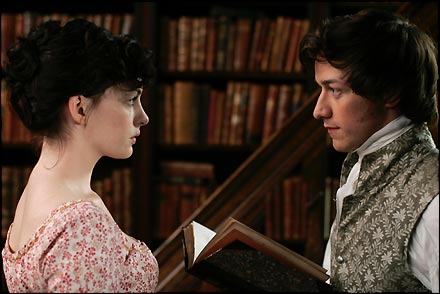
Anne Hathaway plays the 20 year old Jane who, over one tumultuous summer, falls in love with charming lawyer-in-training Tom Lefroy (James McAvoy).  Tom was sent to the country to stay with his cousins by his uncle, a high court judge.  This uncle, upon whom Tom relied, disapproved of his wild behavior (gambling, boxing, carousing with women, etc.)  Tom is also a great pal of the eldest Austen son, Henry (Joe Anderson, a very cute/blonde young actor).

Did you know Anne did her senior thesis at Vassar on JA’s works?  She takes her role seriously here.  Anne’s take on Jane seems well-researched; she never looks out of place.  She learned to write and play paino like JA did!  Upon first meeting Tom, Jane is not impressed.  In a letter, she calls him “insolent, arrogant, impudent, insufferable, impertinent.”   He is bored with this new “rural” set of people, and thinks he’s above them.  Shades of Mr. Darcy!

The Austen parents, James Cromwell and Julie Walters, are grounded in life’s realities, but they married for love.

“That girl needs a husband. But who’s good enough? Nobody!” -Mrs. Austen laments

Father is more sensitive to Jane’s wishes; mother is more of a realist.

“Jane should have not the man who offers the best price, but the man she wants.” -Rev. Austen

I liked Cromwell very much in this role; it really suited him.  (He can currently be seen as George H. W. Bush in Oliver Stone’s biopic W.)

“I will not marry without affection, like my mother!” -Jane to Mrs. Austen

“Affection is desirable.  Money is absolutely indispensable!” -Mrs. Austen to Jane

Another great supporting character is Jane’s beloved older sister Cassandra (Anna Maxwell Martin).  She is the shy, sweet, obedient girl in the family.  But her fiancé, the young parson-to-be, Mr. Fowl, dies overseas of yellow fever.  Cassie, who feels very deeply, never thinks of another man.  (This would later become the impetus for Persuasion.)  Anna suits her role very well; she had been in many period dramas, including North & South and Bleak House.

Henry, who also has a sub-plot, is pursued by their elegant, widowed older cousin, a French countess by marriage.  Eliza is the voice of the experienced, worldly woman in Jane’s life.  The countess uses her beauty, charm, and (especially) money to gain Henry’s interest.

“Sometimes affection is a shy flower that takes time to blossom.” -Mr. Wisley to Jane

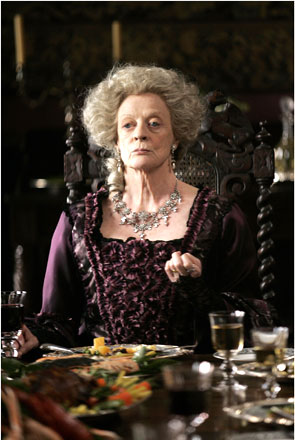
As you may know, Jane received a few marriage proposals over her short life.  One such offer comes from the tall, quiet, socially awkward Mr. Wisley (Laurence Fox) who will inherit the property of his childless, wealthy aunt, Lady Gresham (Maggie Smith).  (Wisley is loosely based on Harris Biggs, a man who proposed to the real JA when she was 27.)

Laurence Fox is the son of actor James Fox and cousin of the lovely Emilia Fox (who appeared as Miss Darcy in the popular Pride & Prejudice miniseries).  Laurence recently played Cecil in the new version of A Room With A View.  Mr. Wisley slowly grows to admire Jane’s independent spirit.  Lady Gresham brings to mind Lady Catherine from P&P, though she is a bit more humane.

Tom Lefroy was believed to be the one love of Jane’s life.  Below is a pic of the real Tom!

The young couple are ill-suited for each other, according to the prevailing thought of the day.  Though Tom seems like a free-wheeling, carefree guy, Tom is from a poor family in Limerick who depend upon him for support.  (His mother married his father for love, and they had many children.)  He’s the kind of young man who must marry for money, or wait until he has made some on his own.  But, like Jane, he has a non-conformist side.

Tom recommends that Jane read Tom Jones to learn more about the world of young men.  He never says anything negative about her desire to be a novelist.

“If you wish to practice the art of fiction, to be considered the equal of a masculine author, experience is vital.” -Tom advises

“I think that you, Miss Austen, consider yourself a cut above the company.” -Tom comments during a public assembly (dance).

“Me?” -Jane replies with surprise.

 “You, ma’am. Secretly.” -Tom observes wisely.

The main reasons to see this movie: James (and his very fine eyes- a great compliment in JA’s time), the terrific chemistry between him and Anne, and the gorgeous music.  James (the more I see of him, the more I want to see!) is full of energy, empathy, grace and style in this film.  He sinks seamlessly into his character, and these costumes look (especially) good on his frame.  He’s one of those (rare) young men who’s not afraid to look vulnerable.  His eyes are very expressive.  Anne calls him “a legend in the making” on the special features.  Check out Becoming Jane ASAP!