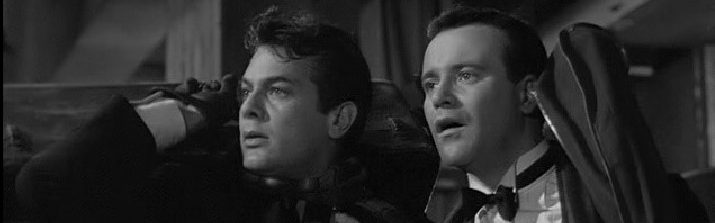
“They Drive By Night” (1940) starring George Raft, Humphrey Bogart, Ann Sheridan, & Ida Lupino

[1] The dialogue is salty and well-delivered… while the background stuff- the diners, rented rooms and garages- is beautifully detailed and always believable.

[2] …it features a top-flight cast of actors who are usually fun to watch.

[3] It’s mile-a-minute banter delivered by pros (this film played a big part in landing bigger roles for Bogie).

-Excerpts from IMDB reviews

[Paul is checking out Cassie, a waitress, at a roadside diner.]

Cassie Hartley: All right, that’s enough of the X-ray treatment.

This is the story of the Fabrini brothers, ladies’ man Joe (George Raft) and married man Paul (Humphrey Bogart), independent-minded truckers somewhere in California. They’d like to buy their own rig, but can’t afford one. There is tough competition and long-haul trucking is dangerous. Cassie Hartley (Ann Sheridan) is the wise-cracking waitress the brothers pick up on the road. Joe obviously has eyes for her. Later that night, they witness a terrible accident after a fellow trucker falls asleep at the wheel! Later on, circumstances drive them to work for Ed Carlsen (Alan Hale), a former trucker who runs his own business. His much younger wife, Lana (Ida Lupino), is very interested in Joe.

Joe Fabrini: Do you believe in love at first sight?

Cassie Hartley: It saves a lot of time.

This film is considered an underrated/lesser-known noir. Raft and Bogart are close in age and have great chemistry, so you believe them as brothers. It’s refreshing to see Bogie (before he became a leading man) as a regular guy; I don’t think I’ve seen him smile so much! I reviewed Thieves’ Highway (1949) earlier on this blog; it also deals w/ the trucking business. The screenplay of They Drive by Night was based on a novel by A. I. “Buzz” Bezzerides, who wrote Thieves’ Highway (based on his experiences as a first gen American/former trucker).

Producer Mark Hellinger’s wife, Gladys Glad (a former showgirl on Broadway for Ziegfeld), was responsible for getting this film made. Hellinger brought home a stack of scripts to read, skimmed this script, but felt that “nobody would pay money to see a bunch of truck drivers.” Glad read this script, liked it, and pressured her husband to read it. The film became the sleeper hit for Warner Bros. It was directed by Raoul Walsh and shot in just 33 days (in sequence).


“Hamlet” (1948) directed by/starring Laurence Olivier

[1] Heartbreaking, well acted, great script and direction, well paced,… it’s the clearest telling of Hamlet I’ve seen, old or contemporary.

[2] …Olivier is superb, his finest filmed acting performance. His Hamlet is measured and nuanced and brilliantly crafted…

-Excerpts from Amazon reviews

[1] Olivier portrays him primarily as “a man who could not make up his mind,” and his fine and often subtle acting brings to his role a deep understanding of his character’s inner struggles and dilemmas, both moral and practical.

[2] He shies away from the humor completely, and instead takes a slow, purposeful tack. To that, it might not appeal to some.

[3] The camera moves and sweeps everywhere… It creates extraordinary images and energy that make many scenes unforgettable- without calling too much attention to itself.

…the climactic fencing scenes are genuinely great- easily the best fencing scenes in a version of Hamlet and possibly among the best in film history.

-Excerpts from IMDB reviews

This is the first English movie adaptation (w/ sound) of Shakespeare’s Hamlet; it cost $2 million to produce (a large sum at that time). This is also the first British (non-American) film to win the Oscar for Best Picture. Laurence Olivier became the first person ever to direct himself and win the Best Actor Oscar. It was shot in black and white b/c (as Olivier later admitted) he was in a fight w/ Technicolor! Desmond Dickinson (the cinematographer) had a special maneuverable camera dolly made w/ tires (the first of its kind in England). To appeal to a wider public, Olivier and Alan Dent (text adaptor) modernized and/or clarified some phrases. This version omits Rosencrantz and Guildenstern. The “Do you think I am easier to be played on than a pipe?” scene is missing. Fortinbras, Prince of Norway, also doesn’t appear; some of his lines were given to Horatio.

Olivier (who wears a blonde wig and tights) can pull off many looks; he created his characters from the outside-in. He speaks his lines in a natural way, as if he had just thought of them. Even if you’re not a huge fan of Shakespeare, you’ll understand and be able to follow Olivier. The famous “To be or not to be” speech is done in an unique way atop a tower; at first, we hear Hamlet’s thoughts, then he speaks out loud. The scene where Hamlet peruses Ophelia’s face is done well (and somewhat unexpected). The adventure w/ the pirates is briefly shown; we don’t see that in the theater. Near the end, Hamlet leaps off the high stairway and stabs Claudius- another unexpected (and potentially dangerous) directorial choice! Olivier was uninjured, but the stuntman for Claudius was knocked out from the impact and lost two of his teeth.

Some critics/viewers didn’t agree w/ the emphasis on the Oedipal complex (a concept arising from theories of Freud) in this adaptation. Hamlet is more affectionate w/ Gertrude (Eileen Herlie) than I’ve seen in other movies and plays. Herlie (who hailed from Scotland) was quite younger than Olivier; she looked familiar (she played a matriarch on the American soap opera All My Children). She also played Gertrude in the 1964 movie starring Richard Burton. Gertrude and Claudius (Basil Sydney) made a believable couple, though you can also sense some tension. I think Gertrude knows the cup of wine is poisoned in the pivotal fight scene!

Christopher Lee (Count Dooku in Star Wars; Saruman in LOTR) is one of the palace guards; he holds a spear. Peter Cushing (Grand Moff Tarkin in Star Wars) is Osric, a foppish courtier. Lee and Cushing worked on 22 films together- wow! Anthony Quayle (The Guns of Navarone; Lawrence of Arabia) plays Marcellus, one of the friends who sees King Hamlet’s Ghost (John Gielgud). Stanley Holloway (Eliza’s father in My Fair Lady) is the darkly funny gravedigger. Terence Morgan (in this first movie) is Laertes; he is boyishly handsome and shines in the sword fighting scene. Norman Wooland (who worked w/ Olivier in Richard III) is Horatio; he has very thick/dark hair and a strong physical presence. Jean Simmons (w/ blonde hair) is Ophelia; she is youthful and vulnerable. She does a good job, but I wanted to see deeper characterization. Vivien Leigh wanted to play Ophelia, but Olivier (then her husband) said she was too famous. The scene of Ophelia floating down a river w/ flowers all over her dress and around her body is reminiscent of the painting by Sir John Everett Millais.

“Hamlet, Prince of Denmark” (BBC: 1980) starring Derek Jacobi, Patrick Stewart, & Claire Bloom

This movie (available to rent on Amazon Prime) was part of the BBC TV Shakespeare project (1978-1985). Claudius (Patrick Stewart) played Derek Jacobi’s stepdad though he is 2 yrs younger. Gertrude (Claire Bloom) was only 7 yrs older than Hamlet. Jacobi was mentored by Olivier while he was a new actor on the London stage! Jacobi played Claudius in the 1996 movie version directed/starring his mentee- Kenneth Branagh. Jacobi’s long-time partner, Richard Clifford, has a fine supporting role in Branagh’s Much Ado About Nothing.

Originally, Director Rodney Bennett wanted to shoot on-location, but BBC said all productions were to be studio based. He said: “it is essentially a theatrical reality. The way to do it is to start with nothing and gradually feed in only what’s actually required.” The production design is open w/ no time-specific architecture, and a lot of empty space. It looks like a kind of filmed-copy of the stage play. The play is in its entirety, which is rare in film.

As I watch Jacobi, I’m tempted to think that he’s every bit as intelligent as Hamlet himself, so alive is he to every nuance of this character’s wit. He deepens, rather than solves, every puzzle regarding Hamlet’s character.

His displays of emotion swing from hatred to sorrow, love to vengefulness and everywhere else on the map… some of the more powerful sequences occur when he underplays them, with stillness, soft speech and thoughtful expression. 

-Excerpts from IMDB reviews

We know the story, some of the lines, and the role is coveted by actors from all over the world. Olivier, Christopher Plummer, Richard Burton, Kevin Kline, Campbell Scott, Mel Gibson, Branagh, Ethan Hawke, David Tennant, Adrian Lester, Benedict Cumberbatch, John Simm, Andrew Scott, and Paapa Essiedou have all played Hamlet. Jacobi is able to show Hamlet as indecisive, funny (in a dark way), passionate, judgmental, and thoughtful. He puts the feeling behind the words, but it (for the most part) feels natural and not forced. When the players arrive at Elsinore, we see Hamlet’s flair for drama. One of the “meta” moments comes when the players gather around Hamlet as he takes on the role of director.

Is Hamlet really mad (crazy)? I don’t think so, though there are a few points where that can be debated. Is he contemplating suicide in the famous “to be or not to be scene?” I didn’t think so when I read it in HS and college, but now think differently. Does he want power himself or is mostly angry about the murder of his father? It’s up to us to decide; though he sees in young Fortinbras the “man of action” which he can’t (or maybe doesn’t want) to be. I thought of Hamlet as a scholarly type who (though 30 y.o.) isn’t quite ready for a leadership role. Though this took me two nights to watch, I thought the last hour was very compelling (incl. the sword fight w/ Laertes).

“Royal Shakespeare Company: Love’s Labour Won” (2015)

Autumn 1918. A group of soldiers return from the trenches. The world-weary Benedick and his friend Claudio find themselves reacquainted with Beatrice and Hero. As memories of conflict give way to a life of parties and masked balls, Claudio and Hero fall madly, deeply in love, while Benedick and Beatrice reignite their own altogether more combative courtship. Set amidst the brittle high spirits of a post-war house party, where youthful passions run riot, lovers are deceived and happiness is threatened – before peace ultimately wins out. -Synopsis

I saw this play on Marquee TV (which is an arts and culture streaming service); I signed up for the free 14-day trial. The play is more commonly known as Much Ado About Nothing; it’s my favorite Shakespeare comedy. This adaptation is set in the time period made famous by the recent PBS drama series and movie Downton Abbey. Hero (Flora Spencer Longhurst) and Claudio (Tunji Kasim) are the younger/fresh-faced couple. Beatrice (Michelle Terry) and Benedick (Edward Bennett) are the slightly older/jaded pair content to be singletons. By means of “noting” (which sounds similar to “nothing,” meaning gossip, rumor, and overhearing), Benedick and Beatrice are tricked into confessing their love for each other; Claudio is tricked (by Don John and his accomplices) into rejecting Hero at the altar thinking she has been unfaithful.

We are in an English village w/ an estate fit for royals. In the living room, there is a tall/elegantly-decorated Christmas tree. In one hilarious scene, Benedick hides inside the tree (while Leonato, Prince Don Pedro, and Claudio discuss him and Beatrice). There are songs and dances which come from (or are orchestrated to fit) the early 1900s vibe. We hear “Sigh No More” sung by Balthasar; it tells women to accept men’s infidelity and keep on living w/ joy. In the 1993 film directed by and starring Kenneth Branagh, the song is featured prominently in both the opening and finale.

Sigh no more, ladies, sigh no more,
Men were deceivers ever,-
One foot in sea and one on shore,
To one thing constant never.

Benedick and Beatrice (“too wise to woo peaceably”) are the main interest of the play; they have some of the best (and most memorable) lines. Terry (who became director of Shakespeare’s Globe Theatre in 2017) commented in an interview that “Beatrice felt very deeply,” so humor was a “defense mechanism” she used. I loved how this actress played the (pivotal) scene in the church.

I had rather hear my dog bark at a crow, than a man swear he loves me.

Not till God make men of some other metal than earth [would she consider having a husband]

Benedick is a bit disappointed when his best pal (Claudio) has the “intention to turn husband.” Benedick is also adept at using humor. The life of a bachelor suits him best, and only a rare woman would convince him otherwise.

…But it is certain I am loved of all ladies, only you excepted: and I would I could find in my heart that I had not a hard heart; for, truly, I love none.

I wish my horse had the speed of your tongue.

I liked how this production created a balance between the light and serious moments. The humor is played (mostly) w/ subtlety, as would suit Brits from that era. Beatrice, Benedick, and some of the minor characters have scenes w/ physical humor. I was impressed by how light the actors were on their feet (when the scene called for it). You can watch some scenes below!

Beatrice and Benedick meet.
Leonato, Prince Don Pedro, and Claudio set a trap for Benedick.
Beatrice and Benedick say they love each other, but she wants him to kill Claudio!

“Les Miserables in Concert: The 25th Anniversary” (2010)

The story is one we know and very simple: a former convict, Jean Valjean (Alfie Boe), tries to rebuild his life w/ adopted daughter Cosette after the death of her mother, Fantine (Lea Salonga). Valjean is pursued for years by a police inspector, Javert (Norm Lewis). Against the backdrop of student rebellions in Paris, a student named Marius (Nick Jonas) and the grown-up Cosette (Katie Hall) fall in love. The songs are also very memorable, incl. Who Am I? and Bring Him Home (sung by Valjean), I Dreamed a Dream (sung by Fantine), and On My Own (sung by Eponine). In a time when there are protests in cities (around the world) calling for racial equality and justice reform, this story still resonates.

Fans of the musical will notice that Salonga previously played Eponine in Great Performances: Les Misérables in Concert (1995)- the musical’s 10th anniversary. The petite (yet powerful) singer is the first full-blooded Filipina to have won the Olivier (1990), the Tony, Drama Desk, Outer Critics Circle, and Theatre World Awards (1991) for Best Actress in a Musical for Miss Saigon. In recent years, she was a guest star on Crazy Ex-Girlfriend, a comedy w/ musical numbers. Most famously, Salonga was the singing voice of Princess Jasmine in the Disney animated movie Aladdin (1992). Not only is she an amazing singer, she also acts out every moment of her role here!

Samantha Barks (Eponine) played the same role in the 2012 film version. Jenny Galloway previously played Madame Thenardier (a crowd favorite) in 1995 and repeated her role in this production. Ramin Karimloo (Enjolras) went on to play the title role in The Phantom of the Opera 25th Anniversary Concert a year later opposite Hadley Fraser (Grantaire) as Raoul. Karimloo (who fled Iran w/ his parents when the shah was overthrown in the early ’80s) made his Broadway debut as Valjean in the 2014 revival and earned a Tony nomination for Best Actor in a Musical. Lewis is perhaps best known as Edison, a senator and one of the ex-boyfriend’s of Olivia Pope on the ABC TV series- Scandal. He became the first Black actor to play the phantom in The Phantom of the Opera on Broadway. Unlike most of the other phantoms, he has a baritone voice (which is rich and very impressive).

At the end of the concert, we see the original 1985 cast, the international tour cast, and the current cast. We hear Colm Wilkinson (considered the best singer to portray Valjean), John Owen-Jones, Simon Bowman, and Boe sing Bring Him Home. There is an appearance by Michael Ball (the original Marius in the London production; a big star in the UK), composers, lyricist, and producer (Cameron Mackintosh). You can rent this show on YouTube; it’s a must-see for fans of the theater (esp. since we’re stuck at home)!

The casting of Nick Jonas, of Jonas Brothers fame, is little more than a casting publicity stunt, and one which almost backfires catastrophically. Quite simply, Jonas is leagues out of his depth, and his voice has not the power nor range to do justice to the role…

So many excellent singers have brought such depth and strength to the character of Jean Valjean and Alfie Boe does an admirable job. His beautiful rendition of “Bring Him Home” really proves he has the chops to handle this role.

Norm Lewis, whose subtle facial expressions and genuine passion commanded the stage/screen, sang Javert with such power and depth that I actually, for the first time, empathized with his character.

No other musical has the power to raise hairs and bring goosebumps throughout, and at the same time bring entire audiences to tears…

-Excerpts from IMDB reviews