3 must-see period films

Lost in Austen (BBC, 2008)
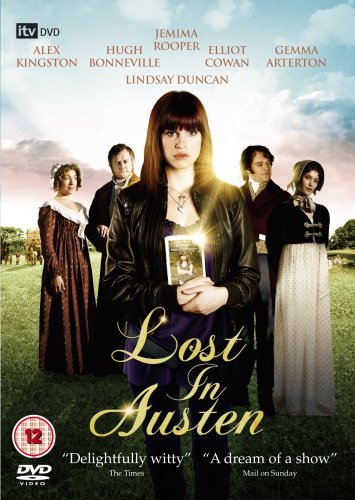
lost_dvd

This show (seen last year on BBC) is a MUST-SEE for all Jane Austen fans!  It has a great cast (including gorgeous/talented new faces), looks beautiful (costumes, cinematography, lighting), and is full of humor.  There are jokes viewers of ALL ages will get, BUT there are also in-jokes for devoted fans of Jane.  (I liked those jokes best, of course!)

Amanda (Jemima Rooper) and Elizabeth (Jemma Arterton)

Amanda Price is a modern-day JA fan who enters into her fave novel, Pride and Prejudice.  She takes the place of P&P’s main protagonist Elizabeth Bennett.  But life in Georgian England is NOT as easy as it seems in the book!
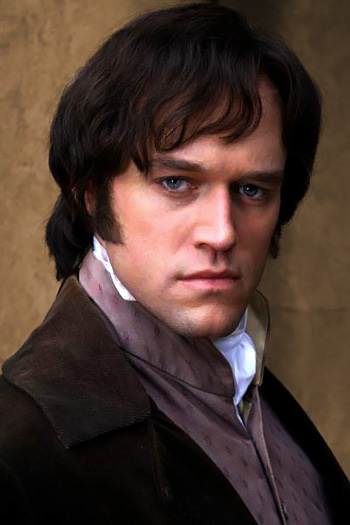
The newest Mr. Darcy (Elliot Cowan)

Amanda meets the the entire P&P gang, plus a few NEW characters (Mr. Collins has brothers- LOL!)  Alex Kingston (ER) and Hugh Bonneville (Daniel Deronda, Miss Austen Regrets) are TERRIFIC as the Bennett parents.  

But the best part is Amanda’s complicated relationship w/ the newest Mr. Darcy!  As in the novel, Darcy is tall, imposing, and irritatingly proper.  (His voice is VERY cool, too!)  At first, he is shocked by Amanda’s (modern/odd) behavior.  She doesn’t want to fall for Darcy- she wants to keep  things EXACTLY like the novel.  But things quickly go wrong!     

eliot

An interview w/ Elliot Cowan:

http://women.timesonline.co.uk/tol/life_and_style/women/celebrity/article4635114.ece


Middlemarch (BBC, 1994) 

middlemarch_dvd

I bought this DVD a few weeks ago b/c it was a VERY good price.  (If you’re a fan of Austen or Dickens, you should definitely check it out!)  It’s a miniseries based on George Eliot’s most famous novel.  She (the pen name of George was in honor of her long-time love, George Henry Lewes) was a writer who could describe a wide swath of society, much like Dickens.  There are MANY interesting/young people trying to carve out a place in the world w/o compromising their dreams.  (These include Jonathan Firth, Colin’s younger brother, and the unusually handsome/intense Rufus Sewell.) 
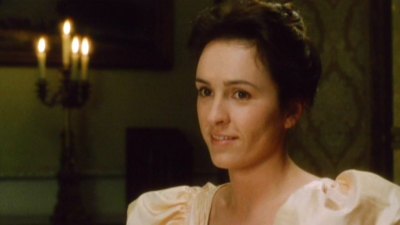
Dorothy (Juliet Aubrey)

The main female character is intelligent, serious-minded, natural beauty Dorothea Brooke (Juliet Aubrey).  She and her younger sister Cecilia (a more conventional girl) were orphaned before their teens, so they live on the estate of their wealthy bachelor uncle, Mr. Brooke.  (The estate is near to the town of Middlemarch.)  Though she has many fine qualities, Dorothea wants to “do something more” w/ her life than what’s expected of a young woman of her time.  She draws up a plan for improving the cottages of Brooke’s tenants, but he doesn’t want to spend money on the project.   

Even though her youthful/outgoing neighbor (Sir James Chettam) is in love with her, Dorothea merely sees him as a friend.  But she quickly grows interested in Rev. Casuabon, a VERY serious/middle-aged/scholarly man.  Dorothea thinks that she can help him in his work.   They have a brief courtship before marrying, much to the disappointment of her family/friends.   

During most of their honeymoon in Italy, Casuabon buries himself in libraries while Dorothea sees the sights with handsome/young Will Ladislaw (Casuabon’s cousin).  Will paints for fun, but wants to find a profession where he can make an impact.
Middlemarch9

Back home, Dorothea is impressed by the painting of a beautiful lady hanging in her house.  Will tells her the story of the unconventional romance between his British grandfather and Polish grandmother (in the picture).  Sadly, the lady wasn’t treated very well by her in-laws.  As he tells it, she is full of quiet amazement at the idea of such a relationship.  (We KNOW Dorothea hasn’t married for love.)     

Casuabon is emotionally distant and refuses his young wife’s help w/ scholarly work.  Dorothea desperately wants to make him happy, but she grows disenchanted with the cold, lonely marriage.  But she never complains. 

Will, who begins work as her uncle’s assistant, continues to see her as a friend.  Casuabon suddenly prohibits Will from coming to his house.  Dorothea is shocked- they did nothing wrong!   Did her husband sense something neither she nor Will can admit?              
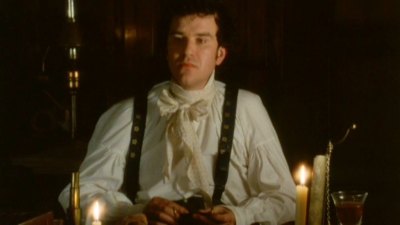
Dr. Lydgate (Douglas Hodge)

The main male character is intelligent, ambitious, and worldly Dr. Tertius Lydgate (Douglas Hodge).  Unlike most of the others in the provincial town of Middlemarch, he is a well-trained MD (w/ specializations done in Scotland and Paris.)  Most docs of that day were NOTHING like ours!  Lydgate is a newcomer who elicits much attention- sometimes of the negative kind.  The other doctors bristle against his techniques (such as warning patients against wacky potions and refusing to operate when not needed).   They feel he’s too young to overstep them.

Like Dorothea, he gives part of his time to the poor.  (They become friends as the story goes along.)  Lydgate’s an idealist who hopes to create BIG changes.  In his personal life, he is quickly drawn to the vivacious and chatty Rosamund Vincy, the daughter of a tradesman.  They fall in love and marry, though he’d intended to wait until he was financially/professionally more stable.   Rosamund dreams of status and money, ignorant of the goals he has.  Will marriage curtail Lydgate’s ambitions?

A GREAT in-depth review of this film:

http://costumedramas.wordpress.com/2009/04/18/middlemarch-1994/

The Wind That Shakes the Barley (2006)  movie_WindThatShakes

  We have a responsibility to attack the mistakes and brutalities of our own leaders, past and present.  If you lie about the past you won’t tell the truth about the present.British director Ken Loach  playing

You may not have heard of this film that came on recently on Encore; I saw it first in the BBC catalog.  It’s a glimpse into the Irish war for independence in the early 1920s as seen through the eyes of a group of very young men in rural County Cork.  At the center of the group is idealistic/sensitive Damien O’Donovan (Cilian Murphy- a native of Cork; The Way We Live Now, Red Eye, Batman Begins) and his older/charismatic brother Teddy (Padraig Delaney).  Damien is soft-spoken, slightly built, and well-respected for his smarts.   Teddy is tall, talks forcefully, and a natural leader.    harassment

Though most of his scrappy country pals are IRA (led by Teddy), Damien is about to go to a London hospital for training.  Then he witnesses some humiliating, unnecessary, and violent events perpetrated by the Black and Tans (British soldiers sent to quash the growing rebellion).         damien_sinead
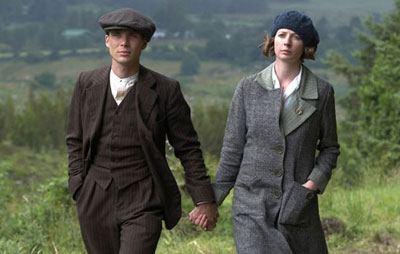
He takes up arms quickly- his community needs him.  Even Damien’s long-time female friend is part of the rebellion- she works as a messenger.      bros

This film juxstaposes the beauty of Ireland with the violence of the rebellion.   In some cases, long-time friends are pitted against each other b/c they have to preserve themselves.   Freedom is not the only issuse; in one scene Damien examines a little boy who’s near starvation.  How will this rag tag group of guys defeat the soldiers?  When a compromise is reached with England, Damien and Teddy are pitted against each other.  

More info re: this film: http://en.wikipedia.org/wiki/The_Wind_That_Shakes_the_Barley_(film) http://www.imdb.com/title/tt0460989/   cillian

More info re: Cilian Murphy: http://en.wikipedia.org/wiki/Cilian_Murphy http://www.imdb.com/name/nm0614165/

NEW Movie Review: Oliver Stone’s “W”

poster_w1

Josh Brolin stars as George W. Bush in this Oliver Stone biopic that traces the head of state’s rise to power from a privileged alcoholic to a born-again Christian whose belief in religious destiny helped move him to the top ranks of political power.  -IMDB synopsis

hat_w

Before I saw Josh Brolin’s (quite respectable) performances in American Gangster and No Country for Old Men, I thought the best thing about him was his wife (the fabulous Diane Lane)!  In W, he gets to stretch his acting repertoire (with help from several veteran actors).  The accent, mannerisms, and mistakes of W are on display here.  But Oliver Stone doesn’t create a (overly) negative picture of the president.  My mom commented that the film made her feel “a little sorry for Bush.”

tx_w

The heart of this film is the father-son relationship; W never feels like he measures up to H.W. (played with great ease/conviction by James Cromwell).  The grande dame of the Bush family, Barbara (Ellen Burstyn), gets a couple of good moments in the film.  She’s great- I wanted to see more Barbara!  Jeb and other family members are barely there; I wanted to know more about the siblings.

ew_w

Believe it or not, W was called “elitist” and “Eastern” when he first ran for office in Midland, TX (his family’s adopted hometown)!  Laura Welch (Elizabeth Banks; she did a fine job in Seabiscuit) was a registered Democrat when she was introduced to Bush at a barbecue.  Laura is as we’d imagine her to be, but her character is not deeply explored.  She’s your typical sweet, supportive, pretty Southern girl.

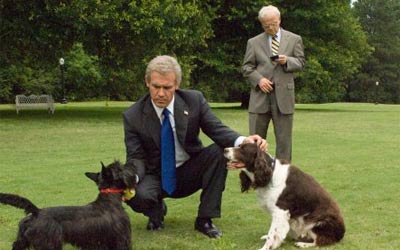
dogs_w

Once Bush enters national politics, he’s supported by “Vice” Cheney (Richard Dreyfuss), Condi Rice (Thandie Newton), Colin Powell (Jeffrey Wright), Donald Rumsfeld (Scott Glenn), and “genius boy” Karl Rove (Toby Jones).  My mom wanted to see more of Condi.  I wanted to see more of Dreyfuss and Glenn; they are solid veteran actors, but under-used here.  That’s just sad!  Dimunitive Brit actor, Toby Jones, gets a few interesting moments with Brolin.  Jones has played sneaky political types many times in his acting career.

frat_w

I was surprised that the first 20 minutes of the film were so dull.  It showed Bush as a young man acting the fool.  He drinks too much, can’t keep a job, and so forth.  My mind wandered off to other things.  I really liked the two long-ish scenes Brolin had with Stacy Keach (who played an Evangelical pastor from Midland).  Brolin commented in an interview that quitting drinking was one of the things he admired about W.  Unfortunately, there isn’t much to admire about this film.  We already know a lot of the things this film covers!  This is a different Oliver Stone than the one who made Born on the Fourth of July and JFK.  Those movie stays in your mind, unlike this one.

Two Classic Movie Reviews: “All About Eve” and “Hud”

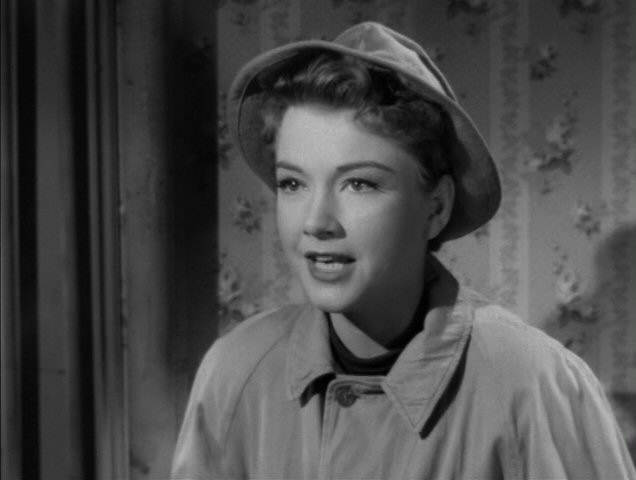
Anne Baxter as Eve
Anne Baxter as Eve, the theater newbie

Ruthless people can be fascinating to watch, as we learn from two wonderful classic (black and white) films, All About Eve and Hud.  Both films are character-driven (my fave kind!), thought-provoking, and intelligent.  The ruthless person in All About Eve (nominted for 14 Oscars!!!) is Eve Harrington (Anne Baxter; you can see her each Thanksgiving as the gorgeous Queen Nefretiri in The Ten Commandmants). 

Yul Brynner and Anne Baxter
Anne w/ Yul Brynner- WOW!!!

Eve is petite, with intense eyes, and (unusually) humble and ingratiating at the start of the film.  She adores Broadway star Margot Channing (Bette Davis) and wants to be a part of her world.  The kind-hearted wife of a great playwright, Karen Richards (Celeste Holm; she co-starred as the grandmother in the TV show Promised Land) introduces Eve to Margot and their circle of theater insiders.  They are touched by her sad life story and her sweet demeanor.  Soon, she becomes Margot’s personal assistant and lives in her apartment.  Margot’s long-time friend/housekeeper, Birdie, thinks that Eve is too good to be true!  What are Eve’s true feelings and intentions?  We wonder this because people are rarely so helpful, humble, and grateful like her.

What's she REALLY up to?

 Don’t get up. And please stop acting as if I were the queen mother. -Margot

The ruthless person in Hud (winner of 3 Oscars) is Hud Bannon (Paul Newman- taking on an anti-hero role), the 34 y.o. son of an old, honest cattle rancher, Homer (Melvin Douglas).  Hud is handsome, charming, reckless, and insensitive to the feelings/needs of others. 

Paul Newman as Hud

Movie tagline: The man with the barbed wire soul!

When he’s not (begrudgingly) working for his dad, Hud is living a protracted adolescence- driving too fast, drinking too much, sleeping with married women, and generally being a bad example to the real adolescent in the family, 17 y.o. nephew Lonnie (Brandon de Wilde).  Lonnie is cute, sweet, and thoughtful; he’s an orphan who also works/lives on the Bannon ranch.   

The only question I ever ask any woman is “What time is your husband coming home?”

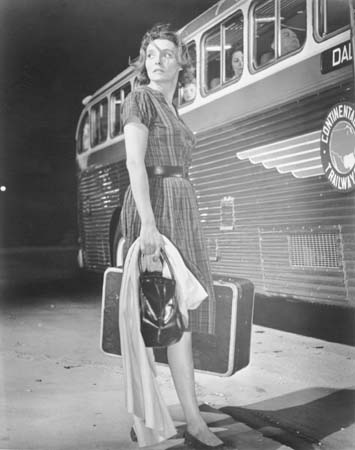
Hud flirts shamelessly with the ranch’s wise and earthy housekeeper, Alma (Patricia Neal).  But she is one woman in town that won’t be had easy!  When hoof and mouth disease threatens the cattle (and the family fortune), Hud suggests an underhanded plan.  Homer is surprised and disappointed by his son’s lack of principles.  But that’s not the only reason there is a distance/coldness between father and son!


If nothing else, there’s applause… like waves of love pouring over the footlights. 

Eve

Though Eve wins the trust and friendship of Margot, Karen, Bill (Margot’s director bf), and Lloyd (Karen’s hubby; a great playwright), she is not afraid to step on/use them on her way to stardom.  There is something disconcerting (notice the eyes) about her intensity and single-mindedness.   She is truly “a wolf in sheep’s clothing”- the ambition behind her smile knows no bounds!

…you don’t value anything. You don’t respect nothing. You keep no check on your appetites at all. You live just for yourself. And that makes you not fit to live with. 
-Homer
Hud, on the other hand, does nothing to disguise his “bad boy” side from his family and small Texas community.  He doesn’t apologize for his behavior because he sees nothing wrong with it!  Hud lives for pleasure (Jack Daniels whiskey, beautiful women, etc.) because he can’t live up to his father’s high moral standards (honesty, plain-speaking, moderation).  In one intense scene, Hud blames Homer for how he turned out, like an immature teen.  Lonnie, who observes his uncle carefully, is actually the bigger man in the film.  He grows to realize that Hud is no role model.

Eve is not the type of character that many viewers will sympathize with, though she is fun to watch.  Hud is self-destructive; only a dedicated actor like Newman can bring (a bit of) humanity to such a guy!  To discover those special moments, pay attention to his eyes, facial expressions, and body language during silent moments.  Sometimes the silence reveals more re: a character than his/her speech. 

Infants behave the way I do, you know. They carry on and misbehave – they’d get drunk if they knew how – when they can’t have what they want, when they feel unwanted or insecure or unloved.

Funny business, a woman’s career – the things you drop on your way up the ladder so you can move faster. You forget you’ll need them again when you get back to being a woman. That’s one career all females have in common, whether we like it or not: being a woman.

Margot Channing is a more well-developed character than nemesis Eve.  Though she is smart, talented, successful, etc., the actress is insecure about her love life.  She worries about getting old, even though her writer calls her “age-less.”  Margot creates drama where there is no need, trying the patience of her old pals.  Unlike Hud and Eve, Margot knows her faults and craves acceptance despite them.  She can laugh at herself- a great quality! 


Claudia: Oh, waiter!
Addison: That is not a waiter, my dear, that is a butler.
Claudia: Well, I can’t yell “Oh butler!” can I? Maybe somebody’s name is Butler.
Addison: You have a point. An idiotic one, but a point.

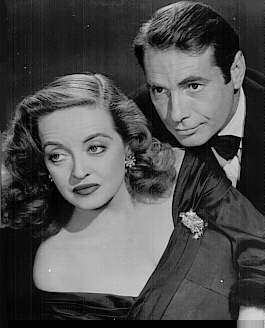
Marilyn Monroe has a small (but funny) part in All About Eve; she looks great (of course)!  The theater critic, Addison De Witt (George Sanders- standing by Marilyn in pic above) has some very witty/biting lines in this film.  He’s the bright, charming villain who takes an interest in Eve’s career.  I liked his character because he’s the one person who can go toe-to-toe with the real, ruthless Eve.  The best things about this film is the fast-paced, clever dialogue.

Hud has great cinematography; the B&W made the film look crisp and modern to me.  Paul Newman just becomes the character- one very different from himself.  His accent is flawless, too.  Check out these two films ASAP!

“Elizabeth: The Golden Age” (2007)

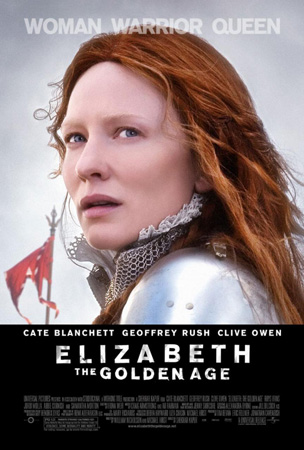
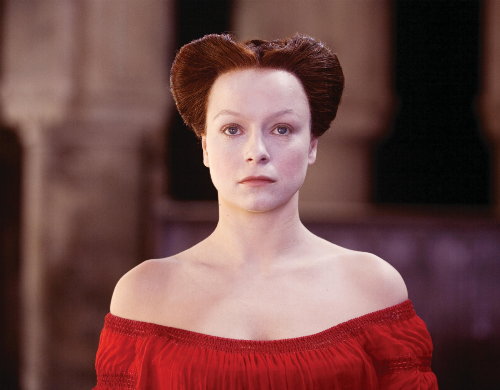
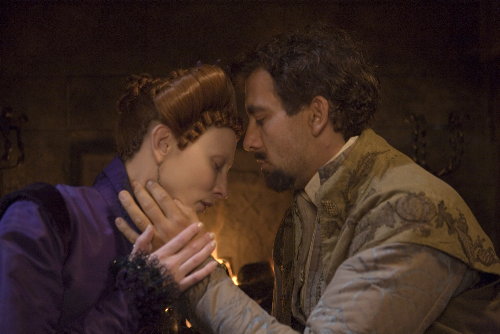
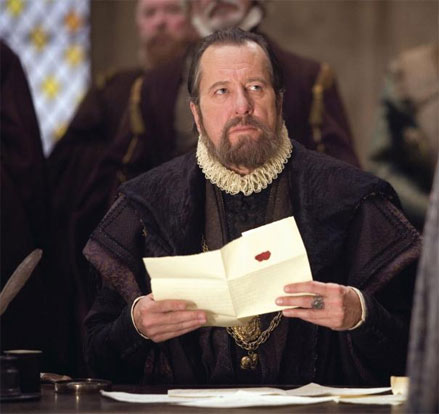
The “definitive” Queen Elizabeth of modern film (Cate Blanchett), director Shekhar Kapur, and the Queen’s “master of intrigue” Lord Walsingham (Geoffrey Rush) return to create a strong sequel.  The costumes, especially those of Elizabeth, are some of the MOST beautiful, intricate things ever seen!  The unusually high camera angles often used reminding the viewer of bigger forces at play in the world (God?  Destiny?) than the machinations of rulers.  There are new chracters to explore as well: sailor/adventurer/privateer, Walter Raleigh (Clive Owen); beautiful, sweet, young lady of the court (Abbie Cornish); the religiously fanatical King Phillip of Spain (Jordi Molla); the steely Mary, Queen of Scots (Samantha Morton).

This is my second viewing of the film; I saw it in the theater this past winter.  It’s the kind of film you MUST see in the theater to appreciate fully.  Kapur envisions this film as light (Elizabeth) vs. dark (Philip); he explains this in the Special Features of the DVD.  Elizabeth is now a mature woman and a confidant ruler, but her country is in trouble.  Spain has an incredibly strong navy (the Armada had more than 2,000 ships), the Inquisition (which Elizabeth says will take away “freedom of conscience and thought”), and a ruler who seeks to glorify God by conquering Britain.

At home, the Virgin Queen must deal with cousin Mary, who has many Catholic supporters plotting for Elizabeth’s demise.  Mary is imprisoned, but still sending out letters to the world.  England is about 50% Catholic, but the queen vows “I will not punish thought- only action.”  Elizabeth stood for religious tolerance, even when her Privy Council said that she should be more tougher on disloyal subjects (speaking/writing against her).

One day, while walking with her ladies from church, Elizabeth meets Raleigh.  He gallantly drops his cloak in order to cover up a puddle.  She is definitely amused and intrigued by the man, as is Beth (her favorite lady-in-waiting).  Raleigh is handsome, bold, and has been to the New World; he presents to the court Native Americans, potatoes, tobacco, and gold (captured from Spanish ships, of course).  You may know that Virginia was named in honor of Queen Elizabeth.

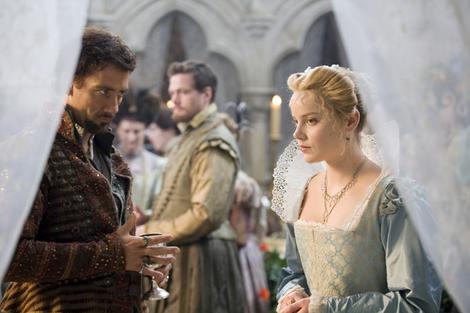
Raleigh speaks with Beth Throckmorton, one of Elizabeth’s closest ladies.

Raleigh was known to be one of Elizabeth’s “favorites” in real life.  In this film, Elizabeth is drawn NOT only to the (very charming) man himself, but to the life of adventure her leads.  She has never been away from British shores, and yearns to see more of what is “beyond the court.” 

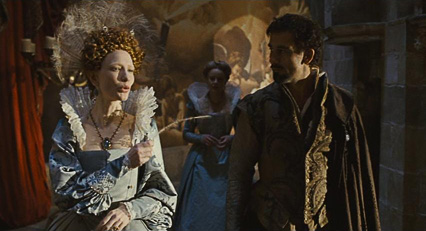
In the above picture, Elizabeth is enthralled as she listens to Raleigh’s account of life at sea.  This section of the film reminded me of Shakespeare’s tragic play, Othello.  (Desdemona fell in love with Othello because of his stories.)

Raleigh wants the Queen’s favor; however, he also shows concern for her as a person and friend.  Though the hair, make-up, and clothes (obviously) proclaim him the “hero” character, the acting is mostly in Clive Owen’s eyes.

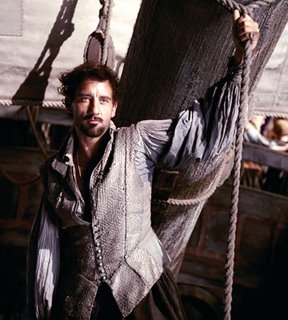
Sir Walter Raleigh (he was knighted by the Queen) aboard his ship, The Tiger.

Some people have complained about the (big) show of emotion in one scene involving the Queen, Beth and Raleigh.  (I understand that, because I thought it was a BIT too much as well.)  But who among us is always in control?  The Queen is NOT ONLY a ruler, she is a woman (who probably would’ve liked to have a husband and family- like most other women of her day).

The dialogue was pretty good, but there were a few places where I thought it could’ve been more subtle.  Modern audiences are NOT as dim as MANY screenwriters think!  The acting, especially by Cate, is VERY good.  In my opinion, this actress can play ANY role.  Geoffrey Rush is strong (as always) but low-key.  He was known as “the spymaster” who had eyes and ears all over Europe; his main concern is the Queen’s safety.

What struck me the most was the beauty of the locations (especially the many different cathedrals), the visual effects, and the scenes between Cate and Clive.  They had a good connection that was based on respect, I feel.  The music was not overly dramatic, unlike in many “epic” scale films.  Check out this film ASAP!

In Honor of Dr. Martin Luther King, Jr.

I thought about writing this because February is considered Black History Month.  But, as Morgan Freeman pointed out: “Black history IS American history- there is no separation”


“The question to ask yourself is not ‘What will happen to me if I stop to help this man?’  The question is ‘What will happen to this man if I do stop to help him?’”

-Dr. Martin Luther King, Jr. (“I’ve Been to the Mountaintop,” 1968)

The lines quoted above are connected to Jesus’ parable of the Good Samaritan that Dr. King spoke about in his “I’ve Been to the Mountaintop” speech in 1968. I listened to this speech recently via iTunes.  (Yes, I am crazy re: my iPod nano!!!)  The story, as he explained it, follows.  An injured Levite was laying on the road, a winding, dangerous road leading from Jericho to Jerusalem.  A priest came along that road and passed him by without doing anything.  Maybe he didn’t have time because he was on his way to a religious meeting.  Or maybe he was on his way to a road construction meeting.  Another Levite came by on the road later, but he did not stop to help the hurt man.  Finally, a man of a different race came to the same place in the road.  He dismounted from his animal and gave the injured Levite medical assistance.  Jesus pointed out to his disciples that this foreign man was the true man of God, because he was doing God’s will.

Dr. King used this story, as well as a few other related ones, to propel others to boycott big businesses that used unfair hiring practices.  He pointed out that black Americans had great economic power, and they could send a message by withdrawing their money from unfair banks, insurance agencies, etc.  Up until then, only the sanitation workers of Memphis, TN (where he was speaking that day) had been feeling the pain of boycott.  He said it was time “to spread the pain around” in the community.  “We are a poor people, but together we are more powerful than all the nations of the world except nine!”

Without the work of Dr. King and his disciples, we certainly would not have  affirmative action.  Legal immigration to the U.S. grew exponentially in the 1970s onwards, also because of his great legacy.  I was (a little) surprised when a professor pointed that out to me in college.  What other man in 20th century America has harnessed the influence of religion to do extraordinary things for our entire world?  Some of the “leaders” of today look very petty and insignificant when compared to Dr. King.  He sought to UNITE, while many today seek to divide people of different political parties, races, religions, social classes, etc.