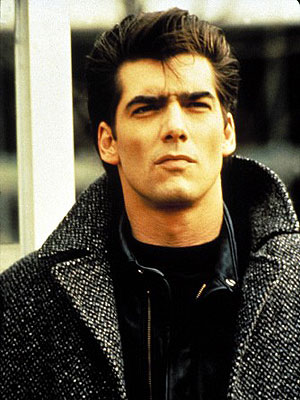
Wiseguy (Season 1, Part 2)

Season 1, Part 2 of the unusual ’80s drama continues w/ the always gorgeous OCB agent, Vinnie Terranova (Ken Wahl), going undercover as a bodyguard to unstable billionairre Mel Proffit (Kevin Spacey) in Vancouver.  Proffit is into guns and drugs big time, we discover over this series of eps.

Fans of Spacey are in for a treat here, b/c aside from Mel’s drug dependency and eccentric ways, there are a FEW believable and touching moments, too!  Vinnie gets himself wrapped up w/ Mel’s stunning younger sister Susan (Joan Severance, a former model).  I was surprised to see such capable acting from a novice (too bad that she’s mainly remembered for her looks and skimpy outfits).
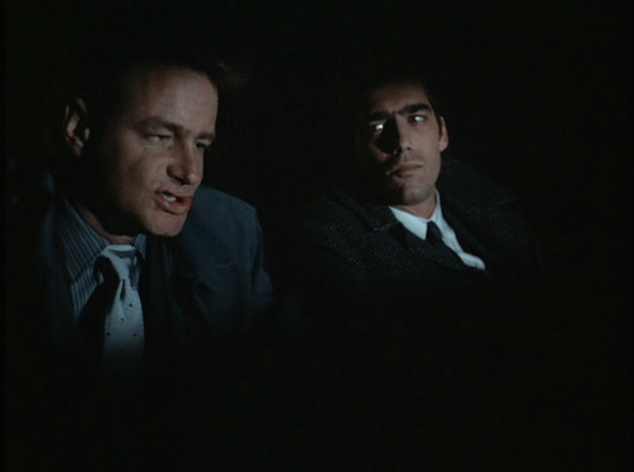
Mel’s most trusted associate (aside from Susan) is hitman Roger Lococco (Canadian actor William Russ; he later played the father on Boy Meets World).  Lococco, a Vietnam vet who operates according to his own code, is VERY intriguing.  Vinnie is mystified by him, yet feels like they’re connected somehow.  We eventually learn that Roger is MORE than what he seems.  Russ is a strong actor, so able to create a fine foil (or perhaps, frenemy) for Wahl.
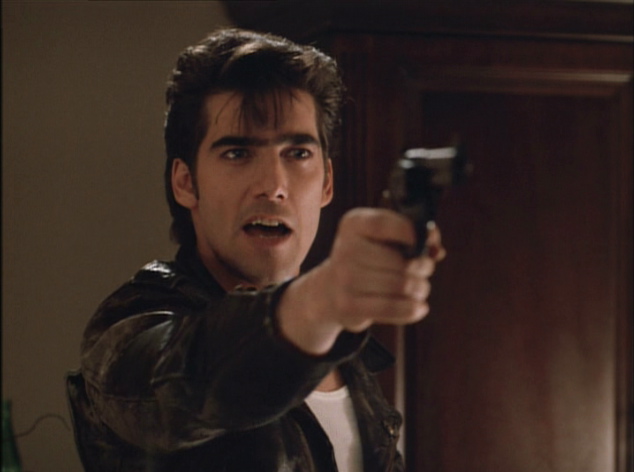
We also see more of Agent Terranova’s field supervisor, Frank McPike (Jonathan Banks), in this arc.  He becomes vulnerable, and more likeable, after his wife asks for a separation.  McPike, who has a young son, gets a love interest.  Vinnie calls on The Lifeguard (Jim Byrnes) more often to discuss his true feelings, not merely business.  They finally meet each other!

Yes, this show has action: guns, fistfights, explosions, etc.  But what keeps me watching are the interesting (sometimes wacky, admittedly) characters that Vinnie has to deal w/ on a daily basis.  He gets involved in their lives, sometimes TOO much.  Though it’s set in the late ’80s, the show is not 100% gung-ho about the police, government, etc.  Vinnie admits in this story arc that he doesn’t want this type of life for long; he thinks of a wife, kids, and wanting to “worry about crabgrass.”  If there was a modern show like this, I’d probably tune in!

Here is my earlier review of Season 1, Part 1.

https://knightleyemma.com/2011/11/21/wiseguy-season-1-part-1/

“Hunger of Memory: The Education of Richard Rodriguez”

Mexican-American conservative essayist Richard Rodriguez (born 1944) is equally masterful on the page and onstage.  (He’s a frequent contributor to PBS and has speaking engagements all over the Western world.)  Many feel that education is the great equalizer.  Rodriguez argues in this biography (published in 1981) that there is a price to pay for that education.  Rodriguez also believes that class, not race, is the issue that needs to be addressed in our educational system.

As a little boy in 1940s Sacramento, California, he is “Ricardo”- speaking Spanish and sheltered by the protective embrace of his immigrant parents.  He sometimes has to translate for his parents in public.  Once he enters the local Catholic school, he becomes “Richard”-a thoughtful student who finds a keen interest in mastering English and reading great works of literature.  As the nuns suggest, the family begins speaking English at home.  English is the language of the public sphere.  Though they have worked their way up to a middle-class life, Richard notices that his parents don’t speak English with confidence as they did Spanish.  The loss of Spanish is correlated with the loss of closeness with his family.

By junior high school, Richard has read hundreds of books.  He learns about work by delivering newspapers and tending the gardens of his elderly neighbors.   Serving as an altar boy, Richard learns about the rituals of life.  (The author is still sustained by his Catholic faith and regularly attends mass).  As a teen, he becomes “the scholarship boy” and gains admission to Stanford (in part due to affirmative action, a policy that he later speaks against).  A local paper does a story on his educational success; he becomes an example in his community.

One summer, Richard works in construction, just to see what manual labor is like.  He finds himself enjoying it, partly because he’s not bound to this kind of work.  Richard realizes that most of his working-class co-workers make decent livings, unlike the Mexican illegals (who are sometimes bused in for the toughest tasks).  While the other men chat and laugh, the illegals are nearly silent and solely focused on getting the job done as quickly as possible.  Of course, they are paid less than the regular construction workers, but they have no voice to protest.

In college and grad school during the ’60s, Richard continues to excel and meets many wealthy, well-connected people (some of whom become life-long friends despite political and social differences).  As he climbs the Ivy-covered, politically-charged ladder of academia, he wonders what work will fulfill him in the long run.  He also begins to publish articles.  How can he live “a life of the mind” and still remain true to himself?

Richard Rodriguez’s thought-provoking and emotionally powerful book reads like many immigrant stories.  The author grew up in a time when assilimination into mainstream American culture was the key to success.  He lost a lot of his native Spanish, then gained it back after careful study in his early adult years.  In one Thanksgiving scene, the author explains that two of his siblings have married non-Mexicans.   Though Rodriguez’s father (who toiled in physically demanding jobs for many years) never fully mastered English, he was able to work his way up to a middle-class position.  Richard’s mother (who spoke English well) always worked outside the home, and eventually earned a secure position with the city government.  All of his siblings are college-educated and work in professional fields.

This book also delves into our American educational system, which Rodriguez feels puts too much emphasis on improving college education, but not elementary and secondary education.  How can a student succeed in college when he’s poor in reading or lacks everyday math skills?  When Rodriguez goes to speak in inner-city schools, he finds a vibrancy lacking in middle-class, mainly white schools.  The teens are wearing bright colors.  They pay careful attention to their hair, clothes, and personal style.  They are confident in their physical bodies and the author wishes he had been like that as an adolescent.  However, most of these poor and working-class kids (no matter of what race), will find limited opportunities as they graduate high school.

“Mad Men” (Seasons 1 & 2)

The cast of "Mad Men" (AMC)
The cast of ensemble drama “Mad Men” (AMC)

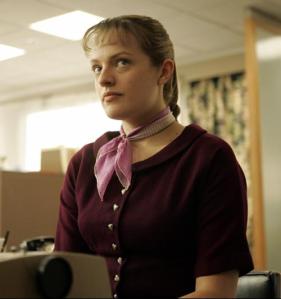
My little sister watches this show, so I decided to check it out.  (She’s usually in the know about what’s cool.)  Another reason to see Mad Men is Elisabeth Moss (known to many as President Bartlett’s youngest daughter, Zoe, on The West Wing).  Elisabeth’s character, Peggy Olson, starts out as a cheerful/eager/naive secretary at the start of Season 1.  Like the viewer, she doesn’t know what to expect from Sterling Cooper (the ad agency that is the main setting of the show).

Peggy Olson- always watching & learning

Women esp. will empathize w/ Peggy, a young woman who experiences workplace harassment (it’s the early ’60s after all), romantic disappointment, and disillusionment on her way to becoming a copywriter (in Season 2).  She brings to mind the compromises, trials, and sacrifices faced by early feminists, though Peggy NEVER calls herself a feminist.  Peggy works hard and wins the trust/confidence/respect of boss, Don Draper (Jon Hamm).

The unflappable Roger Sterling

After Peggy, my fave character is Roger Sterling (played by TV/theater veteran John Slattery).  Roger, a partner in the firm, is an “old-school” guy- charming, confident, and a heavy drinker (w/o any guilt, he comments).  He usually has a twinkle in his eye, enjoying work and life to the fullest.  I particularly enjoyed the few eps where Roger was worried about aging.

Don (Jon Hamm) & Betty (January Jones)
Don & Betty

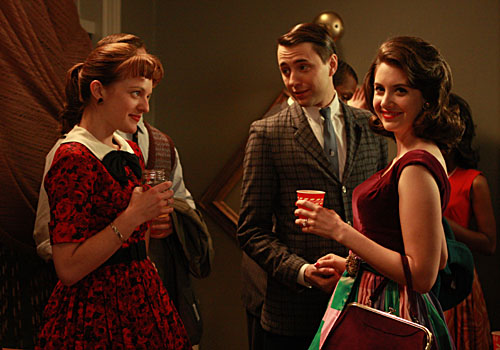
Peggy (Elisabeth Moss) & Pete (Vincent Kartheiser)

Don Draper (Jon Hamm) w/ bohemian Midge (Rosemarie Dewitt)

Don w/ businesswoman Rachel

Though many people have commented on Don’s hot & heavy romance w/ Midge, I thought the storyline w/ him and Rachel was MORE interesting.  She is a successful/single/lonely businesswoman who is a client of Sterling Cooper (in Season 1).   Don doesn’t want to work w/ her at first, but soon becomes intrigued by her perserverence.  Though Rachel is wealthy, she is an “outsider” b/c of her Jewish heritage.   Don falls deeply in love w/ her, and tells her secrets about his life.  (Unfortunately, I didn’t see this ep!)   He’s (visibly) shocked when he sees Rachel w/ her new hubby (Season 2).


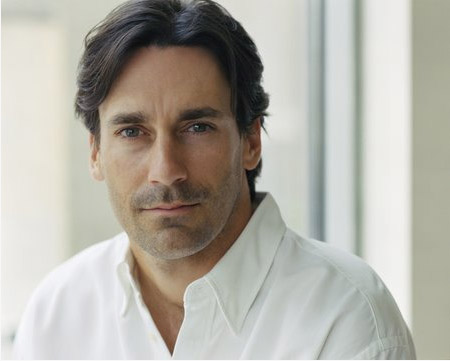
Jon Hamm in "People" mag (2007)
Jon Hamm in “People” mag (2007)

I watched a FEW interviews w/ Jon Hamm; he comes across as a VERY polite/sweet/unassuming actor.  He said he wears glasses and prefers his hair longer than Don’s in real life.  I watched Jon (a few yrs ago) as a sensitive detective on the Lifetime drama, The Division.  After a LONG struggle in Hollywood, this actor has made it BIG!

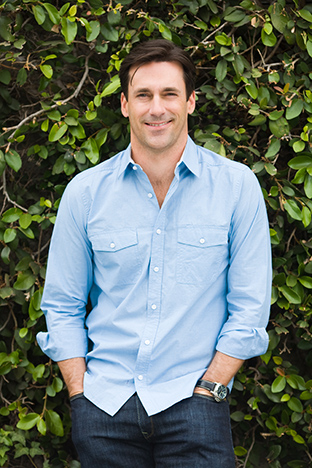
From Parade mag
From “Parade” mag

Hamm “has this wonderful sadness and lost quality in his eyes,” said director Alan Taylor. “It’s a rare quality for a strapping leading man.”  Leave your political correctness at the door, and tune in for Season 3 of Mad Men on SUN night!


Related Links:

An extensive Vanity Fair article: http://www.vanityfair.com/culture/features/2009/09/mad-men200909?printable=true&currentPage=all

Basket of Kisses: a Mad Men fan site

http://www.lippsisters.com/

A comprehensive Jon Hamm fan site:

http://www.jon-hamm.com/

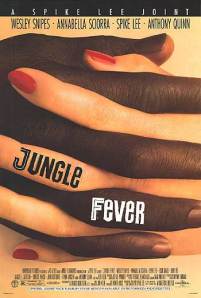
“Jungle Fever” (1991)

 jungle fever_dvd

This is my favorite Spike Lee film (aside from Malcolm X); I’ve seen it several times.  Lee’s premise for making this film: romantic relationships between blacks and whites are (sometimes) based more on curiosity than love.   He didn’t make the central couple (black architect Flipper Purefoy and Italian American temp Angie Tucci) very interesting, Roger Ebert said in his TV review.  However, the people in the communities they come from are VERY well done, he complimented.  I agree with Ebert b/c I wanted to know more re: the lesser characters! 

Flipper (Wesley Snipes) lives in a Harlem brownstone w/ his statuesque biracial wife Dru, a buyer for Nordstrom (Lonette McKee) and young daughter.  In the opener, he seems to have a loving relationship w/ Dru and his little girl (who he walks to school in the mornings).  A source of stress is his job- he’s the only black architect in his firm. 

Flipper (Wesley Snipes) & Angie (Annabella Sciorra)

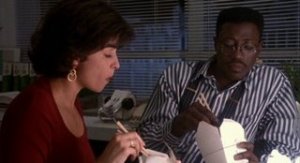
Flipper is visibly upset when his former secretary (a black woman) is replaced by a white temp, Angie (Annabella Sciorra).  “I specifically asked for a woman of color!”  Flipper exclaims to one of his bosses (played by Tim Robbins).  Even though things start out awkward, Flipper and Angie have a good working relationship.  They often work late, share takeout, and get to know each other.  One night, Flipper catches Angie admiring his dark skin.  She says “it’s beautiful.”  Though he has NEVER cheated on his wife, they begin an affair (right on the drafting table)! 

Gator (Sam Jackson) & Viv (Halle Berry)

Flipper eventually confesses to his best pal/upstairs neighbor Cyrus (played by Lee himself) that though he considers himself “a strong black man,” he was “curious about what it would be like” to be with a white woman.  As they are talking, Flipper’s older brother Gator (Samuel L. Jackson) and his girlfriend Viv (a very young and unglamorous Halle Berry) approach.  It’s obvious that Gator is a long-time crack addict, as is his “new lady.”  (Sam Jackson said that his OWN drug addiction in the ’80s helped him portray Gator in a VERY realistic manner.  Producers thought Jackson was a REAL crack addict when he did his screen test, so he had to come in AGAIN to explain it was just acting.)

jungle fever_gator
Lucinda Purefoy (Ruby Dee) can’t refuse giving her addict son money when he comes around, no matter how hard she tries.  Gator invents lame excuses to get a few bucks out of her whenever his father is not around.  The father, a VERY religious man called The Good Reverend Doctor (Ossie Davis) has cast Gator out “like the Devil.”  (I REALLY felt for the mother and her dilemna; if she didn’t give Gator money, he’d surely go out and steal it.)
Paulie (John Turturro) ponders his future

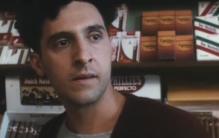
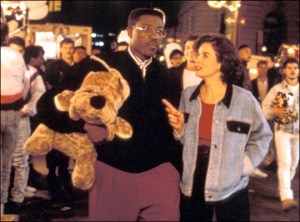
My favorite character is candy shop/newsstand manager Paulie Carbone (John Turturro).  He’s a hardworking/unassuming guy who dated Angie since high school (“b/c he’s from the neighborhood.”)  His overbearing/widower father (Anthony Quinn) has retired from the shop, but micro-manages everything his son does.  Paulie has a crush on Lauren, a young black executive who comes to the store for papers each morning.  She sees him as a friend, and encourages him to apply to Brooklyn College.  The unemployed/Italian American/racist local guys who frequent his store think of all this as a joke.  Paulie is an outsider in his environment, and you wonder if he can get the life he wants.         

junglefever

On one date, Angie asks Flipper “So what are we doing here?”  I think they’re taking a break from their everyday lives.  But their actions have consequences- Dru (along w/ her girlfriends) is VERY upset by her husband’s betrayal.  Angie’s father reacts w/ shocking violence.  After the famous girl-talk session (about color, dating, black  men, etc.), Dru quietly tells her pals: “It really doesn’t matter what color she is- my man is gone.”   

The main characters in Jungle Fever feel unappreciated, I noticed during this viewing.   Angie works all day, then cooks her for father and brothers w/o complain.  Paulie has put his dreams on hold to look after his father and the shop.  Flipper doesn’t get the promotion, so he resigns from his job.  Lee (who grew up in Bensonhurst when it had a large community of working-class Italian Americans) shows us that two people are NOT the only ones involved in a realtionship.  Personal relationships include family, friends, and (sometimes) the community-at-large.  Everyone has SOMETHING to say about Flipper and Angie’s affair, including an angry young waitress at a soul food restaurant (Queen Latifah in a brief, yet memorable, role). 

Want a Thrill?: Jagged Edge & No Way Out

Jagged Edge (1985)

jagged edge_poster

This is a film I didn’t know much about until I saw it last wk.  It’s not TOO gory or scary, but the opening scene might be hard to take for some viewers.  There is some trial testimony that MAY make you cringe, too.  The acting of the main players is quite strong.  There are twists and turns in this thriller, but I’m sure viewers will figure out some of them.

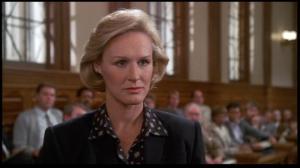
The defender: Teddy Barnes (Glenn Close)

Glenn Close looks VERY pretty in this movie, and plays Teddy Barnes, a lawyer/divorcee/mother of 2 young kids.  I thought she did well in the courtroom scenes, but I REALLY liked her vulnerable and motherly sides here (she doesn’t often get to show that in her roles).  She interacts VERY well w/ the kids and w/ Robert Loggia (who plays a mussed-up/ cynical/elderly former cop).  Teddy and the cop went through a tough criminal case before, and were VERY affected by it.

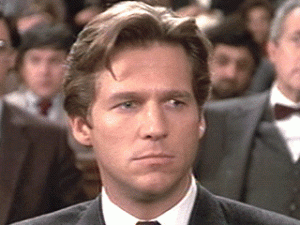
The defendant: Jeff Bridges

The handsome/charming/newspaper editor Teddy defends is Jack Forrester (Jeff Bridges).  His wife Paige, whose family ran a San Francisco paper, was brutally assaulted and murdered in their beach house.  It turns out that the money was ALL in Paige’s name, so Jack would’ve lost it all if there was a divorce (job, status, etc.)  Though Teddy doesn’t want the hassle, her boss convinces her to take on the high-profile case.

From their first meeting, we see that Teddy and Jack have GREAT chemistry (as do the actors).  And he keeps insisting he’s innocent.  (It’s tough NOT to like Jeff Bridges, right?  He’s a VERY natural actor.)  There is a memorable romantic sequence where Jack takes Teddy horseback riding on his ranch.  Though she tries to keep things professional, the lawyer gets involved w/ her client!


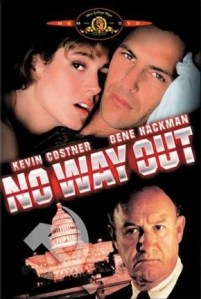
No Way Out (1987)

no way out_dvd

This is another popular ’80s thriller, but set in the world of politics in DC.   This film made Kevin Costner (who plays career navy man Lt. Cmdr. Tom Farrell) a major player in Hollywood.  (I’m NOT a fan of Costner, but he fits his role VERY well here.)  Gene Hackman plays Farrell’s boss in the Pentagon, Defense Sect. David Brice.  After a heroic rescue of a crewmate at sea, Farrell is brought in (by old college pal) to work for Sect. Brice.  That pal, Scott Pritchard (Will Patton), is an enigmatic and ambitious man who serves as Brice’s “right hand.”  Will Patton NEARLY steals almost every scene he’s in!

Lt. Cmdr. Tom Farrell (Kevin Costner) & Susan (Sean Young)
Tom Farrell (Kevin Costner) & Susan (Sean Young)


kev_white

Did you know?

Kevin Costner turned down the role of Jack Forrester in Jagged Edge.

"The Big Chill" (1983)
“The Big Chill” (1983)

Costner played the dead body in the opening of The Big Chill (1983). Director Lawrence Kasdan, who liked Costner’s work, shot some scenes involving his character (the friend who commited suicide), but edited them out later to fit the mood of the film.