Thoughts on a few South Asian diaspora books

Books I’ve Recently Read:

An Unrestored Woman by Shobha Rao

Synopsis: 1947: the Indian subcontinent is partitioned into two separate countries, India and Pakistan. And with one decree, countless lives are changed forever. An Unrestored Woman explores the fault lines in this mass displacement of humanity… In paired stories that hail from India and Pakistan to the United States, Italy, and England, we witness the ramifications of the violent uprooting of families, the price they pay over generations, and the uncanny relevance these stories have in our world today.

Don’t start this book if you’re in a bad (or down) mood; it’s not going to cheer you up. I liked a few of the stories, but some of them seemed too far-fetched or pandering to the exotic image of India. I don’t think men will enjoy this book much; the males in this collection are either terrible or impotent (as in unable to improve the lives of the women and girls in their lives). There is also no mention of the religious (mainly Hindu/Muslim) strife before (or after) Partition; this seemed odd to some of my book club. 

Streets of Darkness by A.A. Dhand

Synopsis: The sky over Bradford is heavy with foreboding. It always is. But this morning it has reason to be – this morning a body has been found. And it’s not just any body. Detective Harry Virdee should be at home with his wife. Impending fatherhood should be all he can think about but he’s been suspended from work just as the biggest case of the year lands on what would have been his desk. He can’t keep himself away. 

This (page-turner) is written by a pharmacist (he kept his day job) who grew up in Bradford, England. If you’re looking for literary, descriptive book re: desis in the UK, this isn’t the book for you; look up Nadeem Aslam and Kamila Shamsie instead. This is mystery w/ some desi flavor and interlinked characters who inhabit a city in decline (joblessness, drugs, religious strife, and white power). One of the best threads is the loving marriage between Harry (who was raised Sikh) and his wife (a nurse of Pakistani Muslim heritage). This book may be tough to find (for those in the US, as I learned from those in my book club); it’s available from UK sellers on Amazon. Dhand has already sold the rights to this book (and its sequel), so it will eventually be made into a TV show. 

Books I’m Currently Reading:

Bengali Harlem and the Lost Histories of South Asian America by Vivek Bald 

Synopsis: Nineteenth-century Muslim peddlers arrived at Ellis Island, bags heavy with silks from their villages in Bengal. Demand for “Oriental goods” took these migrants on a curious path, from New Jersey’s boardwalks to the segregated South. Bald’s history reveals cross-racial affinities below the surface of early twentieth-century America.

This book is full of statistics, so it’s not a fast read. I’m in the middle of it now, and will keep on reading. It’s very educational, so I highly recommend it to anyone in the desi diaspora. I wanted to read it a long time ago, but didn’t get around to it. One of my acquaintances, an actor-turned-teacher, Alauddin Ullah, is featured in the book; his father came to East Harlem about 50 yrs ago from Chittagong (now a mid-sized city in Bangladesh).  

The Underground Girls of Kabul by Jenny Nordberg

Synopsis: In Afghanistan, a culture ruled almost entirely by men, the birth of a son is cause for celebration and the arrival of a daughter is often mourned as misfortune. A bacha posh (literally translated from Dari as “dressed up like a boy”) is a third kind of child–a girl temporarily raised as a boy and presented as such to the outside world. Jenny Nordberg, the reporter who broke the story of this phenomenon for the New York Times, constructs a powerful and moving account of those secretly living on the other side of a deeply segregated society where women have almost no rights and little freedom. 

I’ve only read a few chapters of this (nonfiction) book, but the topic is very interesting, so I will keep on reading. At the start of the story, Nordberg gets to know Azita, a female parliamentarian in her mid-30s, who has turned her fourth daughter into a boy (Mehran). 

Viceroy’s House (2017) starring Hugh Bonneville, Gillian Anderson, Michael Gambon, Simon Callow, Om Puri, Manish Dayal, & Huma Qureshi

SPOILERS: Don’t read this post if you haven’t seen, or don’t want to know, details from this movie (now showing in wide release in the US).

[1] If you saw something similar in a high school world history class it would be interesting and effective. As a theatrical movie it misses the mark.

[2] ...as history, it is inevitably selective. Most glaring is the benign portrait of a compassionate departing colonial power.

[3] It’s interesting to see, but it’s by no means a cinematic masterclass.

[4] What could have been an epic, ends up being too pedestrian. It is this failure in character development which pulls the film down harder than all the other negative factors combined.

[5] A special mention needs to go to Gillian Anderson. Her performance as Lady Mountbatten is wonderful. The received pronunciation was perfect. Her character adds heart, she adds a moral core, to both Lord Mountbatten, and in my eyes, to the film in general.

-Excerpts from reviews on IMDB

I saw this movie (ONLY available in SD- ugh) last night on FIOS On Demand. I had been anticipating it for almost 3 mos, so was VERY excited. (American actor Manish Dayal was posting bits about it on his social media.) I was a big fan of Bend it Like Beckham, British director Gurinder Chadha’s breakout indie hit. I thought her Thanksgiving-themed film (What’s Cooking?) was pretty good. The posters didn’t appeal to me- TOO slick and stereotypical of a historical drama. I liked the trailers that I saw; the high production value was evident (which viewers expect from this caliber of film).

Sadly, Viceroy’s House was NOT what I expected. After it ended, I wondered: “There MUST have been MORE to this film!” It seems edited down (to a mere 1 hr 46 mins); however, it seems longer b/c of it’s plodding nature (at least in the first half). Maybe it needs to be seen on the big screen (for its sheer scope and spectacle)? Or maybe it would’ve been better as a miniseries or movie on HBO (where directors and writers have more creative control)? MANY critics/viewers felt that Hugh Bonneville was miscast as Lord Louis Mountbatten. Hmmm… maybe it’s TOO close to his role as head of Downton Abbey? Gillian Anderson (who plays Lady Edwina) is given some of the best lines in the movie; she does well w/ in her role. (You should check Anderson out in British work, incl. The Fall on Netflix.)

The veteran actors who play Nehru (Tanveer Ghani), Jinnah (Denzil Smith), and Gandhi (Neeraj Kabi) do what they can w/ what they are given. Basically, they sit around and debate w/ the Brits on if and how to divide India and the new Muslim majority nation- Pakistan. Some of you know that Gandhi didn’t want India divided; he imagined a land where ALL religions live together in peace (as before the Brits arrived and used their “divide and conquer” strategy to rule). Some Pakistanis were NOT pleased w/ the portrayal of Jinnah, who comes off as duplicitous.

Michael Gambon plays Gen. Ismay, a cold/intimidating man who doesn’t care what happens to the Indian people. He wants to get the boundaries created ASAP and get back to England. Simon Callow ‘s overwhelmed character, Radcliffe, says that it’s impossible to make these decisions in such a short time frame. Ismay finally shows him a plan from 1945 which already lays out exactly how India and Pakistan should be divided (NOT sure how accurate this is in reality)!

The recently deceased international Indian actor, Om Puri, has a small, yet effective/touching role. (He played Dayal’s father in The Hundred-Foot Journey). In this film, Puri plays Ali Rahim Noor, the blind/elderly father of Aalia (Pakistani actress Huma Qureshi), the Muslim woman who has captured the heart of Dayal’s character, Jeet Kumar. Ali Rahim was a political prisoner in the jail where Jeet worked for 2 yrs as a guard. Now, Jeet is a manservant (alongside his Sikh friend, Duleep Singh) for Mountbatten. As Dayal has said, Jeet represents the Hindu perspective in the film. He is an earnest/optimistic young man who feels that his destiny is to marry Aalia.

One of the servants (among 500+ in the viceroy’s household) who stirs up trouble is Mohsin (Samrat Chakraborti, an American actor/musician whose career I’ve been following since 2005). He also has a crucial role in Midnight’s Children (check Netflix to see if it’s still available). Another pleasant surprise is the original music by A.R. Rahman, an internationally recognized composer. I thought he did a esp. fine job in the last section of the film, when we see large crowds of refugees streaming into the palatial estate.

Related Videos

Two (differing) reviews of the film

BBC interview w/ Chadha (12:16)

BUILD Series interview w/ Chadha & Ghani (34:29)

Private Mohammed Kahn: Civil War Soldier

Wow, this is an AMAZING (and rare) discovery!

usnationalarchives's avatarNARAtions

Today’s post comes from Kate Mersiovsky, National Archives Technician

Since I’ve become an archives technician in the Innovation Hub Scanning Room at the National Archives, I’ve seen my fair share of interesting records. Researchers have digitized the pension of presidential widow Lucretia Garfield, the pension of Harriet Tubman, and the Supreme Court cases In Re Gault and U.S. v. Edith Windsor. Recently one of my fellow technicians, Jesse Wilinski, found another unique record- the pension file for Mohammed Kahn, a Muslim soldier who served in the Civil War.

It is rare to find records of Muslim Civil War soldiers in our holdings. So far, Jesse has only encountered two pensions, and historians know of only about 250 Muslim Civil War soldiers in all. This record, therefore, sheds light on a unique perspective that is often overlooked. As a Muslim immigrant serving in a white unit, Kahn…

View original post 530 more words

2017 Washington Jewish Film Festival: In Between

in_between_still_1_h_2016.jpg
It is the time now for women to come and speak up. Until now, we were listening to men, and they were the ones to run everything. -Maysaloun Hamoud (writer/director)

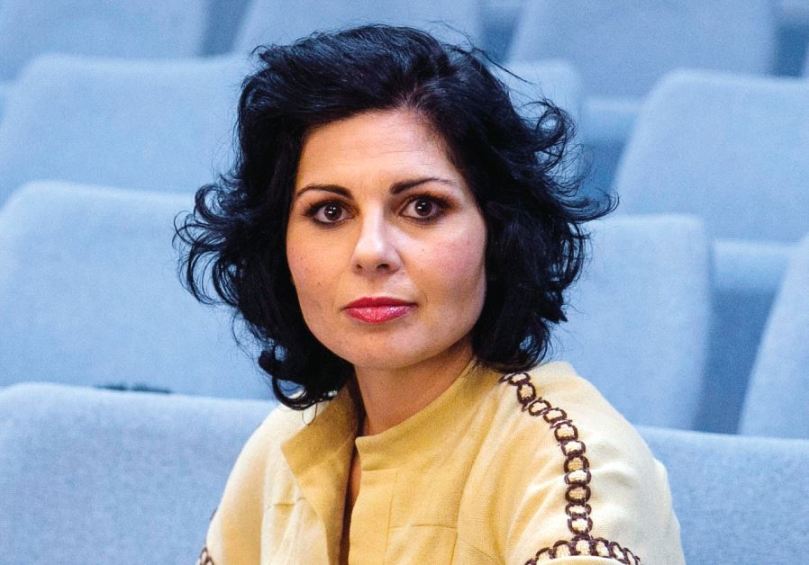
Arab-Israelis make up about 20 percent of Israel’s citizenry. They share the same ethnicity, language, and culture of Palestinians in the West Bank and Gaza Strip; many identify as Palestinians rather than Israeli. This film (written and directed by 35 y.o. Maysaloun Hamoud- pictured below) tells the story of three 20-ish Arab women (two Muslim and one Christian) who have left their hometowns to work/study in Tel Aviv. They find themselves stuck between traditional Arab society (which values modesty, virginity, arranged marriage) and a more open/Westernized Israeli society (w/ dating, alcohol, drugs).

In Between_dir.jpg

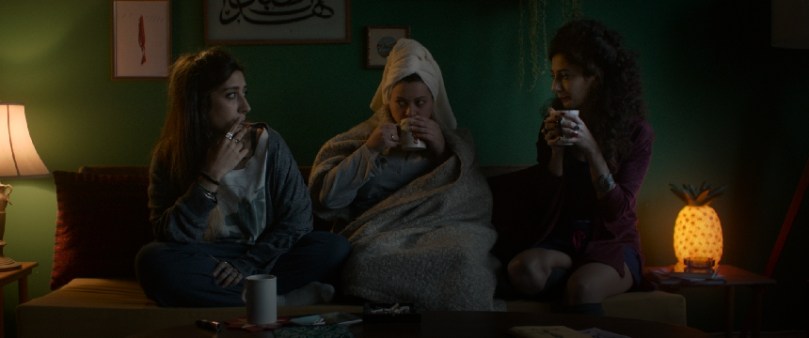
Laila (Mouna Hawa) is an attorney sharing an apt. w/ close friend, Salma (Sana Jammeieh). Into their world enters Noor (Shaden Kanboura), a hijabi Computer Science major who is prepping for finals. We can see that the pals are dismayed to be stuck w/ this new roomie. Though Noor is religious, she is NOT judgmental re: Laila and Salma’s smoking, drinking, and parties w/ a diverse group of friends. She focuses on studying and keeping in touch with her fiance, Wissam. She cooks for him when he comes over to her new place. Wissam keeps pressuring her to move up the date of their wedding. He does NOT approve of her new building or roomies (who slowly become her friends). 

Laila (who loves to flirt) starts seriously dating a man, Ziad, who had his eye on her from a wedding they both attended. Ziad is VERY attracted to Laila, particularly b/c she is an uninhibited/beautiful/strong woman. Salma quits her restaurant job, after she and a fellow Palestinian coworker are yelled at by their (Israeli) boss for joking around (in Arabic) in the kitchen. She also has to deal w/ dinners set-up by her wealthy parents to introduce her to single men. 

In_Between_18-860


[1] …the movie is also very much about sisters doing it for themselves. There’s an automatic solidarity whereby women– at least young women of similar ages– are all automatically soulmates; and men, it almost goes without saying, are swine. Despite those stereotypes, the movie holds interest by virtue of believable acting and believable situations. 

[2] The three women characters were believable, warm, expressing solidarity to each other despite their very different personalities and lifestyles. The theme of personal conflicts between tradition and modernity is not new. What makes this film different is that the issues are very real and current and those outside the tradition don’t see it. 

-Excerpts from IMDB reviews

Ali & Nino (2016)

Ali_and_Nino-intro
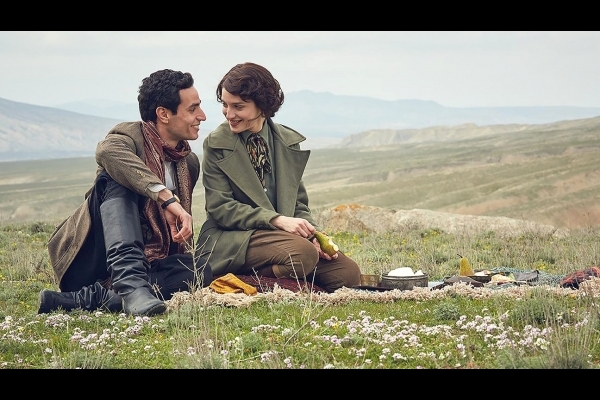
Ali (Adam Bakri) and Nino (Maria Valvarde) share a picnic on a hill.

[1] We get a rare glimpse into an era at the onset of the formation of the Soviet Union. Also, the interaction between two religions, Islam and Christianity, is carefully portrayed and interesting to observe for that time period and location.

[2] The culture of the East was well-depicted… revolution and fight for independence scenes, despite of low budget [$20 million], are well executed- impressive and tragic, as they should be. 

[3] My only concern is that movie is really short- only 1.5 hours. Way too little to show such a complicated time period of Azerbaijani history… You just cannot help but wish for story to slow down and take its time to show more details…

-Excerpts from IMDB reviews

Ali_and_Nino-leads-dir
Bakri and Valvarde with director Asif Kapadia.

This little gem of a film is now streaming (Netflix). If you liked The Promise, or are interested in some of its themes, then you will enjoy this (smaller, yet well-done) love story. The director is British Asian (or South Asian, as we say in US) and a recent Oscar winner- Asif Kapadia. Amy premiered at the Cannes Film Festival in 2015; it focuses on the troubled life of singer/songwriter Amy Winehouse. The film was an international box office hit and is the highest grossing UK documentary of all time. 

There is only one word to describe the cinematography and music- AMAZING! The composer is Italian- Dario Marianelli; he worked on some very good films, including: V for Vendetta, Atonement, and Pride and Prejudice (2005 big screen version). The screenplay writer (Christopher Hampton) may also be familiar; he worked on Dangerous Liaisons (1988), The Quiet American, Atonement, and A Dangerous Method. Hampton adapted Kurban Said’s book Ali and Nino, which I had come across MANY years ago, BUT haven’t read. (There is a VERY interesting story re: the author of the book, too, if you want to look that up.)

hero_Ali-Nino-dance
Ali (Bakri) and Nino (Valvarde) dancing at a ball after a graduation.

The desert doesn’t ask for anything, doesn’t give anything and doesn’t promise anything. -Ali explains why he loves the desert landscape 

The cast here is multi-national and multi-ethnic: Adam Bakri (who is a Palestinian Arab) plays Ali Khan (meaning: ruler) Shirvanshir, the handsome/cultured son of a Muslim nobleman. Maria Valverde (who hails from Spain) is Nino, the petite/wide-eyed princess from a Georgian Orthodox Christian family. Nino’s father is played by American film/stage actor Mandy Patinkin. Ali’s father is Iranian actor Homayoun Ershadi; he can be seen in The Kite Runner and The Queen. These veterans lend gravitas to the film, along w/ strong supporting characters (several of whom hail from Turkey, as does the cinematographer).

Ali’s father laments that though his family has been here for hundreds of years and is well-respected, they have no political authority (Russia was in charge). Though Ali and Nino have different religions and backgrounds, they move in the same small circle of upper-class society in Baku, Azerbaijan (an area rich w/ oil). Nino’s family is originally from Tblisi, Georgia; her father is in Baku on business.