Bonnie and Clyde (1967)

bonnieandclyde_driving
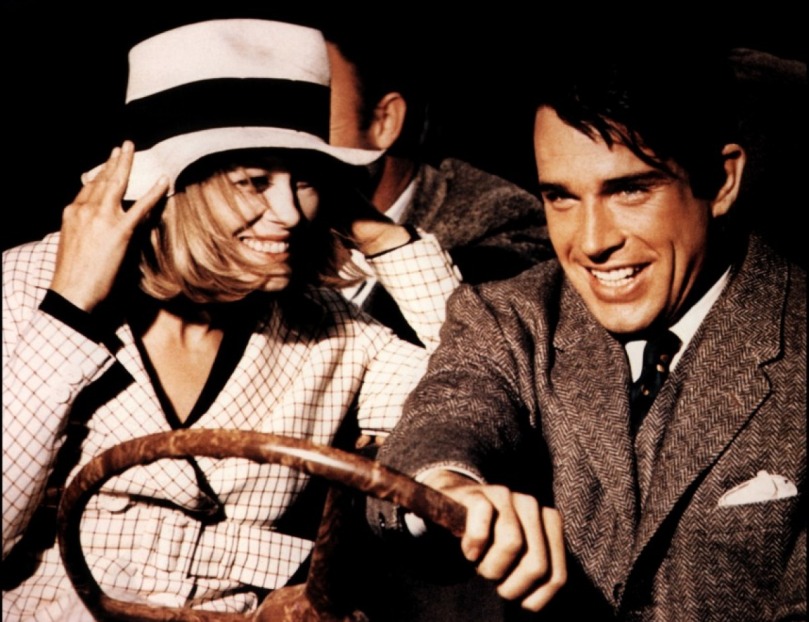
Bonnie Parker (Faye Dunaway) and Clyde Barrow (Warren Beatty) on the run!

Synopsis: In 1934, Bonnie Parker, a waitress, and Clyde Barrow, a criminal, just released from prison, are immediately attracted to what the other represents for their life when they meet by chance in West Dallas, Texas. Bonnie is fascinated with Clyde’s criminal past, his bravado in talking about it, and the power of his gun. Clyde sees in Bonnie someone who wanted more out of life- like himself. They decide to join forces to embark on a life of crime (mainly robbing banks) to make fast money and have fun.  Their  small gang of willing accomplices includes C.W. Moss (a mechanic) and Buck Barrow, one of Clyde’s older brothers.  Buck’s wife, a former preacher’s daughter, reluctantly joins in, but then becomes hysterical when faced w/ danger. 
bonnieandclyde_reallife
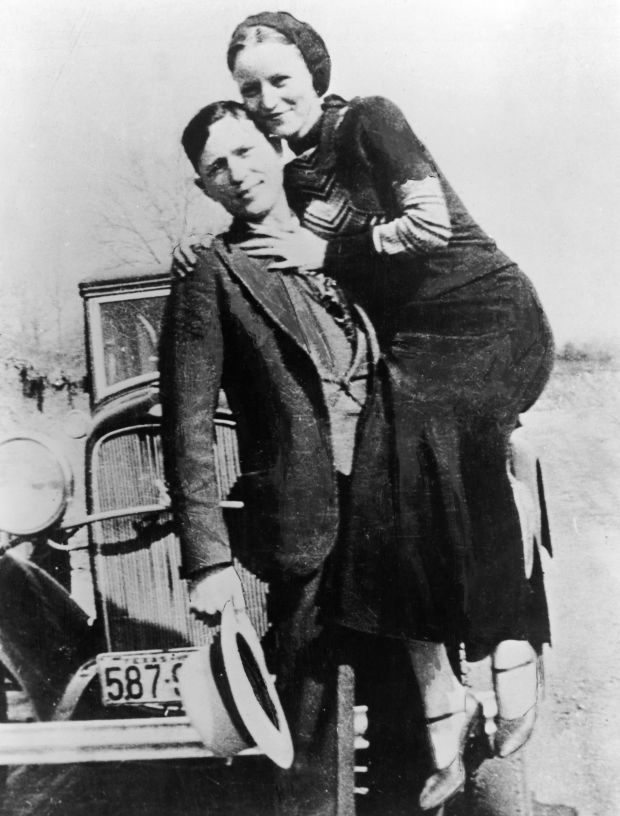
Newspaper photo of the real life Bonnie and Clyde

If all you want’s a stud service, you get on back to West Dallas and you stay there the rest of your life.  You’re worth more than that.  A lot more than that.  You know it and that’s why you come along with me.  -Clyde says to Bonnie

To modern eyes, this movie is rather tame, BUT in it’s day, it caused quite a stir!  In a TV interview, director Arthur Penn pointed out that this film shows for the first time the firing of a gun and the consequences in ONE single frame. Before that, you’d see a gun being fired, then cut, and the next scene would show the bleeding body.  This was the first film to use squibs (which were embedded in costumes and wired to a central control that made them explode in sequence to create the illusion of being shot).

Leading man Warren Beatty (who was at the top of his profession then) wanted his then-girlfriend, Natalie Wood, for the role of Bonnie. However, SHE refused in order to be able to meet daily w/ her therapist. Producers auditioned a LOT of young actresses (incl. Jane Fonda) for the role of Bonnie; at first, they thought Faye Dunaway was not “hot.”  But then Beatty screen-tested w/ her and was convinced that she was the BEST one for the role. 
bonnieandclyde_genehackman
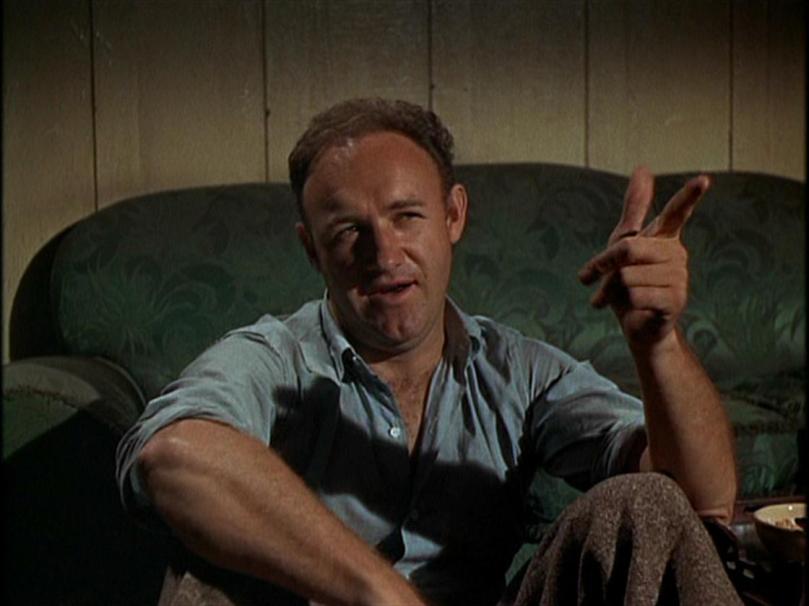
Gene Hackman (in one of his early roles) plays Clyde’s big brother- Buck

Warner Bros. thought it would be a flop, BUT it was a hit!  Roger Ebert had ONLY been a film critic for 6 mos. when he saw this film and hailed it as the first masterpiece he had seen on the job. ONE of the reasons why the film was so successful was because of its anti-establishment stance; people were becoming disillusioned with America’s involvement in Vietnam at this time.

barrowfamily
Young Estelle Parsons (Roseanne’s mom in the ABC sitcom) plays Buck’s wife.

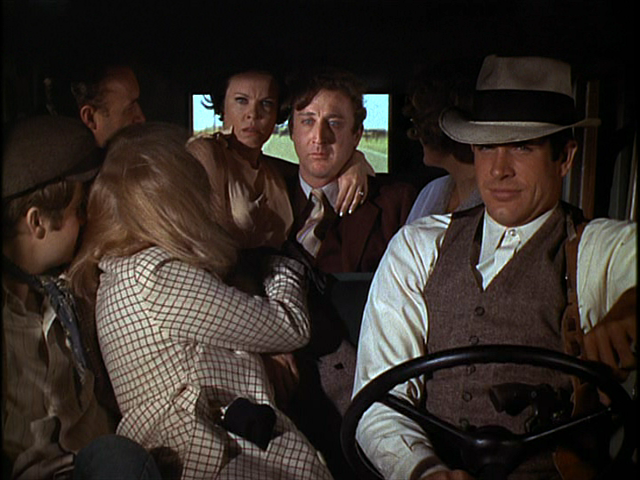
There is SOME humor in this film, too, thanks in part to Gene Wilder (in his debut)!  He plays Eugene, a wealthy Romeo who is robbed of his shiny new car while making out w/ his girlfriend, Velma, on the porch.  Eventually, the couple end up in Eugene’s car WITH the robbers!  When Bonnie asks Velma how old she is, she quickly responds with “33.” Eugene is silent and looks shocked (so she MUST have lied about it before)- LOL!
bonnieandclyde_genewilder.png

Here is a list of Hollywood conventions that were broken in this film (from a commentator on IMDB):

  1. The mix of comic scenes with scenes of violence, intense drama and that weird, beautiful family reunion scene.
  2. The realistic (for the time) portrayal of violence, with blood and moans and pain.
  3. The frank sensuality (for its time).
  4. The likeability (some would say glorification) of criminals (we are sad when they die).
  5. The unlikeability of the sheriff (who, in prior years, would have been the hero).
  6. The portrayal of an unconventional “family” who live together and mostly love each other, reflecting the ’60s hippie ethos.
  7. The use of period music (the bluegrass) rather than all orchestral scoring.
  8. The pointed social commentary (the Depression-era dispossessed, the poor farmer shooting at the bank sign and his foreclosed home, portrayal of the Establishment as villains).
  9. The depiction of “style” (the clothes, the brash attitudes, the coolness) and how its used to establish the triumph outsiders over law-abiding “squares.”

2016 AFI Latin American Film Festival: Mr. Pig (Mexico)

He [Danny Glover] traces Ambrose’s rapidly deteriorating physical with ease. But psychologically, the script (by Luna and Augusto Mendoza) just doesn’t provide a lot of depth to work with — for him or for Rudolph, also a welcome presence in a rare non-comedic role. Excerpt from Variety review

MrPig_poster.jpg

Luna doesn’t ease up on the sadness one iota, and it will undoubtedly be tough for some to sit through.  However, they eventually hit just the right groove, and Mr. Pig becomes an odd story of family reconciliation, one that isn’t afraid to wallow in the emotional mud. -Travis Hopson (The Examiner)

mrpig_cast_director

It turns out that Mexican actor (and noted international heartthrob) Diego Luna is ALSO a director/writer!  He’s in the next Star Wars movie, BUT that doesn’t mean that he wanted to rest on his laurels.  Mr. Pig (Luna’s third directorial attempt) starts out slow, w/ an old farmer, Ambrose (Danny Glover), and his beloved hog heading from his (soon to be repossessed) farm in Southern California to Mexico.  As a young man, Ambrose fell in love w/ Mexico’s natural beauty and its people.

MrPig_wash.jpg

In time, we see that Ambrose is dependent on alcohol and (possibly) ill. When his concerned daughter, Eunice (Maya Rudolph) calls, he doesn’t reveal anything about his money issues or deteriorating health. He goes to the large/industrial farm of his old friend’s son; the two men talk and joke about the old days for a night. But upon seeing the conditions in which the pigs are kept the next morning, he refuses to sell his hog!       

My friend and I BOTH liked this film, BUT it’s for those who need speed and want ALL the problems wrapped up in a nice bow.  I particularly liked the cinematography (by Damian Garcia).  The music was low-key, so it didn’t mess w/ that was happening onscreen.  Ambrose and Eunice have a troubled relationship, BUT she ends up going part of the way w/ him to Guadalajara (where old friends have pooled money to buy the hog).    


2016 AFI Latin American Film Festival: Magallanes (Peru)

In modern-day Lima, middle-aged Harvey Magallanes (Damian Alcazar) works as a driver for his former commanding officer, the wheelchair-bound Colonel (Frederico Luppi), who has lost his memory.  He spends the rest of the day as a taxi driver and drinking w/ Army buddy/mechanic, Milton.   

One morning, he picks up a harried/young/indigenous woman in his cab- Celina (Magaly Solier).  Magallanes is VERY shaken up, looking upset; it turns out that she doesn’t recognize him.  He follows Celina to a convention, learning that she needs money for her hair salon.  After talking to Milton and his reluctant sister, Magallanes sees an opportunity to make some easy money.  WHAT is his connection to Celina?  WHY does he look so guilty?  This film starts out slow (it’s a character drama for the most part), then eventually builds to an (VERY un-Hollywood) climax, which will totally change your view of the protagonist!          

The brilliance of the story is that we find ourselves pulling for Magallanes right up until the moment when we can’t possibly forgive him his transgressions … any more than Celina can. More than an example of the jumbled mess of war and terrorists, the film is a wonderful observation of human nature and how we often rationalize our worst actions to the point of delusion of our own goodness. No matter how hard we try to put things behind us, the bad choices are always there. Some sins just cannot be washed away, and redemption is not always possible.

-Comment from IMDB

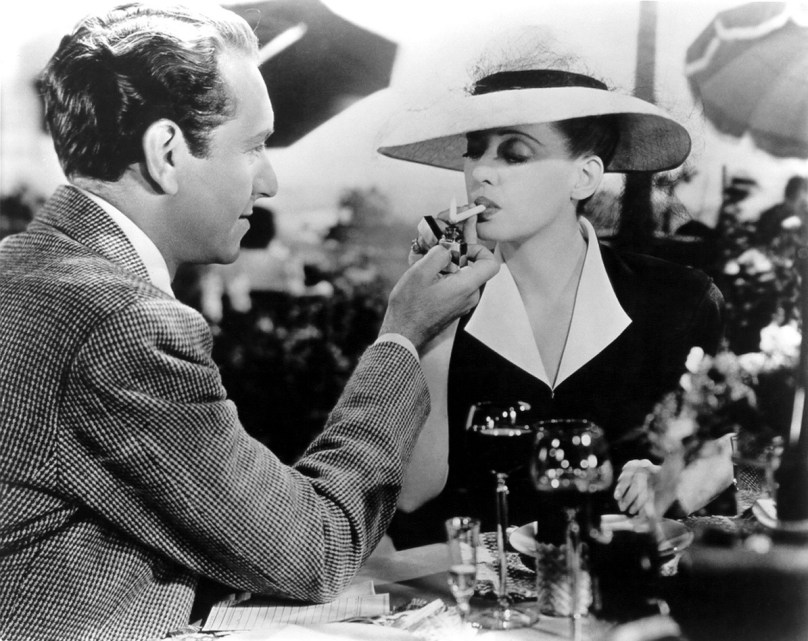
Now Voyager (1942) starring Bette Davis, Paul Henreid & Claude Rains

Now-Voyager-bette-davis-15644428-1195-947

The untold want, by life and land ne’er granted,

Now, Voyager, sail thou forth, to seek and find.  

-From the poem The Untold Want by Walt Whitman

Claude Rains Now Voyager

This box office smash (the BIGGEST of Bette Davis’ career) is loved by MANY, maligned by a few (including film critic Pauline Kael, who referred to it as “schlock”).  The premise is nothing new- an ugly duckling (w/ extra pounds, thick eyebrows, dowdy clothes, and VERY low self-esteem) turning into a beautiful (and more importantly, confident) swan.  

The heroine- neurotic Charlotte Vale (Davis)- is helped by her sister-in-law Lisa, a pioneering psychotherapist named Dr. Jaquith (Claude Rains), and eventually- a friend who becomes more- Jerry Durrance (Paul Henreid). The villain in this film is Charlotte’s mother, Mrs. Vale (Gladys Cooper), a widow of considerable wealth in Boston.  She is a domineering woman, displeased by everyone, though her harshest criticism is for her youngest child- Charlotte.   

nv1

If the psychological elements, glamorous clothes, or music don’t draw you in- there is also a BIG love story element.  But learning to love (and accept) oneself is a key theme in this tale.  As Charlotte tells the depressed preteen Tina: “You can have a kind of beauty… one that comes from within, because you are kind to people.” 

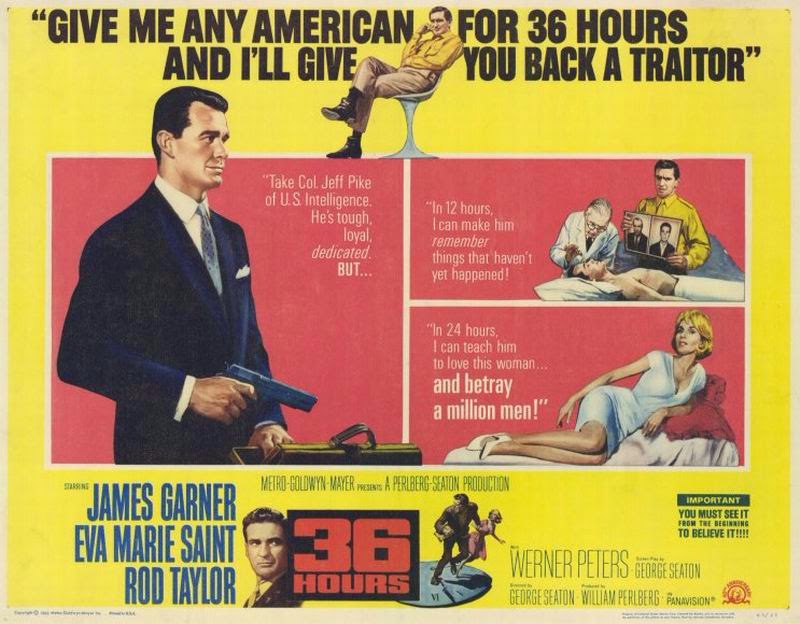
36 Hours (1964) starring James Garner

36Hrs_poster

In this psychological war-drama an Army Major is captured by the Germans during World War II. They attempt to brainwash him into believing the war is over and that he is safe in an Allied hospital, so that he will divulge Allied invasion plans.  -IMDB summary

Naturally charming, funny, handsome, and real-life hero (2 Purple Hearts in the Korean War)- James Garner is the protagonist of this WWII spy film. It was written/directed by George Seaton; the original story (Beware of the Dog) comes from Roald Dahl. Some of you know Garner as Mel Gibson’s cranky sparring partner (Maverick); others saw him regularly on TV (The Rockford Files).  But perhaps his MOST famous role was as the elderly Noah, the devoted husband in The Notebook.

Garner and Saint

This MUST-SEE film was shot in 1962 and released in 1964, BUT in black and white (which adds to its world-building). Garner is joined by two strong actors- Rod Taylor as Dr. Gerber (a jaded psychiatrist) and Eva Marie Saint as Anna (a steely nurse/concentration camp survivor).

Are you really an army sergeant?  -Jeff asks, incredulously

Regular army – no.  I am too old, too fat! Home guard.  We are patrolling the border so then the young, strong, and handsome men can go to Russia and freeze to death. Wonderful system, huh?  -Ernst replies w/ a big laugh

There are Germans in this tale that are NOT all bad, such as portly/jovial/cunning soldier, Ernst (John Banner), who provides terrific comedic moments in the last act of this otherwise serious film. 

I highly recommend this film (so am not going to give away TOO much)!  If you liked The Manchurian Candidate, then this is up your alley.