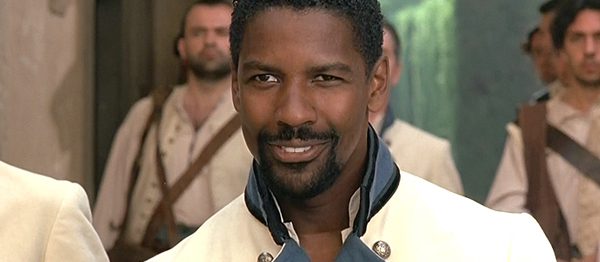

Golden Door, or Nuovomondo (which means “New World” in Italian), is an Italian film written and directed by Emanuel Crialese. The film is introduced by famed American director Martin Scorcese, the child of immigrants from Sicily. Many of the characters in this picture speak in the Sicilian dialect; it reminded Scorsese of his childhood. Though this film didn’t get wide release in the US, it’s a must-see!
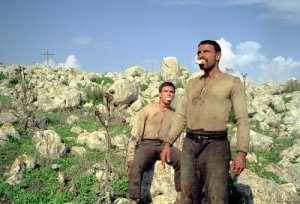
Salvatore Mancuso (Vincenzo Amato) is an early 20th century Sicilian peasant who dreams of a better life in America. (His twin brother left many years ago for the new world.) Salvatore hopes to take his two teen sons (Angelo and Pietro) and his elderly mother (Fortunata) w/ him on the journey.
In the above pic, Salvatore and Angelo take rocks from below up to a high mountain to consult with God (note the simple twig cross in the background).

There are magical elements in this film, as it is told through the eyes of the hopeful immigrants.

Salvatore must convince his mother (a strong-willed, outspoken woman) to go along.
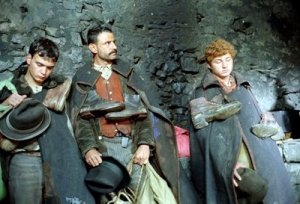
The Mancuso family set off with two young women from their village (promised to “rich Americans” as brides).

Upon arrival at the port city, local priests and doctors look them over. Then they get their pictures taken. A red-headed stranger puts herself in the picture. Later, she tells an official that she’s travelling with their group! The lady is Lucy (Charlotte Gainsbourg; she was the title character in Jane Eyre); she speaks some Italian and looks rather melancholy.

Salvatore and his boys keep a watchful eye on the stranger though Fortunata says it’s none of their business. Lucy (or Luce, meaning light, as the Italians call her) raises many eyebrows and questions.
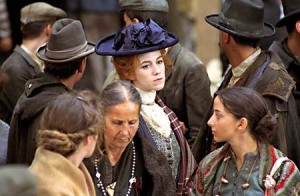
It was unusual for women to travel alone. And why is an Englishwoman going along with Italians? What was her past life like? Salvatore is protective of Lucy when anyone says an unkind word about her below deck. Outside on deck, he follows her movements closely, admiring her from afar but saying little.

The voyage to America is arduous! We follow the “Third Class” passengers who have to lie in cramped bunks nearly end-to-end. When seas are rough, they are tossed about like rag dolls. But somehow they’re able to keep their spirits up through songs and rituals from the “old world.”
A well-dressed businessman (Vincent Schiavelli) introduces Lucy to several older, wealthy, single men on the ship. He also gives her photos of American men who are “willing to help you out of this situation.”

Just before dropping anchor at Ellis Island, Lucy proposes marriage to Salvatore. (She had been observing him and his family very closely, and saw something she liked!) He is surprised, but quickly agrees.
There is much more to come- the new arrivals must go through many trials and tribulations before entering the “golden door” of America!

Crialese (above w/ Amato) creates a simple, yet moving, story about immigration. The images he creates will stay with you long after the film has ended. The music flows very well with the images. The scenery and costumes look very authentic. Golden Door was filmed in Argentina with extras who are descended from Italian immigrants (Crialese explains in the making of).
The main protagonist (Salvatore) is a “paisan” (peasant). How unusual is that for today’s cinema!? He is a simple, straight-forward, illiterate man. He represents the old world- the one left behind. Salvatore has a kind of quiet dignity that sets him apart from the crowd, though.

Salvatore’s unlikely love interest (Lucy/Luce) represents the new world/light/the future. She is well-spoken, independent, and determined. (Crialese said he made her hair red to set Lucy apart from the other women.)
Though Lucy is not Italian, she is treated just as they are at Ellis Island. The inspectors don’t make it easy for the immigrants. There are various tests to see who is “fit” to enter the new world. You’ll learn something new from this film, I’m sure!