Mini-Series Review: “Elizabeth I” (HBO Films)


More than 400 years ago, an intelligent, independent-minded woman (Queen Elizabeth I of England) faced issues that we ladies still face: gaining respect in a male-dominated field (i.e. government), finding the right man to marry (who would also be acceptable to her people), and not-so-friendly relatives (Mary, Queen of Scots).  The British monarch (nearing middle-age in Part I this mini-series) is played by the truly regal Helen Mirren, who can be smart, tough, and vulnerable.  Her closest friend/long-time love is Robert Dudley, the dashing Earl of Leicester (Jeremy Irons).  In the Cate Blanchett film, Joseph Fiennes played the (young) Leicester.  Irons is probably one of the few actors capable of going head-to-head with Mirren.  They also look terrific as a romantic pair, and seem like intellectual equals.


Her closest advisors, Lord Francis Walsingham and Lord Burghley, are pressing her to (finally) marry.  They think they have the man- the Duke of Anjou, heir to the throne of France; their union would unite Protestant England with Catholic France.  Thus, they could fight off Spain, a very formidable Catholic nation at that time.  (Religion was a part of government in Western Europe in those days.)  Elizabeth is not opposed to marrying and bearing children (she knows her duty), but who will be the man for her?  Leicester is jealous; he says: “No one could be close as we too, Bess.”  She explains that she must marry royalty, so he’s not a valid choice. 


Leicester is her friend, confidant, and… more (though she is still a virgin).  A doctor assures her advisors this is true, and that she can bear children.  The queen’s body belongs to the people, not only to her.  As the Queen readies to meet her (arranged) match, all the men around her look nervous.  Will the Duke convert, or be a “quiet Catholic?”  Will his temperament suit Elizabeth?  Meanwhile, she wonders if the Duke is handsome.  Some things never change! 


There is a fun scene on a boat where the Duke reveals himself; he came in disguise.  There is an instant spark of attraction between the pair!  Elizabeth is happily surprised, and ready to make the best of it.  After a few weeks of wooing, her “contentment” is marred by Leicester’s arrival.  Is he a jealous man only thinking of himself?  Or is he worried about his country’s future? 


It soon becomes apparent that her people are against the marriage as well.  Doesn’t she deserve love, just like anyone else?  Out of the blue, the French minister blurts out something about Leicester and Lady Essex, a recently widowed woman of the court.  Watch Mirren’s reaction- it’s terrific!  She only exposes Elizabeth’s true emotion in a quick burst then is the composed Queen once more.            


Then scene, where she sits looking over the marriage contract surrounded by her council, is even stronger.  The men fearfully eye the pen in her hand.  Mirren reveals the Queen’s (natural) longings as a woman before breaking down in tears.  But it is merely a brief outburst; she will sacrifice for her country.  After bravely dealing with personal disappointments, Elizabeth hears of a papal decree which causes her to fear for her life! 


If you’d like to know more, check out Elizabeth I.  In Part II of the series, the male lead is played by the gorgeous Hugh Dancy (as impulsive, ambitious Earl of Essex).  Despite the (big) age difference, Mirren and Dancy create great chemistry together.   I know it’s available at the Virgin Megastore (where I bought it this past winter) and at Blockbuster.  The total time is 211 minutes with two special features, one re: the filming and another about the life of the real Elizabeth. 


Below are portraits of the real Dudley, Anjou, and Essex (in case you were curious)!
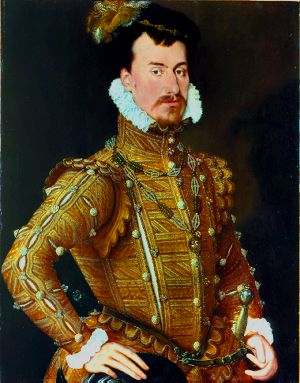
 

Robert Dudley, Earl of Leicester
 
Duke of Anjou
Duke of Anjou
The Second Lord Essex
The Second Earl of Essex


Classic Movie Review: “A Streetcar Named Desire”

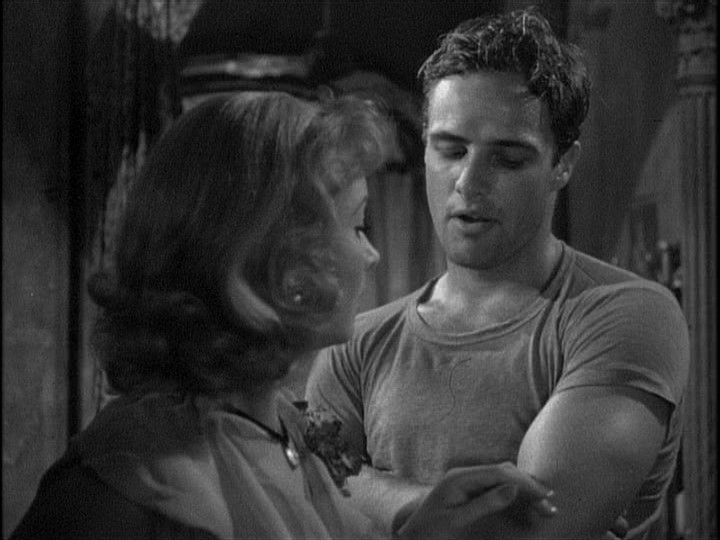
Captivating, troubled, unpredictable, vulnerable- these words could describe Vivien Leigh, Marlon Brando, and the characters they played in this multi-Oscar winning movie. A Streetcar Named Desire was re-mastered and re-released in 1993; I have that 2-disc director’s edition of the film containing 3 minutes of extra/extended scenes and loads of special features.  (I love special features!)  

Blanche: I don’t want realism.  I want magic!

One of Hollywood’s most successful and controversial directors, Elia Kazan, was hand-picked by playwright Tennessee Williams for this film.  Kazan had directed the Broadway play, too; his body of work includes: A Tree Grows in Brooklyn, Gentleman’s Agreement (starring Gregory Peck), East of Eden (starring James Dean; Marlon Brando tested for the part, too), and On the Waterfront (also with Brando).  All the major actors (Brando, Kim Hunter, and Karl Malden) had worked in theater.  Though Jessica Tandy was on Broadway, she wasn’t a big enough star, according to Warner Bros.  So, Vivien Leigh, who’d done the play in London, was brought on-board.


Stanley: Be comfortable. That’s my motto up where I come from. You gonna shack up here? Well, I guess I’m gonna strike you as being the unrefined type, huh?

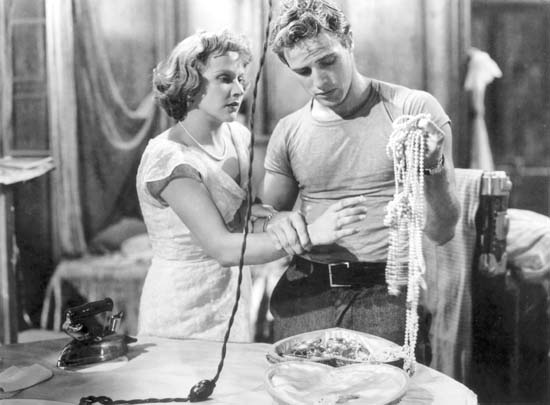
Well-bred, well-educated Blanche DuBois (Leigh) travels (via train and streetcar, of course) from small-town Mississippi to visit her younger sister Stella (Hunter) in hot, crowded New Orleans.  Blanche, a sensitive woman, almost can’t believe to what depths her sister has sunk.  Stella and her husband make their home in a stuffy, run-down apartment in the French Quarter. Their rowdy neighbors/friends drink too much, gamble, and make noise around the clock.  But most shocking of all- Stella has married Stanley Kowalski (Brando in a star-making role).  Stanley is a crude, volatile, working-class man of Polish descent.  (There are derogatory remarks about his background, denoting the prejudice of that time.)  Blanche is definitely not shy speaking about Stanley’s faults!


Stanley: That’s pearls, Stella, ropes of ’em. What is your sister – a deep sea diver?


We realize quickly that Stanley resents the presence of Blanche (with her fine clothes, jewels, perfume, and criticism).  Perhaps he sees her as a threat to his relationship with Stella?  Blanche is herself nervous and guarding secrets beneath her genteel Southern belle facade.  (I won’t give you too many details!)  Stella senses something is wrong.  Why has Blanche come to visit before the end of Spring term?  (She’s a high school English teacher.)  How did she lose their family estate?  But Stella mainly wants to keep the peace in her home, because who knows what will set off her husband?


Stella and Stanley’s relationship is based on lust; this repulses Blanche (she calls it brutal desire).  

Stella: I wish you’d stop taking it for granted that I’m in something I want to get out of. 


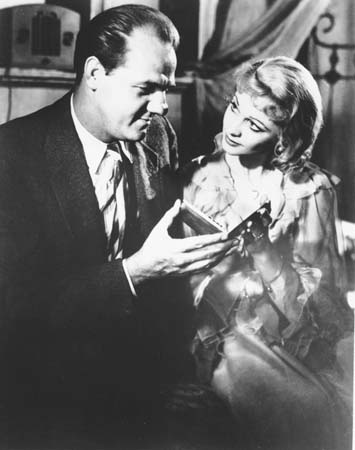
Stella seems happy about her life while Blanche is in a precarious situation: aging (over 30) and nearly penniless.  Then, tall and quiet Mitch (Malden) takes an interest in Blanche.  Could Blanche find some happiness with Mitch? 


Mitch and Blanche

Mitch: I have never known anyone like you.


Brando, though not yet 30, is simply amazing in this film; you won’t be able to take your eyes off him!  Brando was considered “naturalistic” and “realistic”- an actor who broke the mold of leading man in the 1950s.  And because of his penetrating eyes, brooding face, and muscular physique, Stanley is both attractive and repugnant to us.  Stanley is a drunken brawler one minute, then a contrite and confused little boy the next.  There is “ambivalence” in Stanley and in Brando, as Kazan said, that makes us wonder at his motivations.  “Brando was a genius,” says Malden in a behind-the-scenes interview on the DVD.  Check out this movie classic ASAP!


You showed me a snapshot of the place with them columns, and I pulled you down off them columns… 

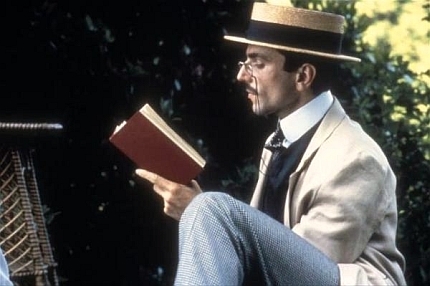
Movie Review: “A Room with a View”


Enchanting from beginning to end. –Rogert Ebert

Overview

Merchant Ivory productions, one of the oldest indie film companies, has produced many smart, beautiful pictures on a small budget: Maurice, Howard’s End, The Mystic Masseur, The White Countess, etc.  My personal favorite is A Room with a View from 1985; it was shot in Florence, Italy and county Kent in England.  It is based on a book by E.M. Forster, regarded as one of England’s most tolerant, sensitive writers.  I have the 2 disc special edition DVD; the film was digitally re-mastered in 2003.  Helena Bonham Carter was an unknown actress before A Room with a View.  Sadly, James Ivory’s business (and life) partner, Ismail Merchant, passed away last year. 

Plot and Characterization

At the opening of the film, Lucy Honeychurch (Bonham Carter), a British upper-middle class young lady, is on vacation in Italy with her cautious/irritating single aunt, Charlotte Bartlett (Maggie Smith).  The ladies happen upon Lucy’s pastor from home, the Reverend Mr. Beebe (Simon Callow).  There is also a romance novelist, Eleanor Lavish (Judy Dench) at the hotel.  Lucy is especially struck by a very unorthodox father and son- Mr. Emerson (Denholm Elliott) and George (Julian Sands). 

Charlotte wants to stick to what the guidebooks say, but Ms. Lavish convinces her to be more independent.  Though the Emersons are British, they have their own way of looking at the world; they speak what they feel.  Lucy is surprised by, but also curious about the handsome, yet brooding George.  Through circumstances, or fate, Lucy and George are thrown together. 

When Lucy gets home to England, she gets engaged to wealthy, uptight Cecil Vyse (Daniel Day-Lewis).  You can suppose they had been courting for a long time.  Her family, including little brother Freddie (a very young Rupert Graves), think Lucy can do better.  Lucy is uncertain about her choice, too.  Into their quiet neighborhood come two new tenants- the Emersons!        


My Thoughts

I can’t believe this movie came out 23 years ago- it always looks fresh and new whenever I see it!  At first, it comes off as a simple love story.  But when you look deeper, you see the conflict between the natural (an individual’s true feelings/desires) and artificial (British society of the early 1900s).  Howard’s End (starring Emma Thompson, Anthony Hopkins, and Bonham Carter) and Maurice (starring the young Hugh Grant and James Wilby) also deal directly with this conflict.  The two men Lucy must choose between personify this conflict. 

Cecil is a well-read young man, but he behaves like a stuck-up old man incapable of enjoying life.  Day-Lewis shows his character’s discomfort by doing every little thing very stiffly.  His costumes are very formal and tight-fitting, purposefully no doubt.  Mr. Beebe even suggests that Cecil is the type of man who will remain a bachelor.  Hmmm…

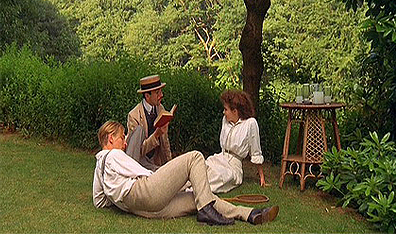
George is quiet and mysterious at first, but later we see he is full of life and very real.  He’s blunt in contrast to the other people Lucy is familiar with.  When he moves to Kent, he becomes a friend to Freddie.  In one hilarious scene the two young men (along with Mr. Beebe) go bathing naked in a pond.  George is comfortable in nature; he doesn’t know how to be not real, as his father points out to Lucy in a crucial scene.    

I really enjoyed the nuanced performances of Maggie Smith and Daniel Day-Lewis in this film.  They seem like the annoying “bad” guys at first glance, but they have moments where they get to show their complexity.  All the characters get their moments to shine in this film; I wouldn’t expect less from Merchant Ivory.  Bonham Carter is strong (as always); I don’t think I’ve ever seen a weak performance from her!  Here she gets to be a likeable “traditional” heroine, not a cheater or oddball- that’s interesting to see.  Check this film out ASAP!!!  

Movie Review: “Truly Madly Deeply”

Overview

This imaginative romantic comedy (released in 1991) was recently deceased director Anthony Minghella’s first film.  It is a terrific film, starring theatrically-trained actors: Juliet Stevenson, Alan Rickman, and Michael Maloney.  Minghella also did commentary for this film; he admits that he was a technical novice, but relied on a team of experts.  Most of this team continued on to work with the director on other films, including The English Patient and The Talented Mr. Ripley.  Truly Madly Deeply involves Minghella’s interests, friends, and sensibilities. 


Plot & Characterization

Nina (Juliet Stevenson- Mrs. Elton in Emma; Keira Knightley’s mom in Bend it Like Beckham) is a charming, intelligent woman (around 30) who works at a language institute in North London.  (Nina is fluent in Spanish.)  Her boss/friend (Scottish actor Bill Patterson; he’s in Amazing Grace) is worried about her because she’s “not having any fun” these days.   Her older sister is worried because Nina’s flat (or “apartment” as we say in the US) is falling apart and has a mouse (yikes!)  She shrugs off their concerns.


Nina meets regularly with a therapist because she is having a very difficult time getting over the recent death of her (cellist) husband, Jamie (Alan Rickman from Robin Hood– note the mustache- and Sense and Sensibility).  She is sad, but also angry, as is revealed in a very intense scene.  (Juliet Stevenson is not afraid to reveal messy emotions.)  Nina busies herself with repairs on her flat with help from a romantic Polish immigrant (Titus).  Then one day, Jamie appears in the living room! 


Jamie is not like other movie ghosts you may’ve seen.  He complains constantly about it being freezing cold in the flat; Alan Rickman chose to wear a long black overcoat the entire time.  He invites other ghosts (from various time periods) to watch classic films, play music, and redecorate Nina’s place. 


Getting off the bus one day, Nina runs into Mark (a man who she saw at a local restaurant).  She decides to go out with this (real life) man.  Check out Truly Madly Deeply to find out what happens next! 


My Thoughts

Visually, there are no tricks or bells, but the acting is superb!  Even the small parts are done very well.  Minghella points out that these actors aren’t the “typical romantic leads.”  Stevenson and Rickman (who worked together before) have the kind of chemistry and comfort with each other that can’t be faked.  Nina and Jamie seem like a real, passionate couple with a shared history.  From the moment he meets Nina, there is a twinkle in Maloney’s eyes- we know that Mark is interested in her.  I especially liked how the two men were quite different: Mark is positive and smiling, while Jamie is sullen and intense.  Will Nina choose to live life again or remain in the past?        

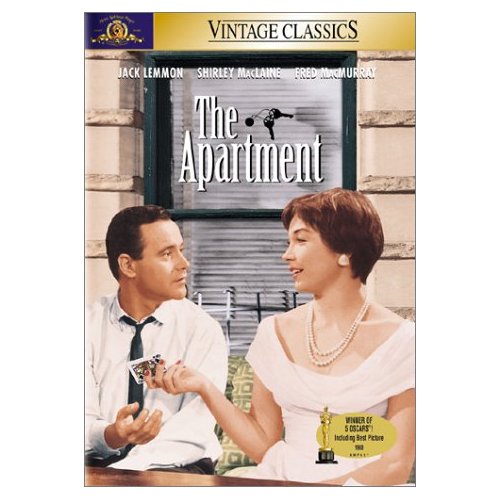
Movie Review: “The Apartment”


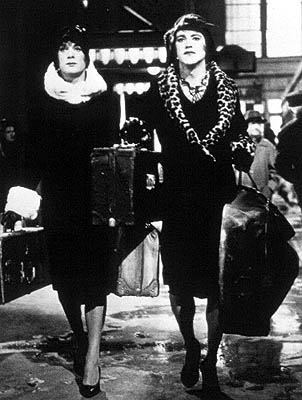
Before last week, I never knew about this terrific comedy film by famed director Billy Wilder.  I picked it up from The Strand bookstore in Union Square because I absolutely loved Jack Lemmon (and co-star Tony Curtis) in Some Like It Hot.  The Apartment won 5 Oscars in 1960, including the most-coveted one, Best Picture!  The stars of this (black and white) film are Jack Lemmon, Shirley MacLaine, and Fred MacMurray.  Unlike Some Like It Hot (another Wilder comedy where the main characters dress in drag to escape the mob), The Apartment is a more serious, true-to-life type of comedy. 


There are light and dark moments relating to ambition and romantic relationships, among other themes.  Jack Lemmon plays C.C. (Bud) Baxter, a single, ordinary “nebbish” (as his neighbor says) working for a huge insurance company in NYC.  But Bud has an advantage over his co-workers- he’s renting out his apartment to four men (working above him in different divisions) who want a little “ring-a-ding-ding” outside their marriages.  These guys, including a hilarious young Ray Walston (known to modern audiences from his serious TV roles), say this will put Bud on the fast track to success.  Bud has no problem with them having fun on the side, until it hits him personally.


The audience can clearly see that Bud has an interest in one of the elevator operators in his office building, Fran Kubelik (a very young Shirley MacLaine).  He thinks she’s “a nice decent girl” and goes out of his way to compliment and chat with her whenever he can.  When he gets a big promotion, he asks her out on a date to the theater.  He got free theater tickets from the head of personnel, Mr. Sheldrake (Fred MacMurray).  But things are not as they seem with the sweet, friendly Ms. Kubelik. 


I’m not going to reveal more about the plot of The Apartment, because I want you all to discover the surprises on your own.  Jack Lemmon does a great job in this film- he can convey conflicting emotions with subtlety.  He can do physical comedy, and his eyes are very expressive.  Shirley MacLaine will remind you of Renee Zellweger; she can be vulnerable and tough.  Young single, working women will relate to the character of Fran (at certain points in the film).  Fran wants to be loved, but keeps falling for the wrong kind of men.  This is a must-see film for anyone looking for a smart, thoughtful comedy!