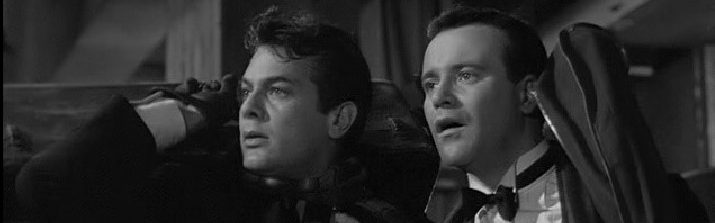
Bogart & Stanwyck Together: “The Two Mrs. Carrolls” (1947)

Sally Morton (Barbara Stanwyck) and Geoffrey Carroll (Humphrey Bogart)- a struggling artist- get married following the passing of Geoffrey’s first wife. Despite quickly falling in love w/ him while on vacation in Scotland, Sally never thought she’d marry him when she discovered that he was already married (regardless of his vow to get a divorce). Then the first Mrs. Carroll’s (called an invalid) passing changed the situation. The time of the first Mrs. Carroll’s illness resulted in Geoffrey’s greatest works, incl. a portrait of her as “The Angel of Death.” While Sally brings a house in the England countryside and a rough-around-the-edges housekeeper (Christine), Geoffrey brings a pre-teen daughter (Bea) into the marriage. Their happiness begins to change when glamourous/flirtatious Cecily Latham (Alexis Smith- who also co-starred w/ Bogart in Conflict) commissions Geoffrey to paint her portrait. Cecily and her mother were introduced to the Carrolls by a London lawyer, Charles Pennington (Sally’s former fiancé). The affable Penny (his nickname) is still in love w/ Sally, which doesn’t amuse Geoffrey.

Bogart says “I think this is the beginning of a beautiful hatred”, which is a nod to the famous line from Casablanca (1942). The movie was completed in June 1945, but released in March 1947, when Bogart’s box-office appeal was at a high (though most critics thought he was miscast). The role of an artist, a profession that viewers, critics, and even the actor himself felt deviated from his typical tough guy persona, there were limits to what he’d agree to. When the director (Peter Godfrey) asked Bogart to wear an artist’s smock and beret, he refused- LOL! I liked the chemistry between Bogart and Stanwyck; they got along well during the filming. I wasn’t a fan of the pacing, the child actress (calm and precocious), or the music (a bit overdone).

[1] Stanwyck has never been better as a panic-stricken wife, trying to survive her husband’s evil doings. Bogart gives a highly underrated performance as a psychopath, who gets brutal when his murder plot doesn’t go according to plan. His presence on screen is often frightening.

[2] Humphrey Bogart, for all of the heroic roles during this stage of his career, is cast against type, and Barbara Stanwyck, always the femme fatale, is now a damsel in distress as matters spiral beyond her control as grave danger closes in on her. The role-reversals of the stars works well and the byplay between them is good.

[3] One problem is that there is an enormous amount of subtlety employed in its unravelling. In fact I would say there is a little too much subtlety, to the point where the details that are supposed to be underplayed to maximise the mystery and suspense do not seem to be underplayed at all, but rather they appear to have simply been ommitted.

The second little problem is with Bogart’s character. He’s the centre of this story, a mentally disturbed and jealous painter who, it would appear, murdered his first wife… But we’re not really given any insight into his character until very late in the film. At first he appears to be just like your stereotypical artist; insular, unpleasant, cynical. But we know, or at least assume, that he has actual psychotic tendencies underneath that eccentric, but nonetheless ordinary exterior.

-Excerpts from IMDB reviews

Suburban Life Can Be Murder: “Crime of Passion” (1956) starring Barbara Stanwyck, Sterling Hayden, & Raymond Burr

A successful advice columnist at The San Francisco Post, Kathy Ferguson (Barbara Stanwyck- 50 and looking fab), is an independent woman w/ no intention of ever getting married. She meets LAPD detective, Lt. Bill Doyle (Sterling Hayden- age 40), during the investigation of a prominent case (which is resolved w/ her help). Sparks fly, they fall in love, and decide to get married (too fast). Kathy quits her job and moves to LA to be a housewife.

Bill is close to his colleagues and their wives; they have regular dinner parties at his home. The banal conversations of these women are almost unbearable for Kathy, who has worked mainly around men and (perhaps) prefers their company. The cops’ wives seem frivolous; she’d feel more comfortable playing cards w/ the men rather than trading recipes with the women. The lack of ambition on Bill’s part push Kathy to a scheme to improve his prospects in the police dept. Kathy “accidentally” has a fender bender on the street where Inspector Anthony Pope (Raymond Burr- also 40 and slimmed down) and his wife Alice (Fay Wray of King Kong fame) live. Social climbing, scheming, and more ensue!

Some women should just not get married; nowadays, there are other routes to follow. This unique movie combines elements of film noir and domestic melodrama. Some viewers have called it “proto-feminist” and “ahead of its time.” I thought that writing was intelligent and also witty at times; the screenplay was by a woman- Jo Eisinger. This is the last film noir for both Stanwyck and Burr; they’d transition to working primarily in TV and appearing only occasionally in movies. Burr moved from the “heavy” (shady/villainous) types he played in films to heroic defense attorney in Perry Mason.

[1] …turns out to be a fairly interesting, sexually frank, compact little noir, featuring a once-in-a-lifetime cast. Stanwyck… is as intense as ever (she always gave her all in every picture); Hayden is his typically macho, upright self; Raymond Burr, playing Hayden’s boss, is a tad less sleazy than usual but still not to be trusted…

[2] Sharper socially than even Fritz Lang’s late noirs, “Crime of Passion” reminds us of the “nostalgia” for the “happy family values” of the 1950’s for the wishful (?) thinking that it is. Stanwyck’s slow descent into middle-class torpor and madness (she’s a sharp, witty, intelligent woman who saddles herself with a maddeningly boring and conventional cop husband, played nicely against type by Sterling Hayden) lays bare the social nightmare presented to women desiring anything but the conventional patriarchal lifestyle…

-Excerpts from IMDB reviews

Film Noir’s “Romeo & Juliet”: “They Live By Night” (1948)

Opening Title Cards: This boy… and this girl… were never properly introduced to the world we live in… To tell their story… They Live by Night.

Chickamaw (Jay C. Flippen), T-Dub (Howard Da Silva) and Bowie (a young Farley Granger in his 3rd role) have just escaped from prison somewhere in the Midwest. Though Chickamaw and T-Dub are hardened criminals (bank robbers), Bowie is just 23 y.o. and has been locked up since age16 (wrongly convicted of murder). Instead of rotting behind bars, Bowie, when given this chance by these older men, believed his best path forward was to help in their upcoming heists. He wanted to make enough money to hire a lawyer to clear his name of the murder conviction. The plan is to hide out with Chickamaw’s alcoholic/older brother, Mobley, until they have enough money to make other arrangements. Also w/ them is Mobley’s daughter, Keechie (Cathy O’Donnell- a waifish girl-next-door), who doesn’t much like her life. She and her father have small/run-down farm.

This unique film (now loved by critics and noiristas) is based on Thieves Like Us (1937), a novel by struggling journo Edward Anderson. It was identified by critic Thom Andersen as an example of film gris, a sub-category of film noir w/ a left-wing narrative. This was the debut of director Nicholas Ray and filmed in 1947; its release was delayed by 2 yrs. b/c Howard Hughes was in the process of buying RKO. Though well-liked by many Hollywood insiders, the film lost money at the box office. It was appreciated more in Europe, particularly France. Robert Mitchum lobbied to play Chickamaw and Jane Greer auditioned for Keechie; they’d soon be working on Out of the Past.

They Live by Night combines youthful innocence, first love, and the gritty world of crime. It’s not glam like many film noirs; this is a world of Greyhound buses, roadside diners, motor inns, etc. Granger asked to audition w/ O’Donnell (a close friend of his from MGM Studios); their onscreen chemistry is obvious. We see a romantic prologue showing Granger and O’Donnell (both newbies in the movie biz) w/ subtitles before the opening credits. The film’s opening action sequence was shot by a helicopter camera placed on a mount. Aerial helicopter photography was rare at that time; this is one of the first times an action scene was filmed from the sky. Bowie is the gang’s driver; he dreams of someday running his own garage/gas station. After he’s injured during a getaway, Keechie nurses him back to health. She doesn’t think much of him or his lifestyle; Bowie feels little shame in his role. There is something about Keechie that appeals to Bowie; both were abandoned by their mothers and inexperienced in romance. They form a strong emotional bond and begin to dream of a life together (where he won’t have to be on the run).

[1] Farley Granger is best remembered for his Hitchcock roles, and he gives a good, multifaceted performance. It’s clear from the get-go that despite the company he keeps and despite his time in prison, he’s really a scared, uncertain kid. Cathy O’Donnell is all but forgotten… extremely convincing and appealing

[2] Bowie, the innocent, sympathetic outlaw hero of “They Live By Night” is a wonderfully drawn. By no means is he the cliched nice-guy-in-a-bad-situation; though essentially good-hearted, he can be frighteningly callous at times. Farley Granger, working with excellent direction, he gives us glimpses of a violent yet passionate nature, struggling against the condemnation of society. Cathy O’Donnell is also entrancingly tender…

[3] In a sense this cuts right to the chase with the theme of doomed youth, years before Rebel Without a Cause yet with the given desperation of the noir films.

…a powerful mix of the bittersweet tale of a criminal and his love that would decades later meld with other crime-film elements into a work like True Romance.

-Excerpts from IMDB reviews

“High Sierra” (1941) starring Ida Lupino & Humphrey Bogart

Bogie was a medium-sized man, not particularly impressive off-screen, but something happened when he was playing the right part. Those lights and shadows composed themselves into another, nobler personality: heroic, as in “High Sierra.” I swear the camera has a way of looking into a person and perceiving things that the naked eye doesn’t register. -John Huston (who wrote the script), when asked about Bogart’s unique appeal on this movie

Roy “Mad Dog” Earle (Humphrey Bogart) was broken out of prison by an old associate who wants him to help w/ a robbery of a casino on the California-Nevada border. The two young punks who’ll be assisting are Babe (Alan Curtis) and Red (Arthur Kennedy, before he became a well-known character actor). When the robbery goes wrong (a cop is dead), Roy is forced to go on the run. Also in the mix are a loyal dog, Pard (played by Bogart’s own dog) and two potential love interests- former dancehall girl, Marie (Ida Lupino), and Okie farmgirl, Velma (Joan Leslie). Police and press are hot on his trail; he hides in the Sierra Nevada mountains.

Roy Earle: Of all the 14 karat saps… starting out on a caper with a woman and a dog.

Bogart also sent many telegrams to Hal B. Wallis and studio head Jack L. Warner asking to be cast as Earle (who was modeled on John Dillinger). Paul Muni left Warner Bros. after a contract dispute and George Raft turned down the role, so Warner called Bogart. This was the last movie Bogart made where he didn’t receive top billing; the studio decided that Lupino should have top billing, as she’d been a big hit in They Drive by Night (1940). Though Marie admires and falls for Roy, Lupino didn’t like the way Bogart treated her and his use of sarcasm. Director Raoul Walsh saw Bogart more as a supporting player, not a leading man. He wrote  in his biography that Bogart complained about everything: food chosen for lunch, settings, conditions of shooting, etc.

Roy Earle: I wouldn’t give you two cents for a dame without a temper.

Roy is a lonely/romantic man; he came from a small town, as he tells Pa (the farmer he meets on the road). He falls in love w/ Pa’s granddaughter, Velma, a pretty/club-footed young woman who sees him as a friend/benefactor. Roy has emotions which run deep; he wants to give up crime and marry a “good girl.” He has a soulmate in Marie; she is weary, straight-forward, and cares deeply for him. Roy prefers the one he can’t get- of course! Bogart and Lupino have very strong chemistry here.

[1] Not cocky like Cagney and Muni, not psychopathic like the early Edward G. Robinson, not as smooth as Raft, Bogart is a ruthless professional with a wide stripe of sentimentality. His Roy never shirks from killing, but he doesn’t get off on it. He’s more a rebel than a gangster, a poetic soul denied respectability, a man longing for the innocence of his youth.

[2] Bogart’s interpretation already showed signs of the special qualities that were to become an important part of his mystique in a few more films.

Here, for the first time, was the human being outside society’s laws who had his own private sense of loyalty, integrity, and honor. Bogart’s performance turns “High Sierra” into an elegiac film.

[3] Many fine moments [for Lupino] with Bogey… including a memorable speech within his cabin hideout. This is one of the best portraits of a desperate outlaw in film history. A blueprint for all the antihero films that would follow over the years…

-Excerpts from IMDB reviews

Hitchcock’s 50th Film: “Torn Curtain” (1966) starring Paul Newman & Julie Andrews

Prof. Michael Armstrong (Paul Newman- the hottest scientist ever) is heading via boat to Copenhagen to attend a conference w/ his assistant/fiancée, Sarah Sherman (Julie Andrews). Once they arrive, Michael informs her that he’ll be staying for a while and she should go home. Sarah follows him and realizes Michael is actually going to East Germany (behind the Iron Curtain). She is shocked when Michael announces that he’s defecting; the U.S. government cancelled his project after 6 yrs. In truth, Michael is there to get info (which a professional spy couldn’t understand) from another nuclear physicist!

I did not have to act in ‘Torn Curtain’. I merely went along for the ride. I don’t feel that the part demanded much of me, other than to look glamorous, which Mr. Hitchcock can always arrange better than anyone. I did have reservations about this film, but I wasn’t agonized by it. The kick of it was working for Hitchcock. That’s what I did it for, and that’s what I got out of it. -Julie Andrews

The idea behind this film came from the defections of British diplomats (Guy Burgess and Donald Maclean) to the Soviet Union in 1951. Sir Alfred Hitchcock was very intrigued re: Maclean’s life in the Soviet Union, incl. about Melinda Marling (his wife) who followed her husband a year later w/ their three children. In the end, Hitch was so unhappy w/ this movie that he didn’t make a trailer w/ his appearance in it (as was his habit). Bernard Herrmann (composer) wrote an original score, but Universal execs convinced the director on something more upbeat. Hitchcock and Herrmann had a big fight and never worked together again! Steven Spielberg admitted on Inside the Actors Studio (1994) that as a young man he snuck onto the soundstage; he was there for 45 mins. before an assistant producer asked him to leave.

I think Hitch and I could have really hit it off, but the script kept getting in the way. -Paul Newman

The working relationship between Hitch and Newman was problematic; the actor came from a different generation than Cary Grant and James Stewart. He questioned the director re: the script and his characterization, which Hitch later said he found “unacceptable and disrespectful.” As a Method actor, Newman consulted Hitch about his character’s motivations; Hitch replied that his “motivation is your salary.” Also, no romantic chemistry developed between Newman and Andrews (another disappointment to the director). Though the screenplay drags along, the colorful Eastern European supporting actors do fine w/ what they are given. Many critics/viewers recalled the (memorable) killing scene where Gromek fights Armstrong and a housekeeper in the farmhouse.

[1] Pity. I love Hitchcock. There is a detachment here never seen before in a Hitch flick. As if the master was tired or uninterested.

[2] The main thing about Torn Curtain is the photography. It’s full of pretty pictures- one of the most beautifully filmed of all Hitchcock’s films, with lots bold swaths of primary colors and attractive and constantly changing locations…

[3] This was Alfred Hitchcock’s last star vehicle. At the time this was made Julie Andrews was fresh from Mary Poppins and had all kinds of roles offered her. …she and Newman really have no chemistry at all.

-Excerpts from IMDB reviews