This month (July) TCM has been showing Hitchcock’s films every MON & WED; Rear Window is probably my fave of his films. (Strangers on a Train would come in second, b/c WHO could resist the devilish Robert Walker!?) This is a simple story, BUT there is a LOT going on (once you watch it a few times)! Most of you know the synopsis (below from IMDB):
Professional photographer L.B. “Jeff” Jeffries breaks his leg while getting an action shot at an auto race. Confined to his New York [Chelsea] apartment, he spends his time looking out of the rear window observing the neighbors. He begins to suspect that a man across the courtyard may have murdered his wife. Jeff enlists the help of his high society fashion-consultant girlfriend Lisa Freemont and his visiting nurse Stella to investigate.
When two people love each other, they come together – WHAM – like two taxis on Broadway. -Stella tells Jeff her view of relationships
The relationship between Jeff (James Stewart) and Lisa (Grace Kelly) is a BIT complicated; they are VERY attracted to each other, BUT have different lifestyles and personalities. Jeff thinks that Lisa is TOO good for him; you can tell by the way he describes her (to others and also during their evening dates at home). Lisa is (obviously) waiting for him to settle down (note the comment about the art gallery) and ask for her hand in marriage (b/c she loves him a LOT, putting up w/ his quirks). Straight-talking Stella (Thelma Ritter- always a delight) bemoans the fact that courtships have become SO complicated (LOL- a LOT of modern/single people would agree).
Stewart gets to flex his acting muscles in this darkly comic role. You can’t help but laugh at a LOT of Jeff’s lines, the way he looks, and generally expresses himself. He doesn’t have the luxury of much movement, being confined to a wheelchair (though is still VERY effective). Lisa is willing to make their lives work together, though he has doubts. And when she faces danger, Jeff realizes just how much he loves her!
[1] Alfred Hitchcock is considered by most to be the master of suspense. I believe he was also a master of understanding human nature. He intuitively understood that human beings are voyeurs by nature, not in the perverted sense, but in the curious sense.
[2] The acting is superb in this film. Jimmy Stewart is unabashedly obsessed as the lead character. Photographers have an innate visual perceptiveness and the ability to tell a story with an image and Stewart adopts this mindset perfectly. Grace Kelly has often been accused of being the “Ice Maiden” in her films, yet in this film she is assertive and even reckless. Though cool at times, she is often playful and rambunctious.
[3] The main characters are wonderfully portrayed and full of life. The apparently simple setting in an apartment complex is developed into a world filled with intriguing and sometimes unsettling possibilities, and this apparently average neighborhood comes to life with a wealth of lavish visual detail and interesting minor characters.
[1] The first thing that you notice is the outstanding cinematography.
[2] …Joan Fontaine is just perfect as de Winter’s new bride. I can’t spot an unconvincing moment in her performance and can’t imagine any other actress in the role.
[3] Her [Judith Anderson’s] presence is as dark and foreboding as that of the deceased Rebecca herself, and Fontaine is evidently cowed by her icy stare and unnervingly formal manner. The dynamics between the two actresses are wonderful.
-Excerpts from various reviews on IMDB
Alfred Hitchcock often claimed that this film wasn’t his own. It belonged to Daphne Du Maurier because she had created such vivid characters and such a complex and exciting story. I disagree. You can’t deny his hallmark in all areas of this expertly crafted film. -Bette’s Classic Movie Blog
It is said that director Alfred Hitchcock encouraged the cast to shun Joan Fontaine (sister of Olivia de Havilland), even going as so far as to tell her “everyone here hates you” (in order to making her performance even more self-conscious and nervous in the lead role). Laurence Olivier was already upset w/ the fact that Vivien Leigh (his then-girlfriend) wasn’t chosen for the role. A gothic romance (inspired undoubtedly by Jane Eyre and Wuthering Heights), Rebecca is a suspenseful study in guilt and anxiety, exploring themes of love, obsession, and power. This is a moody (atmospheric) film which draws in the viewer w/ its music (by Franz Waxman), superb use of light and shadow, and (most importantly)- characters. The Grapes of Wrath was a fine film (and a great contender), but Rebecca won the Oscar.
CHARACTERS
Narrator/Mrs. de Winter (Joan Fontaine): A shy, self-deprecating young woman working as “a paid companion” (an assistant/friend). Her mother and father (who she said people didn’t understand) are deceased, so she (as a single woman) has to make a way for herself in the world. Sometimes you will relate to her; at other times, feel sorry for her predicament.
It’s just that I, well I’m, not the person men marry.
Maxim de Winter (Laurence Olivier): A middle-aged, handsome, aristocratic widower from Cornwall, where he owns an estate- Manderley. He can be witty/charming one moment, then angry/brooding the next (like Mr. Rochester); he is trying to forget his past.
Happiness is something I know nothing about.
Mrs. Van Hopper (Florence Bates): Rebecca’s wealthy/widowed/high-maintenance employer. The two ladies are vacationing in Monte Carlo at the start of the story. She is shocked when she discovers that her companion and Maxim are engaged; she asks:
Have you been doing anything you shouldn’t?
Mrs. Danvers (Judith Anderson): She seems to be as much a nanny-figure and a controlling mother figure, as a sinister housekeeper. She is creepily devoted to the memory of her former mistress, Rebecca; we are left to wonder just what sort of relationship they had. In the pivotal bedroom scene, she asks the second Mrs. de Winter:
Do you think the dead come back and watch the living?
Beatrice Lacy (Gladys Cooper): Maxim’s older sister who is surprised to meet the new Mrs. de Winter, but eventually warms up to her as a family member. She lives nearby w/ her somewhat comedic husband, Major Lacy (Nigel Bruce). Cooper is perhaps best known as the domineering mother to Bette Davis’ character in Now Voyager (1942); she also played Rex Harrison’s mother in My Fair Lady (1964). It’s nice to see her in a more lighthearted role here.
Jack Favell (George Sanders):A clever, charming cousin of Rebecca’s who we sense has a shady side. He shares secrets w/ Mrs. Danvers and feels contempt for Maxim. Jack acts like he feels sorry for the new Mrs. de Winter when he meets her by chance. Sanders has a pivotal role in All About Eve (1950), where I first noticed him and became a big fan. He was in another (gothic-inspired) film- The Ghost and Mrs. Muir starring Rex Harrison and Gene Tierney.
Frank Crawley (Reginald Denny): The manager of the Maderley estate; he is cordial to everyone in the household, including the new mistress. This is NOT the type of guy who makes (or likes) drama, unlike others in this tale.
Colonel Julyan (C. Aubrey Smith): He is a no-nonsense elderly aristocrat in charge of the court case (inquest). This actor played Mr. Laurence in Little Women (1949) starring Elizabeth Taylor and Janet Leigh (another of Hitch’s players).
Dr. Baker (Leo G. Carroll): He is a medical doctor in London. This prolific character actor appeared in several of Hitch’s films: Suspicion (1941), Spellbound (1945), Strangers on a Train (1951), and North by Northwest (1959).
THEMES
Food
Mrs. de Winter has trouble with eating. The long lonely dining room table separates her and her husband. Food is heaped up around characters: Jack tears into cold chicken, Mrs Van Hopper wolfs down chocolates, and “Oh! What a plateful!” exclaims Beatrice.
Clothing & Hair
At the beginning, Fontaine’s character is dressed like she made terrible selections at a Macy’s basement sale. Later, as she tries to fill the role of the “great lady”… her clothes always appear too big and out of character. Note the black evening dress with the absurdly large flowers across the front and the overwhelming gown at the costume ball. -Excerpt from IMDB review
Mrs. de Winter is repeatedly subjected to adverse comments on her hair. When she tries for a new more sophisticated look, Maxim hates it. Hair (confined, unbound, luxurious, neglected) is mentioned several times in the film. We hear that Rebecca had long dark hair.
Scent
Scent is as suspect and degenerate as all of Rebecca’s luxuries: a trap, a snare and a betrayal. -Les Senteurs blog
Mrs. de Winter talks of storing up her memories like perfume. Maxim comments that those little bottles “sometimes contain demons that have a way of popping out at you just as you’re trying most desperately to forget.” He prefers his new bride to smell natural.
Innocence
He had a theory that if you should find one perfect thing, or place or person, you should stick to it. Do you think that’s very silly? -The narrator says about her father to Maxim
The main thing that attracts Maxim to the narrator is her innocence (including her inexperience w/ men, unassuming manners, and youth). When she woefully wishes she were older and elegantly dressed, Maxim stops the car and solemnly replies: “Please promise me never to wear black satin or pearls… or to be 36 years old.” We can sense that Maxim has emotional baggage, but the second Mrs. de Winter doesn’t see the warning signs, or she overlooks them, being so much in love.
NOTE: This review contains SPOILERS for the streaming drama series, book, and 1990 movie version of The Handmaid’s Tale.
Introduction
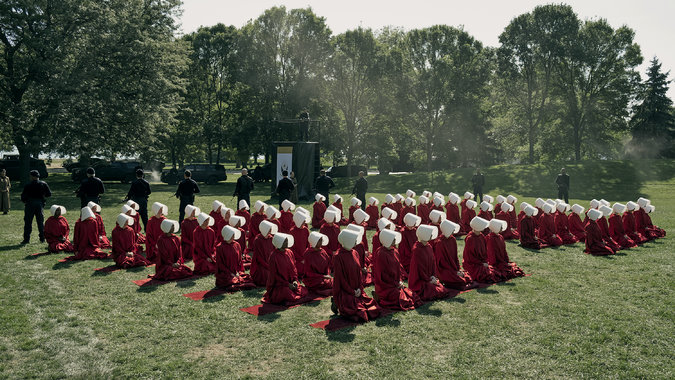
Handmaids kneeing at a gathering with Guardians surrounding the area
Atwood’s book has echoes of New England Puritanism, along with atrocities drawn from sources including Saudi Wahhabism, the Third Reich, American slavery, and the East German surveillance state. It’s constructed not as a realistic story, however, but as an eyewitness account… -Emily Nussbaum (The New Yorker)
Mankind is failing, most women are sterile because of industrial pollution (or Mother Nature just having enough of us). Birth rates are plummeting. An ultra religious cult see it as their God-given mission to “save mankind.” They seize power by staging a fake terrorist attack against the US government, impose marshal law, and set about rebuilding American society. (“War On Terror” anyone?) They use The Old Testament as their blueprint, but with some totally wack interpretations and distortions. Fertile women become the property of the state. Brainwashed and farmed out to the new ruling elite as baby makers, slavery and subjugation is all they can hope for. -Summary by IMDB reviewer
Serena Joy (Faye Dunaway) and Offred (Natasha Richardson) in the 1990 movie version of “The Handmaid’s Tale”
Canadian writer Margaret Atwood wrote her dystopian novel in 1985 (while she was living in Berlin, Germany); it was first published in 1986. She didn’t put anything in that hadn’t happened before at some place and time period in history. Her book is considered a blend of historical fiction and sci-fi; I read it in HS (I think). Many years later, I saw the 1990 movie starring Natasha Richardson, Robert Duvall, Faye Dunaway, and Aiden Quinn. Critics (mostly) hated that film, BUT I thought it was pretty decent. Veteran actors Duvall and Dunaway played the Waterfords; their ages were appropriate to the book. However, in this new Hulu series, the couple are much younger, energetic, and passionate.
Setting
A group of Handmaids clean blood from the wall by the river.
The Handmaid’s Tale looks extraordinary – stylised, choreographed almost, menacing. It sounds fabulous, too. -Sam Wollaston (The Guardian)
Even the light coming in through the windows has a soft luxury to it, a Vermeer-ish quality. -Sonia Saraiya (Variety)
Much has been written lately re: the importance of world-building in good drama series; after all, the look is what first draws the attention of viewers to a show. Offred wears a distinctive white bonnet (the 1990 film had a red veil) and scarlet-colored dress and hooded cape, as do ALL the other Handmaids. The commanders wear black suits w/ dark-colored ties; their wives wear blue dresses (covering the knees and and conservatively cut) and matching capes. There are also lower-ranked married women in this world; they are called Econowives and wear grayish striped dresses. The Guardians dress like modern-day SWAT teams- in black and gray colors.
There are also little/subtle touches which enrich the show. The Gilead-era flag (which is shown in Canada) only has two stars, b/c the U.S. ONLY has control over two states- Alaska and Hawaii. In the real world, the red tags attached to the Handmaids’ ears are used on livestock (such as cows); this is a reminder that the Handmaids are viewed as farm animals, NOT humans. There are mentions of Uber, Tinder, the SATs, and even a cute scene involving a food truck- things that we are familiar w/ in 2017.
Characters
In the book, Gilead is a white-supremacist culture. In the show, black actors play Moira and Luke. The result is an odd trade-off: we get brown faces, but the society is unconvincingly color-blind, as if race had never existed. -Emily Nussbaum (The New Yorker)
June/Offred (Elisabeth Moss)
The book uses a 1st person narrator, so the reader ONLY knows what Offred knows. This series also gives us POVs of other characters, BUT she is the lead. Moss has tackled meaty roles before (The West Wing; Mad Men; Top of the Lake). She is VERY good at expressing a lot of (conflicting) emotions w/ subtle/brief looks and body movements. In her previous life, Offred was a book editor and married mother to an adorable young daughter (Hannah). At the start of the series, her goal is to stay mentally strong and survive in order to someday find her little girl.
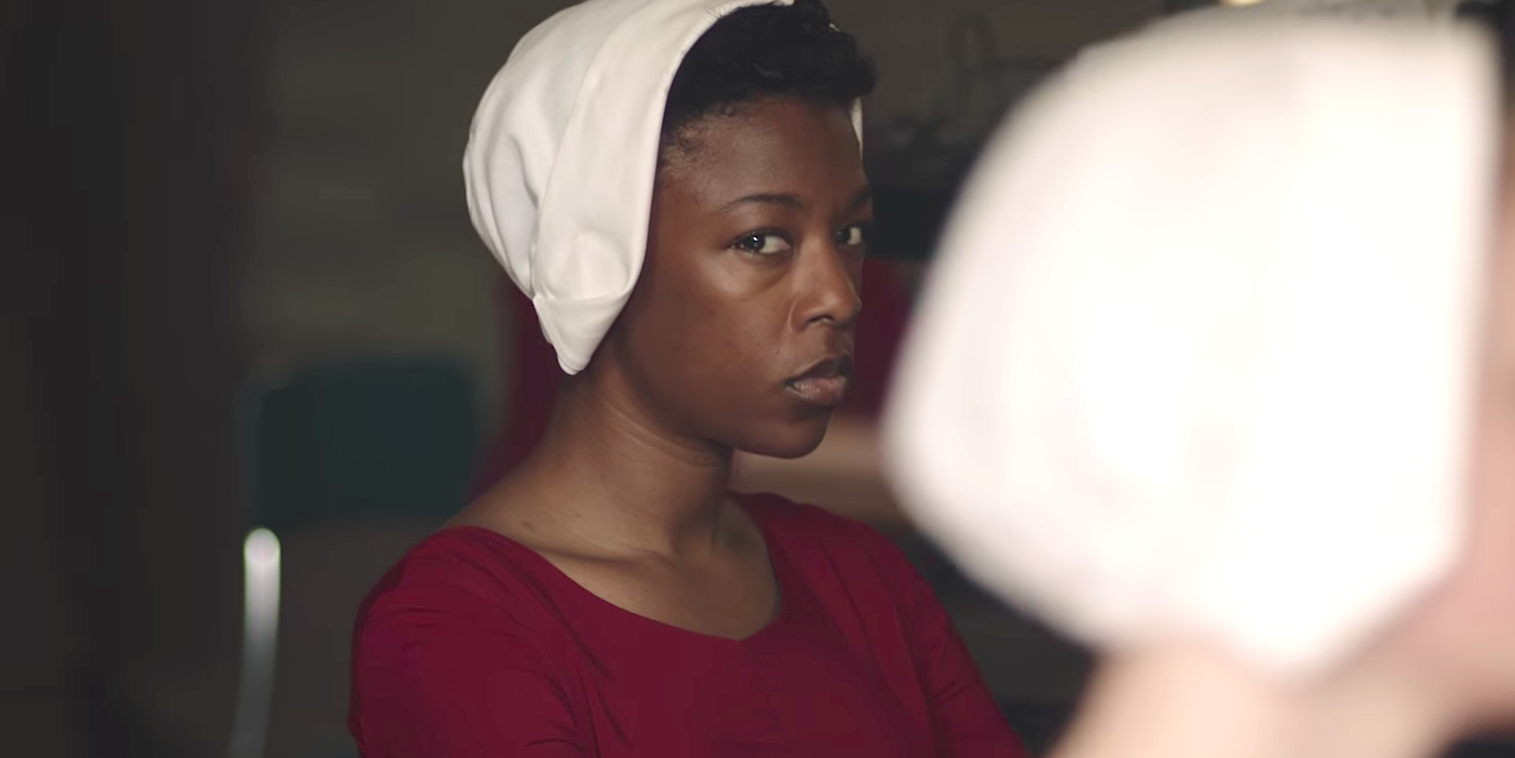
Moira (Samira Wiley)
Moira (Samira Wiley) at the training center
The petite, out and proud lesbian is June’s best friend. Moira, who is BOTH funny and strong-willed, manages to escape from the Rachel and Bilhah Center in the disguise of an Aunt. Offred gets left behind on the subway platform, BUT she understands the difficulty of the situation. Though there are rumors that Moira died, we see her (later in season) working at Jezebels, a club where commanders come to fulfill their fantasies w/ a diverse array of women (many of whom were intellectuals in the past). Just like the Handmaids, these women can’t say “no.” When they are reunited (by chance), Moira explains to June that Jezebels get good food, booze, and drugs. In the book, she says that she can read and have relationships w/ women. Fans of OITNB rejoice!
Luke Bankole (O-T Fagbenle)
Luke, June’s husband and father to Hannah, gets a backstory in this series; that is NOT in the book. When they first met, Luke was married to another woman; this adds to the shades of gray in the story. This actor is British-Nigerian and I had never seen him before; he does a great job in this role (incl. the more action-oriented scenes).
Emily/Ofglen (Alexis Bledel)
Ofglen (Alexis Bledel) and Offred (Elisabeth Moss) at the grocery store
In her previous life, Emily was a college prof, married (w/ a wife), and young son. Offred doesn’t really know much re: Ofglen until after 2 mos. of walking w/ her to do the grocery shopping; no Handmaid can travel alone. Later in the series, Ofglen goes through FGM (scary, yet still happening ALL over the world). This is a VERY meaty (and unusual) role for Bledel; she is best known for The Gilmore Girls.
Janine/Ofwarren (Madeline Brewer)
Janine, a fiery redhead, was mouthy at the training center; she was severely punished by one of the Aunts (losing an eye). Poor Janine has a tragic past; she was a survivor of a gang assault (resulting perhaps in PTSD). Moira is tough on her, BUT June has success in calming her down; the behavior of one Handmaid will affect ALL of them. Even after Ofwarren gives birth to the Putnam’s baby girl, her emotional turmoil continues.
Aunt Lydia (Ann Dowd)
Aunt Lydia (Ann Dowd) at a gathering of the Handmaids
Ordinary is just what you’re used to. This might not seem ordinary right now, but after a time it will. This will become ordinary.-Aunt Lydia to the Handmaids
Aunt Lydia is the head of the Rachel and Bilhah Center; she is a harsh taskmaster who seems to truly believe in the ways of Gilead. In time, we notice that she feels bad for Janine, BUT she can’t let things slide for ANY of her “girls.” Ann Dowd, a veteran character actress, brings a BIT of ambiguity to the role- she is NOT a total villain.
Cmdr. Fred Waterford (Joseph Fiennes)
Offred (Elisabeth Moss) plays Scrabble with The Commander (Joseph Fiennes) in his study
Better never means better for everyone. It always means worse for some. -Cmdr. Waterford explains to Offred
He is usually called “The Commander” by everyone; his wife (Serena Joy) only calls him Fred. Some of the other Handmaids tell Offred that he is “really high up” and “very important” in the government of Gilead. At first, The Cmdr. is merely going by the book during ceremony nights; later, he wants to connect w/ Offred. He requests that Offred come down to his study (a no-no); they chat (even flirt a BIT), play Scrabble (which they are BOTH good at), and he gives her fashion magazines to read (another no-no).
To show her just how much power he holds over her, The Cmdr. takes Offred (wearing one of Serena Joy’s blue capes) out to the club- Jezebels. Notice that he chose a sparkly mini-dress and matching heels for Offred to wear; this shows us what type of woman he desires (someone to show off). Fiennes does a great job w/ his American accent; I don’t think I’ve seen him using one before. The actor creates a man who is complicated, yearning for connection (esp. to Offred), and enjoys flaunting the rules (which he helped establish).
Serena Joy Waterford (Yvonne Strahovski)
Serena Joy (Yvonne Strahovski) listens to the prayer in her parlor
Never mistake a woman’s meekness for weakness. -Serena says to the Mexican ambassador, Mrs. Castillo
Serena Joy is portrayed by an Australian actress (former model) who somewhat resembles Grace Kelly, BUT w/ a more taller/athletic body. She gets a backstory in this series that is NOT in the book (like Luke). In flashbacks, we see how Serena Joy was a part of the establishment of Gilead; she wrote a book about the role of women. (Atwood modeled Serena Joy on the historical anti-feminist figure, Phyllis Schlafly, an outspoken opponent of the ERA in the ’70s.) The world she helped create has left her feeling alone, bitter, and (eventually) cruel. Serena Joy eventually turns on Fred, saying that he is NOT “worthy” of fathering a child, so God has denied him one.
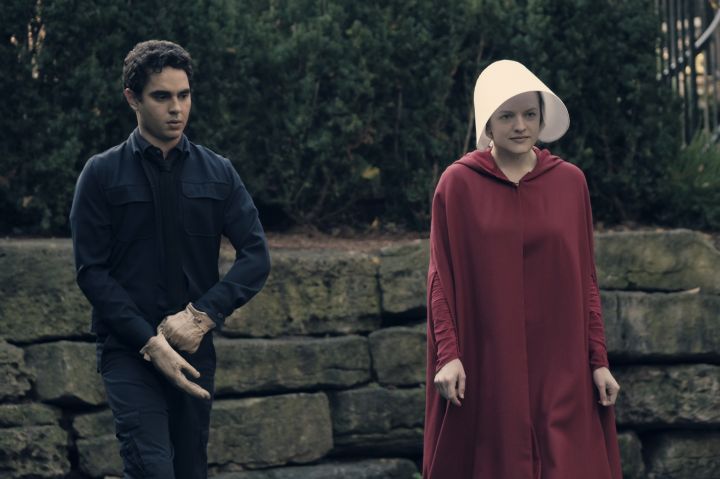
Nick (Max Minghella)
Nick (Max Minghella) and Offred (Moss) in the yard
Max Minghella’s performance gets more interesting every week. You never know what he’s going to say until he says it—that face is unreadable in the best and most unsettling way. -Allison Shoemaker (A.V. Club)
Nick is The Commander’s driver; he lives in a humble room above the Waterford’s garage. In the pilot, Offred explains that he is “low rank” and “has not even been assigned a woman.” At first, Nick just watches Offred (w/o speaking); this makes her a BIT nervous, BUT also curious. They begin to secretly flirt; BOTH are feeling lonely and need someone to talk to. Mrs. Waterford gets them together b/c, MOST likely, The Commander is shooting blanks. It takes time, BUT Nick is revealed to be a protector, NOT merely a coward or survivor. He was recruited rather young as one of the Sons of Jacob, a secret group of men who are the Eyes in the households of the commanders.
Rita (Amanda Brugel)
Rita is one of the Marthas; she has worked for the Waterfords for a few yrs (like Nick). She is brusque, at first, BUT then treats Offred w/ kindness (making her healthy meals). After all, the birth of a baby would be great for ALL of the household. We learn that she lost her grown son in the war; most likely, he was fighting against the establishment of Gilead. I hope that she gets a backstory in Season 2; she is one of the few Latina women on the show.
Themes
Identity/Individualism
The Handmaids’ uniform denies the women individuality until the camera moves close enough so that we see their faces. In Gilead, the group is MORE important than the individual, as the Aunts and Commanders often say. Those women who don’t fall in line, like Ofwarren (who went through emotional turmoil after pregnancy) and Ofglen (who fell in love w/ one of the Marthas), are dealt w/ VERY harshly.
Children
And she said, Behold my maid Bilhah, go in unto her; and she shall bear upon my knees, that I may also have children by her.-Genesis 30:3 (King James Bible)
In this world, a healthy birth happens 1 out of 5 times. June/Offred is in her early 30s and already has a daughter, so there is a good chance that she can have another child. Janine/Ofwarren gives birth to a fine baby girl, gets to breastfeed her, BUT then is ceremoniously put out of the Putnam’s household. Like MANY other viewers, I am NOT convinced that Serena Joy wants a child; she has bought into this society, BUT that doesn’t mean that she’s happy w/ it.
Love & Marriage
Unlike in any number of other gender dystopias, most men don’t oppress women because they hate or fear them, but because they can’t empathize enough to love them when it becomes inconvenient.
…And women gave up everything by empathizing too much and turning on each other to support the men they loved. -Adi Robertson (The Verge) re: the book
Serena Joy is rejected (coldly) by her husband after one halted ceremony scene; after all, intimate relations in Gilead are solely for the purpose of procreation. Maybe some viewers felt sympathy for her then? I was a BIT shocked when The Cmdr. admitted to Offred that he didn’t believe in love; in flashbacks, it seems like he and his wife were once deeply in love. (In the book, Atwood explains that some couples were already married before the establishment of Gilead; others were placed in arranged marriages to spouses of equal status.)
Offred goes to Nick’s room b/c she wants to spend the night w/ him; this happens after Mrs. Waterford has them perform the ceremony. As for love, Offred likes Nick, BUT is still in love w/ Luke. As for Nick, I think that he does fall in love w/ Offred; he can’t express himself, as it could get them BOTH killed.
Women & Femininity
“Women have too much freedom here,” a foreign undergrad student commented when I asked him how he liked America. A few months ago, I mentioned to a friend how it’s too bad that apt. buildings in some countries (EX: Japan and India) didn’t rent to unmarried couples. “They should have a choice, at least,” I said. She replied quickly: “Oh, all those rules are for protection of women. What if the boyfriend leaves her? And if she gets pregnant?” The founders of Gilead take this type of thinking to another (extreme) level; they think they are protecting the Handmaids and the (possible) future children. How is legally sanctioned rape protection!? In one scene, The Cmdr. tells Offred that it’s the “destiny” of women to bear children. So, where does that leave his wife?
Freedom & Confinement
Offred (Moss) sees Moira in the club
“You’re free here,” The Cmdr. tells Offred in their room at the club. We know that no woman is free in this world! In the flashbacks, we see June (and other women in Boston) being let go from their jobs, then their bank accounts frozen, before being sent to the training center. Moira lashes out at Luke when he tells June “I’ll take care of you.” Ugh, that’s NOT the point- it’s about choice! One can argue that Offred finds a sort of freedom in her relationship w/ Nick, which is a (dangerous) rebellion.
Reading, Writing, & Storytelling
Since reading is forbidden for Handmaids, ALL the items in the grocery store are marked by pictures instead of words. Before Moira’s escape scene, we see workmen chipping away at the signs in the subway. You know what reading promotes- thinking! Before each ceremony, the household gathers in the parlor while The Cmdr. reads the story of Rachel, Jacob, and Bilhah from the family Bible. Offred discovers a Latin phrase written inside the closet in her room; she finds out (from The Cmdr.) that it translates to “don’t let the bastards grind you down.” The Mexican ambassador’s assistant proves that he can be an ally to Offred when he hands a pad of paper and pencil, asking her to write a message for her husband (who is alive). The mysterious package Moira mails from the club to the butcher (another male ally) turns out to be letters and photos from a diverse group of women (some mothers); they are desperate to tell the wider world their story.
Flower seller Eliza Doolittle (Audrey Hepburn) dreams of a better life.
[1] From first frame to last, the film is slick, graceful, gorgeous to behold, with costumes and sets richly evoking the Edwardian era…
[2] The acting from Rex Harrison deserves high praise, it is effortless and believable. The same can be said for Audrey Hepburn…
…despite his success, the experience of tutoring Eliza has humbled him. The end of the film where they show respect and care for each other was a masterstroke as no romance was needed.
[3] What Higgins is, in reality, is a misanthrope. A misanthrope basically dislikes and distrusts everyone! Watch the film and you’ll notice that Higgins treats everyone with the same disregard…
[4] The songs are extraordinary in their ability to enrich our knowledge of the characters… Eliza’s father, who calls himself one of “the undeserving poor” is one of Shaw’s best comedy creations…
[5] It’s a momentous film but it has its subtle points: watch the way in which Eliza’s eyes are centered on Higgins when she enters at the ball, and the way in which the two of them stare at each other for a few seconds at the top of the stairs a few moments later.
-Excerpts from various IMDB reviews
This is a musical that I’ve seen MANY times (usually w/ my family as a kid); I esp. like the songs and costumes. This is one of my mom’s fave films; she’s a big Audrey Hepburn fan. The play Pygmalion by George Bernard Shaw was inspired by a Greek myth by Ovid. Pygmalion was a sculptor from Cyprus who carved a woman out of ivory. This statue was so beautiful and realistic, he fell in love with it. When Aphrodite’s festival day came, Pygmalion made offerings at the altar of the goddess of love, and wished for a bride who would look like his statue. When he returned home, Pygmalion kissed the statue, and found that its lips felt warm. He kissed it again, and found that it was transformed into a real woman. Aphrodite had granted Pygmalion’s wish. He married the woman (named Galatea) w/ Aphrodite’s blessing.
You see this creature with her curbstone English? The English that will keep her in the gutter till the end of her days? Well, sir, in six months, I could pass her off as a duchess at an Embassy Ball. I could even get her a job as a lady’s maid or a shop assistant, which requires better English. -Professor Henry Higgins declares to Colonel Pickering
Eliza Doolittle (Hepburn) is no marble Galatea lacking agency; she is a single working-class woman in early 1900s London who has a job (selling flowers), rents her own room, and lives a morally upright life (she insists: “I’m a good girl, I am!”) She dreams of having comfort and love, as we hear in the song Wouldn’t it Be Loverly? Some lyrics below:
All I want is a room somewhere Far away from the cold night air With one enormous chair Oh, wouldn’t it be loverly?
Someone’s head restin’ on my knee Warm and tender as he can be Who takes good care of me Oh, wouldn’t it be loverly?
Even in this early scene, it is Eliza’s will that drives the plot; Higgins might have tinkered forever with his phonetic alphabet and his recording devices if Eliza hadn’t insisted on action… It is her ambition, not Henry’s, that sets the plot in motion…
Eliza’s escape from the “lower classes,” engineered by Higgins, is a revolutionary act… It is a lesson that resonates for all societies, and the genius of “My Fair Lady” is that it is both a great entertainment and a great polemic. It was actually about something.
-Roger Ebert
After meeting Professor Henry Higgins (Rex Harrison), Eliza wants lessons to get rid of her (Cockney) accent. She wants a better job working in a florist’s shop. Eliza even offers to pay, BUT the elderly/kind Col. Pickering (Wilfrid Hyde-White) insists on providing the funds (even getting her new clothes). Higgins only thinks of Eliza as a challenging project, NOT an individual w/ feelings and dreams.
Eliza enters high society by attending a horse race with Higgins.
Over 6 months, Eliza works w/ Higgins (and Pickering, serving as a cheerleader) to improve her pronunciation, vocabulary, and manners. At the races, she looks gorgeous in her fitted white and black gown, and catches the eye of Freddy Eynsford-Hill (Jeremy Brett). Eliza makes polite small talk w/ some society people, BUT then launches into a funny/inappropriate story from her old life. We see that though Eliza can pronounce the words, she hasn’t yet learned which words to choose to speak in high society. However, the young/handsome Freddy gets a huge crush on Eliza, as we hear in On the Street Where You Live:
Does enchantment pour Out of every door? No, it’s just on the street where you live
And oh, the towering feeling Just to know somehow you are near The overpowering feeling That any second you may suddenly appear
Higgins (who Eliza gets to know by living in his house) doesn’t praise the hard work Eliza has done or see how naturally pretty she was (underneath the soot and rags). On the other hand, Freddy (a mere acquaintance) is VERY happy to bring her flowers and get a glimpse of her face. It makes more sense that Eliza would end up w/ Freddy, NOT Higgins.
At the ball, Eliza is stunning (hair, jewels, gown, her dancing, etc.)- even fooling Zoltan Karpathy, the blackmailing language expert (and former student of Higgins). However, she is dismayed/saddened when Higgins gets ALL the credit (You Did It). Eliza becomes sophisticated, transcending the parameters of the professor’s test of social engineering. She resents this, so she throws slippers at Higgins. Eliza sees that he has his own social and emotional limitations.
Higgins seems unaware of the place of women; in his mind, Eliza’s worries are over. Eliza asks him what she is to do with herself, now that she has become a lady. He says that she could marry. Eliza’s answer shows that lower-class women MAY have a stronger sense of morality than most “ladies.” She never before thought of selling herself into marriage.
I sold flowers. I didn’t sell myself. Now you’ve made a lady of me, I’m not fit to sell anything else. -Eliza explains to Higgins
Eliza goes off to Mrs. Higgins’ house for advice. Sure, we know Freddy wants to marry her, but she’s NOT sure that’s the right step. (Notice how she tosses, then later retrieves, the ring that Higgins gave her?) The relationship between Mrs. Higgins (Gladys Cooper) and her son is humorous b/c the mother’s attitude toward her son is eccentric; she expresses herself w/ as much honesty as her son. Mrs. Higgins is filled with tolerance, intelligence, and imagination. Like Higgins’ housekeeper, Mrs. Pearce, she was VERY concerned over the fate of Eliza from early on in the story.
Eliza’s hard work resulted in her developing an intense devotion and loyalty towards Higgins (and also Pickering). Maybe she’s NOT feeling a romantic kind love, BUT a strong desire to please? When the film ends, the audience is left to ponder what will happen to the characters later. Now, for my younger sister, it was a foregone conclusion that Higgins and Eliza would marry. I was NOT 100% sure though; it’s an ambiguous ending.
When Eliza emancipates herself – when Galatea comes to life – she must not relapse. She must retain her pride and triumph to the end. When Higgins takes your arm on ‘consort battleship’ you must instantly throw him off with implacable pride; and this is the note until the final ‘Buy them yourself.’ He will go out on the balcony to watch your departure; come back triumphantly into the room; exclaim ‘Galatea!’ (meaning that the statue has come to life at last); and – curtain. Thus he gets the last word; and you get it too. -George Bernard Shaw in a 1920 letter to actress playing Eliza (Mrs. Patrick Campbell)
Shaw asserted that such a wedding is absolutely impossible. He subtitled his play a “romance” b/c the technical meaning of “romance” refers to anything that was highly improbable (EX: the transformation of a flower girl into a duchess in six months). A romance can also suggest a “happy ending,” and Shaw is not interested in that. He wouldn’t allow his creation, Eliza, to marry such a misfit as Higgins simply to satisfy the whims of the sentimentalists of the world, even though these people outnumber the realists. But we know Broadway, then later Hollywood, had other ideas!
Despite the title, this movie isn’t really about a wedding, at least not in the way you might think. Instead, it’s a surprisingly biting look at a grown-up relationship set against the backdrop of a wedding. -Blonde at the Film
…the dialogue is terribly adult, taken directly from the play without much editing, often reminiscent of pre-Codes. June Bride is lots of fun and much snappier and wittier than reviewers give it credit for, though to be fair, it does occasionally buckle under the weight of post-war sensibilities. -She Blogged By Night
Independent, happily single women’s magazine editor, Linda Gilman (Bette Davis), takes an appointment w/ globe-trotting foreign correspondent, Carey Jackson (Robert Montgomery), who also happens to be her ex-boyfriend. Carey (after suddenly leaving the country a year ago) is eager to get into Linda’s good graces (admitting that she’s the ONLY woman who made him think of settling down), though she wants nothing to do w/ him. After all, Linda likes her life as it is, and she doesn’t lack male company. Carey negotiates w/ Linda to get a job at the magazine, saying that he won’t mind having a woman for a boss.
Linda, Carey, and a team (incl. noted character actresses Mary Wickes and Fay Bainter) go to Indiana to cover a small-town girl weds boy-next-door wedding. The Brinkers are a typical Midwestern family w/ strong values, a garish parlor (which needs to be redone), and two teen daughters (Jean and Boo), and a few secrets. 19 y.o. Jeanne (Barbara Bates) and fiance Bud Mitchell (Raymond Roe) seem to be VERY much in love and eager to wed. However, 17 y.o. Boo (who greatly admires Linda) reveals that Jeanne was once engaged to Bud’s older brother, Jim (Ray Montgomery). Carey (who was bored by all the wholesomeness) sees “an angle,” and leaps on it.
It’s a light comedy, so Davis is NOT the first name that would come to one’s mind. But she wanted to make a comedy for a change. Montgomery’s character is a BIT egotistical, yet also mischievous and energetic; Davis is more business-like and mature about their (conflicted) relationship. If you like this film, check out Christmas in Connecticut (1945) starring another iconic actress, Barbara Stanwyck.






 Knightleyemma