The Handmaid’s Tale (Hulu)

NOTE: This review contains SPOILERS for the streaming drama series, book, and 1990 movie version of The Handmaid’s Tale.

Introduction
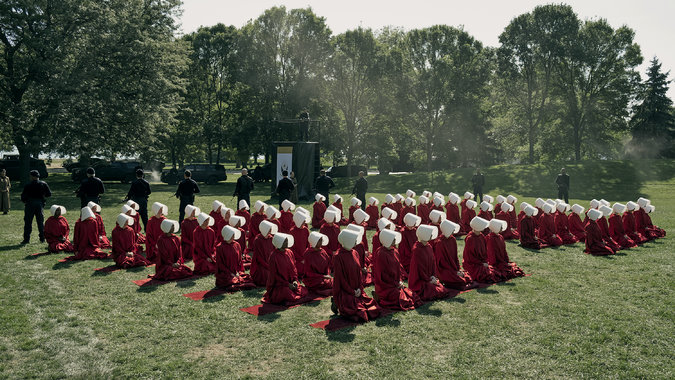
Handmaids kneeing at a gathering with Guardians surrounding the area

Atwood’s book has echoes of New England Puritanism, along with atrocities drawn from sources including Saudi Wahhabism, the Third Reich, American slavery, and the East German surveillance state. It’s constructed not as a realistic story, however, but as an eyewitness account… -Emily Nussbaum (The New Yorker)

Mankind is failing, most women are sterile because of industrial pollution (or Mother Nature just having enough of us). Birth rates are plummeting. An ultra religious cult see it as their God-given mission to “save mankind.” They seize power by staging a fake terrorist attack against the US government, impose marshal law, and set about rebuilding American society. (“War On Terror” anyone?) They use The Old Testament as their blueprint, but with some totally wack interpretations and distortions. Fertile women become the property of the state. Brainwashed and farmed out to the new ruling elite as baby makers, slavery and subjugation is all they can hope for. -Summary by IMDB reviewer

Serena Joy (Faye Dunaway) and Offred (Natasha Richardson) in the 1990 movie version of “The Handmaid’s Tale”

Canadian writer Margaret Atwood wrote her dystopian novel in 1985 (while she was living in Berlin, Germany); it was first published in 1986. She didn’t put anything in that hadn’t happened before at some place and time period in history. Her book is considered a blend of historical fiction and sci-fi; I read it in HS (I think). Many years later, I saw the 1990 movie starring Natasha Richardson, Robert Duvall, Faye Dunaway, and Aiden Quinn. Critics (mostly) hated that film, BUT I thought it was pretty decent. Veteran actors Duvall and Dunaway played the Waterfords; their ages were appropriate to the book. However, in this new Hulu series, the couple are much younger, energetic, and passionate. 

Setting

A group of Handmaids clean blood from the wall by the river.

The Handmaid’s Tale looks extraordinary – stylised, choreographed almost, menacing. It sounds fabulous, too. -Sam Wollaston (The Guardian)

Even the light coming in through the windows has a soft luxury to it, a Vermeer-ish quality. -Sonia Saraiya (Variety)

Much has been written lately re: the importance of world-building in good drama series; after all, the look is what first draws the attention of viewers to a show. Offred wears a distinctive white bonnet (the 1990 film had a red veil) and scarlet-colored dress and hooded cape, as do ALL the other Handmaids. The commanders wear black suits w/ dark-colored ties; their wives wear blue dresses (covering the knees and and conservatively cut) and matching capes. There are also lower-ranked married women in this world; they are called Econowives and wear grayish striped dresses. The Guardians dress like modern-day SWAT teams- in black and gray colors. 

There are also little/subtle touches which enrich the show. The Gilead-era flag (which is shown in Canada) only has two stars, b/c the U.S. ONLY has control over two states- Alaska and Hawaii. In the real world, the red tags attached to the Handmaids’ ears are used on livestock (such as cows); this is a reminder that the Handmaids are viewed as farm animals, NOT humans. There are mentions of Uber, Tinder, the SATs, and even a cute scene involving a food truck- things that we are familiar w/ in 2017. 

Characters

In the book, Gilead is a white-supremacist culture. In the show, black actors play Moira and Luke. The result is an odd trade-off: we get brown faces, but the society is unconvincingly color-blind, as if race had never existed. -Emily Nussbaum (The New Yorker)

June/Offred (Elisabeth Moss)

The book uses a 1st person narrator, so the reader ONLY knows what Offred knows. This series also gives us POVs of other characters, BUT she is the lead. Moss has tackled meaty roles before (The West Wing; Mad Men; Top of the Lake). She is VERY good at expressing a lot of (conflicting) emotions w/ subtle/brief looks and body movements. In her previous life, Offred was a book editor and married mother to an adorable young daughter (Hannah). At the start of the series, her goal is to stay mentally strong and survive in order to someday find her little girl. 

Moira (Samira Wiley)
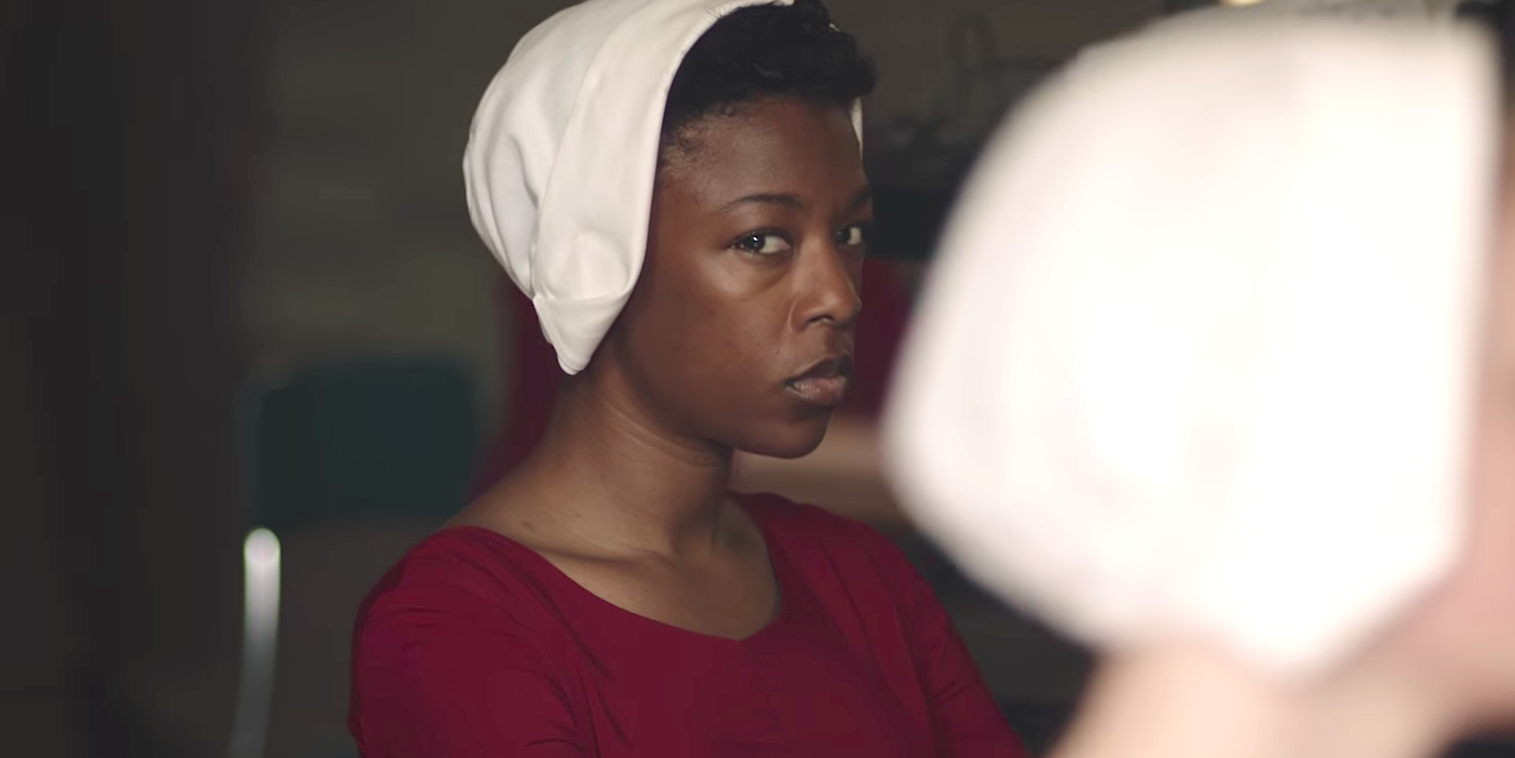
Moira (Samira Wiley) at the training center

The petite, out and proud lesbian is June’s best friend. Moira, who is BOTH funny and strong-willed, manages to escape from the Rachel and Bilhah Center in the disguise of an Aunt. Offred gets left behind on the subway platform, BUT she understands the difficulty of the situation. Though there are rumors that Moira died, we see her (later in season) working at Jezebels, a club where commanders come to fulfill their fantasies w/ a diverse array of women (many of whom were intellectuals in the past). Just like the Handmaids, these women can’t say “no.” When they are reunited (by chance), Moira explains to June that Jezebels get good food, booze, and drugs. In the book, she says that she can read and have relationships w/ women. Fans of OITNB rejoice! 

Luke Bankole (O-T Fagbenle)

Luke, June’s husband and father to Hannah, gets a backstory in this series; that is NOT in the book. When they first met, Luke was married to another woman; this adds to the shades of gray in the story. This actor is British-Nigerian and I had never seen him before; he does a great job in this role (incl. the more action-oriented scenes). 

Emily/Ofglen (Alexis Bledel)

Ofglen (Alexis Bledel) and Offred (Elisabeth Moss) at the grocery store

In her previous life, Emily was a college prof, married (w/ a wife), and young son. Offred doesn’t really know much re: Ofglen until after 2 mos. of walking w/ her to do the grocery shopping; no Handmaid can travel alone. Later in the series, Ofglen goes through FGM (scary, yet still happening ALL over the world). This is a VERY meaty (and unusual) role for Bledel; she is best known for The Gilmore Girls

Janine/Ofwarren (Madeline Brewer)

Janine, a fiery redhead, was mouthy at the training center; she was severely punished by one of the Aunts (losing an eye). Poor Janine has a tragic past; she was a survivor of a gang assault (resulting perhaps in PTSD). Moira is tough on her, BUT June has success in calming her down; the behavior of one Handmaid will affect ALL of them.  Even after Ofwarren gives birth to the Putnam’s baby girl, her emotional turmoil continues.

Aunt Lydia (Ann Dowd)

Aunt Lydia (Ann Dowd) at a gathering of the Handmaids

Ordinary is just what you’re used to. This might not seem ordinary right now, but after a time it will. This will become ordinary. -Aunt Lydia to the Handmaids

Aunt Lydia is the head of the Rachel and Bilhah Center; she is a harsh taskmaster who seems to truly believe in the ways of Gilead. In time, we notice that she feels bad for Janine, BUT she can’t let things slide for ANY of her “girls.” Ann Dowd, a veteran character actress, brings a BIT of ambiguity to the role- she is NOT a total villain.

Cmdr. Fred Waterford (Joseph Fiennes)

Offred (Elisabeth Moss) plays Scrabble with The Commander (Joseph Fiennes) in his study

Better never means better for everyone. It always means worse for some. -Cmdr. Waterford explains to Offred

He is usually called “The Commander” by everyone; his wife (Serena Joy) only calls him Fred. Some of the other Handmaids tell Offred that he is “really high up” and “very important” in the government of Gilead. At first, The Cmdr. is merely going by the book during ceremony nights; later, he wants to connect w/ Offred. He requests that Offred come down to his study (a no-no); they chat (even flirt a BIT), play Scrabble (which they are BOTH good at), and he gives her fashion magazines to read (another no-no).

To show her just how much power he holds over her, The Cmdr. takes Offred (wearing one of Serena Joy’s blue capes) out to the club- Jezebels. Notice that he chose a sparkly mini-dress and matching heels for Offred to wear; this shows us what type of woman he desires (someone to show off). Fiennes does a great job w/ his American accent; I don’t think I’ve seen him using one before. The actor creates a man who is complicated, yearning for connection (esp. to Offred), and enjoys flaunting the rules (which he helped establish). 

Serena Joy Waterford (Yvonne Strahovski)

Serena Joy (Yvonne Strahovski) listens to the prayer in her parlor

Never mistake a woman’s meekness for weakness. -Serena says to the Mexican ambassador, Mrs. Castillo

Serena Joy is portrayed by an Australian actress (former model) who somewhat resembles Grace Kelly, BUT w/ a more taller/athletic body. She gets a backstory in this series that is NOT in the book (like Luke). In flashbacks, we see how Serena Joy was a part of the establishment of Gilead; she wrote a book about the role of women. (Atwood modeled Serena Joy on the historical anti-feminist figure, Phyllis Schlafly, an outspoken opponent of the ERA in the ’70s.) The world she helped create has left her feeling alone, bitter, and (eventually) cruel. Serena Joy eventually turns on Fred, saying that he is NOT “worthy” of fathering a child, so God has denied him one. 

Nick (Max Minghella)
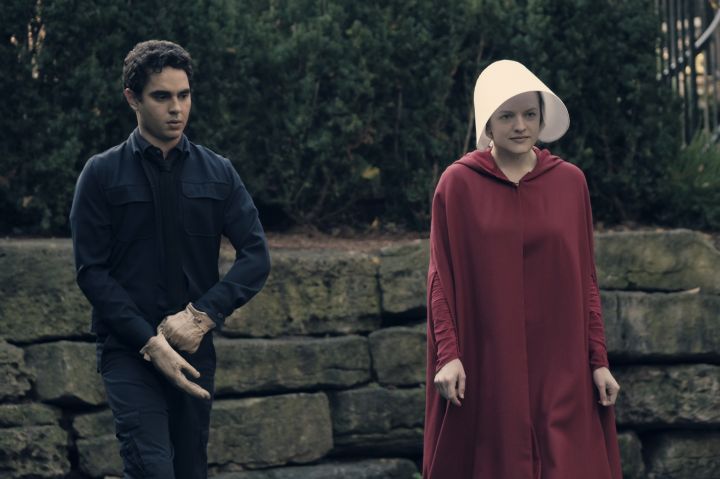
Nick (Max Minghella) and Offred (Moss) in the yard

Max Minghella’s performance gets more interesting every week. You never know what he’s going to say until he says it—that face is unreadable in the best and most unsettling way. -Allison Shoemaker (A.V. Club)

Nick is The Commander’s driver; he lives in a humble room above the Waterford’s garage. In the pilot, Offred explains that he is “low rank” and “has not even been assigned a woman.” At first, Nick just watches Offred (w/o speaking); this makes her a BIT nervous, BUT also curious. They begin to secretly flirt; BOTH are feeling lonely and need someone to talk to. Mrs. Waterford gets them together b/c, MOST likely, The Commander is shooting blanks. It takes time, BUT Nick is revealed to be a protector, NOT merely a coward or survivor. He was recruited rather young as one of the Sons of Jacob, a secret group of men who are the Eyes in the households of the commanders. 

Rita (Amanda Brugel)

Rita is one of the Marthas; she has worked for the Waterfords for a few yrs (like Nick). She is brusque, at first, BUT then treats Offred w/ kindness (making her healthy meals). After all, the birth of a baby would be great for ALL of the household. We learn that she lost her grown son in the war; most likely, he was fighting against the establishment of Gilead. I hope that she gets a backstory in Season 2; she is one of the few Latina women on the show.

Themes

Identity/Individualism

The Handmaids’ uniform denies the women individuality until the camera moves close enough so that we see their faces. In Gilead, the group is MORE important than the individual, as the Aunts and Commanders often say. Those women who don’t fall in line, like Ofwarren (who went through emotional turmoil after pregnancy) and Ofglen (who fell in love w/ one of the Marthas), are dealt w/ VERY harshly. 

Children

And she said, Behold my maid Bilhah, go in unto her; and she shall bear upon my knees, that I may also have children by her. -Genesis 30:3 (King James Bible)

In this world, a healthy birth happens 1 out of 5 times. June/Offred is in her early 30s and already has a daughter, so there is a good chance that she can have another child. Janine/Ofwarren gives birth to a fine baby girl, gets to breastfeed her, BUT then is ceremoniously put out of the Putnam’s household. Like MANY other viewers, I am NOT convinced that Serena Joy wants a child; she has bought into this society, BUT that doesn’t mean that she’s happy w/ it.

Love & Marriage

Unlike in any number of other gender dystopias, most men don’t oppress women because they hate or fear them, but because they can’t empathize enough to love them when it becomes inconvenient.  

And women gave up everything by empathizing too much and turning on each other to support the men they loved. -Adi Robertson (The Verge) re: the book

Serena Joy is rejected (coldly) by her husband after one halted ceremony scene; after all, intimate relations in Gilead are solely for the purpose of procreation. Maybe some viewers felt sympathy for her then? I was a BIT shocked when The Cmdr. admitted to Offred that he didn’t believe in love; in flashbacks, it seems like he and his wife were once deeply in love. (In the book, Atwood explains that some couples were already married before the establishment of Gilead; others were placed in arranged marriages to spouses of equal status.)

Offred goes to Nick’s room b/c she wants to spend the night w/ him; this happens after Mrs. Waterford has them perform the ceremony. As for love, Offred likes Nick, BUT is still in love w/ Luke.  As for Nick, I think that he does fall in love w/ Offred; he can’t express himself, as it could get them BOTH killed.

Women & Femininity

“Women have too much freedom here,” a foreign undergrad student commented when I asked him how he liked America. A few months ago, I mentioned to a friend how it’s too bad that apt. buildings in some countries (EX: Japan and India) didn’t rent to unmarried couples. “They should have a choice, at least,” I said. She replied quickly: “Oh, all those rules are for protection of women. What if the boyfriend leaves her? And if she gets pregnant?” The founders of Gilead take this type of thinking to another (extreme) level; they think they are protecting the Handmaids and the (possible) future children. How is legally sanctioned rape protection!? In one scene, The Cmdr. tells Offred that it’s the “destiny” of women to bear children. So, where does that leave his wife? 

Freedom & Confinement

Offred (Moss) sees Moira in the club

“You’re free here,” The Cmdr. tells Offred in their room at the club. We know that no woman is free in this world! In the flashbacks, we see June (and other women in Boston) being let go from their jobs, then their bank accounts frozen, before being sent to the training center. Moira lashes out at Luke when he tells June “I’ll take care of you.” Ugh, that’s NOT the point- it’s about choiceOne can argue that Offred finds a sort of freedom in her relationship w/ Nick, which is a (dangerous) rebellion.  

Reading, Writing, & Storytelling

Since reading is forbidden for Handmaids, ALL the items in the grocery store are marked by pictures instead of words. Before Moira’s escape scene, we see workmen chipping away at the signs in the subway. You know what reading promotes- thinking! Before each ceremony, the household gathers in the parlor while The Cmdr. reads the story of Rachel, Jacob, and Bilhah from the family Bible. Offred discovers a Latin phrase written inside the closet in her room; she finds out (from The Cmdr.) that it translates to “don’t let the bastards grind you down.” The Mexican ambassador’s assistant proves that he can be an ally to Offred when he hands a pad of paper and pencil, asking her to write a message for her husband (who is alive). The mysterious package Moira mails from the club to the butcher (another male ally) turns out to be letters and photos from a diverse group of women (some mothers); they are desperate to tell the wider world their story.  

The Manchurian Candidate (1962) starring Frank Sinatra, Laurence Harvey, Janet Leigh & Angela Lansbury

TMC_poster
A poster for the film

…it feels as if it were made yesterday. Not a moment of “The Manchurian Candidate” lacks edge and tension and a cynical spin. And what’s even more surprising is how the film now plays as a political comedy, as well as a thriller.

-Roger Ebert

I love this movie & find it disturbing. It’s a thriller but at times it even seems a satire.

Sinatra is so great here, you hardly notice how good Laurence Harvey is.

#TCMParty (selected tweets)

I keep telling you not to think! You’re very, very good at a great many things, but thinking, hon’, just simply isn’t one of them. -Mrs. Iselin explains to her husband

There is something timeless, yet also eerily timely about this classic film (in Trump’s America). Though it was released in 1962, it is set in 1952 in New York and DC; the use of black and white makes it look older. I think the novelist (Richard Condon) was influenced by Hamlet; note Sgt. Raymond Shaw’s (Laurence Harvey) deep hatred for his stepfather, Senator John Iselin (James Greogory), who married his domineering mother, Eleanor Shaw Iselin (Angela Lansbury). We are NOT told anything re: Raymond’s birth father; I imagine that he was a wealthy/intelligent/influential man. In the youthful romance of Raymond and Jocelyn Jordan (Leslie Parrish), there is an echo of the feud between noble families as in Romeo & Juliet

TMC_train_mtg
Maj. Bennett Marco and Rosie chat on the train in a mysterious manner.

Janet (Psycho) Leigh plays a shady, Robert Walker-like femme fatale whose cryptic language may or may not indicate she’s a member of the Communist Ring… The most celebrated (and widely discussed) meet-cute in film history occurs aboard a train, as Janet Leigh and Sinatra whisper sweet-somethings in the most roundabout, I’ve-never-heard-people-talk-like-this way imaginable. 

-Stanford Arts Review

Women are (in several scenes) depicted as capable, smart, and active agents in their romantic lives. Obviously, Mrs. Iselin is the power behind her loud-mouthed/dim-witted husband. A young Josie comes to Raymond’s rescue after he’s bitten by a snake. Rosie (Janet Leigh) approaches Maj. Bennett Marco (Frank Sinatra) during their train ride, shows him that she’s VERY interested, then tells him her address and phone number.

TMC_raymond_mother
Mrs. Iselin (Angela Lansbury) and Raymond (Laurence Harvey)

It’s a terrible thing to hate your mother. But I didn’t always hate her. When I was a child, I only kind of disliked her. -Raymond explains to Bennett Marco 

This is the type of film that you MUST pay attention to, or you’ll miss something! It showcases Sinatra’s acting range; many critics/classic movie fans consider this performance to be the best of his career. The Manchurian Candidate proves us just how scary Lansbury can be, if the script calls for it; I wished there was more of her performance. The way that she controlled Raymond’s life has contributed to how his life is like at that start of the story: humorless, friendless, and loveless. He attempts to get away by taking a job w/ a newspaper editor he admires, BUT alas, his life is NOT his own. 

TMC_costumeball
Mrs. Iselin (Angela Lansbury) faces off against Senator Tom Jordan (James McGiver).

There are people who think of Johnny as a clown and a buffoon, but I do not. I despise John Iselin and everything that Iselinism has come to stand for. I think, if John Iselin were a paid Soviet agent, he could not do more to harm this country than he’s doing now. -Senator Jordan says to Mrs. Iselin

Little details add to the richness of the story. There is a scene where an African-American soldier is having a nightmare/flashback (VERY similar to that of Marco), BUT we see that the ladies in the tea party are African-American. That’s b/c it’s happening w/in the context of his life, NOT that of a white man. There are two supporting East Asian characters, including Dr. Yen Lo (Khigh Dhiegh) and Korean translator-turned-cook, Chunjin (Henry Silva- of Puerto Rican heritage). In one exciting scene, Marco and Chunjin fight using karate. 

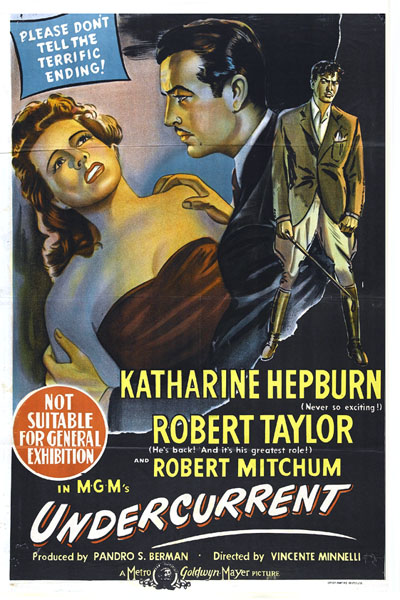
Undercurrent (1947) starring Katharine Hepburn, Robert Taylor, & Robert Mitchum

Undercurrent-1946.jpg
A poster for the film

This is a film I’d NEVER heard of, BUT was curious to see (since it has both Hepburn and Mitchum). It was shown on TCM last week and is directed by the famed Vincente Minnelli (husband of Judy Garland and father to Liza). Minnelli does a VERY good job w/ a domestic drama mixed w/ film noir, which is NOT something you’d expect if you know his more well-known works (Meet Me in St. Louis, Father of the Bride, Gigi). He also directed The Bad and the Beautiful, which shows the dark side of Hollywood. 

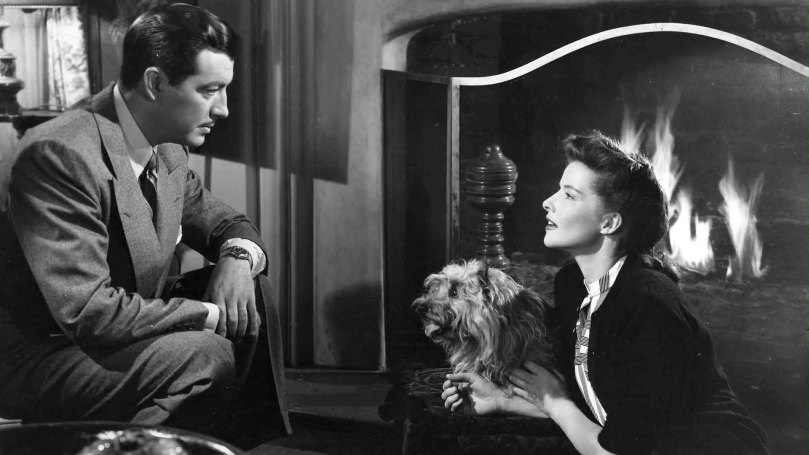
Hepburn is cast against type here, which fans (like me) may enjoy, and even some haters will be pleasantly surprised to see. She plays Ann Hamilton, the quirky/single daughter of small-town professor, Dink (Edmund Gwenn from Miracle on 34th Street). Ann prefers playing w/ her dog and tinkering in her home chemistry lab, eschewing ideas of marriage pushed upon her by cranky housekeeper, Lucy (Marjorie Main) and eager academic, Prof. Bangs (Dan Tobin).

Hepburn_Taylor_fireside_Undercurrent
Alan Garroway (Robert Taylor) chats with Ann Hamilton (Katharine Hepburn) at her home.

[1] Call it Film-Noir. Call it Mystery/Suspense. Call it Psychological Thriller. Call it what you may…I call it: absorbing drama.

It moves very deliberately… and the facts are revealed one by one, in true mystery fashion, until the fantastic, thrilling ending.

[2] Hepburn gives her usual intelligent performance, showing a vulnerable, feminine side that is very appealing. There is a scene in a fitting room where she is absolutely stunning. The scenes between her and her father, played by Edmund Gwenn, are delightful and realistic…

[3] As others have noted, the plot has “Rebecca-esque” qualities, but a character completely its own.

-Various IMDB comments

One night, Ann’s life is changed when she meets Alan Garroway (Robert Taylor), a suave/dapper inventor who was meeting w/ Dink. It turns out that his company helped win WWII w/ a cutting-edge missile guidance system. Ann is struck by him at first sight; it’s obvious that he is interested, too. Soon, they’re married and off to DC! Ann meets his (high society) friends, gets a new/stylish wardrobe, and learns that her new husband is more complicated than she thought. 

Hepburn_Gwenn_Undercurrent
Her father (Edmundf Gwenn) looks on as Ann (Katharine Hepburn) receives roses.

Film Trivia:

BOTH Taylor and Mitchum were younger than Hepburn. 

In Minnelli‘s autobiography, he says that Mitchum was very uncomfortable in the role of the sensitive Michael.

Katharine Hepburn and Robert Mitchum did NOT get along during the filming. One day, Hepburn told Mitchum, “You know you can’t act, and if you hadn’t been good looking you would never have got a picture at all. I’m tired of working with people like you who have nothing to offer.” (OUCH!)


House of Cards (Netflix): Season 5

NOTE: This review contains SPOILERS for the latest season of the streaming series. Fun fact: My dad also doesn’t like “sorry” (like Claire). 

HoC_FU_IWillNotYield.jpg
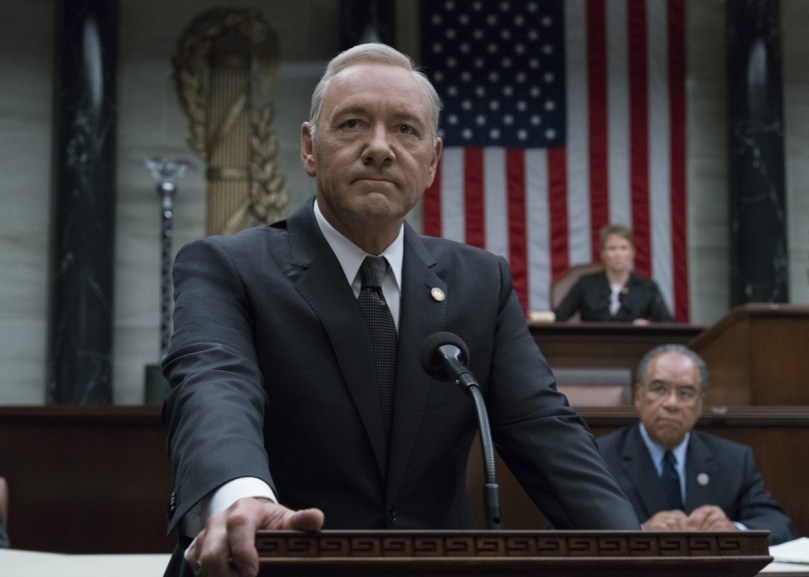
“I will not yield!” Frank (Kevin Spacey) declares to Congress.

“You don’t want me to stand for something,” Frank states to the viewer late in season five. ‘You just want me to stand.” But, uh, reality would beg to differ. We increasingly want politicians to push back against the bland, corporatist kind of politics Frank and Claire represent, to elevate outsiders. House of Cards is a show about the ultimate insiders, and it can’t overcome that central fact. -Vox

Frank’s “war on terror” has deadly consequences for ICO-inspired Joshua Masterson. With a little help from Asst. Dir. Green (FBI), Underwood had stashed the homegrown terrorist in an underground/high-tech prison. Frank tells Green “to get rid of the asset.”So, did you think that Frank was upset re: the reaction of the Millers’ teen daughter at the funeral? It’s like that girl saw through Frank, though she was SO young and grief-stricken (b/c of her father’s murder). 

HoC_toast
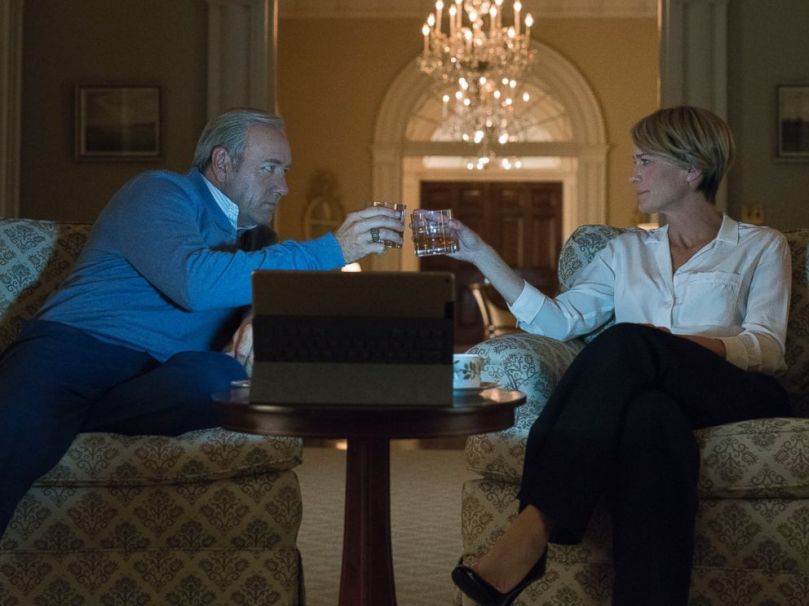
Frank (Kevin Spacey) and Claire (Robin Wright) drink a toast.

…the name of Frank’s secret society can be traced back to Greek mythology. “Elysian Fields” is said to be a true paradise where gods who are gifted immortality are sent. Basically, only the most favored gods got to go to this place and live out their endless lives in bliss. This is especially fitting for a reference point because on House of Cards, Elysian Fields is essentially a place for important men (and only men) to hang out together in the woods. -Bustle

It was one of the most talked about ep of the season, as I learned from Twitter (and later on- few articles). Viewers wondered: “Is that real!?” once it was revealed that prominent men were behind the masks at the weekend retreat (or shall we call is “glamping?”)

HoC_MarkUsher_WillConway.jpg
Marc Ursher (Campbell Scott) and Will Conway (Joel Kinnaman)

Will Conway, the Republican presidential candidate was clearly modeled on Obama (w/ a side of Kardashian-level status on social media, as we saw in S4). We learn that he has PTSD, which he keeps hidden from even Marc Usher (Campbell Scott- still slim and handsome) and retired Gen. Brockhart (Colm Feore- one of Canada’s best theater actors). The CEO from Pollyhop, also Conway’s old pal, knows about the PTSD.

Marc finds out what’s up when Conway loses his cool on a small jet, demanding that pilots let him fly (“I’m going to be the president and you’re going to flip me those motherf****ing controls!”) This rant is caught on tape, then later leaked to the Underwoods. The tall telegenic family man is a damaged individual (after serving in Afghanistan after 9/11). 

HoC_Eric_Augustus.png
Eric AKA Augustus Underwood (Malcolm Madera) comes to the White House.
At the peak of Frank’s unpopularity, it seems that Eric [who role plays Confederate soldier Augustus Underwood- Frank’s grandfather] is just about the only person left who truly believes that the man could make a great president… -Bustle
Eric never openly states why he thinks Frank could be a good president; I think it’s his youthful naiveté. Eric and Frank get closer over his visits; he starts working as a personal trainer (his day job). Over talking about the world and laughing about how Eric actually made up Augustus’ backstory, the two become fast friends (something rare/unexpected for Frank). Things eventually get VERY intimate (which I expected) and also a BIT scary (nope, did NOT see that).  
Secretary of State Catherine Durant (Jayne Atkinson) decides to testify to the senatorial investigation into the President’s misdeeds. She goes to the White House and delivers the news to her frenemy Frank (VERY bad idea). “You need to take a fall,” he says, before pushing Cathy down a flight of steps. She’s alive, but won’t be testifying any time soon. Poor Cathy- she was one of the FEW good characters on this series! 
HoC_MissDavis
Jane Davis (Patricia Clarkson) in the Oval Office.

Something terrible always happens when I go to a party. -Jane tells Claire

…I’m more interested now, going forward, with how this murder [Tom Yates’] will wind up compromising Claire since Mark Usher knows about it and – perhaps Jane Davis too! The two people Claire’s now relying on to steer her forward have a big advantage over her, and she doesn’t fully trust them. -Mark Fowler (IGN)

Some of you on Twitter thought that Miss Davis was NOT a believable character. Is she a war profiteer?  She has created this unassuming personality, BUT under it all, is a force to be reckoned w/, no doubt.

Claire turns more to Jane over time, shutting out LeeAnn (Neve Campbell), who is worried re: her old friend Aiden Macallan (Damian Young). It took me a BIT of time to figure out what was going on w/ Mac! I felt bad for the guy, even though he was NOT the most exciting character.  

HoC_TomYates_Claire.jpg
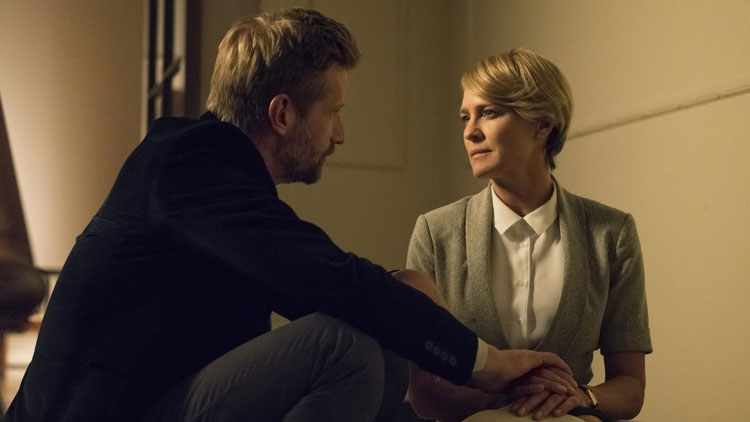
Tom Yates (Paul Sparks) and Claire (Robin Wright)

Stamper has never made peace with killing Rachel Posner – shouldering the responsibility for Barnes’ death is his penitence. –The Telegraph

Lisa (Rachel Posner’s girlfriend) turned to drugs, and also became a threat, BUT Doug (Michael Kelly) decided NOT to kill her. The story of Anthony Moretti being bumped off the organ donor list, then dying to save Frank, is found out by Sean, Seth, and Claire. Back in S2, then VP Underwood murdered Washington Herald reporter, Zoe Barnes, by shoving her in front of a metro train. Over dinner, Claire and Frank share their plan w/ the ever-loyal Doug: “We need you to implicate yourself in the death of Zoe Barnes.” 

Tom, don’t cheat on my wife. –Frank tells Yates (after seeing photos of him w/ a White House tour guide)

Yates’ death cannot be considered a surprise. He had persisted in writing thinly-disguised accounts of the Underwood’s double-dealings and, as his ill-considered interview with a journalist early in the season confirmed, had a big mouth to boot. Applying patented Underwood logic, he had to go. -The Telegraph

Now, I was NO fan of Tom Yates (Paul Sparks), BUT I was troubled by his death. Claire poisoned him; like Lady Macbeth, there is “blood” on her hands now. Did she ever love Tom? We see that Tom became possessive over time, which she was turned off by (duh). 

HoC_Claire
Claire (Robin Wright) as the Acting President

Hauled before young/upstart Arizona Congressman Romero (James Martinez) and his House Intelligence Committee, Underwood snaps and says he is resigning- WHOA! 

In real American politics, the Congressional Progressive Caucus is composed of 75 representatives, led by co-chairs Rep. Raúl Grijalva (a Democrat from Arizona) and Rep. Mark Pocan (a Democrat from Wisconsin). There’s a good chance Alex could be loosely based on either of the co-chairs of the caucus or any of the 75 representatives who are members, though the the House Of Cards showrunners have not indicated that there’s any real inspiration behind the character. -Bustle

What is this job? -Angela asks her boss

Not what it used to be. Tom Hammerschmidt replies

Perhaps the biggest surprise in this is that Frank has himself become a leak to Tom Hammerschmidt as the Washington Herald, revealing insider secrets to add press interest on the crumbling administration and justify monitoring of the entire White House and its staff…  –Screenrant

Frank will walk away from it all, so that Claire will step in as the new President, and pardon him for his crimes. Then, in the private sector, Underwood will become a source of power, working in tandem with his wife, to “own this house.” It turns out that Claire will NOT be pardoning him too soon!

If she doesn’t pardon me, I’ll kill her. -Frank states in his last monologue

But while he’s thought of every possibility, like the constitutional loopholes he took advantage of to get here, there’s one eventuality not accounted for; while Frank is functioning on a higher sociopathic level than seemingly anyone else in Washington D.C. and able to connive his resignation and transition of power, he doesn’t consider his wife’s fury. Screenrant

Claire also breaks the fourth wall (NOT a total surprise, as it had been hinted at before). I think MANY of you enjoyed those moments. Did you notice how Claire’s outfits became more conservative, buttoned, and (somewhat) militaristic as the season went on? 


Matewan (1987) starring Chris Cooper, James Earl Jones, Mary McDonnell, & David Strathairn

Dir_JohnSayles
Director John Sayles at AFI Silver Theater on May 17, 2017.

I’d never seen this movie (part of DC Labor Film Fest this year) before, though I’m a BIG fan of independent director John Sayles. On this blog, you’ll find reviews of Passion Fish and Casa de Los Babys– two of his more female-centered works. In my view, Sayles was a “masculine feminist” even before the term became popular. He writes BOTH male and female characters who are multi-dimensional living inside stories which are realistic.

Now, you may be thinking- HOW does Sayles keep doing his own high-quality, yet rather low-budget projects!? He explained that his day job is “writer for hire”- he worked on movie and TV scripts, many of which didn’t get made by the big Hollywood studios. “In the past 15 years or so, studios seem to want their leads to be like Tony Soprano,” Sayles explained in the Q&A session after the film. (Most of the audience laughed at this part.) 

Matewan_ChrisCooper
Union organizer Joe Kennehan (Chris Cooper) addresses the miners.

Matewan is based on true events which occurred in a rural town in 1920s West Virginia. Some of the character names are real; others are amalgams of several people. When I first saw the trailer for the film two weeks ago, it reminded me of the Western genre (which Sayles was inspired by). The cinematographer here was Hollywood veteran Haskell Wexler (d. 2015); he won two Oscars, one for Who’s Afraid of Virginia Woolf? (1966) and the other for Days of Heaven (1978)- considered one of the MOST beautiful films by critics and fans alike. The music is also a crucial element here; there is a blending of different styles.

A stranger- Union organizer Joe Kennehan (Chris Cooper in his first film role)- arrives in the town of Matewan. (Cooper plays the lead in Sayles’ Lone Star, which also stars a young Matthew McConaughey.) He gets a room at a boarding house run by a widow, Elma Radnor (Mary McDonnell- lead in Passion Fish), and her teenage son Danny (Will Oldham, then just 17 y.o.) Danny recently went to work in the mines, though he’s NOT yet 15 y.o. His real passion is preaching. 

Matewan_JamesEarlJones
Few Clothes (James Earl Jones) is a representative/leader of the black miners.

Joe meets w/ (white/native born) coal miners at the local restaurant. These workers, struggling to form a union, are up against the Stone Mountain Coal Company operators and thugs from the Baldwin-Felts agency (basically guns for hire). Black and newly-arrived Italian immigrants, brought in by the company to break the strike, are caught in the middle. A tall, burly black miner- nicknamed Few Clothes (James Earl Jones)- boldly comes to this meeting. He’s an advocate for the African-American men brought in to work recently from further South. The local white miners don’t want to include the black men (or Italians) in the union; they consider these two groups to be a threat to their livelihood. (Well, some things NEVER change! And yeah, Italians were NOT considered “white” at this time in American history.)  

You think this man is the enemy? Huh? This is a worker! Any union keeps this man out ain’t a union, it’s a goddamn club! They got you fightin’ white against colored, native against foreign, hollow against hollow, when you know there ain’t but two sides in this world – them that work and them that don’t. You work, they don’t. That’s all you got to know about the enemy. -Joe explains to the white miners

Matewan_DavidStrathairn
Police chief Sid Hatfield (David Strathairn) readies his pistol in his office.

I’ve met Mr. Felts. I wouldn’t pee on him if his heart was on fire. -Sid Hatfield tells the men from the Baldwin-Felts agency

This film contains some colorful characters, including stone-faced cop Sid Hatfield (David Strathairn). Kevin Tighe (a veteran of film and TV) and Gordon Clapp (who later made a name on NYPD Blue) play the main villains. Sayles is in the small role of a fiery, anti-union Baptist preacher. Producer Maggie Renzi (herself of Italian heritage) takes on the role of Rosaria, wife to one of the Italian miners and mother to several kids. Sayles and Renzi have been creative and life partners since their days as students at Williams College. Sayles also met Strathairn at Williams; they’re good friends. Local people (NOT professional actors) were used in MANY of the scenes of Matewan; they give authenticity to the film, as does the setting.

I think ALL the actors did a fine job; I esp. liked the characters played by Jones (what a great get for young filmmakers) and Renzi (who spoke in Italian). Cooper was the first actor who auditioned for the role of Joe; he had ONLY done theater before. Sayles revealed that several well-known actors also went in for the part, BUT he and Renzi kept thinking back to Cooper. As for Jones, they wanted someone like him, b/c they thought there was a small chance of the man behind Darth Vader taking on a supporting role. Well, you NEVER know until you try!