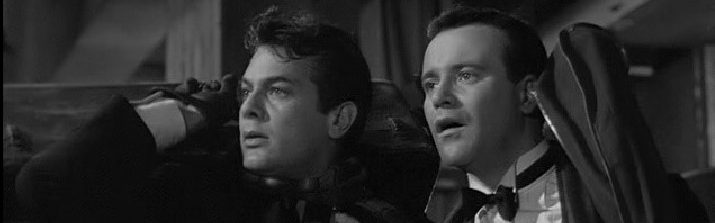
CBS This Morning (November 13, 2016)
Live with Kelly (November 16, 2016)
CBS This Morning (November 13, 2016)
Live with Kelly (November 16, 2016)
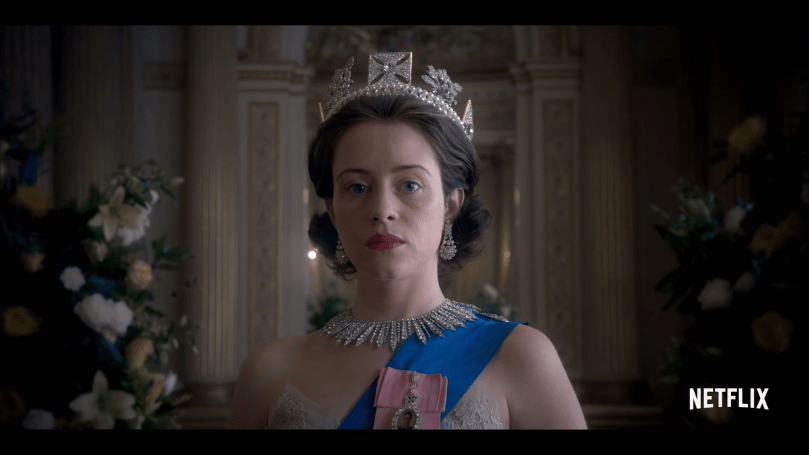
The Crown focuses on Queen Elizabeth II as a 25-year-old newlywed faced with the daunting prospect of leading the world’s most famous monarchy while forging a relationship with legendary Prime Minister, Sir Winston Churchill. The British Empire is in decline, the political world is in disarray, and a young woman takes the throne….a new era is dawning. Peter Morgan’s masterfully researched scripts reveal the Queen’s private journey behind the public facade with daring frankness. Prepare to be welcomed into the coveted world of power and privilege and behind locked doors in Westminster and Buckingham Palace….the leaders of an empire await. -Netflix Summary

Lead Actors: Claire Foy (Queen Elizabeth II), Matt Smith (Philip Mountbatten, Duke of Edinburgh), & John Lithgow (Sir Winston Churchill)
Supporting Actors: Jeremy Northam, Eileen Atkins, Victoria Hamilton, Harriet Walter, Ben Miles & Alex Jennings
Director: Stephen Daldry
Writer/Producer: Peter Morgan

This highly-anticipated series will be available on November 4th. Two seasons with a total of 20 episodes are planned (so far), as noted in Variety. Daldry was the director of Billy Elliott and The Hours. In 2006, Peter Morgan wrote The Queen (starring Helen Mirren).
Rather than finding this woman and this predicament less and less interesting it becomes more and more interesting. The Queen’s story is a good way to examine the modern history of England because she is so intertwined with the British constitution and the British soul. -Peter Morgan
I’m excited to see Foy in a starring role; she was great in the miniseries Little Dorritt. Matt Smith (best known for Dr. Who) can handle both comedy and drama. Maybe he will get a chance to do both? And it’s so cool to see the film/stage veteran, Lithgow, in good shape and working regularly! The official trailer (below) gives us some hint, BUT not too much, re: the crux of the series- how a young woman manages different roles (daughter, queen, wife, and mother).
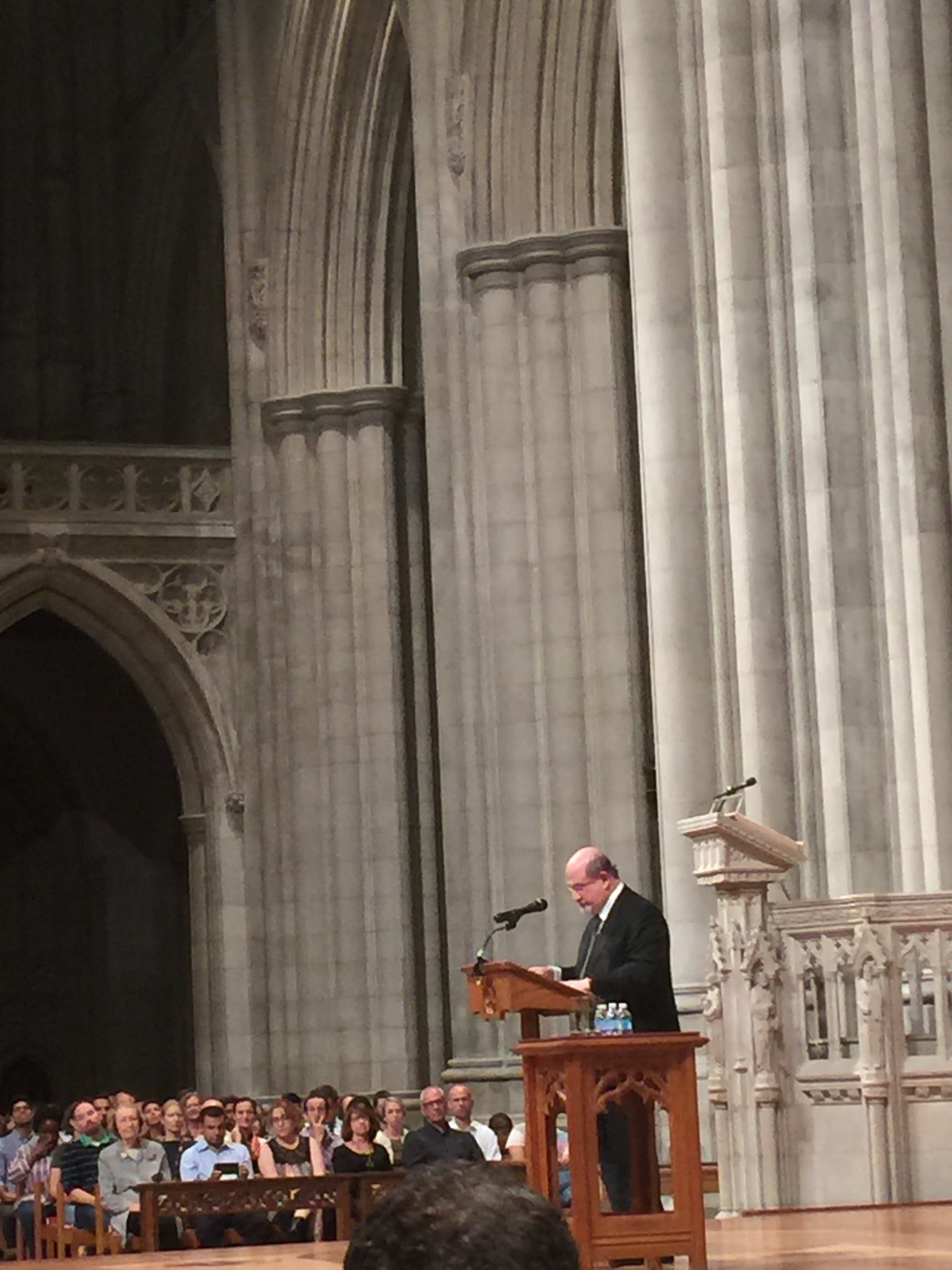
Salman Rushdie continues to be a controversial figure, but in today’s world, I feel that voices like his (British, Indian, and atheist) need to be heard MORE than ever! Depending on your age, you may know Rushdie from the fatwa (which was placed on him by Ayatollah Khomeini of Iran), his cameo on Bridget Jones’ Diary, or his short-lived marriage to Padma Lakhshmi (of Top Chef fame). Or maybe you have a FEW of his books (BUT are intimidated to read)? A few years ago, a book club I organized both read Haroun and the Sea of Stories, which is Rushdie’s YA book.
*NOTE: Special thanks to my friend Lana for above photo and taking notes.
The Beginning of Rushdie’s Life as a Writer:
He realized that he would never write a good book until he knew who he was (not English, but Indian).
He was part of first generation of free Indian Children.
His father told bedtime stories (oral tradition strong in his family)- animal stories; tales of heroes. His mother told local tales: gossip, scandal, secrets (when he included in stories, she said he “got in trouble”). One of his academic grandfathers took him to university library, where he discovered Agatha Christie. His other grandfather was a very religious man (prayed 5X/day, fasted, etc.) He was also open to any/all ideas; Rushdie admitted that he didn’t believe in God (age 10).
Read comics from early age. He was lucky to have a lending library/bookstore nearby where he got into Perry Mason mysteries, Alice in Wonderland.
The Wizard of Oz (film) inspired him to write his first story at age 10.
His family had a tradition of kissing books and bread to apologize to it and place someplace where wouldn’t happen again (food for mind; food for the body).
Left Bombay 1961 for English boarding school at age 13 (his idea, not his parents’). Maybe he had an”unnoticed love of adventure” b/c was quiet as a child?
Got into Cambridge, but didn’t want to go b/ c of racism faced at boarding school earlier. He went and enjoyed it a lot; studied history; wrote for student newspaper. He also got into Borges and Joyce at this time, and learned about incident of satanic verses (in his last semester).
His parents moved to Karachi, Pakistan; this was not an appealing place for him. His father initially disapproved, but then supported his return to England after he graduated from Cambridge.
Wrote TV commercials and scripts in London for an ad agency (where he worked part-time). In the early 1970s, he wrote and published, but these works were not successful because he hadn’t known himself enough. He decided to understand what he was doing wrong and traveled to India, which entered state of emergency (1977).
Midnight’s Children: Started in 3rd person, but then told from Salim’s voice and it was better (voice not my own, but gave me voice). Kept working in advertising again to pay bills. This book took 5 years to write it because was learning how to write. He also needed to blend news with fiction.
Quotes:
Geography is key [to a person’s writing]. Writers (like Faulkner): Have roots/history and can mine the earth for a lifetime of stories.
Work we do about the past, changes the future.
As we discover, we remember, as we remember, we discover.
Stories are not true- but can make you know truths that truths cannot tell.
Can’t write until you hear people speak, because can’t tell their story if you don’t hear their voice.
I think the greatest gift my family gave me was freethinking.
[On his trip to India when writing Midnight’s Children]: From childhood, dig out memories from attics of mind. Healing of rift within myself that separated me from my past… drank deeply from well of India.
Write what you know, but only if what you know is interesting.

We became acquainted with a community of strangers – it was not like a work experience, it was a life experience, a thing that affects you very deeply. We became a part of that Arkansas community settling down in new homes there. It was a terrific experience, right from the beginning, the people we met, the insights we got, the privilege we had of being inside a society that otherwise we would never have touched. -Andy Griffith
Larry Rhodes (Andy Griffith, in his 1st movie role- VERY far from Sheriff Andy and Matlock) is in a small-town Arkansas jail when the niece of a radio station owner, Marcia Jeffries (Patricia Neal- always great in every role), interviews him and has him sing an impromptu song for a weekly radio program. She even names him “Lonesome, ” much to his surprise and amusement.

You put your whole self into that laugh, don’t you? -Marcia asks
Marcia, I put my whole self into everything I do. -Lonesome replies
Lonesome quickly proves to be quite popular with his homespun humor/song lyrics. He soon has a radio show of his own (in Memphis). An opportunistic/ambitious office worker, Joey DePalma (Anthony Franciosa) lands Lonesome a contract for a TV show (in NYC) thanks to support of Vitajex, a new dietary supplement.
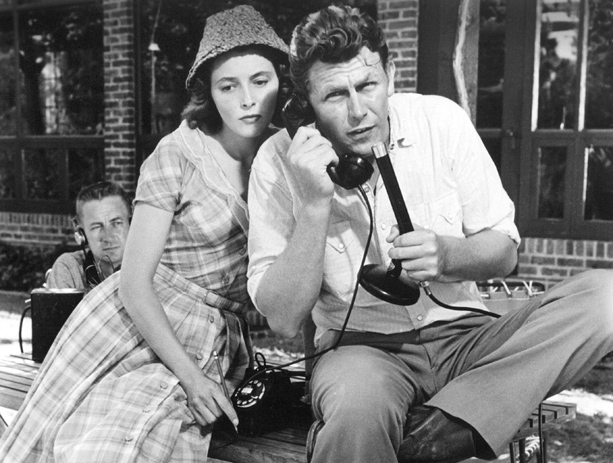
I was totally taken by surprise by this edgy, brilliant movie. I was also mesmerized by the beautiful and fabulous Patricia Neal. …she just smoked in this movie. -IMDB comment
They love his voice, they love his guitar, they love his ideas… they should know some of his ideas. -Marcia says re: Lonesome
Lonesome becomes SO popular that he gets his own television show. He brings his “Girl Friday” Marcia w/ him to NYC. Their working relationship gets complicated, BUT you need to watch it to find out how!

The portion of the film where [Lonesome] “reinvented” the marketing message of the pill was like a precursor of current Viagra commercials, particularly the blonde in bed talking about how the pill helped her “boyfriend.” -IMDB comment
Didn’t you know? All mild men are vicious. They hate themselves for being mild, and they hate the windy extroverts whose violence seems to have a strange attraction for nice girls. You should know better. -Mel comments re: men like him
Mel Miller (Walter Matthau) is one of the writers who works on this show; he develops feelings for Marcia. In no time, Lonesome attracts the attention of a retired general, who introduces him to an aspiring politician.

I’m not just an entertainer. I’m an influence, a wielder of opinion, a force… a force! -Lonesome exclaims re: his power over the masses
A comparison to the fictional Lonesome and the too real Donald Trump can’t be avoided. Art imitating life or is it life imitating art? -IMDB comment
Did you know Marlon Brando (a frequent collaborator of director Elia Kazan) was considered for the lead role? One of the hosts at TCM pointed this out after the film ended; it was shown in early October. Brando refused, probably b/c he knew that would’ve been woeful miscasting!
On Twitter, a viewer noted that the dinner scene in Lonesome’s spacious penthouse was styled like the one in Citizen Kane. Director Spike Lee noted that A Face in the Crowd film was a BIG inspiration for his film, Bamboozled.
In modern-day Lima, middle-aged Harvey Magallanes (Damian Alcazar) works as a driver for his former commanding officer, the wheelchair-bound Colonel (Frederico Luppi), who has lost his memory. He spends the rest of the day as a taxi driver and drinking w/ Army buddy/mechanic, Milton.
One morning, he picks up a harried/young/indigenous woman in his cab- Celina (Magaly Solier). Magallanes is VERY shaken up, looking upset; it turns out that she doesn’t recognize him. He follows Celina to a convention, learning that she needs money for her hair salon. After talking to Milton and his reluctant sister, Magallanes sees an opportunity to make some easy money. WHAT is his connection to Celina? WHY does he look so guilty? This film starts out slow (it’s a character drama for the most part), then eventually builds to an (VERY un-Hollywood) climax, which will totally change your view of the protagonist!
The brilliance of the story is that we find ourselves pulling for Magallanes right up until the moment when we can’t possibly forgive him his transgressions … any more than Celina can. More than an example of the jumbled mess of war and terrorists, the film is a wonderful observation of human nature and how we often rationalize our worst actions to the point of delusion of our own goodness. No matter how hard we try to put things behind us, the bad choices are always there. Some sins just cannot be washed away, and redemption is not always possible.
-Comment from IMDB
 Knightleyemma