Indonesian Mini Film Festival (March 25-27)

Introduction

About 400 films are made in the U.S. each year.  Even more (600) are made in India.  But, did you know that about 100 films are made in Indonesia each year?  The Indonesian ambassador to the U.S., Dr. Dino Patti Jalaland his wife were joined by the Singaporean ambassador’s wife, actor Nicholas Saputra (star of Joni’s Promise), and members of his staff during the first film showing.  Recently, Dr. Jalal met with Hollywood director Michael Mann, who will be shooting his film, The Philosopher, in Jakarta.  The film’s lead actor will be Aussie actor, Chris Hemsworth.

Lovely Man (2011)

Screeshot from the Indonesian drama, Lovely Man
A daughter gets to know her absentee father for one night

This is a 75 minute film, but it packs some big punches.  (It won many awards in Asia.)  It focuses on the relationship between a transvestite streetwalker in Jakarta and a small-town/devout Muslim teen, who just happen to be father and daughter. Without telling her mother, Cahaya (Raihaanun), travels by train to see the father who left home many years back.  Cahaya is dressed conservatively and wears a white hijab (headscarf).  When she gets off the train, she stops at a mosque to wash and pray.  She’s amazed by the sights and sounds of the big city, as she goes in search of her father’s address.  (This film uses shadow and lights very well.)  At the side of a bridge, she talks to some women (who are obviously streetwalkers).  She meets Ipuy (Donny Damara)- dressed in long wig, sparkly red dress, and high heels (reminiscent of some of the characters in the films of Pedro Almodovar).  Needless to say, they are both shocked.

Actor Donny Damara accepting an award

Ipuy wants nothing to do with Cahaya- his life is tough enough as it is.  Most people look at him with disgust and treat him unfairly.  What would a hijabi like her know about someone like him?  (Eventually, Cahaya takes off her hijab, to make her father more comfortable.)  She’s carrying a secret, which is giving her much worry.  Cahaya exclaims that she needs a father to talk to about important matters.  What she doesn’t know is that some gangsters are after Ipuy for stealing a lot of cash.

Joni’s Promise (2005)

Joni goes through a LOT in one day

This funny, light-hearted film is considered to be “one of the first comedies made in Indonesia.”  (It reminded me of a French comedy.)  A 22 year-old man, Joni (Nicholas Saputra) delivers film reels- a job he likes and considers to be quite important.  One afternoon, she sees a very pretty girl standing in line at the theater, but he’s too nervous to talk to her.  We learn that she’s with her boyfriend (an entitled rich kid).  She gets fed up with her guy, so she goes out.  She notices Joni’s good nature and they have a chat.  She doesn’t get her name or get give his out.  The girl says that they can talk more of he gets done with his deliveries on time.  Joni is happy with that- he’s never had a girlfriend yet.  Joni’s motorbike gets stolen, he witnesses childbirth, gets a walk-on role in a film, plays the drums, and meets a mysterious artist.  Can he make it back to the theater to have his first date?     

IMDB photo of actor Nicholas Saputra

The Dancer (2011)

Srintil and Rasus share some fruit

This is a full-length historical drama based on a trilogy of novels.  The story focuses on the love between two young people in the village of Dukuh Paruk in Java.  As a small child, the parents of Srintil are killed by some fellow villagers, who believed that they were poisoning food.  The ronngeng (village dancer) also died- she ate the food.

The teenaged Srintil (Prisia Nasution) and Rasus (Oka Antara) love each other deeply, though they are poor, illiterate, and don’t have many prospects.  Rasus works in the rice paddy fields, like the other young men.  However, Srintil thinks that she may have the spirit and the talent to become ronggeng.  Her grandfather champions her cause, even though they are first met with doubt and derision.  The local dance master won’t come to see Srintil perform.

Srintil goes through various rituals to become ronggeng

Rasus has a little dagger-like object which belonged to the former ronggeng.  After he presents it to Srintil, everyone proclaims her to be the next ronngeng.  She will not only dance , but belong to the village.  Her virginity will be sold to the highest bidder- a fact that greatly upsets Rasus.  (The elderly blind drummer is the only older person who senses what is going on with the couple.)  Rasus runs away to the nearest town, then meets with a military commander (who thinks he could one day become a “loyal” soldier).
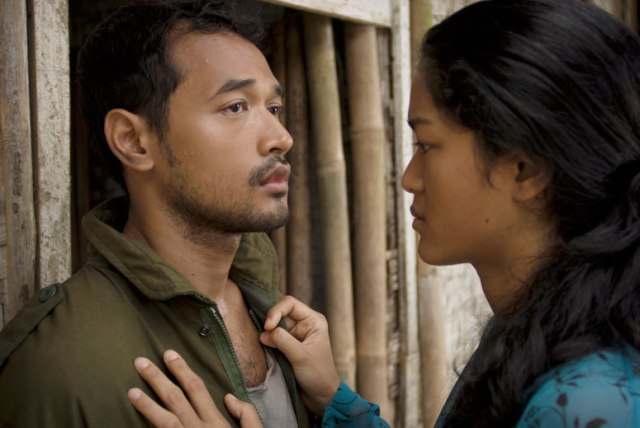
Srintil realizes that Rasus has joined the military

Srintil has to go through various rituals, aided by the dance master’s wife.  Men bring goats, cows, and money to present to her grandfather and teacher.  Before the “deflowering” ceremony, Rasus returns and they sneak off together.  Later that night, Srintil pushes him away, explaining that she can’t run away with him forever.  (We know that she has status and money in her community now.)

Srintil shines as a dancer (but not in her personal life)

While Srintil adapts to the lifestyle of a dancer, Rasus adapts to that of a soldier.  His superiors look on him well and he finally learns to read.  He crosses paths with Srintil on very few occasions.  They only spend one more night together, but their lives must always be separate.  When Srintil urges him to come back to the village and offers money to start his own business, Rasus refuses (too proud).

A (Communist) man from the city comes to talk to the villagers, but they only want more food, and don’t grasp what allegiance to his ideas truly mean.  (In fact, 1965-1966 was a very bloody year was Indonesia’s history.  Many people, who were thought to be Communist or sympathizers, were killed by the military.)  This man also wants Srintil and village musicians to perform at his rallies.

Rasus and Srintil meet after the1965 war
Rasus and Srintil meet after the 1965 war

This film is very powerful!  It won the 2011 Best Picture award in Indonesia and was submitted for a Foreign Film Academy Award.  It just draws you in with it’s setting, characters, and values (which are quite different from those of urbanized, modern Indonesia).  The love story starts out very gently and innocently, then we see the darker aspects (depression, frustration, etc.)- this pair must stay apart because of Srintil’s chosen path.  Being a village dancer was being above others- connected to the gods (ancestors.)

Silver Linings Playbook / Kai po che!

Silver Linings Playbook (2012)

Dance brings two troubled people together in this (unlikely) hit film

The silver lining is actually the fact that there is an audience for sensitive/grown-up films like this one!  Bradley Cooper (never overacting) and Jennifer Lawrence (a naturally gifted actress) fall in love, despite their respective issues (hey, we all got’em).  This is shot like a ’60s film, an avid moviegoer in my office said, with long takes.  It’s a treat to see DeNiro, who looks to be in fine form (and great shape, too).  Chris Tucker gets a few funny moments, but doesn’t overdo it.   Who says the psychological issues can’t be dealt with using humor!?  (The only odd note was the racial incident involving the therapist, his fellow Indian football fans, and some angry white guys.)  Also, there is a great interview w/ director David O. Russell on Fresh Air w/ Terry Gross (NPR) that I recommend you listen to. 

Kai po che!  (2013)

Indians going crazy for cricket (as usual)

This is a film for folks who avoid (or even abhor) typical Bollywood fare.  Why?  It’s well-acted (no joke), well-written, and just keeps your attention (watchable).  There is a bit of romance and great music, too.  It’s about three idealistic friends (more like brothers) who open a sports store in the city of Ahmedabad.  One has the business savvy, the other a passion for cricket, and the third procures a loan.  They also discover a pre-teen cricket prodigy (Muslim) who they nurture. Then, a series of (true) events occur which affect all their lives deeply.  Check this film out! 

Reblog: North & South (BBC)

I updated and posted my review of the minseries! 

Emma's avatarKnightleyemma

Daniela Denby-Ashe as Margaret Hale and Richard Armitage as John Thornton

Introduction 

Cotton, tea pouring, and firm handshakes NEVER looked SO good!  A very unlikely romance, labor union struggles, friendship across social classes, and other very “modern” themes are found in this timeless story (not unlike the work of Jane Austen).  However, unlike JA, Mrs. Gaskell delves into the lives of the poor/working class in Milton (a city VERY similar to Manchester) where she moved after she married.  I’m reading the novel, and this adaptation stays close to it.  If you haven’t seen this 2004 show yet, check out You Tube (under MissJaneAustenfan, a young Spanish woman who is ALSO crazy over period dramas).   

http://www.youtube.com/user/MissJaneAustenfan

Or you can buy the DVD (set of 2 discs) online or at your B&N store.  It’s worth it!

UPDATE: It’s now also on Netflix! 


Background, Setting, & Costumes  

The time period is AFTER that of JA- N&S is set during the…

View original post 722 more words

Imitation of Life (1959)

This melodrama is based on a novel and directed by Douglas Sirk (known for his distinct style and focus on “women’s problems”).  In our time, his influence can be seen in Todd Haynes’ Far from Heaven and the AMC’s Mad Men.  

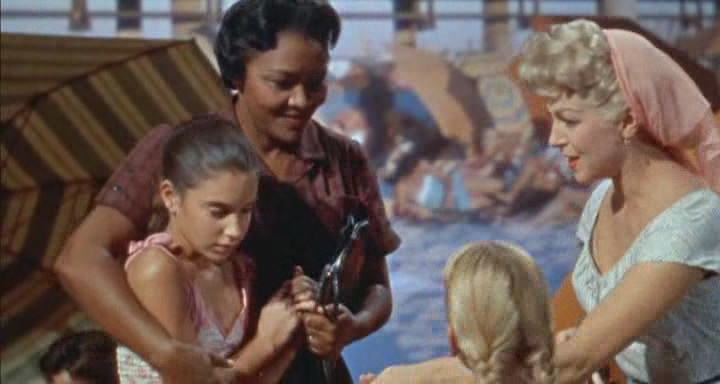
Widowed/single mother, Lora Meredith (Lana Turner), temporarily loses her 6-year old daughter, Susie, at the beach on Coney Island.  She scrambles to find the girl amid the crowd, and runs into a handsome photographer, Steve Archer (John Gavin), who offers his help.  When she finds Susie, she is with a kind black woman, Annie Johnson (Juanita Moore) and her 8-year old daughter, Sarah Jane (who has dark brown hair and looks white).  “Her father was almost white,”  Annie explains to the surprised Lora, who thought Annie was the girl’s nanny.  It turns out that Annie is also a widow, and she and her child have no place to stay.  Lora asks them over to her humble Manhattan apartment. 

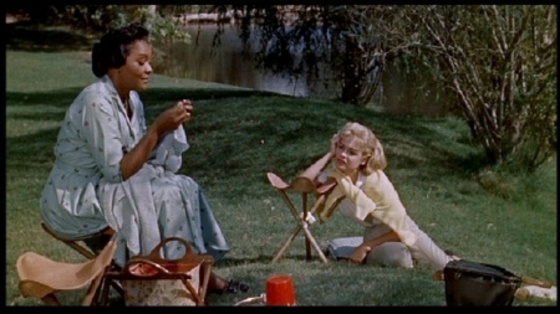
In no time, the four are functioning as family.  Lora goes out into the theater world to seek work as an actress; Annie takes care of the home, kids, and picks up little jobs now and then.  The girls go to school and grow up like sisters, though conflicts arise when Sarah Jane insists on hiding her true racial identity.  For many months, Steve and Lora date.  Though he loves his art, he gets a stable job in marketing.  He’s good with Susie, too.  But he’s not as perfect as he seems…

In time, Lora achieves the success she dreamed of professionally.  She becomes a star of theater, then movies, working with notable directors.  The family moves to a spacious house on Long Island.  Annie is always there- the “wind beneath her wings”- serving as a homemaker, confidant, and partner.  In one poingnant scene, Lora admits that Annie was more of a mother to Susie than she was (because of her high ambitions).

The girls grow into beautiful, charming, independant-minded teenagers.  Susie (petite, blonde Sandra Dee) has a positive outlook on life, though Sarah Jane (Susan Kohner, an actress of Czech and Mexican heritage) is troubled and restless. 

There is much to admire in this film, but also troubling aspects (reflecting the limitations of Hollywood and US.)  Why is Annie always humble, obliging, and wise?  Why doesn’t she have weak moments, like Lora?  Why weren’t African American actresses chosen to play Sarah Jane (as in the 1934 version)?  I’ll have to watch that version, too.  Some of the themes in this film are very modern: navigating a man’s world without a husband, raising a child as a single parent, and mother-daughter conflicts. 

Lora and Annie are like two sides of a coin- one has the strength to face the outside world (with her beauty and confidence), while the other has a quiet, inner strength (stemming from her spirituality).  Moore won a Best Supporting Actress Oscar for her performance. 

I was impressed by Kohner’s performance; I thought she did a fine job of a rebellious, conflicted individual seeking a place in the world. 

Gilda (1946)

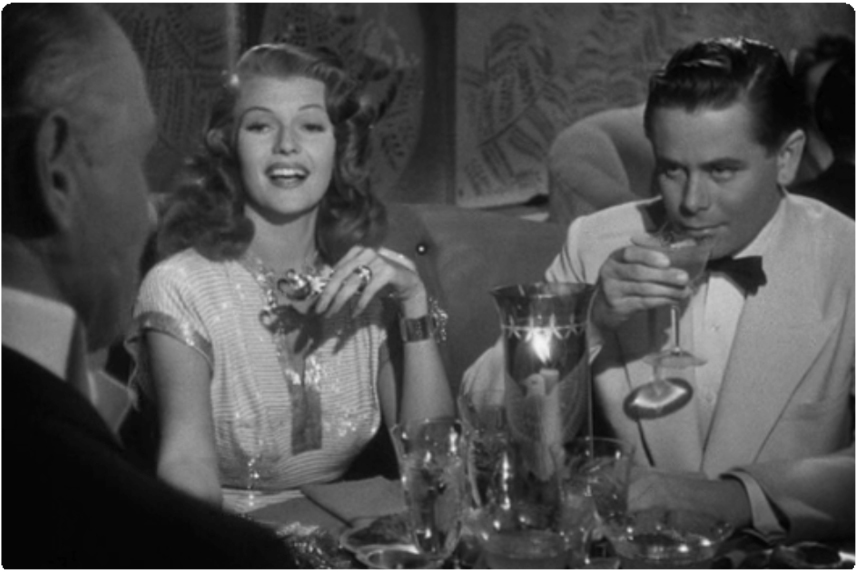
In post-WWII Buenos Aires, Argentina, petty American gambler Johnny Farrell (Glenn Ford) is rescued by wealthy businessman Ballin Mundson (George Macready).  In no time, Johnny becomes his “right-hand man,” managing his casino.  Why does Mudson help Johnny so much?  (Many critics pointed to the homoerotic dialogue and imagery in the first section of the film.)  

Ballin goes to the US for a short time; when he returns, Johnny learns that his wife is an American dancer, Gilda (Rita Hayworth), Johnny’s former love.  We can tell that they had a bitter, nasty break-up.

When Gilda is brought back to Argentina by Tom, she slaps Johnny hard across both sides of his face. In reality, Rita Hayworth’s smacks broke two of Glenn Ford’s teeth. He held his place until the take was finished.   -IMDB

Gilda: If you’re worried about Johnny Farrell, don’t be.  I hate him!
Ballin: And he hates you.  That’s very apparent.  But hate can be a very exciting emotion.  Very exciting.  Haven’t you noticed that?

While her controlling, disinterested husband is busy running his hotel/casino and overseeing a tungsten cartel, Gilda is left to her own devices.  She buys beautiful, expensive things and openly flirts with several men, so Ballin decides to make Johnny her watchdog.  The younger man resents this position, and bites back at Gilda.  He stops her from fooling around with any men, delivering her to her husband’s mansion. 

All of the goings-on of the place are observed by a lowly (yet wise) employee, Uncle Pio (Steven Geray).  He calls Johnny a “peasant” and has empathy for Gilda’s situation. There is a sub-plot involving former Nazis and a local detective.  To find out more, watch the film.

Johnny (to Gilda): What was that word?  It [decent] sounds funny coming from you.

This is an uneven film with a flimsy plot, but it’s also well-loved by many viewers.  It packs a punch because of the presence of the gorgeous femme fatale and the (almost palpable) chemistry between Hayworth and Ford.  If you’re interested in the themes explored in this film, check out Separate Tables (starring Hayworth, Burt Lancaster, Deborah Kerr, & David Niven) and The Lady from Shanghai (starring Hayworth and Welles).  I need to check out more movies with Ford; so far, I’ve seen 3:10 to Yuma, The Fastest Gun Alive, and The Courtship of Eddie’s Father.