Classic Movie Review: “Laura”

Her youth and beauty, her poise and charm of manner captivated them all. She had warmth, vitality. She had authentic magnetism. Wherever we went, she stood out. Men admired her; women envied her.

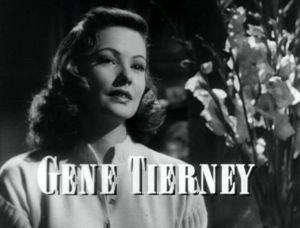
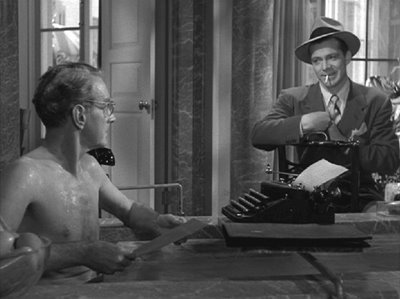
Waldo Lydecker (Clifton Webb) describes businesswoman Laura Hunt (Gene Tiermey) in glowing terms to Detective Mark McPherson (Dana Andrews) after her (presumed) death.  Lydecker is an influential, wealthy, sharp-tongued, witty columnist in NYC.  He narrates part of this 1944 film noir, and for the first half of the film, he creates for the audience a picture of Laura.  She was gorgeous, mysterious, confidant- the type of woman that men dream about. 


How singularly innocent I look this morning.

Lydecker served as her mentor, and they spent the past 5 years together.  What was the nature of their relationship?  He is imperious, but effeminate in manner- looks non-threatening to the audience.     

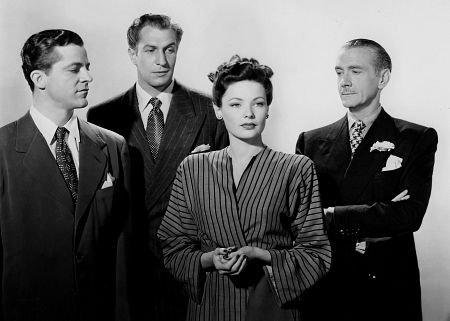
Because of Laura’s status and the terrible manner of her death, the media flocks to the doorstep of her 5th Ave apartment.  Though Waldo (a man in his 50s) was close to Laura, she was engaged to the charming, handsome, easy-going Shelby Carpenter (Vincent Price).  Shelby is very friendly with Laura’s wealthy, widowed, middle-aged aunt, Ann Treadwell (Judith Anderson).


Waldo, who often tags along with Mark during his investigation, warns the detective.

You’d better watch out, McPherson, or you’ll finish up in a psychiatric ward. I doubt they’ve ever had a patient who fell in love with a corpse.


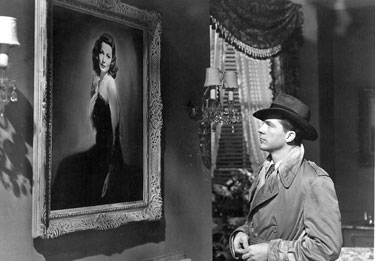
McPherson is a tough, no-nonsense cop who’s not fazed by dealing with society people; he keeps calm by playing with a little handheld game.  He goes over her apt, her letters, and diary.  Laura’s portrait fascinates and unsettles him.  This is not just a typical murder case to him!

Since Laura is a murder mystery, I don’t want to give too much away.  However, I can tell you that it’s a film worth watching.  You won’t see some surprises coming!  The dialogue is sophisticated and entertaining.  The characters are distinct, interesting individuals.  I especially liked Vincent Price’s performance; he seemed very modern and realistic as a down-on-his-luck Kentucky playboy.  Judith Anderson has a great scene where she describes why they are suited for each other.  Clifton Webb has a lot of terrific lines in the film; he reminded me of Oscar Wilde’s writing. 


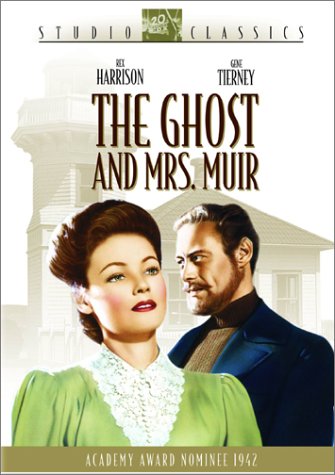
Movie Review: “The Ghost and Mrs. Muir”

I couldn’t believe my luck in finding this film on sale at F.Y.E. in Astoria recently!  I had wanted to see The Ghost and Mrs. Muir for a long time.  This is an exceptionally well-made Hollywood classic (out in 1947) film starring theatrically-trained/powerhouse actor Rex Harrison (the ghost, Captain Daniel Gregg), one of Hollywood’s most beautiful movie stars Gene Tierney (Mrs. Lucy Muir), charming/rakish comedian George Sanders (Miles Fairley), respected character actor Edna Best (Martha), and a very adorable 8 year old Natalie Wood (Anna Muir).  The unusually beautiful music will stay with you long after the film; the composer also worked on Citizen Kane and collaborated many times with Hitchcock.  It was a big success when it first came out, and also received great reviews from critics- you’ll see why!  It combines the genres of thriller, romance, and comedy.  But romance is key!


The story opens at the start of the century (1900 that is) in London.  Young widow Mrs. Lucy Muir, whose husband passed away a year ago, is living with her mother-in-law, sister-in-law, daughter, and housekeeper.  The ladies are all dressed in mourning clothes.  She expresses a strong desire to live on her own (with the income from her husband’s gold shares), much to the shock and disapproval of the in-laws (two hysterical, overbearing ladies).  Mrs. Muir has decided that the seaside will suit her well; she sets off with the eager Anna and loyal Martha. 


Upon arrival at Whitecliff-by-the-Sea, Mrs. Muir seeks out a “house agent” to find a suitable place.  Mr. Coombe, the agent, thinks he knows better than the young lady, but Mrs. Muir decides to rent Gull Cottage, a house said to be haunted by the ghost of Capt. Gregg (a seaman who died mysteriously 4 years ago).  She is not frightened away by disembodied laughter like previous tenants.  She says the house is “perfectly fascinating.”  So begins the adventure…


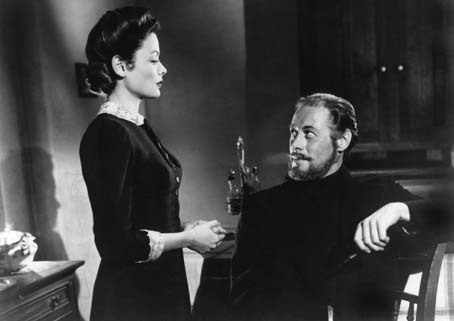
The cranky ghost of Capt. Gregg, dressed all in black except his silver buckled belt, reveals himself to Mrs. Muir soon after the family moves in; he’s not happy to have people in his house.  But she stands up to him; she’s not scared by his actions (noises, swearing, extinguishing candles).  She earns respect for that.  In that (first meeting) scene, their faces are only lit.   Light and shadow are used very cleverly and purposefully in this film.


Capt. Gregg is unlike the ethereal, other-worldly ghosts we’re used to in modern/special-effects laden movies.  He seems “real” to the audience, because Rex Harrison creates a very masculine, humorous, and witty character.  Harrison uses his strong physical presence (a must for any leading man), commanding voice (after all, he was chosen for My Fair Lady even though he couldn’t sing), and (especially) his eyes to “bring life” to the ghost.  But we also wonder if he is a figment of Mrs. Muir’s imagination?  Harrison is great at reacting to his fellow actors- a big part of acting.  In my honest opinion, the only way to get through the over-hyped Cleopatra is to focus on his portrayal of Julius Caesar.    


The ghost and the widow become friends; they “occupy the same domestic space like a married couple” (Jeanine Bassinger, chair of the Women’s Studies department at Wesleyan points out on one of the commentary tracks).  However, he has no body, so Mrs. Muir is safe; this satisfied the censors of the day.  When her investments fail, her in-laws come to visit; they urge her to go back with them to London.  But Capt. Gregg forms a plan- he “ghostwrites” a book to boost her finances.  Over some months, Daniel dictates to Lucy (or “Lucia” as he prefers to call her) the story of his lusty, adventurous life.  They work together and fall deeply in love.  It’s a sad fact that she is alive and he is dead! 


When Mrs. Muir goes up to London to see a publisher, she catches the eye of Miles Fairley, a well-dressed, smooth-talking, wealthy man in the office.  He’s not exactly her type of man, but he’s real.  Will Mrs. Muir let this (corporeal) man into her heart?    There is a similar choice to be made in Anthony Minghella’s first film, Truly Madly Deeply (if you want to know more). 


I highly recommend this film to everyone, not only fans of classic black and white films.  It seems modern to me, in many ways.  The music, lighting, costumes, etc. all work to create a memorable picture.  The exchanges (even the ones without words) that Harrison and Tierney have are terrific; you can see that their characters care about and respect each other.   The film is also “very literate” (Bassinger comments).  This is an intelligent viewer’s movie, though it also evokes emotions.  It is about loss, yearning, and “the dream of love.”  In reality, men are not perfect.  And not everyone has love in their life.  But we all dream!   


Movie Review: “Appaloosa”

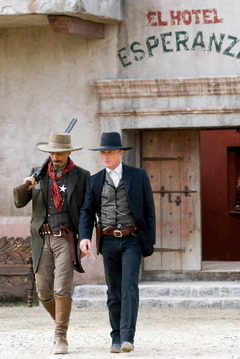
Ed Harris and Viggo Mortensen in France: WOW- talk about aging gracefully!!!

Last Sunday afternoon, I was feeling a little down, so I went to check out a new movie I was curious about.  (I wrote a previous post about Appaloosa.)  I would catagorize it as a subtle, low-key Western drama.  The small audience (mostly folks 50 and up) seemed to like the sly humor, in-depth characterization, and development of the female character (she’s not a one-dimensional woman like in traditonal Westerns).


The stars are: Ed Harris (lawman for hire Virgil Cole; he also co-wrote the screeplay and directed), Viggo Mortensen (Cole’s quiet, observant, long-time partner in “gun work” Everett Hitch), Renee Zellweger (young widow Allie French), and Jeremy Irons (rich bad guy/rancher Randall Bragg).

Cole and Hitch have been partners for many years.  They have traveled through little Southwestern towns enforcing the law whenever called upon.  Appaloosa is under siege by Bragg and his men; they drink too much, fight, don’t pay bills, and aren’t hesitant to use their guns.  The town leaders (scared stiff by the mention of Bragg) think he may have killed the former lawman of the town.  They quickly agree to the terms set by Cole (he carries his own list of laws), and he becomes marshall.  Hitch, who always carries a 12-gauge (a big gun), is his deputy.

Into the town comes Mrs. Allison French, a pretty, young, well-mannered widow.  She is cheerful and plays the piano, but hasn’t much money.  Cole takes an instant interest in her; he says she can stay in the town’s hotel as long as she likes.  Before you can say “Gunsmoke,” Allie is overseeing building a house and Virgil is helping choose curtains!  Everett is a bit surprised by his friend’s behavior.

Feelings get you killed.  (One of the taglines for the film)

Bragg, his men, and two newcomers to the town eventually use the budding romantic relationship to their advantage.


I liked the way that the film built things up, often in unexpected ways.  Issues that come across as simple in old Westerns are not so here.  (Remember that old Hollywood had to deal with stricter censorship codes.)  In those films, you had the bargirls/whores, married woman, and little girls- that’s all.  There weren’t many respectable single women hanging about.

Allie, who has an air of mystery, changes the dynamics (a little) between the two old friends.  She’s trying to survive in a man’s world, so she must rely on men (and all that comes with it).  Another woman in the town, a prostitute that Hitch sees, wonders if Allie “even knows how she feels.”  She can be sweet, bubbly, but is tough on the inside.  You’ll wonder about her past…

Viggo’s character, we learn in the opening narration, is a West Point graduate who served in the Civil War.  But his heart was not in “soldiering,” so he traveled West.  He helped Virgil out of a tough situation, and the men became partners.  Their friendship is very strong- almost like that of brothers.  In one great scene, Everett has to (physically) stop the older man from doing something rash.

There are humorous little moments, too.  Virgil has trouble with long, complicated words- Everett fills them in for him.  Jeremy Irons is pretty good as a evil guy, though I kept expecting him to revert back to his English accent!  (I guess we’re not used to seeing him as an American much.)  The scenery, music, and small characters all work well together, too.  Appaloosa is a very well-made, intelligent film with different layers.  It makes you think!

“Elizabeth: The Golden Age” (2007)

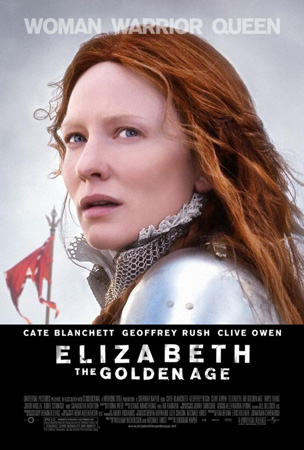
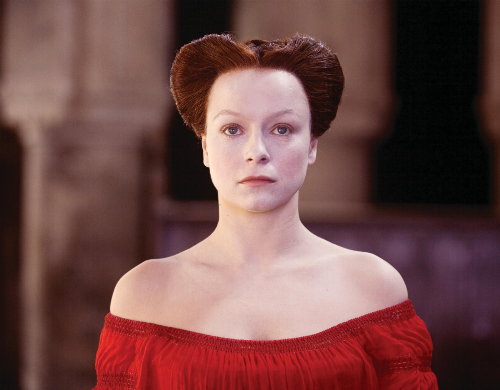
The “definitive” Queen Elizabeth of modern film (Cate Blanchett), director Shekhar Kapur, and the Queen’s “master of intrigue” Lord Walsingham (Geoffrey Rush) return to create a strong sequel.  The costumes, especially those of Elizabeth, are some of the MOST beautiful, intricate things ever seen!  The unusually high camera angles often used reminding the viewer of bigger forces at play in the world (God?  Destiny?) than the machinations of rulers.  There are new chracters to explore as well: sailor/adventurer/privateer, Walter Raleigh (Clive Owen); beautiful, sweet, young lady of the court (Abbie Cornish); the religiously fanatical King Phillip of Spain (Jordi Molla); the steely Mary, Queen of Scots (Samantha Morton).

This is my second viewing of the film; I saw it in the theater this past winter.  It’s the kind of film you MUST see in the theater to appreciate fully.  Kapur envisions this film as light (Elizabeth) vs. dark (Philip); he explains this in the Special Features of the DVD.  Elizabeth is now a mature woman and a confidant ruler, but her country is in trouble.  Spain has an incredibly strong navy (the Armada had more than 2,000 ships), the Inquisition (which Elizabeth says will take away “freedom of conscience and thought”), and a ruler who seeks to glorify God by conquering Britain.

At home, the Virgin Queen must deal with cousin Mary, who has many Catholic supporters plotting for Elizabeth’s demise.  Mary is imprisoned, but still sending out letters to the world.  England is about 50% Catholic, but the queen vows “I will not punish thought- only action.”  Elizabeth stood for religious tolerance, even when her Privy Council said that she should be more tougher on disloyal subjects (speaking/writing against her).
One day, while walking with her ladies from church, Elizabeth meets Raleigh.  He gallantly drops his cloak in order to cover up a puddle.  She is definitely amused and intrigued by the man, as is Beth (her favorite lady-in-waiting).  Raleigh is handsome, bold, and has been to the New World; he presents to the court Native Americans, potatoes, tobacco, and gold (captured from Spanish ships, of course).  You may know that Virginia was named in honor of Queen Elizabeth.

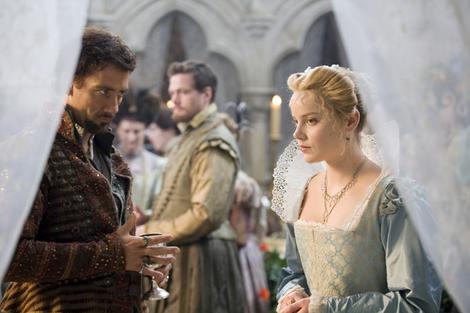
Raleigh speaks with Beth Throckmorton, one of Elizabeth’s closest ladies.

Raleigh was known to be one of Elizabeth’s “favorites” in real life.  In this film, Elizabeth is drawn NOT only to the (very charming) man himself, but to the life of adventure her leads.  She has never been away from British shores, and yearns to see more of what is “beyond the court.” 
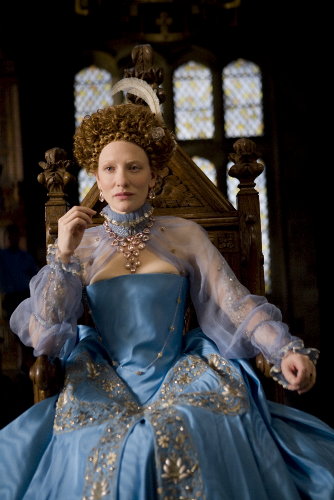
In the above picture, Elizabeth is enthralled as she listens to Raleigh’s account of life at sea.  This section of the film reminded me of Shakespeare’s tragic play, Othello.  (Desdemona fell in love with Othello because of his stories.)
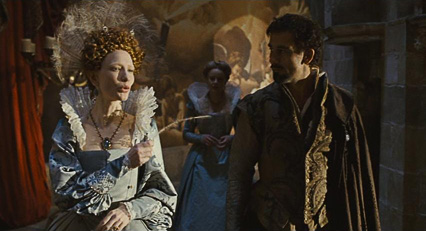
Raleigh wants the Queen’s favor; however, he also shows concern for her as a person and friend.  Though the hair, make-up, and clothes (obviously) proclaim him the “hero” character, the acting is mostly in Clive Owen’s eyes.
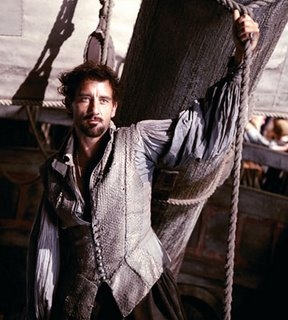
Sir Walter Raleigh (he was knighted by the Queen) aboard his ship, The Tiger.

Some people have complained about the (big) show of emotion in one scene involving the Queen, Beth and Raleigh.  (I understand that, because I thought it was a BIT too much as well.)  But who among us is always in control?  The Queen is NOT ONLY a ruler, she is a woman (who probably would’ve liked to have a husband and family- like most other women of her day).
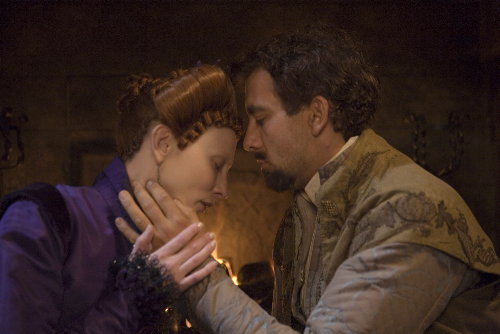
The dialogue was pretty good, but there were a few places where I thought it could’ve been more subtle.  Modern audiences are NOT as dim as MANY screenwriters think!  The acting, especially by Cate, is VERY good.  In my opinion, this actress can play ANY role.  Geoffrey Rush is strong (as always) but low-key.  He was known as “the spymaster” who had eyes and ears all over Europe; his main concern is the Queen’s safety.
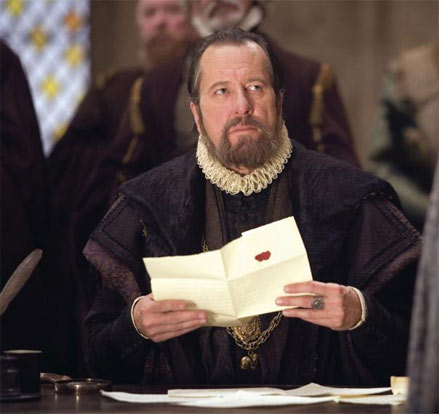
What struck me the most was the beauty of the locations (especially the many different cathedrals), the visual effects, and the scenes between Cate and Clive.  They had a good connection that was based on respect, I feel.  The music was not overly dramatic, unlike in many “epic” scale films.  Check out this film ASAP!
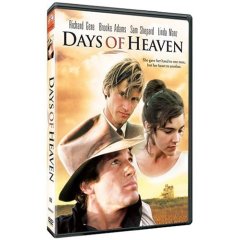
Movie Review: “Days of Heaven”

There is a pervading sadness to the movie, like a memory of something wonderful that could have been, that should have been, that almost was, and is all the more tragic because it was in your hands but slipped through your fingers. This is not a movie for everyone, but if you believe that film can be one of the highest forms of art, this is the film to see. 

–IMDB review

What is it really about?  Fleeting beauty. There aren’t any random shots in the film at all, each frame and edit is a word or period for thought and mood. What joys and disappointments to be found in life. The churning machines, the lighting, the chatter, the dialogue-free actions… 

–IMDB message board 


This is a very visually engaging and beautiful film that came out in 1978.  It was directed by Terrence Malick (mostly known for The Thin Red Line and The New World).  If you know his work, don’t worry, this movie is not overly long (only 94 minutes) and languorous!  The acting is subtle and the dialogue is simple, but you’ll be drawn in by the hopeful young characters and the natural beauty around them.  Oh, and the characters are beautiful, too!   

In the opening, Bill (Richard Gere- young and very striking), his girlfriend Abby (Brooke Adams- also youthful, but bright; wife of multi-talented Tony Shalhoub), and Bill’s pre-teen sister Linda (the narrator) are struggling to get by in pre-WWI Chicago. 
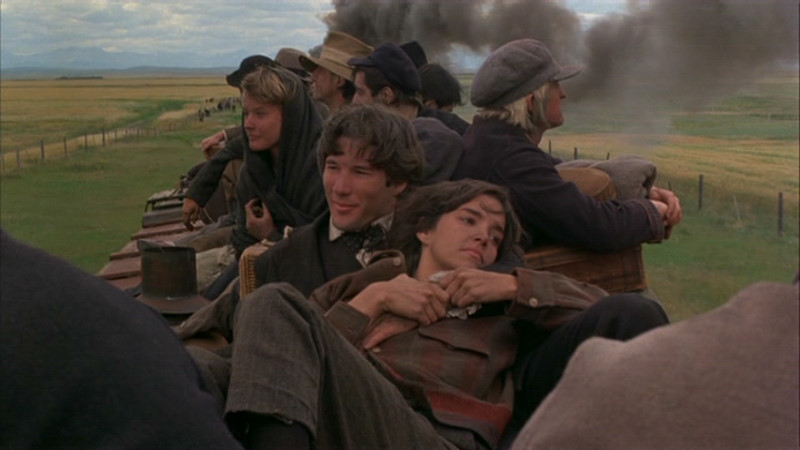
Bill, who has a short temper, gets into a fight (for no apparent reason) with an older man at his job; he unwittingly kills the man.  The self-made family travel (via train) to work on a wheat farm (during harvest time) in the Texas panhandle.  Bill and Abby, who are deeply in love and very comfortable with each other, pose as brother and sister in order to prevent “talk” about them.  

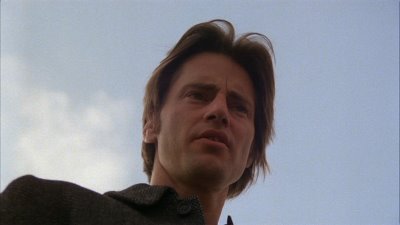
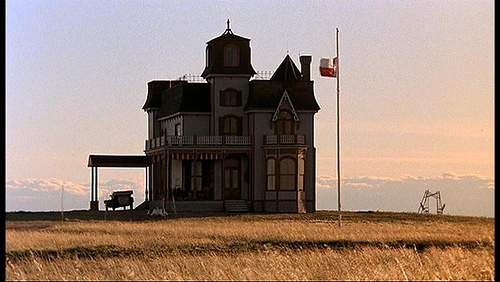
The Farmer (Sam Shepard- also a noted playwright; I think he resembled Viggo Mortensen as a young man) is wealthy, but looks sad and lives alone in his huge house (no relatives; single).  He becomes interested in Abby; Brooke Adams’ beauty is in her large expressive eyes.  The Farmer asks another employee about Abby, then one day, gathers up courage to speak to her.  After harvest, he suggests that she stay on to work on his farm.  The work would be easier, and it would be a more stable life.

When Abby mentions this idea to Bill, he doesn’t get jealous.  Bill overheard the doctor saying The Farmer doesn’t have long to live.  The family becomes friendly with the lonely man.  Very soon, we realize that The Farmer is in love with Abby.  The Farmer, who is kind and gentle, could give Abby a financially secure life.  But what will happen after she decides to marry The Farmer?  Will Bill be able to handle it?  (It’s not easy to be part of a love traingle!)  


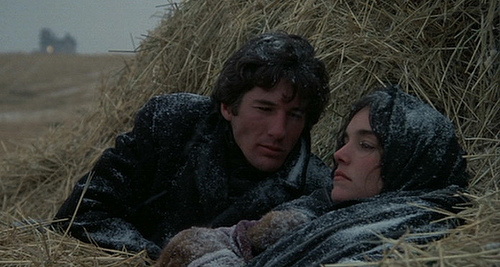
I really like the shot below because it shows the harshness of their lives, though they are beautiful and young. 

The last 30 minutes are very interesting; the action picks up a lot!  Sam Shepard suits the role of a farmer very well with his tall, lean build and shy, quiet demeanor.  His character is easy to sympathize with!  Brooke Adams and Richard Gere look comfortable doing the hard labor of farmwork.  Gere grew up on a small farm in upstate New York.  You can believe that Abby and Bill are a loving couple, but their relationship is not (totally) secure.  I found her to be a very watcheable character.  It’s too bad that there wasn’t more dialogue- that’s what I like best in films.  However, you could see the conflict in the characters’ eyes, faces, body language. 


Check out this film when you’re in a reflective mood, or looking for something different from the ordinary.