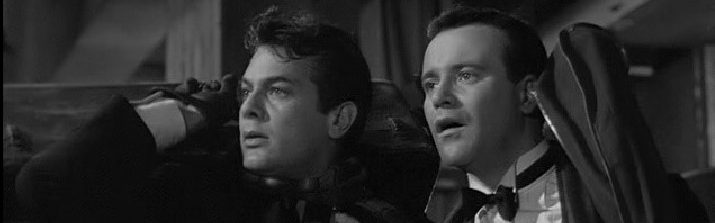
“The Accused” (1949) starring Loretta Young, Robert Cummings, & Wendell Corey

Wilma Tuttle (Loretta Young) is a 30-something Psychology professor at a small college in California. One night, she agrees to have dinner w/ one of her students, Bill Perry (Douglas Dick), in order to discuss his behavior. Though he is an intelligent young man, he is too forward in his attentions (even in class). After dinner at a drive-in restaurant, Wilma insists on going home, but Bill drives up to a cliff high above the ocean in Malibu, making Wilma nervous. He quickly changes into his swimming trunks, saying they should go down to the beach. Wilma grows more scared, but she is strong enough to she act in self-defense (when Bill attempts to rape her). This results in his death, which Wilma covers up. Soon, she finds her conscience bothering her, which could jeopardize her mental health and promising career. Bill’s guardian/lawyer- Warren Ford (Robert Cummings)- arrives from San Francisco. He takes a liking to Wilma, as does his old friend- Lt. Ted Dorgan (Wendell Corey). The policeman (who has some of the best lines) wants to investigate further into Bill’s death, though an inquest ruled it an accident.

At the time, this must have seemed daringly modern and contemporary. Now it just seems quaint, a waystation in the breakdown of small-town American values…

Wendell Corey is his inscrutably poker-faced self, as always, hinting between the lines…

Each of the main characters is an interesting study, with ambivalent emotions that alternately spark and grate against those of the others.

-Excerpts from IMDB reviews

The Accused has noir-like psychological elements, though isn’t typical of the film noir genre. Wilma’s behavior is understandable to viewers, so she has our sympathy. The directing will hold the viewer’s attention to many scenes, though there is not much suspense. These scenes were esp. handled well: the opening sequence of Wilma trying to get home, a boxing match where she suffers a flashback, and the reconstruction of the killing.

Going w/ conventions of the time, a woman can’t have a career and a romantic life at the same time. As she gets closer to Warren, Wilma transforms into a glamorous woman from the prim stereotypical schoolteacher (w/ hair in bun, high collars, and long skirts). I thought the most interesting character was Lt. Dorgan (who wondered if he might have a chance), and felt bad about investigating Wilma. Though he admires her beauty, brains, and charming manners, he is compelled to get to the truth!

“Seventh Heaven” (1937) starring James Stewart & Simone Simon

James Stewart is superb as Chico. He’s awkward, gruff, reluctant to get involved with other people…

It’s as if Stewart’s star quality is irrepressible. It’s as if his personal good character comes across better than the script can tell...

-Excerpts from IMDB reviews

This was James Stewart’s first film in 1937; he was loaned out from MGM (the studio to which he was contracted) to 20th Century Fox. This is a remake of a silent classic that starred Charles Farrell and Janet Gaynor (who won the first Best Actress Oscar). It was based on a play by Austin Strong that ran for 704 performances on Broadway (1922-1924). Some are going to think it’s odd that Stewart is playing a Frenchman, but it was common for American actors then not to attempt accents when playing foreign parts. I came across this movie on YouTube; it’s in the public domain.

In pre-WWI Paris, Chico (a late 20s Stewart) is sewer worker and atheist b/c his prayers were not answered. He wanted a better job and a beautiful, golden-haired wife. Though disappointed w/ his lot, Chico continues to do the right thing, but wonders why. A young woman, Diane (Simone Simon), is working for her abusive sister (a madam) in a small tavern (until she throws wine at a customer who violently kissed her). When that customer threatens to have the police close the tavern, Diane’s sister beats her all the way out to the street! Chico pops out of the sewer and saves her; he even claims that she is his wife when a policeman comes by. Several colorful characters join in the film w/ this pair, as they pretend to be married while waiting for the police to verify their claim. Chico’s flat is on the 7th (top) floor of the apt. building, hence the title.

In the late 30’s to early 40’s, Simon was a wanted actress by the studios. She’s petite, bouncy-haired, and adorable (reminding me of a more mature Shirley Temple). In 1936, Darryl F. Zanuck signed Simon to a contract at 20th Century Fox. She was launched with an expensive publicity campaign which accentuated her European allure, esp. her pout. Problems surfaced re: her command of English and also her limited singing skills. Dissatisfied w/ the roles she was given, she returned to France for a time. During the production of the cult classic Cat People (1942), Simon was under FBI surveillance (b/c of her relationship w/ a Russian MI-5 spy)!

“The Strange Woman” (1946) starring Hedy Lamarr

Bored with being a film star, Hedy became an accomplished amateur scientist, designing in the early 1940’s the basics of spread spectrum and frequency hopping for radio waves – a concept embodied in every wi-fi and cell phone in use today.

…I feel like the writers read Jane Eyre and Gone with the Wind in the same sitting and said “let’s combine the two”. FYI “Strange” was the term used for “adulteress women” back in the day.

I really see this movie as about a woman who learns that she can “pretend” her way into being a better person. She may seem sociopathic or narcissistic to some, but she is desperate to survive and thrive in a world where she has no education, no money, and only her looks and charm in a rough land.

-Excerpts from reviews on Amazon

I came across this film from a Facebook group; it is in the public domain (as are most films directed by Edgar G. Ulmer). It has a mix of historical melodrama, film noir, and feminism. In 1824 in the port city of Bangor, Maine, Jenny Hagar grows up w/o the love and guidance of her mother (who left her and her drunken/violent father). As a girl, she tries to drown her friend, Ephraim, but then saves him (while other kids look on in wonder). A wealthy local man, Judge Saladine, stops his carriage upon seeing this commotion. His young daughter, Meg, asks if Jenny can go to boarding school w/ her; the judge considers it for a moment, then says Jenny can come work/live in his household. Jenny’s father, Tim (Dennis Hoey), admits that he’s not equipped to raise a child properly. However, Jenny turns down the offer. She demonstrates both her anger at the inequity of her circumstances and her determination to rise by her bootstraps. Jenny tells her father not to worry, b/c “I’ll grow up to be beautiful!” Douglas Sirk (uncredited) directed the opening sequence.

Men like me… and it’s men that have the money in this world! -Jenny declares to her father

After her father hears of Jenny (Hedy Lamarr) walking out w/ a young sailor, he beats her so roughly that she runs to the richest man in town. The owner of several businesses, Isaiah Poster (Gene Lockhart), sent Ephraim (his son) away to college to keep him away from Jenny. After Jenny is cleaned up by his housekeeper, Mr. Poster marries Jenny that same night! He discussed the matter of her safety w/ Judge Saladine (Alan Napier) and the town pastor, Rev. Thatcher (Moroni Olson). Napier would later become famous as Alfred the Butler, in the 1960s series- Batman.

It wasn’t by knowing how to set a table that Cleopatra got along. -Jenny comments to her friend Meg

Jenny pledges a generous amount to the church, earning the respect of her neighbors. She starts doing charity work in the community, visiting those in need w/ food and kind words. Jenny remembers where she came from and she means to do something about those she left behind. When Epraim (Louis Hayward) returns home, he’s still deeply in love w/ Jenny, and she encourages his attentions. Mr. Poster is eager to have his son gone. After her husband falls ill, Jenny nurses him herself. Mr. Poster recovers and other town leaders come to him for help w/ a violent riot. Jenny is so concerned for her older friend, Lena (June Storey), that she takes her in after her tavern is burned down. Unlike Scarlett in Gone With the Wind, Jenny doesn’t care for propriety; she despises it, recognizing that its standards are applied far more strictly to women than men. Some of Mr. Poster’s lumbermen are called in from the hills to serve as a police force. Jenny becomes infatuated w/ one of the men; he is Meg’s (Hillary Brooke) fiance, John Evered (George Sanders).

There are similarities between Jenny Hager and Scarlett O’Hara, but Jenny’s intentions and the root of her flaws are much darker and more mysterious.

So often in films, femme fatales are portrayed to have no conscience, no sense of compassion for others, and yet Jenny does.

…Ulmer has crafted a moody and daring picture that strikes devilish notes without banging the drum too loudly. Striking scenes and imagery are many…

-Excerpts from IMDB reviews

“Mangal Pandey: The Rising” (2005) starring Aamir Khan, Toby Stephens, Rani Mukherji, & Ameesha Patel

Aamir Khan plays Mangal Pandey passionately with a complete conviction. All the scenes between Aamir and Toby are a delight to watch. Toby doesn’t fail to impress with his acting or his Hindi-speaking lines.

Stephens’ brief speeches about the ruthlessness of a private corporation pillaging a country seem all too relevant to our own time… The film is wildly entertaining, filled with the color and beauty of Bollywood- superb cinematography, epic sets and crowd scenes, music-and-dance numbers that pop out of nowhere, and a love story…

-Excerpts from reviews on Amazon.com

This is an epic set against the backdrop of what the British called the Sepoy Mutiny; for the Indians, it was the First War of Independence. It took two years to complete this film b/c of the research that went into its production. “Company Raj” (the British East India Company) had been plundering the country, treating the locals unjustly, and causing widespread resentment. During battle in one of the Afghan wars in the mid-1800s, Mangal Pandey (Aamir Khan), an Indian sepoy, saves the life of his commanding officer, Capt. William Gordon (Toby Stephens- son of Dame Maggie Smith). He is indebted, even giving Mangal his pistol. The first act is focused on the friendship; historians have pointed out that this was unlikely. A few years later, the Company introduces the Enfield rifle, which comes w/ a new cartridge rumored to be coated w/ grease from cow and pig fat. This cartridge has to be bitten before it is loaded, which ignites resentment and anger among the sepoys; the cow is sacred to Hindus and the pig is forbidden for Muslims.

The film was offered to Bollywood superstar, Shah Rukh Khan, but he declined (thank goodness). Director Ketan Mehta first thought of making this film in 1988 w/ Amitabh Bachchan. Hugh Jackman turned down the role of Gordon; this required Stephens to speak w/ a Scottish accent and also in Hindi. A very young Kiera Knightley was considered for the role of Emily Kent, who is new to India and develops a crush on Gordon. After Aishwarya Rai turned down the part of Jwala (due to contract issues), Rani Mukerji was given the script to consider taking the part. Mukherji, however, liked the character of Heera and asked if she could play her instead. Khan requested to cast Ameesha Patel as the young widow, Jwala, after he saw her on a BBC game show. Patel wears no make-up; this was Khan’s suggestion.

We only sell our bodies; you sell your souls. -Heera explains to Mangal re: the difference between her girls and the sepoys

The BJP wanted to ban the film, as it showed Pandey visiting a prostitute (though their scenes are platonic in the movie). As Lol Bibi (veteran actress Kiron Kher) points out, her house is only for white men (mainly the British officers). Though this is not a “typical” Bollywood film, it contains songs and dances. One number by Heera and other nautch (dancing) girls, Main Vari Vari, created controversy due to Mukherji’s outfit (where her cleavage was covered by transparent fabric). This song serves a dual purposes- to entice the British officers and to show how conflicted Mangal feels re: trusting Gordon (and biting the new bullet). A.R. Rahman was the music director on this movie; the music flows w/ the story. My favorite song is below- Rasiya.

In your Ramayana there was one villain “Ravana” who had ten heads, company has a hundred heads and they’re all joined by the glue of greed. -Gordon replies when Mangal asks re: the Company

I think this movie is a must-see, though it is uneven (particularly when it comes to editing). The narration (in Hindi) done by veteran actor Om Puri is repetitive; I think it was used to appeal to Hindi speakers who may not be fluent in English. There is a mix of English and Hindi spoken in this film, which I’m sure was accurate for the period. The bromance is much more stronger than both the romances. The relationship between Mangal and Heera was underdeveloped, but I could see the chemistry between the actors. I liked the wrestling scene and hand-to-hand combat between Mangal and Gordon. The sepoys and villagers confronting the British one night w/ their torches stood out to me. However, the scene where Gordon stops the sati (bride burning) looks disorganized. Mangal Pandey: The Rising was shown at the 2005 Cannes Film Festival. The screenwriter is British of Parsi heritage- Farrukh Dandy- associated w/ black (as in minority in UK) and left-wing intellectuals and activists.

You have tasted a black man’s loyalty – now taste his fury! -Mangal declares to Gordon

On second viewing, I noticed how colonialism was compared to slavery (which we may associate w/ the American South and West Indies). Hewson beats a waiter and insults him w/ “kalla kutta” (“black dog”). One of the villagers near the cantonment, Kamla, works as a wet nurse for one of the British officer’s wives. When she gets home, there is no milk left for her baby. Perhaps the most direct correlation to slavery is made in the market scene; Emily is appalled to see an auction of men and women (incl. Heera). It turns out that the Company buys girls, too!

“Water” (2005) starring Seema Biswas, Lisa Ray, & John Abraham

[1] The film is lovely in the way Satyajit Ray’s films are lovely and the best elements of Water involve the young girl and the experiences seen through her eyes. – Rogert Ebert (The Chicago Sun-Times)

[2] Not a dry eye in the house by the time the film ends! Unforgettable and grand in my view; a fabulous achievement for all involved!

[3] The beauty of this movie is the incredible acting. The performances are so touching and so eloquent that you are drawn into the story and the feelings of the women.

-Comments from viewers on Amazon

[1] Despite the bleak conditions portrayed in the movie, there are moments of wonder and comedy and great love. 

[2] The script articulates the tragedy and hypocrisy these women must bare, but it also illustrates the quiet revolution we must all experience in order to grow, in order to change. 

-Excerpts from IMDB reviews

Water (shot in both Hindi and English) was nominated for the Best Foreign Language Film Oscar at the 79th Annual Academy Awards. The Vancouver Film Critics Circle named Deepa Mehta (an immigrant from India) the Best Canadian Director of 2006. Many viewers have praised the look of the film. The natural beauty of the setting is captured by cinematographer Giles Nuttgens, a Brit who won an Oscar for his work on Hell or High Water; he worked with w/ Mehta on her other trilogy films: Fire and Earth. The music (which adds to the story) was composed by A.R. Rahman; the lyrics were written by Sukhwinder Singh.

I would prefer to be known as a storyteller. I don’t set out to provoke reactions. I don’t even feel vindicated, but the irony does not escape me. It is like my father used to say: the two things you could never predict were the day of your death and the success of a movie. -Deepa Mehta (on Water‘s success)

Filming began on Water in 2000 with Akshay Kumar and two actresses who worked w/ Mehta before- Shabana Azmi and Nandita Das. This film was stalled due to protests in India; sets were vandalized (in organized attacks from Hindu nationalists) and Mehta’s life and those of the actors was threatened. Production was restarted in 2004 in Sri Lanka w/ model-turned-actor John Abraham (before he hit it big in Bollywood), Seema Biswas (an indie/theater actress), and Canadian actress Lisa Ray (who was in Bollywood/Hollywood– also directed by Mehta). Ray studied to improve her Hindi, as it is not her first language; her mother is Anglo-Canadian and her father is an Indian immigrant to Canada.

The unknown girl who plays Chuyia (Sarala Karlyawasam) didn’t speak Hindi; she is Sri Lankan and never acted before this film! She does a great job, as everything comes across as natural and believable. Chuyia (only 9 y.o.) is a catalyst for change and the viewer’s entry into this ashram of widows; she doesn’t know what to expect either. There is a hierarchy among the women who live humble lives of poverty. Chuyia finds a mother-figure in the spiritual Shakuntala (Biswas); she tries to help the child adjust to this bleak life. Chuyia forms a friendship w/ the beautiful young widow, Kalyani (Ray). By chance, Kalyani meets a handsome young man, Narayan (Abraham), who is another change-agent. Chuiyia upsets the order of things w/ her spirited personality; Narayan brings in revolutionary ideas from Gandhi (incl. that widows should be allowed to remarry).