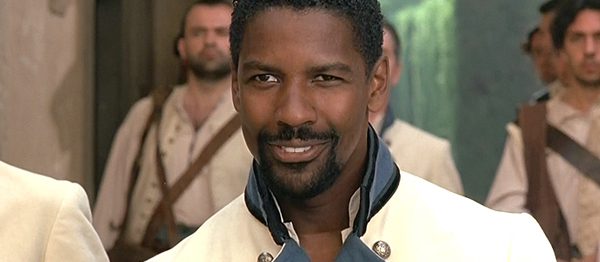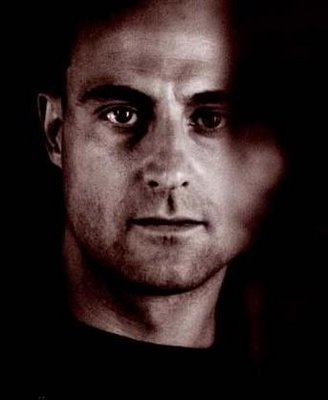
Mark Strong (“my Mr. Knightley”) gets critical acclaim!

The current issue of Time notes that in Guy Ritchie’s new action film RocknRolla “Gerard Butler stars, Tom Wilkinson makes a star turn, and Mark Strong steals the show.”

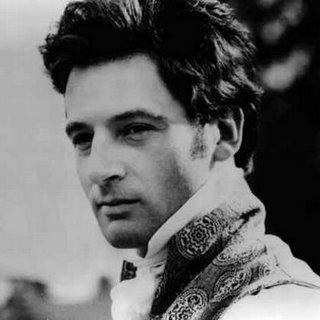
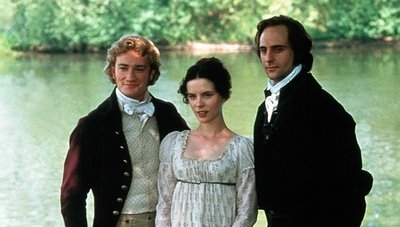
Mark Strong, a VERY talented British actor, played Mr. Knightley alongside Kate Beckinsale in my favorite movie version of Jane Auten’s Emma.  I felt that his characterization of Mr. Knightley was close to the book; he was tough (lectured Emma loudly), haughty (knew his position in society), and rooted in the mores of the period.  Don’t get me wrong- I LOVE Jeremy Northam’s work, but he made the character more light-hearted and fun in Emma with Paltrow.  Even the way Northam moved was easy; Strong made Knightley darker, moodier, and more of a mystery.

Mark as Mr. Knightley

Jeremy as Mr. Knightley

In that same issue of Time, there is a review of the spy thriller Body of Lies starring Crowe and DiCaprio.  Mark Strong has a crucial role in that film; he plays Hani Salaam, the chief of Jordanian intelligence (who helps out Leo’s character).  Okay, Mark is definitely NOT Middle Eastern, but his looks could be considered “exotic” in Hollywood.  His parents immigrated from Italy before he was born; they chose to give him a British name (because they felt it’d help him fit in).

DiCaprio has some unusual-looking facial hair in this film!  A reviewer thought it was “squiggly” and “distracting”- LOL!

http://www.imdb.com/title/tt0758774/

Next up for “my Mr. Knightley”- Sherlock Holmes with Robert Downey Jr. (Holmes) and Jude Law (Watson).

http://www.imdb.com/title/tt0988045/

But the coolest of all- Mark has acted alongside Sir Ian McKellan!  Below is a pic from a theater production of Richard III.

Classic Movie Review: “Laura”

Her youth and beauty, her poise and charm of manner captivated them all. She had warmth, vitality. She had authentic magnetism. Wherever we went, she stood out. Men admired her; women envied her.

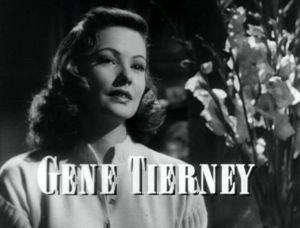
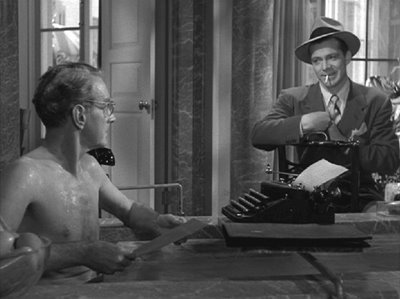
Waldo Lydecker (Clifton Webb) describes businesswoman Laura Hunt (Gene Tiermey) in glowing terms to Detective Mark McPherson (Dana Andrews) after her (presumed) death.  Lydecker is an influential, wealthy, sharp-tongued, witty columnist in NYC.  He narrates part of this 1944 film noir, and for the first half of the film, he creates for the audience a picture of Laura.  She was gorgeous, mysterious, confidant- the type of woman that men dream about. 


How singularly innocent I look this morning.

Lydecker served as her mentor, and they spent the past 5 years together.  What was the nature of their relationship?  He is imperious, but effeminate in manner- looks non-threatening to the audience.     

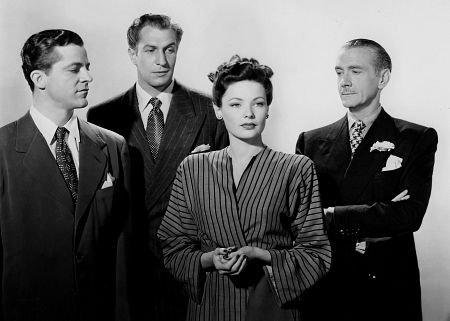
Because of Laura’s status and the terrible manner of her death, the media flocks to the doorstep of her 5th Ave apartment.  Though Waldo (a man in his 50s) was close to Laura, she was engaged to the charming, handsome, easy-going Shelby Carpenter (Vincent Price).  Shelby is very friendly with Laura’s wealthy, widowed, middle-aged aunt, Ann Treadwell (Judith Anderson).


Waldo, who often tags along with Mark during his investigation, warns the detective.

You’d better watch out, McPherson, or you’ll finish up in a psychiatric ward. I doubt they’ve ever had a patient who fell in love with a corpse.


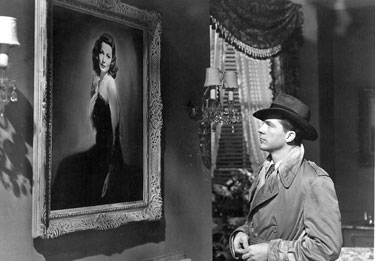
McPherson is a tough, no-nonsense cop who’s not fazed by dealing with society people; he keeps calm by playing with a little handheld game.  He goes over her apt, her letters, and diary.  Laura’s portrait fascinates and unsettles him.  This is not just a typical murder case to him!

Since Laura is a murder mystery, I don’t want to give too much away.  However, I can tell you that it’s a film worth watching.  You won’t see some surprises coming!  The dialogue is sophisticated and entertaining.  The characters are distinct, interesting individuals.  I especially liked Vincent Price’s performance; he seemed very modern and realistic as a down-on-his-luck Kentucky playboy.  Judith Anderson has a great scene where she describes why they are suited for each other.  Clifton Webb has a lot of terrific lines in the film; he reminded me of Oscar Wilde’s writing. 


Movie Review: “The Ghost and Mrs. Muir”

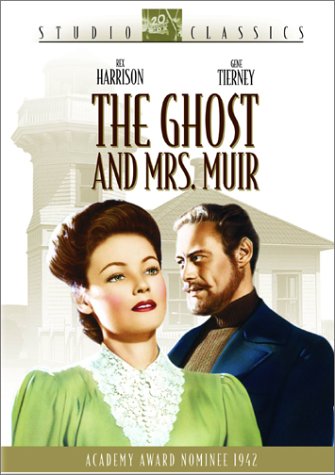
I couldn’t believe my luck in finding this film on sale at F.Y.E. in Astoria recently!  I had wanted to see The Ghost and Mrs. Muir for a long time.  This is an exceptionally well-made Hollywood classic (out in 1947) film starring theatrically-trained/powerhouse actor Rex Harrison (the ghost, Captain Daniel Gregg), one of Hollywood’s most beautiful movie stars Gene Tierney (Mrs. Lucy Muir), charming/rakish comedian George Sanders (Miles Fairley), respected character actor Edna Best (Martha), and a very adorable 8 year old Natalie Wood (Anna Muir).  The unusually beautiful music will stay with you long after the film; the composer also worked on Citizen Kane and collaborated many times with Hitchcock.  It was a big success when it first came out, and also received great reviews from critics- you’ll see why!  It combines the genres of thriller, romance, and comedy.  But romance is key!


The story opens at the start of the century (1900 that is) in London.  Young widow Mrs. Lucy Muir, whose husband passed away a year ago, is living with her mother-in-law, sister-in-law, daughter, and housekeeper.  The ladies are all dressed in mourning clothes.  She expresses a strong desire to live on her own (with the income from her husband’s gold shares), much to the shock and disapproval of the in-laws (two hysterical, overbearing ladies).  Mrs. Muir has decided that the seaside will suit her well; she sets off with the eager Anna and loyal Martha. 


Upon arrival at Whitecliff-by-the-Sea, Mrs. Muir seeks out a “house agent” to find a suitable place.  Mr. Coombe, the agent, thinks he knows better than the young lady, but Mrs. Muir decides to rent Gull Cottage, a house said to be haunted by the ghost of Capt. Gregg (a seaman who died mysteriously 4 years ago).  She is not frightened away by disembodied laughter like previous tenants.  She says the house is “perfectly fascinating.”  So begins the adventure…


The cranky ghost of Capt. Gregg, dressed all in black except his silver buckled belt, reveals himself to Mrs. Muir soon after the family moves in; he’s not happy to have people in his house.  But she stands up to him; she’s not scared by his actions (noises, swearing, extinguishing candles).  She earns respect for that.  In that (first meeting) scene, their faces are only lit.   Light and shadow are used very cleverly and purposefully in this film.
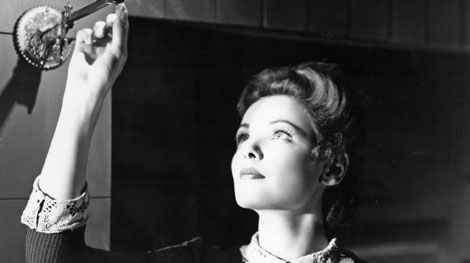
 

Capt. Gregg is unlike the ethereal, other-worldly ghosts we’re used to in modern/special-effects laden movies.  He seems “real” to the audience, because Rex Harrison creates a very masculine, humorous, and witty character.  Harrison uses his strong physical presence (a must for any leading man), commanding voice (after all, he was chosen for My Fair Lady even though he couldn’t sing), and (especially) his eyes to “bring life” to the ghost.  But we also wonder if he is a figment of Mrs. Muir’s imagination?  Harrison is great at reacting to his fellow actors- a big part of acting.  In my honest opinion, the only way to get through the over-hyped Cleopatra is to focus on his portrayal of Julius Caesar.    
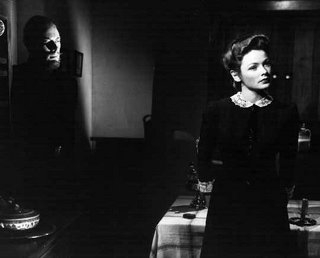


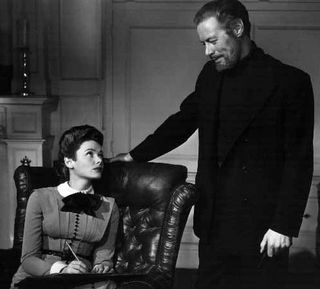
The ghost and the widow become friends; they “occupy the same domestic space like a married couple” (Jeanine Bassinger, chair of the Women’s Studies department at Wesleyan points out on one of the commentary tracks).  However, he has no body, so Mrs. Muir is safe; this satisfied the censors of the day.  When her investments fail, her in-laws come to visit; they urge her to go back with them to London.  But Capt. Gregg forms a plan- he “ghostwrites” a book to boost her finances.  Over some months, Daniel dictates to Lucy (or “Lucia” as he prefers to call her) the story of his lusty, adventurous life.  They work together and fall deeply in love.  It’s a sad fact that she is alive and he is dead! 


When Mrs. Muir goes up to London to see a publisher, she catches the eye of Miles Fairley, a well-dressed, smooth-talking, wealthy man in the office.  He’s not exactly her type of man, but he’s real.  Will Mrs. Muir let this (corporeal) man into her heart?    There is a similar choice to be made in Anthony Minghella’s first film, Truly Madly Deeply (if you want to know more). 
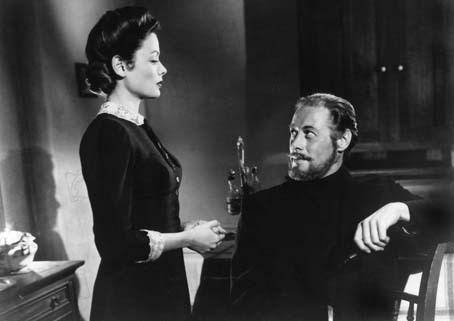
 

I highly recommend this film to everyone, not only fans of classic black and white films.  It seems modern to me, in many ways.  The music, lighting, costumes, etc. all work to create a memorable picture.  The exchanges (even the ones without words) that Harrison and Tierney have are terrific; you can see that their characters care about and respect each other.   The film is also “very literate” (Bassinger comments).  This is an intelligent viewer’s movie, though it also evokes emotions.  It is about loss, yearning, and “the dream of love.”  In reality, men are not perfect.  And not everyone has love in their life.  But we all dream!   


Movie Review: “Appaloosa”

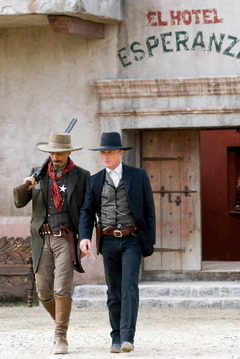
Ed Harris and Viggo Mortensen in France: WOW- talk about aging gracefully!!!

Last Sunday afternoon, I was feeling a little down, so I went to check out a new movie I was curious about.  (I wrote a previous post about Appaloosa.)  I would catagorize it as a subtle, low-key Western drama.  The small audience (mostly folks 50 and up) seemed to like the sly humor, in-depth characterization, and development of the female character (she’s not a one-dimensional woman like in traditonal Westerns).


The stars are: Ed Harris (lawman for hire Virgil Cole; he also co-wrote the screeplay and directed), Viggo Mortensen (Cole’s quiet, observant, long-time partner in “gun work” Everett Hitch), Renee Zellweger (young widow Allie French), and Jeremy Irons (rich bad guy/rancher Randall Bragg).

Cole and Hitch have been partners for many years.  They have traveled through little Southwestern towns enforcing the law whenever called upon.  Appaloosa is under siege by Bragg and his men; they drink too much, fight, don’t pay bills, and aren’t hesitant to use their guns.  The town leaders (scared stiff by the mention of Bragg) think he may have killed the former lawman of the town.  They quickly agree to the terms set by Cole (he carries his own list of laws), and he becomes marshall.  Hitch, who always carries a 12-gauge (a big gun), is his deputy.

Into the town comes Mrs. Allison French, a pretty, young, well-mannered widow.  She is cheerful and plays the piano, but hasn’t much money.  Cole takes an instant interest in her; he says she can stay in the town’s hotel as long as she likes.  Before you can say “Gunsmoke,” Allie is overseeing building a house and Virgil is helping choose curtains!  Everett is a bit surprised by his friend’s behavior.

Feelings get you killed.  (One of the taglines for the film)

Bragg, his men, and two newcomers to the town eventually use the budding romantic relationship to their advantage.


I liked the way that the film built things up, often in unexpected ways.  Issues that come across as simple in old Westerns are not so here.  (Remember that old Hollywood had to deal with stricter censorship codes.)  In those films, you had the bargirls/whores, married woman, and little girls- that’s all.  There weren’t many respectable single women hanging about.

Allie, who has an air of mystery, changes the dynamics (a little) between the two old friends.  She’s trying to survive in a man’s world, so she must rely on men (and all that comes with it).  Another woman in the town, a prostitute that Hitch sees, wonders if Allie “even knows how she feels.”  She can be sweet, bubbly, but is tough on the inside.  You’ll wonder about her past…

Viggo’s character, we learn in the opening narration, is a West Point graduate who served in the Civil War.  But his heart was not in “soldiering,” so he traveled West.  He helped Virgil out of a tough situation, and the men became partners.  Their friendship is very strong- almost like that of brothers.  In one great scene, Everett has to (physically) stop the older man from doing something rash.

There are humorous little moments, too.  Virgil has trouble with long, complicated words- Everett fills them in for him.  Jeremy Irons is pretty good as a evil guy, though I kept expecting him to revert back to his English accent!  (I guess we’re not used to seeing him as an American much.)  The scenery, music, and small characters all work well together, too.  Appaloosa is a very well-made, intelligent film with different layers.  It makes you think!

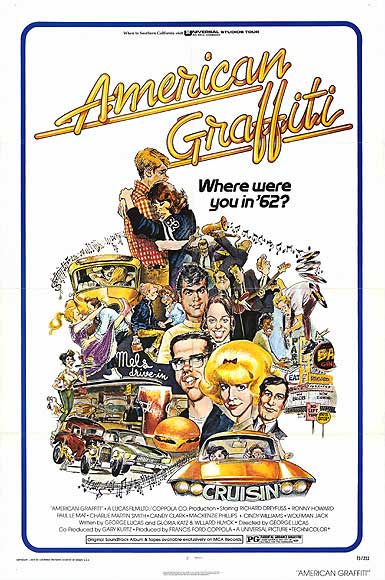
Movie Review: “American Graffiti”

Are you feeling nostalgic about your high school days, glorious or not?  Do you think fondly back on your first car, bf/gf, or your old hometown?  Do you like classic rock ‘n roll music?  Then you’re in the right mood to check out American Graffiti, director George Lucas’ first “big” picture from 1973.  I can’t believe that such a fun, sweet, good quality film had a budget around $750,000!


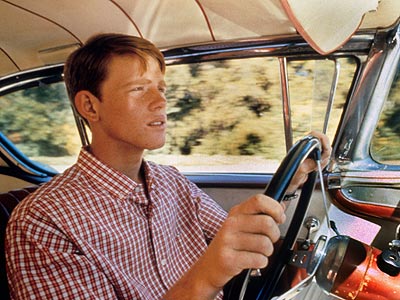
The actors including Ron Howard (just 18), Richard Dreyfuss, Charles Martin Smith, Cindy Williams, Paul Le Mat, Mackenzie Phillips (wow- only 12!)  and Harrison Ford, were all young/relatively little-known actors.  George Lucas filmed in a small California town not unlike the one he grew up in.  The characters are based on Lucas and kids/teens he grew up with.  He explains in the Bonus Features that 1962 (when the film is set) was an “age of innocence”- before Vietnam, before the death of JFK, etc.  The 4 main boys in the film are concerned about ordinary things: cars, girls, college/work, and (of course) beer.


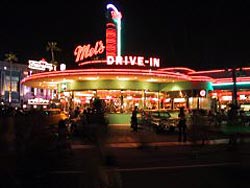
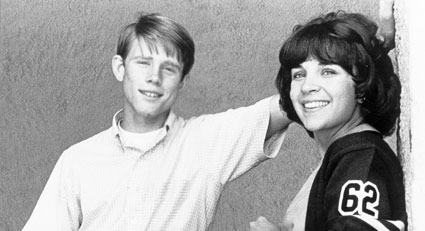
Steve (Howard) is your typical boy-next-door; he’s a HS senior who loves hanging at the drive-in (with gf/first love Laurie, played by Williams), is very careful re: his car, and looks forward to (maybe) going East to college.  


Laurie, a popular cheerleader, is worried about what may happen to their relationship if Steve goes away.  There is a great scene, with little dialogue, where the couple slow-dance.  You can see the characters’ emotions come through.  The actors relate very well to each other!


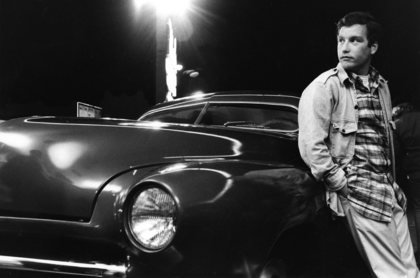
Laurie’s big bro Curt (Dreyfuss) has received a scholarship to college, but he’s not sure if he’ll go.  Steve tells him that this is what they’ve both been waiting for, so why is he suddenly scared?  Curt (who Lucas based on himself) is smart, funny, but a little anxious- he’s seeking something from life.  It’s really cool to see Dreyfuss as an young actor; even then, he was a little chubby.  I always enjoy his acting!     


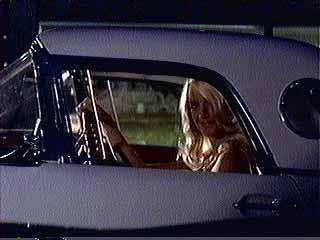
 Curt sees his “dream girl” (Suzanne Somers) cruising along the strip, but she eludes him.   


John (Le Mat), a tall, blonde mechanic who goes to JC (junior college), also cruises about looking for girls.  Suddenly, he gets stuck with the little sis of a friend (played by Phillips) who wants to see some “action.”    They have good screen chemistry.  She’s a cute, eccentric character. 

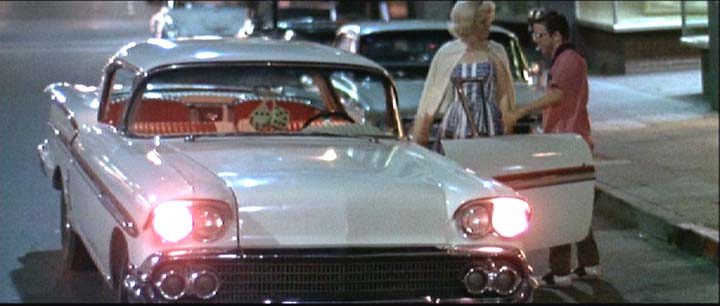
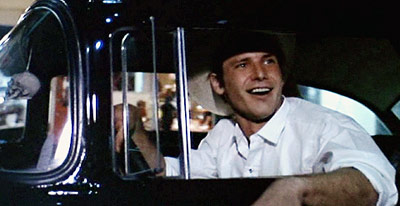
Later, John is challenged to a race by a newbie in town with a fancy car, Harrison Ford (then in his late 20s).  Before this film, Ford had been working (for several years) as a carpenter to support his 2 kids.  He wasn’t a carpenter before going to Hollywood, he taught himself after facing hard times getting roles.  Ford had many small roles, but American Graffiti got him more notice.  He wore a cowboy hat (see above pic) b/c he didn’t want to cut his hair too short (in case another acting job came up).  

Another kid, Terry the Toad (Martin Smith), borrows Steve’s car and meets a beautiful, ditzy girl.  He’s a nerdy, short, but sweet guy.  Terry is also very nervous around girls; that creates funny moments.  I related with him and Curt the most while watching the film!

This film has a lot good acting- the actors did a lot of improv b/c Lucas encouraged it.  They all lived, dressed (no separate trailers!), and partied together during the 5 week filming.  Lucas is known to be a laid-back director on-set; he did most of the work in the editing room.  The movie has wall-to-wall great music reflecting the times; that was rare for Hollywood at the time.