“Body of Lies” (2008)

poster_bol

I saw this film last week and REALLY enjoyed it!  It’s a fun, fast-paced, and smart spy thriller.  I’m not going to reveal TOO much about it, b/c you should see for yourself.

leo_bol

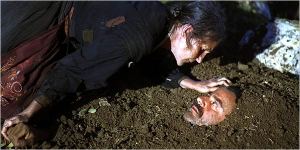
Leonardo DiCaprio stars as Roger Ferris- a young CIA operative based in the Middle East.  (Leo’s hair is dyed dark brown, he sports fluffy facial hair, and speaks w/ a North Carolina accent.)  Not only is Ferris fluent in Arabic, he’s knowledgeable about AND respectful of the ways of the Arab world.  In the opening of the film, Ferris is being assisted by a local (a young family man) in getting intel about terrorist activity in Iraq.

rus_bol

His DC-based boss is Ed Hoffman; Russell Crowe gained about 30 lbs for the role.  Unlike Ferris, Hoffman plays politics, enjoys manipulating others, and is highly prejudiced against the Middle East.  Hoffman constantly talks about ending the war on terror by any means necessary, but Ferris isn’t always comfortable with all his tactics.  Sometimes Hoffman ignores Ferris’ info and shoots off w/ his own plan!  You’ll get a kick out of how Hoffman goes about his daily life in suburbia (family dinner, car pool, soccer games, etc.) while making life/death decisions on the phone w/ Ferris.

GolshiftehFarahani_bol

While in Amman, Jordan, Ferris develops a keen interest in an (unconventionally) pretty nurse, Aisha (Golshifteh Farahani, a big star in her native Iran).  Though this part of the movie seemed contrived to many reviewers, the two actors have good chemistry.   Also, we get to see a sweet, respectful, budding romance between a Christian and a Muslim (very rare in Hollywood)!

ms_bol1

In my opinion, the main reason to see Body of Lies is Brit actor Mark Strong (who played Mr. Knightley in the A&E version of Emma).  Strong (who is actually of Italian and Austrian heritage) plays Hani Salaam, the sharply-dressed, well-spoken, and enigmatic head of Jordanian intelligence.  Hani prefers to use “punishment” instead of “torture” to get info from suspected baddies; Ferris feels bad about this.  Strong has a terrific accent suiting his character; Hani is portrayed as intelligent, arrogant (he’s of high status), and funny in a  sly way.  He’s far removed from the Arab Muslim Holywood stereotype, thank goodness!

Related Links:

A video interview w/ Mark Strong:

http://www.youtube.com/watch?v=91MtjruZrdU

A newspaper interview w/ Mark:
http://www.independent.co.uk/news/people/profiles/my-secret-life-mark-strong-actor-age-45-926736.html

“The Claim” (2000)

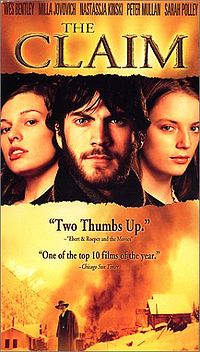
claim_poster

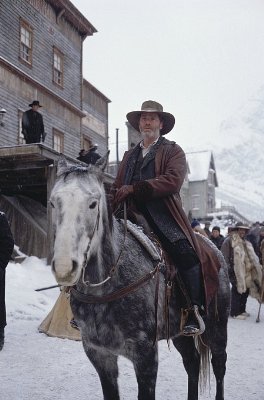
They were like kings.  The pioneers- they came out here when there was nothing, built these towns, and ruled them like kings.

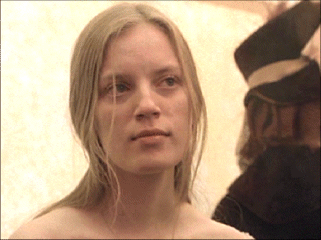
This 2000 film is inspired by Thomas Hardy’s The Mayor of Casterbridge; it stars Irish actor Peter Mullan, a young Wes Bentley, Nastassja Kinski (who was the title character in Roman Polanski’s Tess, another Hardy story), a very young Sarah Polley (now 30, and an award-winning director), and Russian-American model/actress Milla Jovovich.  The setting is the fictional town of Kingdom Come in the Sierra Nevadas (a mountain range) of Northern California, though the film was shot in Colorado and Alberta, Canada.  It is 1869, and Mr. Dillon (Mullan) serves as mayor, peacekeeper, and is the wealthiest man in town. 

Daniel Dillon (Peter Mullan)

The story opens with a group of newcomers arriving in small town of Kingdom Come, including several prostitutes, a crew of men from the Central Pacific Railroad led by engineer Mr. Daglish (Bentley), and two respectable and pretty ladies from back East- ailing widow Mrs. Burn (Kinski) and her daughter Hope (Polley). When a man insults Hope, Daglish defends her honor.  Hope is affected by his kindness.  The railroad men are given a warm welcome at the town’s main attraction- The Paradise Saloon, where Daglish is intrigued by Lucia (Jovovich), a tall, Portuguese beauty who sings and manages the place.  But Lucia is also involved in a long-term relationship with Dillon based on mutual needs.   

Hope Burn (Sarah Polley)

Mrs. Burn simply refers to Dillon as “a rich relative.”  But in a flashback, we learn that many years ago, Dillon (a young, drunken, and disenchanted ‘49er) sold his young wife Elena and infant daughter to another prospector.  That man gave Dillon his claim to a gold mine in return.  Now Dillon wants to “make things right” by reunting the family.  In one memorable scene, he has a team of men pull his new house closer to town (to be near his love). 

 dillon_house1

While Dillon is absorbed with his personal life, Daglish and his men survey the valleys nearby to determine where to lay track for the railroad.  Their work is important, but also very dangerous, as we discover in another memorable scene. Hope’s feelings for the engineer become stronger as they spend more time together.  However, Daglish also feels a strong attraction to Lucia.

Daglish and Lucia dance at Dillon's wedding

Mrs Burn/Mrs Dillon (Nastassja Kinski)

Though he is a man of few words, Dillon loves Elena; he tries to improve her health by using the latest technology.  Dillon is deeply affected by things going on around him, but he hides behind his gruffness.  Hope and Lucia are portrayed well; they not stereotypical ladies we usually see in Westerns.  The cautious romance between Hope and Daglish is nice as well.  Wes Bentley’s large, cat-like, blue-gray eyes stand out against the snowy landscape.

Donald Daglish (Wes Bentley)

Unlike Hardy’s original story, there is no concern for appearances or societal conventions.  Kingdom Come is populated with people of many backgrounds, races, and levels of respectability.  They all interact with each other as needed.  The town’s growth and survival depends on the railroad coming through.  But if this occurs, Dillon will no longer be able to rule the town as he pleases.

Movie Review: “Arranged”

arranged_dvd

This is a 2007 indie film I came across at Blockbuster 2 wks ago.   The movie was shot in NY and NJ with unknown/little known actors.  This film is based partly on the experiences of one of its producers- an Orthodox Jewish woman.  It’s a refreshing picture about how modernity AND tradtion can coexist in America. 


arranged_nasira

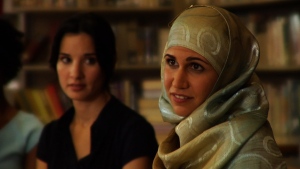
The film follows  two smart/articulate/pretty young women recently out of college, Rochel (an Orthodox American Jew) and Nasira (a Syrian American Muslim).  Both ladies come from caring traditional families, work at a public school in Brooklyn, and are in the process of getting arranged marriages.


arranged_2gals

Rochel (Zoe Lister Jones) and Nasira (Francis Benhamou) have more in common than meets the eye, and they eventually become good friends.  Their friendship causes many raised eyebrows, but the girls grow to rely on each other.  The dialogue is very realistic and the main characters are enjoyable to watch.  I learned a few things while watching this movie, too. You should check it out, if it’s available in your area!


Arranged at Internet Movie Database: 

http://www.imdb.com/title/tt0848542/


The Making of Arranged:

http://www.youtube.com/watch?v=ioQkzYk3No8

Movie Review: “Golden Door”

golden_door

Golden Door, or Nuovomondo (which means “New World” in Italian), is an Italian film written and directed by Emanuel Crialese.  The film is introduced by famed American director Martin Scorcese, the child of immigrants from Sicily.  Many of the characters in this picture speak in the Sicilian dialect; it reminded Scorsese of his childhood.  Though this film didn’t get wide release in the US, it’s a must-see!

golden_door_rocks

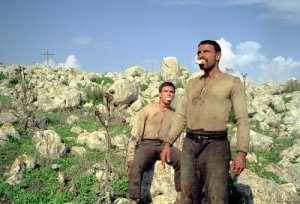
Salvatore Mancuso (Vincenzo Amato) is an early 20th century Sicilian peasant who dreams of a better life in America.  (His twin brother left many years ago for the new world.)  Salvatore hopes to take his two teen sons (Angelo and Pietro) and his elderly mother (Fortunata) w/ him on the journey.

In the above pic, Salvatore and Angelo take rocks from below up to a high mountain to consult with God (note the simple twig cross in the background).

golden_door_dream

There are magical elements in this film, as it is told through the eyes of the hopeful immigrants.

golden_door_bury

Salvatore must convince his mother (a strong-willed, outspoken woman) to go along.

golden_door_men

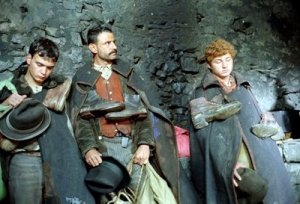
The Mancuso family set off with two young women from their village (promised to “rich Americans” as brides).

golden_door_photo

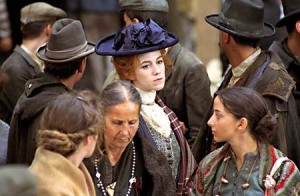
Upon arrival at the port city, local priests and doctors look them over.  Then they get their pictures taken.  A red-headed stranger puts herself in the picture.  Later, she tells an official that she’s travelling with their group!  The lady is Lucy (Charlotte Gainsbourg; she was the title character in Jane Eyre); she speaks some Italian and looks rather melancholy.

golden_door_crowd

Salvatore and his boys keep a watchful eye on the stranger though Fortunata says it’s none of their business.  Lucy (or Luce, meaning light, as the Italians call her) raises many eyebrows and questions.

goldendoor

It was unusual for women to travel alone.  And why is an Englishwoman going along with Italians?  What was her past life like?  Salvatore is protective of Lucy when anyone says an unkind word about her below deck.  Outside on deck, he follows her movements closely, admiring her from afar but saying little.

golden_door_lucy

The voyage to America is arduous!  We follow the “Third Class” passengers who have to lie in cramped bunks nearly end-to-end.  When seas are rough, they are tossed about like rag dolls.  But somehow they’re able to keep their spirits up through songs and rituals from the “old world.”

A well-dressed businessman (Vincent Schiavelli) introduces Lucy to several older, wealthy, single men on the ship.  He also gives her photos of American men who are “willing to help you out of this situation.”

golden_door_exam

Just before dropping anchor at Ellis Island, Lucy proposes marriage to Salvatore.  (She had been observing him and his family very closely, and saw something she liked!)  He is surprised, but quickly agrees.

There is much more to come-  the new arrivals must go through many trials and tribulations before entering the “golden door” of America!

amato_crialese

Crialese (above w/ Amato) creates a simple, yet moving, story about immigration.  The images he creates will stay with you long after the film has ended.  The music flows very well with the images.  The scenery and costumes look very authentic.  Golden Door was filmed in Argentina with extras who are descended from Italian immigrants (Crialese explains in the making of).

The main protagonist (Salvatore) is a “paisan” (peasant).  How unusual is that for today’s cinema!?  He is a simple, straight-forward, illiterate man.  He represents the old world- the one left behind.  Salvatore has a kind of quiet dignity that sets him apart from the crowd, though.

golden_door_wash

Salvatore’s unlikely love interest (Lucy/Luce) represents the new world/light/the future.  She is well-spoken, independent, and determined.  (Crialese said he made her hair red to set Lucy apart from the other women.)

Though Lucy is not Italian, she is treated just as they are at Ellis Island.  The inspectors don’t make it easy for the immigrants.  There are various tests to see who is “fit” to enter the new world.  You’ll learn something new from this film, I’m sure!

http://www.imdb.com/title/tt0465188/

Movie Review: “AmericanEast”

ae_poster

Hi all,

You may not have heard about this film; it premiered last year at the Arab American Film Festival in NYC.  Tony Shalhoub (Wings, Big Night, Monk, etc.) spoke about  AmericanEast on opening night.  I wanted to go to see him, but didn’t reserve a ticket early enough.  Tony acted and executive produced this movie.

The main character is an Egyptian immigrant/father of 2/small businessman named Mustafa (Sayeed Badreya: both a director and actor; recently seen in Iron Man).  He owns and runs Habibi’s Cafe in the Little Arabia neighborhood in West Los Angeles.  Mustafa prays on Fridays at the mosque and tries to keep the old cuture alive; he ALSO believes strongly in “The American Dream” and in cooperation between religions/races/etc.  His future dream is to make “real Egyptian food” in a big upscale restaurant with his close friend Sam (Tony Shalhoub), a successful Jewish-American businessman.

Mustafa is honest, hard-working, and protective of his friends and family.  He approaches life with a big smile.  He isn’t comfortable with religious/political discussions at his little cafe.  But since 9/11, life has become very difficult for his community…

Mustafa’s  young friend Omar (Kais Nashif: a handsome Paul Rudd-type), a cabdriver/actor, keeps getting cast in terrorist roles.    The degrading, stereotypical roles are “killing my soul,” Omar admits to his agent.  Fikri- an Iraqi Christian (Erick Avari- a veteran of many films) and Murad (Anthony Azizi)- who favors hip-hop styles discuss Middle East conflicts at the cafe, somtimes too loudly.  Sam, who is often harrassed by the angry Murad, tells Mustafa that “certain elements” will not be welcome at the new restaurant.  “It’s not a social club,” Sam says, but this group of people care for and support each other.

Son (after stepping away from prayer): Who’s a good Muslim?

Mustafa: Muhammad Ali is a good Muslim!

Son (exasperated): He’s a black guy!  Who’s like me?

Mustafa (slowly and softly): “I’m Egyptian… and… I’m a Muslim.  Doesn’t your father count?”

On the family front, Mustafa’s pre-teen son feels conflicted about being Muslim.  His younger sister Salwah- a nurse and beautician (Sarah Shahi) is not quite ready for arranged marriage to an older first cousin (fresh from Egypt).  Tensions at home and in the wider world (w/ police, customers, etc.) slowly wear away at Mustafa.

If this sounds interesting to you, then check out AmericanEast.  (There is even a cool animated sequence explaining the birth of Islam and the roots of the Middle East crisis.)

http://www.imdb.com/title/tt0808148/