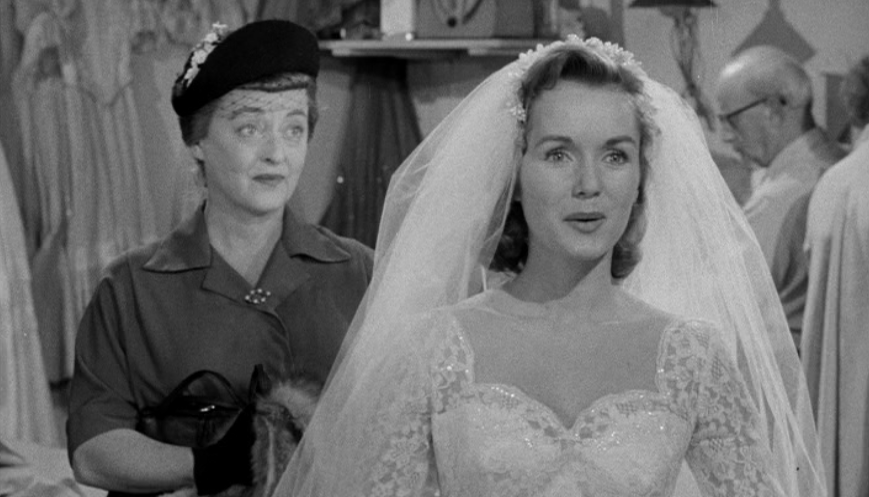
This is a great little movie filled with real life heartache and genuine emotion. Bette Davis gives a strong performance as the matriarch of the family determined to give her only daughter a proper wedding even though the family can’t afford to do so. Ernest Borgnine is perfectly cast as the slovenly, hard working taxi cab driver. In fact, everyone is up to par in this film, but it’s the real life situations that tug at your heart strings. –IMDB review
The trick is not to become somebody else. You become somebody else when you’re in front of a camera or when you’re on stage. There are some people who carry it all the time. That, to me, is not acting. What you’ve gotta do is find out what the writer wrote about and put it into your mind.-Ernest Borgnine on his method of acting
I watched this film, written by Paddy Chayefsky (Marty), last weekend w/ my parents; they had seen it before and really liked it. It took me a FEW minutes to realize that the mother was Bette Davis- LOL! She is totally transformed; they gave her a “make-under,” as we’d say today. Tom (Borgnine) and Agnes Hurley (Davis) are working-class/devout Irish-Catholics living in a small apartment in the Bronx with a daughter, son, and Agnes’ older brother. Tom, a taxi driver, has been saving money for many years to buy a cab and license (medallions don’t come cheap nowadays either). They both become concerned when their eldest child, daughter Jane (Debbie Reynolds in an early role), announces that she’s getting married to her long-time beau, a teacher- Ralph (Rod Taylor).
Jane, who has an office job, insists that she wants a very small wedding and no reception. Agnes thinks that’s not good enough, lamenting to Tom: “We never did anything for that girl!” Agnes knows what she missed out on, and now wants those experiences for her daughter. In no time, Jane’s wedding planning gets out of hand, thanks to the wishes of Agnes and Ralph’s parents (who are more better off financially). Jane tells Ralph she doesn’t want to end up like her parents. We learn more about the Hurleys (strained/seemingly loveless) marriage. Agnes awkwardly tells Jane that marriage is not like dating; there will be sacrifices and compromises (mostly made by women).
Steve Thompson (Burt Lancaster) watches his ex-wife
Tagline: The savage drama of an amazing double double-cross!
This meaty film noir is a follow-up to The Killers (1946). It reteams German director Robert Siodmak with star Burt Lancaster (age 35 here), who once again finds himself in a deadly love triangle. Lancaster, cast against type as a loser, Steve Thompson, a man who returns to his native LA after a year of wandering about the country. He doesn’t call up his ex-wife, Anna (Yvonne De Carlo), but they bump into each other. Steve still “has her in his blood,” much to the dismay of his mother. Maybe it was bad luck? Or fate?
Anna (Yvonne de Carlo) & Slim (Dan Duryea) in the club
She’s all right, she’s just young. -Steve
Hah! Some ways, she knows more than Einstein. -Mrs. Thompson
Anna and Steve rekindle their relationship for a time, but then she sneaks off to marry gangster Slim Dundee (Dan Duryea), who operates out of a local bar/nightclub. Steve almost can’t believe his ears when the sympathetic bartender breaks the news. Does Anna only care about money?
Steve is warned to stay away from Anna by old pal/cop Pete (Stephen McNally)
I should have been a better friend. I shoulda stopped you. I shoulda grabbed you by the neck, I shoulda kicked your teeth in. I’m sorry Steve. -Pete
This film is unusual for the genre, because Steve is not a loner, with no one to look out for his well-being. He has a loving family- mother, jovial little brother, and future sister-in-law. He has a good friend in Lt. Pete Ramirez, a cop he’s known since childhood. The many minor characters lend flavor to this film.
Steve’s fellow armored car guards at work
In time, he draws himself into Slim’s sphere, proposing an armored car heist. This heist involves a elderly co-worker who’s seeing his widowed mother. The main action scene was very well-done, as it looked quite modern.
Love… love! You’ve got to watch out for yourself! -Anna
The last scene of the film
He [Siodmark] fragments the narrative through flashbacks, counterposing the hopes of Lancaster’s return home with the desperation into which he has fallen. He also slows down for virtuosic sequences that only a great director could bring off: a long scene when the heist is being plotted, with the bored DeCarlo smoking cigarettes (“It passes the time”) while the railway criss-crosses the window behind her; and an equally long one in the hospital, involving a cranked-up bed, a tilted mirror on the bureau, and a visitor in the corridor- a good Samaritan who turns out to be his worst nightmare. -IMDB review excerpt
Anna is not like a typical femme fatale, as she’s not the planner. Steve takes agency in the robbery, though he never wanted anyone to be killed, if possible. He thinks naively, as he “wasn’t born into this” (Pete comments). He cared about love, not the money. The last quarter of the film is atmospheric, intense, and very well done. Anyone can become a fool for love, even Lancaster. Look at how young/sad/lost Steve looks when he sees Anna in the club (dancing carelessly) after so long. This is a fine performance, layered yet accessible.
The Swede (Burt Lancaster) falls head over heels for Kitty (Ava Gardner)
This film noir is based on a short story by Ernest Hemingway. It was Burt Lancaster’s first film role (at age 32). I thought he looked/acted much younger. There is that openness and vulnerability in his eyes that fans will recognize. Even battered and bruised, he has potential. Lancaster plays Ole Andresen (known to most as “The Swede”), a quiet gas station attendant in Brentwood, New Jersey.
Jim Riordan (Edmond O’Brien) investigates the why of the murder
We learn that there’s much more to The Swede than meets the eye, thanks to an insurance investigator, Jim Riordan (played by noted character actor Edmond O’Brien). He later went on to play Big Daddy in The Long Hot Summer (starring Paul Newman and Joanne Woodward). The movie gains momentum after a murder by two strangers to the small town. Riordan comes to deal with the $2,500 insurance policy left behind by the deceased. He eventually teams up with one of Ole’s oldest friends from Philly, Lt. Sam Lubinsky, to get to the crux of the matter. The femme fatale of the story is Kitty Collins (Ava Gardner), the girlfriend of a well-known hood in Atlantic City.
Kitty (Gardner) is the catayst in this tale.
Most people seem to think I’m the kind of guy who shaves with a blowtorch. Actually I’m bookish and worrisome. –Burt Lancaster
If you liked this movie, you’ll love Out of the Past (1947), starring Robert Mitchum, Kirk Douglas, and Jane Greer. BOTH Mitchum and Lancaster were able to show the masculine man’s sensitive side. But maybe Mitchum had a BIT more danger and unpredictability? They’re both fabulous actors who used their presence and physicality to enhance their roles (think Denzel Washington). After all, it takes more than height and looks to make a leading man!
As my dad once said (in Bengali): “Ki ekta beta!” (This translates to “What a man!” This is an exclamation of admiration for a guy who other men want to emulate.) He “popped” (as the kids say) onscreen. Burt Lancaster was one of Hollywood’s (unusual) leading men- stunning on the outside and able to create compelling characters from the inside. Why unusual? He didn’t primarily rely on his looks or strong screen presence to get by; he took on challenging anti-hero and villainous roles, too. I believe today’s audiences will be able to connect with his work, as his method is quite modern. The born and bred New Yorker showed a vulnerability and passion in his acting (which more stoic leading men of his generation lacked).
Lancaster in Sweet Smell of Success (1957)
AFI Silver Theatre and Cultural Center (just a few blocks from me) will be showing some of Lancaster’s films from February 7-April 17. Below are the films that I’m most interested in.
I think Christmas is almost a “device” in this movie. It isn’t a “Christmas” movie, although Christmas certainly helps. Rethink it as MacMurry taking Stanwyck home for the Fourth of July parade and picnic. I think it almost works, although there is nothing like the atmosphere that Christmas conjures up.
-IMDB comment
Stanwyck and MacMurray in Double Indemnity
I saw this secular Christmas-themed film (at AFI Silver) with my parents, who are also fans of Double Indemnity, which also stars Barbara Stanwyck and Fred MacMurray. This film was made 4 years prior to that film noir. Once again, the theme is redemption- a thief who realizes what she’d been missing in her childhood, falls in love (with a man and his family), then faces the consequences of her crime. (Don’t you think Benedict Cumberbatch resembles a young MacMurray? )
Remember the Night (1940)
Lee Leander: Now there’s nothing as dangerous as a square shooter. If all men were like you, there wouldn’t be any nice girls left.
On the night before Christmas Eve, up-and-coming ADA John Sargeant (MacMurray), decides to bail out Lee Leander (Stanwyck), the thief (with tree strikes) whose case was postponed for the holidays. The bail bondsman takes her over to John’s apartment, much to his confusion/shock. John, being a decent guy (see above quote), decides to take Lee out for dinner. They run into the judge who presided over their trial- oops!
John wonders how a normal person like her can turn to crime, and she tells him her way of thinking. They get to know each other a bit- turns out their both from small towns in Indiana. Every Christmas, John drives home for the holidays, and he offers to take Lea along with him. Lee’s tough gal façade fades, and she becomes very emotional. She doesn’t even know if her mother is alive, since she’s “never” been back home after coming to NYC.
Lee and John in a cow field
There are some funny/wacky scenes in small-town Pennsylvania, after they (unknowingly) trespass on a very angry/gun-toting farmer’s land. They end up at the justice of the peace’s office, but John is not very adept at lying, but Lee is an old hand. Lee creates a little fire in a small wastebasket, enabling them to get away. John is shocked, yet also impressed, by her quick thinking.
When they reach Lee’s hometown, her mother (remarried) wants nothing to do with her. It’s a dark, well-done scene- not what you’d see in the cloying/unrealistic Hallmark holiday movies of recent times. While Lee tries to explain her side to her mother, John is quietly/calmly supportive.
The scene at Lee’s childhood home when John takes her back home to her mother’s house is such a chilling scene… Listening to her mother’s “good riddance” speech and Lee’s comments in the yard afterward… it’s just such a creepy, lonesome moment, filled with utter rejection…
But when he asks Lea’s mother her name and she responds “The name doesn’t concern you.” His delivery of “It certainly does not” gives me the chills. It just says so much of his character.
-IMDB comments
With John’s loving family
There’s a moment when John is playing the piano and his family is gathered around when Lee looks around her in wonder. Barbara Stanwyck did a brilliantly subtle job of expressing the thought “What would it have been like to have grown up in a home like this?” in that brief moment.
-IMDB comment
Jack’s family includes his level-headed mother Mrs. Sargeant (played by Beulah Bondi, Ma Bailey from It’s a Wonderful Life), doting Aunt Emma, and (comic relief) farm boy, Willy. They rush about getting everything perfect for John’s arrival. (John explained earlier that he grew up quite humble, but in the past few years, has been able to provide well for his family.) Lee is happily surprised by their lovely farmhouse and friendly demeanor. They gather about the piano (John plays some) and sing songs.
Being the honest man, John admits to his mother that Lee is a thief with no family to go to, not his “special lady.” His mother is still sympathetic toward Lee. The next morning, they even give Lee a few presents!
John and Lee embrace
Over the next few days, Aunt Emma sees that Lee and John are falling in love. At the barn dance, she beams with happiness as she watches the couple dance and kiss. Mrs. Sargeant is worried, so she has a serious (yet gently worded) talk with Lee the night before they leave for NYC. She explains exactly how hard John worked to get to where he is in his life. Lee says she’d never ruin his life, but admits that she’s in love with her son.
On the way back, they take a road through Canada, and end up in Niagara Falls. They admit their love for each other. John tells Lee that she can get away now, if she wants. She refuses, because she wants to face up to her sentence. John feels guilty, since the jury was about to acquit her (before the holiday recess).
Back in the courtroom, John begins to treat Lee in such a harsh manner, garnering her sympathy from the jury. After a few questions, Lee realizes what he’s doing, and begs the judge to allow her to plead guilty. In the final scene, before Lee is taken away by the prison matron, John explains that her sentence probably won’t be too long. Lee’s ready to face anything (now that she’s loved).







 Knightleyemma