Movie Review: “The Ghost and Mrs. Muir”

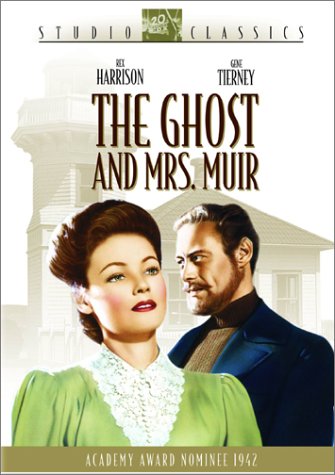
I couldn’t believe my luck in finding this film on sale at F.Y.E. in Astoria recently!  I had wanted to see The Ghost and Mrs. Muir for a long time.  This is an exceptionally well-made Hollywood classic (out in 1947) film starring theatrically-trained/powerhouse actor Rex Harrison (the ghost, Captain Daniel Gregg), one of Hollywood’s most beautiful movie stars Gene Tierney (Mrs. Lucy Muir), charming/rakish comedian George Sanders (Miles Fairley), respected character actor Edna Best (Martha), and a very adorable 8 year old Natalie Wood (Anna Muir).  The unusually beautiful music will stay with you long after the film; the composer also worked on Citizen Kane and collaborated many times with Hitchcock.  It was a big success when it first came out, and also received great reviews from critics- you’ll see why!  It combines the genres of thriller, romance, and comedy.  But romance is key!


The story opens at the start of the century (1900 that is) in London.  Young widow Mrs. Lucy Muir, whose husband passed away a year ago, is living with her mother-in-law, sister-in-law, daughter, and housekeeper.  The ladies are all dressed in mourning clothes.  She expresses a strong desire to live on her own (with the income from her husband’s gold shares), much to the shock and disapproval of the in-laws (two hysterical, overbearing ladies).  Mrs. Muir has decided that the seaside will suit her well; she sets off with the eager Anna and loyal Martha. 


Upon arrival at Whitecliff-by-the-Sea, Mrs. Muir seeks out a “house agent” to find a suitable place.  Mr. Coombe, the agent, thinks he knows better than the young lady, but Mrs. Muir decides to rent Gull Cottage, a house said to be haunted by the ghost of Capt. Gregg (a seaman who died mysteriously 4 years ago).  She is not frightened away by disembodied laughter like previous tenants.  She says the house is “perfectly fascinating.”  So begins the adventure…


The cranky ghost of Capt. Gregg, dressed all in black except his silver buckled belt, reveals himself to Mrs. Muir soon after the family moves in; he’s not happy to have people in his house.  But she stands up to him; she’s not scared by his actions (noises, swearing, extinguishing candles).  She earns respect for that.  In that (first meeting) scene, their faces are only lit.   Light and shadow are used very cleverly and purposefully in this film.


Capt. Gregg is unlike the ethereal, other-worldly ghosts we’re used to in modern/special-effects laden movies.  He seems “real” to the audience, because Rex Harrison creates a very masculine, humorous, and witty character.  Harrison uses his strong physical presence (a must for any leading man), commanding voice (after all, he was chosen for My Fair Lady even though he couldn’t sing), and (especially) his eyes to “bring life” to the ghost.  But we also wonder if he is a figment of Mrs. Muir’s imagination?  Harrison is great at reacting to his fellow actors- a big part of acting.  In my honest opinion, the only way to get through the over-hyped Cleopatra is to focus on his portrayal of Julius Caesar.    


The ghost and the widow become friends; they “occupy the same domestic space like a married couple” (Jeanine Bassinger, chair of the Women’s Studies department at Wesleyan points out on one of the commentary tracks).  However, he has no body, so Mrs. Muir is safe; this satisfied the censors of the day.  When her investments fail, her in-laws come to visit; they urge her to go back with them to London.  But Capt. Gregg forms a plan- he “ghostwrites” a book to boost her finances.  Over some months, Daniel dictates to Lucy (or “Lucia” as he prefers to call her) the story of his lusty, adventurous life.  They work together and fall deeply in love.  It’s a sad fact that she is alive and he is dead! 


When Mrs. Muir goes up to London to see a publisher, she catches the eye of Miles Fairley, a well-dressed, smooth-talking, wealthy man in the office.  He’s not exactly her type of man, but he’s real.  Will Mrs. Muir let this (corporeal) man into her heart?    There is a similar choice to be made in Anthony Minghella’s first film, Truly Madly Deeply (if you want to know more). 
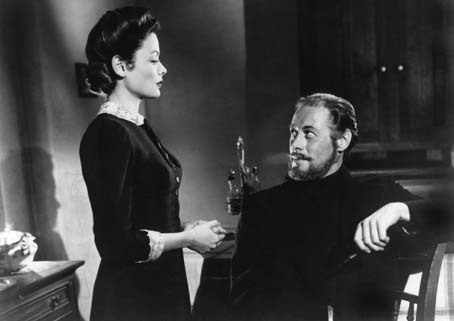
 

I highly recommend this film to everyone, not only fans of classic black and white films.  It seems modern to me, in many ways.  The music, lighting, costumes, etc. all work to create a memorable picture.  The exchanges (even the ones without words) that Harrison and Tierney have are terrific; you can see that their characters care about and respect each other.   The film is also “very literate” (Bassinger comments).  This is an intelligent viewer’s movie, though it also evokes emotions.  It is about loss, yearning, and “the dream of love.”  In reality, men are not perfect.  And not everyone has love in their life.  But we all dream!   


A Tribute to Paul Newman (1925-2008)


“There is a point where feelings go beyond words… I have lost a real friend. My life – and this country – is better for his being in it.”

-Robert Redford


 (You can purchase an art print of the above picture at Allposters.com.)

“He was my hero.”

-Julia Roberts, who served on the board of Newman’s Hole in the Wall Gang


“I was blessed to have known him. The world is better because of him. Sometimes God makes perfect people and Paul Newman was one of them.”

-Sally Field (starred with Newman in the legal thriller Absence of Malice.)

 “Paul was an American icon, philanthropist and champion for children. We will miss our dear friend, whose continued support always meant the world to us. Our prayers and thoughts are with Joanne and the Newman family and the many people who Paul impacted through his endless kindness and generosity.”

-A statement by Senator Hillary Clinton and former President Bill Clinton

 “If my eyes should ever turn brown, my career is shot to hell,” Paul Newman once joked.


“Why fool around with hamburger when you have steak at home?”

-Newman regarding his lasting marriage to Joanne Woodward


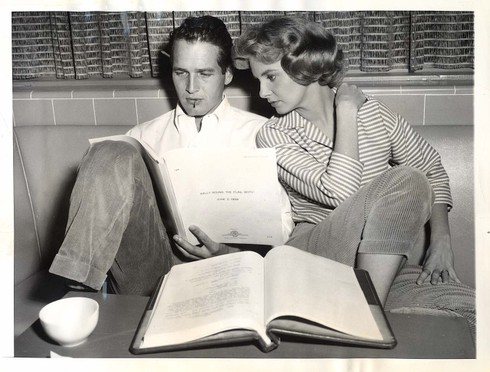
Yowza- domestic life looks smokin’ hot here!

“Sexiness wears thin after awhile and beauty fades, but to be married to a man who makes you laugh every day, ah, now that’s a real treat!”

-Joanne Woodward

“He learned to use that flawless face, so we could see the complexities underneath.”

-Manohla Dargis, New York Times web site 

Classic, elegant, engaging- words like these fit Paul Newman to a tee.  Not only remarkably handsome- striking blue eyes, chiseled face, athletic physique- he used the power of celebrtity to do many good works.  Like many great actors (that I admire), Newman started out in theater in his early 20s.  Quickly, Holywood noticed his gorgeous looks; he tried to go against the “sex symbol” image (not unlike protege and friend, Robert Redford). 

Brando and Newman at a civil rights rally (sometime in the early 1960s).

He was called “the next Marlon Brando”; both men studied at The Actor’s Studio.  Brando was known for his mercurial emotions (both on and off-stage); while Newman was subdued and cool.  But there was something under the surface, making him all the more interesting to watch! 

Newman realized that doing typical leading man parts (which hit big at the box office) would enable him to do projects (plays/small-budget films) which showcased his range of ability.

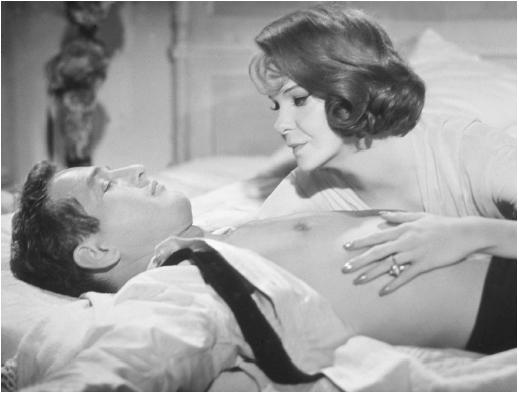
Above is a still from Cat on a Hot Tin Roof  with Elizabeth Taylor.  Wow, shouldn’t the set be on fire?  Seriously, Newman (who played depressed alcoholic Brick) is intriguing in this film, especially in scenes with Burl Ives (the overbearing Big Daddy).


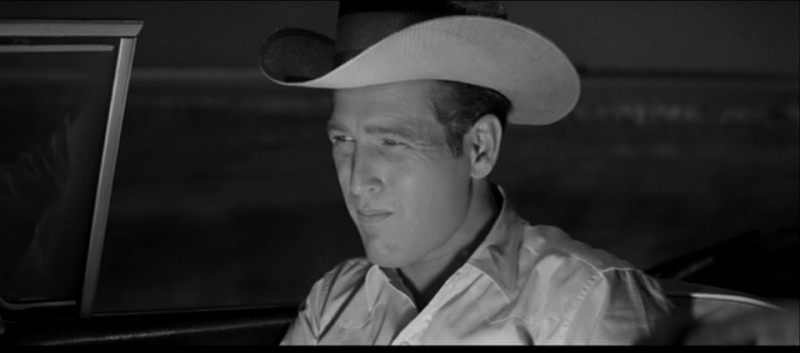
In the eyes of mainstream Hollywood, Paul Newman took a risk with Hud- a memorable film where he played the swaggering, lay-about son of a Texan landowner.  Newman showed that charm can be dangerous.  Perhaps Hud’s anger towards his father affects his (bad) decisions?  Though he is a shallow character (not a tortured soul), Newman makes Hud very engaging.  Co-star Patricia Neal, the housekeeper that Hud hits on, does a great job also.  Noted film critic Pauline Kael wrote: there are some men who “project such a traditional heroic frankness and sweetness that the audience dotes on them, seeks to protect them from harm or pain.”

The Long Hot Summer is one of my mom’s favorite Newman movies.  The dialogue is terrific: fast, snappy, intelligent; the story was adapted from a novel by William Faulkner.  Newman and Woodward fell in love during the filming of The Long Hot Summer.  It’s an (unusual) love story involving two people who seem like total opposites.  Newman plays Ben Quick (great name for the character, you’ll see), a mysterious, charming, nearly-penniless man who is kicked out of one Southern  town.  He happens upon another town, and quickly makes himself useful to the wealthy patriarch of the community- Will Varner (Orson Welles).   


Mr. Varner’s daughter Clara (Woodward), a single, sensitive schoolteacher, has a strong dislike for Ben from the moment she meets him.  She feels that he can’t be trusted- an obvious opportunist in her mind.  Though he knows very little about Ben, Varner puts him in charge of the town’s general store.  Varner has a son (Jody) and daughter-in-law Eula (a very young Lee Remick) who also live with him in his mansion; they are newlyweds.   


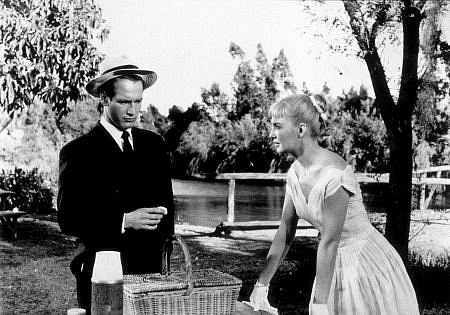
But, the old man doesn’t see much of himself in his son, and soon thinks of Ben as family.  Varner’s lady-friend Minnie Littlejohn (a very funny Angela Lansbury) also seeks to be part of the family.  When her father (not so subtlely) suggests that Clara and Ben would make a good pair, she is horrified.  He wants grandkids to carry on his name, power, land, etc. To Clara, Ben represents heat, uncertainty, and other things that “nice girls” keep repressed.  Her blatant hostility doesn’t turn him off; he looks at her with unguarded interest.  “Miss Clara, you slam the door in a man’s face before he even knocks on it,” he says with disappointment.  During the picnic scene (see above photo), Clara clearly states what she is looking for in a husband.  She has not been saving herself up for a man like Ben, she insists.  Hmm, you shall see…  Below are some great lines from the film:

Ben and Clara discuss their (potential) relationship:

Clara: You’re too much like my father to suit me, and I’m an authority on him.
Ben: He’s a wonderful old man.
Clara: One wolf recognizes another.
Ben: Tame us. Make pets out of us. You could.


Varner talks about his youth:

Will Varner: I was young myself once. I used to hide in the greenery and hoot and bellow.
Clara: I’ll bet you did. I’ll bet you stayed longest and yelled loudest.
Will Varner: Your mama listened.


Varner confronts Ben about his past:

Will Varner: I got influence. I’ll dog you, boy, wherever you go. I’ll break you.
Ben: No, you won’t. You’ll miss me.  [Ah yes, very true!]

Classic Movie Review: “A Streetcar Named Desire”

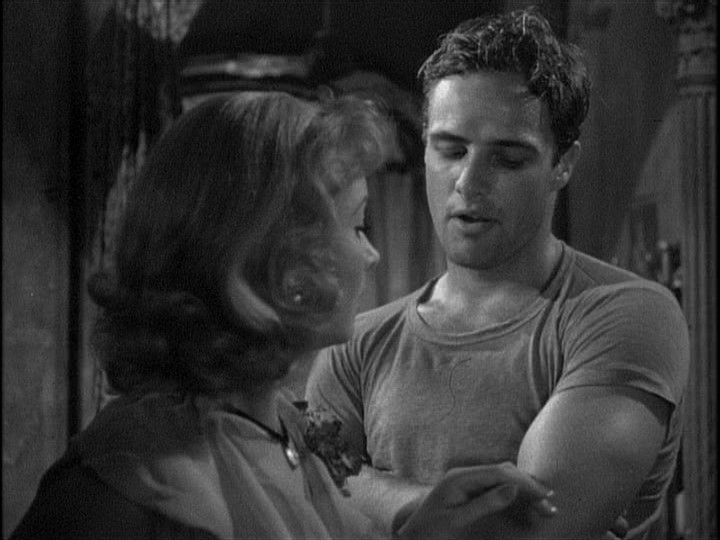
Captivating, troubled, unpredictable, vulnerable- these words could describe Vivien Leigh, Marlon Brando, and the characters they played in this multi-Oscar winning movie. A Streetcar Named Desire was re-mastered and re-released in 1993; I have that 2-disc director’s edition of the film containing 3 minutes of extra/extended scenes and loads of special features.  (I love special features!)  

Blanche: I don’t want realism.  I want magic!

One of Hollywood’s most successful and controversial directors, Elia Kazan, was hand-picked by playwright Tennessee Williams for this film.  Kazan had directed the Broadway play, too; his body of work includes: A Tree Grows in Brooklyn, Gentleman’s Agreement (starring Gregory Peck), East of Eden (starring James Dean; Marlon Brando tested for the part, too), and On the Waterfront (also with Brando).  All the major actors (Brando, Kim Hunter, and Karl Malden) had worked in theater.  Though Jessica Tandy was on Broadway, she wasn’t a big enough star, according to Warner Bros.  So, Vivien Leigh, who’d done the play in London, was brought on-board.


Stanley: Be comfortable. That’s my motto up where I come from. You gonna shack up here? Well, I guess I’m gonna strike you as being the unrefined type, huh?

Well-bred, well-educated Blanche DuBois (Leigh) travels (via train and streetcar, of course) from small-town Mississippi to visit her younger sister Stella (Hunter) in hot, crowded New Orleans.  Blanche, a sensitive woman, almost can’t believe to what depths her sister has sunk.  Stella and her husband make their home in a stuffy, run-down apartment in the French Quarter. Their rowdy neighbors/friends drink too much, gamble, and make noise around the clock.  But most shocking of all- Stella has married Stanley Kowalski (Brando in a star-making role).  Stanley is a crude, volatile, working-class man of Polish descent.  (There are derogatory remarks about his background, denoting the prejudice of that time.)  Blanche is definitely not shy speaking about Stanley’s faults!


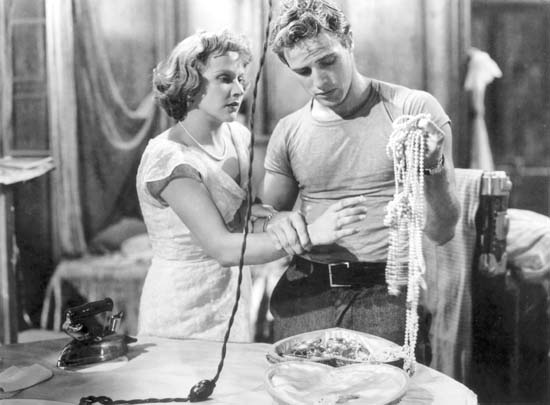
Stanley: That’s pearls, Stella, ropes of ’em. What is your sister – a deep sea diver?


We realize quickly that Stanley resents the presence of Blanche (with her fine clothes, jewels, perfume, and criticism).  Perhaps he sees her as a threat to his relationship with Stella?  Blanche is herself nervous and guarding secrets beneath her genteel Southern belle facade.  (I won’t give you too many details!)  Stella senses something is wrong.  Why has Blanche come to visit before the end of Spring term?  (She’s a high school English teacher.)  How did she lose their family estate?  But Stella mainly wants to keep the peace in her home, because who knows what will set off her husband?


Stella and Stanley’s relationship is based on lust; this repulses Blanche (she calls it brutal desire).  

Stella: I wish you’d stop taking it for granted that I’m in something I want to get out of. 


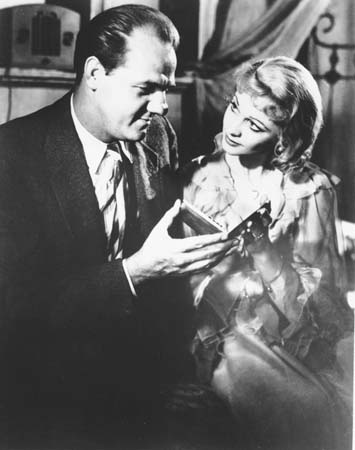
Stella seems happy about her life while Blanche is in a precarious situation: aging (over 30) and nearly penniless.  Then, tall and quiet Mitch (Malden) takes an interest in Blanche.  Could Blanche find some happiness with Mitch? 


Mitch and Blanche

Mitch: I have never known anyone like you.


Brando, though not yet 30, is simply amazing in this film; you won’t be able to take your eyes off him!  Brando was considered “naturalistic” and “realistic”- an actor who broke the mold of leading man in the 1950s.  And because of his penetrating eyes, brooding face, and muscular physique, Stanley is both attractive and repugnant to us.  Stanley is a drunken brawler one minute, then a contrite and confused little boy the next.  There is “ambivalence” in Stanley and in Brando, as Kazan said, that makes us wonder at his motivations.  “Brando was a genius,” says Malden in a behind-the-scenes interview on the DVD.  Check out this movie classic ASAP!


You showed me a snapshot of the place with them columns, and I pulled you down off them columns… 

Movie Review: “The Sting”


thesting13br81.pngI

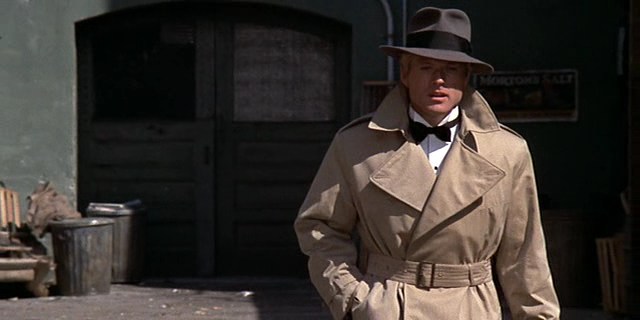
Redford in tux and trench- WOW!!!  Sigh…

I just saw this 1973 buddy/crime movie today for the 1st time.  This film has a lot of twists and turns, but it’s basically about con men (in Chicago) who are trying to get revenge for the (unnecessary) death of an old friend, and making a LOT of cash.  The ending is VERY unexpected!

The draw was (of course) Paul Newman and Robert Redford.   I would watch them read the dictionary.  Frankly, I don’t think it’s FAIR to have two amazing, super-hot actors (like these guys) in ONE film b/c the audience doesn’t know who to look at when they’re in a scene together!

thesetup13uy71.png

It’s a fun film w/ upbeat music (from 1930s period) and great costumes (esp. those worn by Redford).  He looks GORGEOUS (as usual) and has terrific chemistry w/ Newman (who acts as a mentor in the film).  Redford has a lot of running, jumping, and hiding to do in this film, which is fun.

Below is a shirtless pic of Redford.  (Who wouldn’t want to see him shirtless!?)

thesting03zc11.png