Tony Curtis (1925-2010)

The street kid who became an “American prince”

I could have been a politician or a brain surgeon.  But I didn’t have an education, so there wasn’t anything I could do but get into the movies. And, boy, did I ever.  To burst into the movies like I did…  Isn’t that neat?

Tony Curtis (born Bernard Schwartz) was one of Hollywood’s ultimate outsider-insiders.  His parents were immigrants from Hungary who settled in the Bronx.  (The actor never completely lost his Bronx accent.)  Tony didn’t speak English until he went to school at age six.  His father was a tailor; the family lived in the back of his shop.  Tony and his brothers suffered at the hands of their abusive and schizophrenic mother.  He even spent time in an orphanage when money got TOO tight for the family!  

As a kid, he was beaten up for being BOTH Jewish and good-looking.  During these fights, he took care to protect his face, feeling that ONE day it could be the making of him.  At 11, Tony joined the Boy Scouts and eventually began acting in school plays at 16 at Seward Park High School.  (To this day, this public school on the Lower East Side of Manhattan is attended by many young immigrants to the US.)  Reaching 18, he joined the Navy; this was right after Pearl Harbor. 

Because some like it VERY hot…

I was the best-looking kid in town.  It’s not what you have but what you do with it that counts.
At 23, Tony reached Hollywood and got roles in fluffly comedic films.  This was a period of learning for him.  However, he STILL faced anti-Semitism, as Jews weren’t yet fully accepted in the Hollywood studio system.  But Tony made his mark; later on, his duck-tail hairstyle would be copied by another ladies’ man- Elvis Presley.  Very cool!

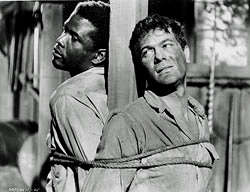
Roles in some GREAT films, including his Oscar-nominated performance in The Defiant Ones (w/ Sidney Poitier) came in the late ’50s.  Hollywood took a few years to realize that Tony was more than a pretty (err, insanely gorgeous) face.   He broke a Hollywood taboo by insisting that Poitier have co-starring billing next to him.

Jack Lemmon and I always had a great time together; even though we were from different backgrounds – he was Harvard-educated, very intelligent and urbane.  We balanced each other out.

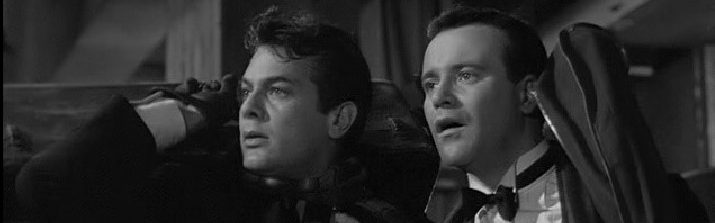
Tony acted w/ Marilyn Monroe and Jack Lemmon in the comic hit Some Like It Hot.  Tony’s lovestruck character copied Cary Grant’s posh accent to win over Marilyn’s character. 

Jerry: What are you trying to do to that poor girl, putting on a millionaire act?  And, where did you get that phony accent?  Nobody “talks loike thet!”

Aiming high… & scoring BIG

Another former NYC street kid, Burt Lancaster, recognized Tony’s talent, charisma, and ambition.  They were co-stars in two films- Trapeze and Sweet Smell of Success.  In Sweet Smell of Success, both actors transcended their looks to interpret amoral, ruthless strivers (a press agent and a popular newspaper columnist) in the Big Apple.          

J.J. to Sidney: I’d hate to take a bite outta you. You’re a cookie full of arsenic.

Swords, Sandals, & Shirtless Scenes
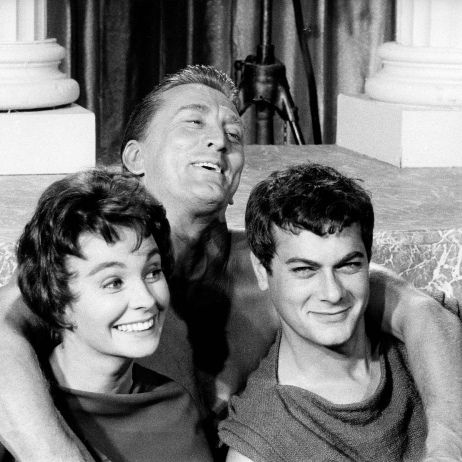
In the photo above, Tony jokes around w/ his Spartacus co-stars Kirk Douglas and Jean Simmons.  In the epic historical drama, Tony played Antoninus, innocent young slave of power-hungry ex-gladiator, Crassus (Laurence Olivier).  After Crassus  hits on Antoninus (during a bath in a NOT so subtle manner), he runs away to join Spartacus.

Idols United

In Operation Petticoat, Tony acted alongside Cary Grant, one of his long-time idols.   Tony played a tennis pro/playboy Navy officer who needs to be kept in line by Grant’s character- his captain.  It was a dream come true for Tony!    

Early on, I decided I didn’t want to be known as a mere actor.  I wanted to feel like a star.  I wanted to get my footprints in Hollywood on the sidewalk, which I got.  I wanted to be on the cover of all the magazines and go to parties in a limousine with a beautiful girl.  I did all of that – and more.  And I appreciate it.   

Three Reviews: “Paris Blues” (1961), “He Knew He Was Right” (2004), & “Two Lovers” (2008)

Paris Blues (1961)

This is a TERRIFIC, though lesser-known, Paul Newman-Joanne Woodward film.  (It was made after their marriage and birth of their first child.)  Trombone player Ram Bowen (Newman) and saxophonist Eddie Cook (Sidney Poitier) are expatriate American jazz musicians living in Paris.  They have a regular gig at a small/artsy/popular club, though Ram has a dream of being a serious composer.  Also, Ram is in a (friends w/ benefits) relationship w/ the singer/owner of the club, Marie.

The guys meet two beautiful American tourists- straight-talking jazz lover Lilian (Woodward) and socially-conscious teacher Connie (Diahann Carroll).  After Ram meets his old friend “Wild Man” Moore (Louis Armstrong) on a train, he confidantly approaches Connie.  This must’ve raised some eyebrows in ’61- a white man hitting on a black woman.  Of course, it was no big deal in France.  Ram invites her to hear him play at the club.  Connie brushes off his come-on and comments that she has a white friend with her.  Soon Lilian arrives to meet Connie; we see her keen interest in Ram.

Though Connie is suspicious of guys like Ram (“I know these jazz musicians…”), Lilian convinces her to go to the club that night.  When she hears Ram play, Lilian is visibly moved by the music.

Aside from romance, this film deals head-on with serious issues- ambition, racism, and drug abuse (one of the musicians at the club is addicted to cocaine).  The costumes, scenery, lighting, music, and dialogue are pitch perfect.  Newman and Poitier seem like two old friends; the chemistry between the two couples is almost palpable.  (As you may know, Poitier and Carroll were romantically involved at this time.)

Newman, who plays an anti-hero here, has some very good lines.  “Look, you don’t want me for what you want,” he tells Lilian directly when she shows interest in going out after a gig.  Lilian calmly comments that she’ll decide what she wants.  This is a grown-up look at love, not a fairy-tale story.  Check it out ASAP!


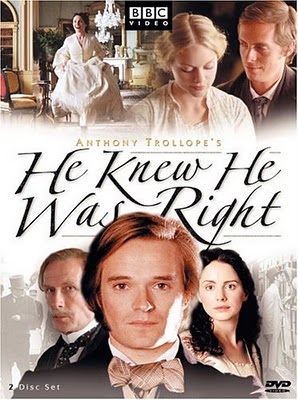
He Knew He Was Right (2004)


I watched this BBC miniseries for the second time recently.  Novelist Anthony Trollope was inspired to write the book by Shakespeare’s tragedy, Othello.  The main character, irrationally jealous husband Louis Trevelyan is also based on the author’s (often temperamental) father.

Louis (young Brit Oliver Dimsdale), a posh London gentleman, goes to the Canary Islands and falls quickly in love with Emily (Scotswoman Laura Fraser), the lovely daughter of the governor.  Though she is young and has never been in British society, he proposes marriage.  “He looks like a man who likes to have his way,” her father comments, though he feels it will be a very good match.  “Emily likes to have her way, too,” her concerned mother adds.

Emily and Louis settle in London and have a son.  Emily’s gorgeous young sis, Nora (Christina Cole) lives w/ them; she’s much admired by the bachelors in their circle.  But she falls for Louis’ best pal- young journalist Hugh Stanbury (Stephen Campbell Moore).  They can’t marry right away, as Hugh doesn’t come from money, is just getting started in his career, and has a mom and sisters to support out in the country.

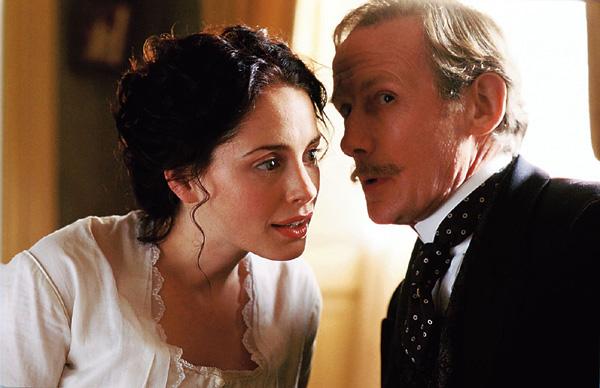
To their friends, the Trevelyans seem to be the perfect marrieds.  But things start to go sour when Emily’s father’s old friend, and reputed playa, Colonel Osborne (Bill Nighy) enters the picture.  At a party, an older lady comments on his bad boy ways, alerting Louis.  Osborne visits Emily at the house; Louis doesn’t like this, as it could expose his wife to rumor and innuendo.  Emily, who is innocent/unspoiled like Desdemona, wonders why she shouldn’t see an old family friend.  “But I won’t see him if you forbid me to,” she eventually promises.

Osborne is refused entry to the house, but he approaches the couple while they’re out on a stroll in the park.  When the older man calls Emily by her first name, Louis gets visibly angry.  (In Victorian society, if a man called a woman by her first name, it could be inferred that he had intimate knowledge of her.)  Emily pulls Louis away, rushing towards home.  Finally, Louis decides to send Emily, his boy, and Nora to live in the country w/ the Stanbury ladies.  He rationalizes this decision by saying they’ll be “safe” there from Osborne.  Emily is stunned, but goes along w/ the plan.  (What other choice does she have?)  Her friends and family believe that Louis will soon come to his senses.

Aside from the main (dark/serious) storyline, there are several lighter ones to keep you entertained.  Nora and Hugh share a very tender love.  The eligible, soon to be titled Mr. Glascock (Raymond Coulthard), is intrigued by a forthwright American woman he meets while traveling in Italy.  Hugh’s sister, plain/serious Priscilla Stanbury (Amy Marston) doesn’t expect any beaus to come her way, but wants her kindly younger sis Dorothy (Caroline Martin) to marry.  When their rich/elderly aunt (Anna Massey) asks Dottie to become her companion, the world opens up for the good-hearted girl.

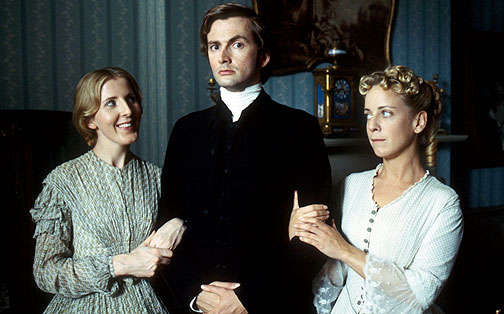
The flirtatious Reverend Gibson (Scotsman David Tennant) can’t seem to choose between three women in his town- Dottie and two vain, eager-to-marry sisters (character actresses Claudie Blakely and Fennella Woolgar).  Hilarity ensues when he decides on the wrong woman.


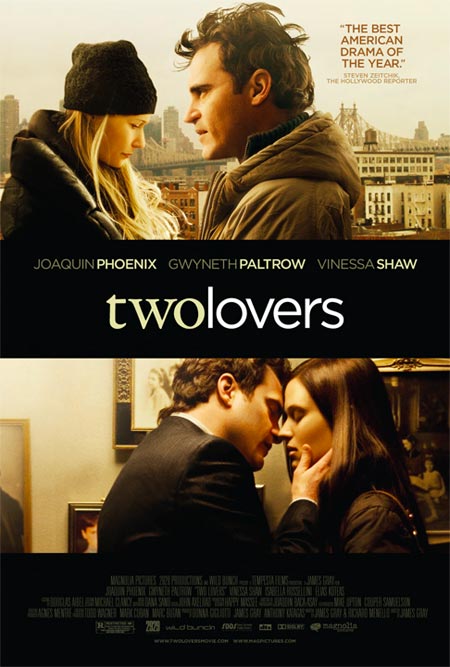
Two Lovers (2008)

Leonard Kraditor (Joaquin Phoenix), having survived heartbreak and suicide attempts, lives with his watchful (yet kindly) parents in the predominantly Russian Jewish ‘hood of Brighton Beach, Brooklyn.  He also helps out at the family laundromat, though he’s not very interested in his work; photography is his passion.  Though Leonard takes medication, we don’t know his exact illness.

One night, Michael Cohen, the man who’s going to buy the Kraditor’s business, comes over for dinner with his family.  When they are left alone, the elegant/single daughter, Sandra (Vinessa Shaw), confesses that she wanted to meet Leonard.  When she explains that she works for Pfizer, Leonard jokes that he “knows all about that.”  Sandra admires his photos; we can also tell that she’s very interested in him.  She comes across as a capable woman who could take care of the sensitive Leonard.

Leonard also happens upon his  new neighbor Michelle (Gwenyth Paltrow), who ducks into his place to escape the rebuke of her angry father.  What was he mad about?  It turns out that Michelle has an older, married lover (played by Elias Koteas).  Though we (and his observant mom, played by Isabella Rosselini) can see that Leonard has an instant crush on her, Michelle quickly comes to rely upon him.  It turns out that Michelle need a good friend- she’s battling tremendous insecurity and a drug habit.  When she calls or texts, Leonard goes running.

Leonard, Sandra, and even the troubled/rootless Michelle, will seem quite real to viewers.  They are not stereotypical Hollywood versions of people.  Often, the demons within us are worse that those found in the outside world.  We have to choose to be happy, as my mom says.

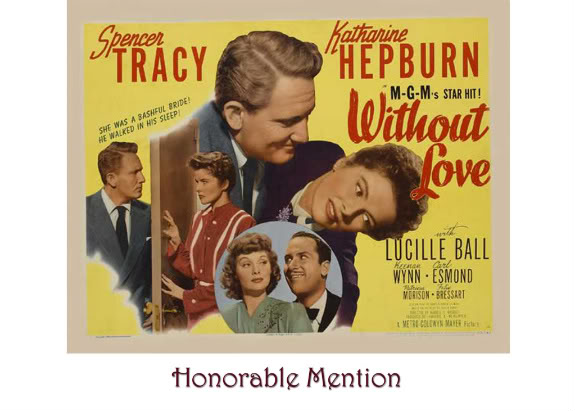
“Without Love” (1945)

Like I wrote before, Katherine Hepburn + Spencer Tracy = movie magic.  In this (lesser-known) rom com, Hepburn and Tracy play two opposites who agree on a marriage of convenience, BUT end up falling in love.  Lucille Ball co-stars as Hepburn’s tough-talking real estate agent.  Keenan Wynn plays Hepburn’s tipsy cousin, who may or may NOT have feelings for his ex-gf (Ball), though he’s engaged to a high-maintenance society woman.  Wynn and Ball provide GREAT comic relief in this film, but never go overboard! 

Wealthy young widow Jamie (Hepburn) has been living alone for several years in a big house in Manhattan.  Her cousin worries that she’s lonely.  To help the war (WWII) effort, she marries a brilliant and blunt-speaking scientist, Patrick (Tracy).  She doesn’t want love, as she feels she’s already had the love of her life.  He doesn’t want love either, having fallen for the wrong woman before.  Emotions are too messy for him.  They quickly marry, then begin working on a (top secret) invention in Jamie’s basement. 

From their first meeting, there is a spark of interest between the pair.  Patrick can play piano (which Jamie likes).  Jamie’s knowledgeable about science, having assisted her father for many years.   (She’s a big help to Patrick.)  But the BEST thing- they respect each other!

The dialogue is smart and snappy, but there are also some quiet, meaningful moments when the camera actually captures Hepburn and Tracy’s REAL love for each other.  This film is a must-see!          

http://www.imdb.com/title/tt0038256/

http://en.wikipedia.org/wiki/Without_Love

Update on me… and more!

Hey everyone,

How is your summer going?  Last week in DC was VERY humid (like Bangladesh, BUT not as extreme).  But I’m sure plenty of people were badly affected nonetheless!  I joined the pricy, but nice/clean Washington Sports Club (WSC) in downtown Silver Spring and plan to go to the group exercises classes Mon-Thurs.  Since I had a coupon, I bought some (comfy) gym clothes from Land’s End.


From eBay, I bought this (super cute) yoga bag and mat set.  These are made by Gaiam.   


On Thursday, a storm came in around 4 p.m. out all of a sudden.  The sky became unusually dark and threatening before the lightening, thunder, and heavy rainfall (for a short time).  There were electricity, Metro, traffic, and tree-falling problems.  But this time, power outages occurred mostly in Alexandria (NoVa), not so much in MoCo (where Dad and I live).

Dad is happy to have a new 40″ Samsung HD TV for the (upstairs) living room.  He bought a 32″ TV before, but thought that was a BIT too small.  Next up for the house- a backyard deck.     


What I’m currently reading:

Days of Obligation: An Argument with My Mexican Father by Richard Rodriguez

War Dances by Sherman Alexie


What I’m currently watching:

Horatio Hornblower (Collector’s Edition)

Bored w/ modern TV shows?  Check out this old-fashioned, British action-adventure series (which includes 8 full-length movies on 8 DVDs) starring a very young Ioan Gruffudd and Jamie Bamber.  Midshipman Horatio Hornblower is a 17 y.o. boy when he first joins the Royal Navy in 1795.  The Brits are at war w/ France, so there are plenty of battles at sea, hand-to-hand sword combat, and even some mystery and romance.  Aside from that, you see the development of a bright, honorable, well-intentioned youngster as he grows from a boy to a man (and leader).     


St Elsewhere (Season 1)

See the medical drama that came before ALL the rest!  Though the pace is slower than ER, the issues faced by the docs, nurses, patients, and their loved ones are often very touching and realistic.  The ensemble cast includes energetic up-and-comers Denzel Washington (confident; bold), Howie Mandel (funny, yet sensitive), and David Morse (an obvious inspiration for ER’s caring family man- Dr. Mark Greene).  I know what you’re thinking- Howie Madel as a doctor!?  Trust me, it’s a GREAT role!  The wonderfully natural, empathetic veteran actors bring gravitas to the show.  Look for guest stars before they were famous.  Another cool note: Tom Fontana worked on this show before Homicide.  (The first season is on DVD and on Hulu.) 

Thanks for visiting!

EMMA

“Hunger of Memory: The Education of Richard Rodriguez”

Mexican-American conservative essayist Richard Rodriguez (born 1944) is equally masterful on the page and onstage.  (He’s a frequent contributor to PBS and has speaking engagements all over the Western world.)  Many feel that education is the great equalizer.  Rodriguez argues in this biography (published in 1981) that there is a price to pay for that education.  Rodriguez also believes that class, not race, is the issue that needs to be addressed in our educational system.

As a little boy in 1940s Sacramento, California, he is “Ricardo”- speaking Spanish and sheltered by the protective embrace of his immigrant parents.  He sometimes has to translate for his parents in public.  Once he enters the local Catholic school, he becomes “Richard”-a thoughtful student who finds a keen interest in mastering English and reading great works of literature.  As the nuns suggest, the family begins speaking English at home.  English is the language of the public sphere.  Though they have worked their way up to a middle-class life, Richard notices that his parents don’t speak English with confidence as they did Spanish.  The loss of Spanish is correlated with the loss of closeness with his family.

By junior high school, Richard has read hundreds of books.  He learns about work by delivering newspapers and tending the gardens of his elderly neighbors.   Serving as an altar boy, Richard learns about the rituals of life.  (The author is still sustained by his Catholic faith and regularly attends mass).  As a teen, he becomes “the scholarship boy” and gains admission to Stanford (in part due to affirmative action, a policy that he later speaks against).  A local paper does a story on his educational success; he becomes an example in his community.

One summer, Richard works in construction, just to see what manual labor is like.  He finds himself enjoying it, partly because he’s not bound to this kind of work.  Richard realizes that most of his working-class co-workers make decent livings, unlike the Mexican illegals (who are sometimes bused in for the toughest tasks).  While the other men chat and laugh, the illegals are nearly silent and solely focused on getting the job done as quickly as possible.  Of course, they are paid less than the regular construction workers, but they have no voice to protest.

In college and grad school during the ’60s, Richard continues to excel and meets many wealthy, well-connected people (some of whom become life-long friends despite political and social differences).  As he climbs the Ivy-covered, politically-charged ladder of academia, he wonders what work will fulfill him in the long run.  He also begins to publish articles.  How can he live “a life of the mind” and still remain true to himself?

Richard Rodriguez’s thought-provoking and emotionally powerful book reads like many immigrant stories.  The author grew up in a time when assilimination into mainstream American culture was the key to success.  He lost a lot of his native Spanish, then gained it back after careful study in his early adult years.  In one Thanksgiving scene, the author explains that two of his siblings have married non-Mexicans.   Though Rodriguez’s father (who toiled in physically demanding jobs for many years) never fully mastered English, he was able to work his way up to a middle-class position.  Richard’s mother (who spoke English well) always worked outside the home, and eventually earned a secure position with the city government.  All of his siblings are college-educated and work in professional fields.

This book also delves into our American educational system, which Rodriguez feels puts too much emphasis on improving college education, but not elementary and secondary education.  How can a student succeed in college when he’s poor in reading or lacks everyday math skills?  When Rodriguez goes to speak in inner-city schools, he finds a vibrancy lacking in middle-class, mainly white schools.  The teens are wearing bright colors.  They pay careful attention to their hair, clothes, and personal style.  They are confident in their physical bodies and the author wishes he had been like that as an adolescent.  However, most of these poor and working-class kids (no matter of what race), will find limited opportunities as they graduate high school.