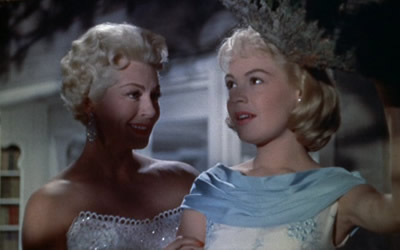
Three Films of Rita Hayworth

Only Angels Have Wings (1939) – This was the first movie role for teenaged Margarita Cansino (Rita Hayworth), a dancer since the age of 4.  The film stars Cary Grant and Jean Arthur.

Gilda (1946) – This film pairs Hayworth with the subtle/talented Glenn Ford- sparks fly!  I saw this film recently, but need to see it again to get all the nuances.  This role made Hayworth a star, and created the bombshell image that was so opposite from her real persona (a shy woman who wanted a quiet, secure family life).

Affair in Trinidad (1952) – Another film w/ Ford that served as a comeback for Hayworth; she produced it herself.

In the Land of Blood and Honey (2011)

Yes, this is Angelina Jolie’s movie (her directorial debut), but don’t let that put you off- it’s quite a tale!  There are no flashy directorial moves, and the pace can seem slow, but I feel the subject matter is worth a look.  However, if you are a sensitive person, this is not the film for you!  (FYI: There are 2 versions of the film- one where actors tell the story in English and the other in Bosnian/Serbian.  I saw the English version.)  The time is the recent past; the setting is the Bosnian War.  Here is some info from Wikipedia:

The war came about as a result of the breakup of Yugoslavia.  Following the Slovenian and Croatian secessions from the Socialist Federal Republic of Yugoslavia in 1991, the multi-ethnic Socialist Republic of Bosnia and Herzegovina, which was inhabited by Muslim Bosniaks (44 percent), Orthodox Serbs (31 percent) and Catholic Croats (17 percent), passed a referendum for independence on 29 February 1992.  This was rejected by the political representatives of the Bosnian Serbs, who had boycotted the referendum and established their own republic. Following the declaration of independence, the Bosnian Serbs, supported by the Serbian government of Slobodan Milošević and the Yugoslav People’s Army (JNA), mobilized their forces inside the Republic of Bosnia and Herzegovina in order to secure Serbian territory, then war soon broke out across the country, accompanied by the ethnic cleansing of the Bosniak population, especially in Eastern Bosnia.

Love in a time of conflict is not uncommon in film, but this is a compelling depiction.  This film focuses on a promising romance twisted and killed by war.  A dark-haired woman, who lives with her sister and baby nephew in a humble apartment, goes out to a bar/nightclub and dances with a blonde man; they are obviously very into each other.  There is a live band playing and the mood is joyous.


The encounter each other a time later when the woman, a Muslim painter named Ajla (Zana Marjanovic) is a prisoner in the camp run by the Serbian man, a soldier named Danijel (Goran Kostic).  Danijel meets with Ajla in private, just to talk at first, because there is no one else to relate to in the prison.  He needs to let off steam, and show her that he’s not a monster.  Danijel also softens the blow for her, while the other women are treated horribly (beaten, raped, and worked like dogs cooking and cleaning).  Is she in love with Danijel or merely protecting herself?  (It’s up to the viewer to decide.)  They think of a plan that will enable Ajla to escape the prison.   


Ajla is unable to escape; she sees brutality all around her, and somehow stays sane.  Meanwhile, her sister suffers a terrible loss and joins a group of rebels.  Danijel is not the typical grunt soldier, he’s the son of a particularly successful/brutal general, Nebojsa (Rade Serbedzija).  His father is grooming him for leadership.  The stress of war gets to the younger man, and he turns on the woman closest to him.  He keeps her hidden away for quite a whille, but Ajla is not safe- not even from Danijel!  

I wished there was more information in this film about the politics of this war.  The secondary characters needed more development.  This film come off as limited at times, but the lead actors work very well together.  They have great chemistry with each other, and connect deeply with their characters.  (Nobody is a well-known face here, aside from Serbedzija.)  Ajla is dignified and strong even in the toughest situations.  Danijel slowly transforms from a rather sympathetic antagonist into a fallen, broken man.


Not as a Stranger (1955) starring Robert Mitchum & Olivia de Havilland

At the opening, Lucas Marsh (Robert Mitchum, one of my favorite actors) is an idealistic intern at a private hospital.  Luke has dreamed of being a doctor since childhood, though he comes from very humble roots (his mother is dead and his father is a drunkard).  His best friend is Alfred Boone (Frank Sinatra in a fine supporting role), the jovial son of a comfortable family who loves chasing women.  Al comments to a classmate that though they all want to be doctors, Luke “wants it more- he has to.”  Luke works as a lab researcher, usually late into the night.

While working, Luke strikes up a friendship with a 1st gen. Swedish-American nurse from Minnesota, Kristen (Olivia de Havilland).  She even arranges it so that he and Al can watch an important surgery.  When Luke’s father spends the money his mother saved for his education, he’s desperate (though he conceals it well).  He gets some help from Al and his teacher, Dr. Aarons (Broderick Crawford), but it’s not enough.  Dr. Aarons, who is Jewish, went through a lot of trouble to become a doctor, and sees great potential in Luke.   

When Kris invites Luke and Al to dine with her friends Bruni and Oley (Harry Morgan from M.A.S.H.), Luke learns that Kris has saved quite a bit of money.   It’s obvious that Kris likes Luke more than a friend, so he asks her out.  (After all, she’s a fine nurse with a “pretty face” and “nice figure.”)  After a few dates, he decides to propose, though Al reminds him that he doesn’t love her.  They nearly come to blows (Luke has a hot temper).  “It’s not like that.  Things are not always black and white,” Luke replies.

They marry and move into her little apartment.  They continue with their respective work; Kris helps Luke prepare for his exams and with his people skills.  (Since he has such high standards, it’s difficult for him to tolerate weakness in others.) 

Marsh, you’re one of the most brilliant students we’ve ever had here.  You’ll be a great physician.  Stop living your life like a Greek tragedy, or you’ll muff it!  -Dr. Aarons
After graduation, the couple move to a small town, where Luke shares a practice with Dr. Runkleman (Charles Bickford), the most experienced doctor in the area.  Dr. Marsh is pleasantly surprised to learn that the older man keeps up with the latest research.  The life of a country doctor is tougher and more tiring than anticipated.  

There is also temptation- a wealthy young widow, Mrs. Lange (Gloria Grahame), summons Dr. Marsh to her home late one night (to check him out).  He’s taken aback by her looks and boldness.  At home, Kris wants to start a family. 

The secret of Robert Mitchum’s success(ful) appeal as an actor was his ability to easily combine tough masculinity and tender vulnerability in one persona, unlike any of his peers (John Wayne, William Holden, Gregory Peck, Charlton Heston).  One felt that Mitchum concentrated more on fully and honestly showing all sides of whatever character that he was playing, even the weak and not-so-tough moments… 

A commentor on YouTube

This film is a must-see for any fan of cinema!  It has well-developed characters, great dialogue, and takes the viewer on a journey.  The editing and pacing are also well done; this is important since the film clocks in at 2 hours and 15 minutes.  (The director is a groundbreaker in the field, Stanley Kramer; he also directed Inherit the Wind, The Defiant Ones, Guess Who’s Coming to Dinner, and many others.)  The ending is fitting and very fulfilling- I got a bit teary-eyed.

Film classics to watch on YouTube

Hey all!

Recently, I rewatched Alfred Hitchcock’s Rope (1948) on YouTube.  I’d seen it a few years ago, but didn’t recall the ending.  The stars of the film are John Dall, Farley Grainger (who later starred in Strangers on a Train), and one of my favorite actors of all time- Jimmy Stewart.  This film is very different from the English play it’s based on, mainly because of the censorship rules of its time.  The film is pretty great, technically, which is expected from Hitchcock.  Some of you may also be interested in Rope Unleashed, a 30 minute behind the scenes look with Hume Cronyn, Granger, Patricia Hitchcock (the director’s daughter), and writer Arthur Laurents.

Below are some (full-length) film classics that you can watch (FREE) on YouTube!

Thanks for visiting!

-EMMA

Mary Galante – 1934; starring a young Spencer Tracy

Pygmalion – the inspiration for My Fair Lady; 1938; starring Leslie Howard

Love Story – 1944; inspiration for An Affair to Remember; starring Margaret Lockwood & Stewart Granger

The Stranger – 1946; starring Orson Welles & Edward G. Robinson

Borderline – 1950; starring Fred McMurray, Clare Trevor, & Raymond Burr (best known as Perry Mason)

Witness to Murder – 1954; starring Barbara Stanwyck, George Sanders, & Gary Merrill

Quick opinions of recent views

Black Swan (2010)

We all know the story.  Virginal girl, pure and sweet, trapped in the body of a swan.  She desires freedom but only true love can break the spell.  Her wish is nearly granted in the form of a prince, but before he can declare his love her lustful twin, the black swan, tricks and seduces him.  Devastated the white swan leaps of a cliff killing herself and, in death, finds freedom.

This film was highly hyped when it came out, but I think it’s overrated.  It’s edited well and shot beautifully.  There is an atmosphere of claustrophobia in the film, reflecting the very circumscribed life of the main character, NYC-based ballerina Nina Sayers (Natalie Portman).  It was nice to see veteran actress Barbara Hershey as Nina’s overly-concerned mother.  Too bad not much was done with Winona Ryder’s role.  The meaning of the ending is up to the viewer to decide! 

House of Games (1987)

What I’m talking about comes down to a more basic philosophial principle: Don’t trust nobody.

In David Mamet’s film noir (done in his usual style), respected Chicago psychiatrist/author Margaret Ford (Lindsay Crouse) tries to help a troubled young patient with an IOU.  She’s is drawn into the world of  con man Mike (Joe Mantegna), a smooth/charismatic character who teaches her about “hustling” (through real-world experiences).  Margaret can’t resist the dark side, nor Mike, though she may be be the biggest “patsy” in the game.  

You say I acted atrociously.  Yes.  I did.  I do it for a living.

I recommend this film for Mantegna’s fine performance, as well as for the plot twists.  However, I preferred The Winslow Boy and The Spanish Prisoner (two great Mamet films).     

Please Believe Me (1950)

This film has some nice moments/dialogue, but is pretty uneven.  It takes too long to set up the premise, but that’s not unusual for older films.  Sensible single gal, Alison Kirbe (Deborah Kerr) of London, receives a telegram from Texas, that she has inherited a livestock ranch from an old friend. It is plastered throughout newspapers that Alison has become a rich heiress, and is sailing to the United Slates alone to claim her inheritance.  Smooth-taking gambler Terence (Robert Walker from Strangers on a Train), laid-back playboy Jeremy (Peter Lawford), and Jeremy’s no-nonsense lawyer, Matthew (Mark Stevens) take an interest in Alison aboard the ship.

Rage in Heaven (1941)

I wanted to see this film since a young Ingrid Bergman is in the lead role.  I recommend this film, as does my dad.  Stella (Ingrid Bergman), a refugee/ personal secretary to wealthy English widow Mrs. Monrell, accepts the marriage proposal of her son, Philip (Robert Montgomery).  This is a bit of a surprise since Philip seemed to encourage a relationship between his college  friend, Ward Andrews (George Sanders from All About Eve) and Stella.  After Stella and Philip get married, he assumes the lead management role in the family’s steel business.  Philip’s behavior becomes increasingly erratic, both at home and in the office.  How will Stella, Ward, and those involved in the steelworks cope?