Persuasion (2007)

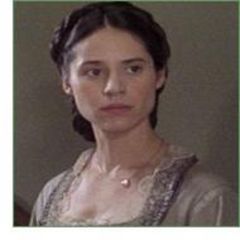
In this  newest adaptation, a sense of urgency is infused into Austen’s last novel- a story of lost love found.   Anne Elliot (Sally Hawkins) becomes a woman of action (note all the running toward the end).  Also, the ending is changed in a (rather BIG) way- Capt. Wentworth doesn’t leave a letter tucked under some other paper for Anne to discover, as in the ’95 film version. 

Okay, I wasn’t TOO impressed w/ this film when I first saw it on PBS.  But when I saw it last week, I was VERY impressed by Penry-Jones’ subtle acting.  And talk about dashing… WOW! 

Anne, with an elegance of mind and sweetness of character, which must have placed her high with any people of real understanding, was nobody with either father or sister; her word had no weight, her convenience was always to give way — she was only Anne.
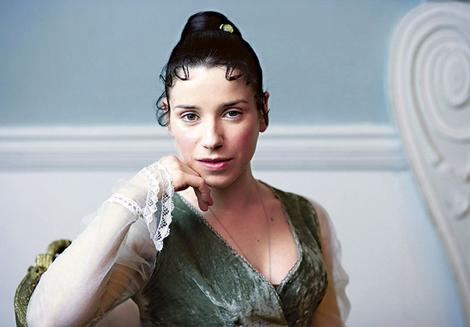
Though Hawkins is NOT how I pictured Anne, she does a fine job in portraying a sensible, warm-hearted, and low-key woman.  Anne is described as a bit of a faded beauty in the book.  (To use modern terms, she’s not the type that gets noticed in the club.)

Casting created some problems here.  Elizabeth is too old, Mary is too irritating and unpoised, and Mr. Elliot (Tobias Menzies from Rome) has zero chemistry w/ Anne.  The other actors suit their roles well, esp. Anthony Head (Buffy the Vampire Slayer) as Sir Walter and Alice Kriege (the Borg queen in Star Trek: TNG) as Lady Russell. 

My favorite scene is when Wentworth ducks into the shop (to wait out the rain) and almost runs into Anne.  While discussing the sudden engagement of Louisa and Benwick, Wentworth reveals HIS true feelings.  It’s movie magic!   
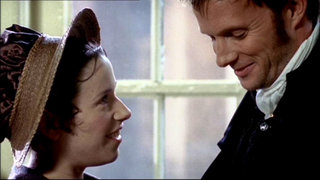
Persuasion is in some regards a fairy tale.  Anne has to leave her home for a place she hates.  Her father spends too much money and her sisters ignore or take advantage of her kindness.  Wentworth reenters Anne’s life when she’s given up hope of marrying.  He isn’t taken w/ the charms of the Musgrove girls.  The heroine gets her prince, finally!

Here is my review of the ’95 film:

https://knightleyemma.wordpress.com/2008/07/23/movie-review-persuasion-bbc-1995/

Two Films (w/ “North & South” actors)


The Glass Virgin (1995)

What qualities makes one a “gentleman” or “lady?”  Is one’s identity determined from birth, or can it change?  These are the questions at the core of Catherine Cookson’s The Glass Virgin.  As a child in 1870s England, Annabelle LeGrange is sheltered by her mother and servants.  One day, her curiosity leads her to see something long kept hidden. 

During a trip into town, Annabelle is rescued from a runaway coach by a young outsider, Miguel Mendoza (Brendan Coyle).  Seeing his strength, Mr. LaGrange offers him a job.  Miguel, who is actually Irish, says he’ll only work w/ horses.  In time, he teaches Annabelle to ride, and they become good friends.       

The 17 y.o. Annabelle (a young Emily Mortimer) flees from her life of upper-middle class comfort when her true parentage in revealed and her “father” arranges a marriage to be rid of her.  Annabelle’s only ally is Miguel, who insists on traveling w/ her to find another life.  The pair find work on a small farm, then a bigger one run by a good-hearted, fair-minded family.  They say they are cousins and live as such, never as a couple.   

Over the course of one tough, life-changing year, Annabelle learns and matures into her own person.  She teaches Miguel to read, and says that he has a lot of potential.  He falls in love w/ her, but keeps it hidden, as her station in life was so above his.  Can Annabelle marry a working-class man?  What will she do when called back to her mother and old way of life?


This film is not very well-made and had a low budget; it was a TV miniseries.  There are no frills, some bad (wooden) acting from supporting players, and weird transitions.   Most of the dialogue is very simple.  (Honestly, I watched it just b/c Brendan Coyle was in it.  He does a great job, as usual!)  Emily Mortimer, who was a newcomer to film then, takes some time to grow into her role.

Some viewers thought it was weird that an older friend from childhood became a love interest.  (But wait, what about Emma and Mr. Knightley?  He was 16 yrs older than her.)  Those who read the novel noted that Miguel was only 10 yrs older than Annabelle.  I had a Renaissance Lit prof who said that “we shouldn’t put the values from our modern world onto the past.”            


The Impressionists (2008)

This is one of the most gorgeous films I’ve ever seen!  (It ranks up there w/ A Walk in the Clouds, which Rogert Ebert praised as the “type of movie you’d want to live in.”)  It’s actually a 3-part miniseries, has a strong ensemble cast, and is a true story. 

The elderly Claude Monet (Julian Glover) talks about his life, and that of his fellow Impressionist painters, to a reporter.  The younger Monet (Richard Armitage) left home, served in the army, then went to Paris to study.  At the school, he met the wealthy/jovial Renoir (Charlie Condou) and doctor-in-training- Bazille (James Lance).  They chafed against their “old school” teacher’s methods and eventually went off by themselves to paint.  As we know, Monet was inspired by the outdoors (nature) and always sought to “capture the light.” 


The young artists deal w/ money troubles, various romances, government art critics (that seek to protect the image of “good art”), and their own frustrations.  There are stories about quirky painters, such as Cezanne- a hermit who’s actually from a wealthy family.  There are interesting tales behind famous paintings.  Did you know that the woman in the green dress became Monet’s first wife?  He approached her in the marketplace and asked to paint her portrait. 

Monet’s second wife (played by Amanda Root) was the former wife of his benefactor.  At first, she didn’t see what was the big deal about his work- LOL!  One reason that I liked this film was that two of my fave actors were playing a couple.  (Below is an Impressionistic promo pic w/ RA and Root.) 


If you haven’t yet, watch RA and Coyle together in the 2004 BBC miniseries North & South!  Here is a short clip:

http://www.youtube.com/watch?v=fM0gsBnbfrc

You can watch the entire film here:

http://www.youtube.com/watch?v=oN58WAmuuqI


“Anna Karenina” (BBC – 2000)

Happy families are all alike; every unhappy family is unhappy in its own way.

Sometimes fine actors just don’t have chemistry w/ each other!  This is the main problem in the 2000 BBC miniseries based on Leo Tolstoy’s well-known, tragic love story.  Helen McCrory (in the title role) and Kevin McKidd (who plays Count Vronsky) don’t generate much heat, which is a crucial part of the story.  She is an especially good actor w/ a great voice and onscreen presence.  Her few scenes w/ the little boy who played her son were touching.

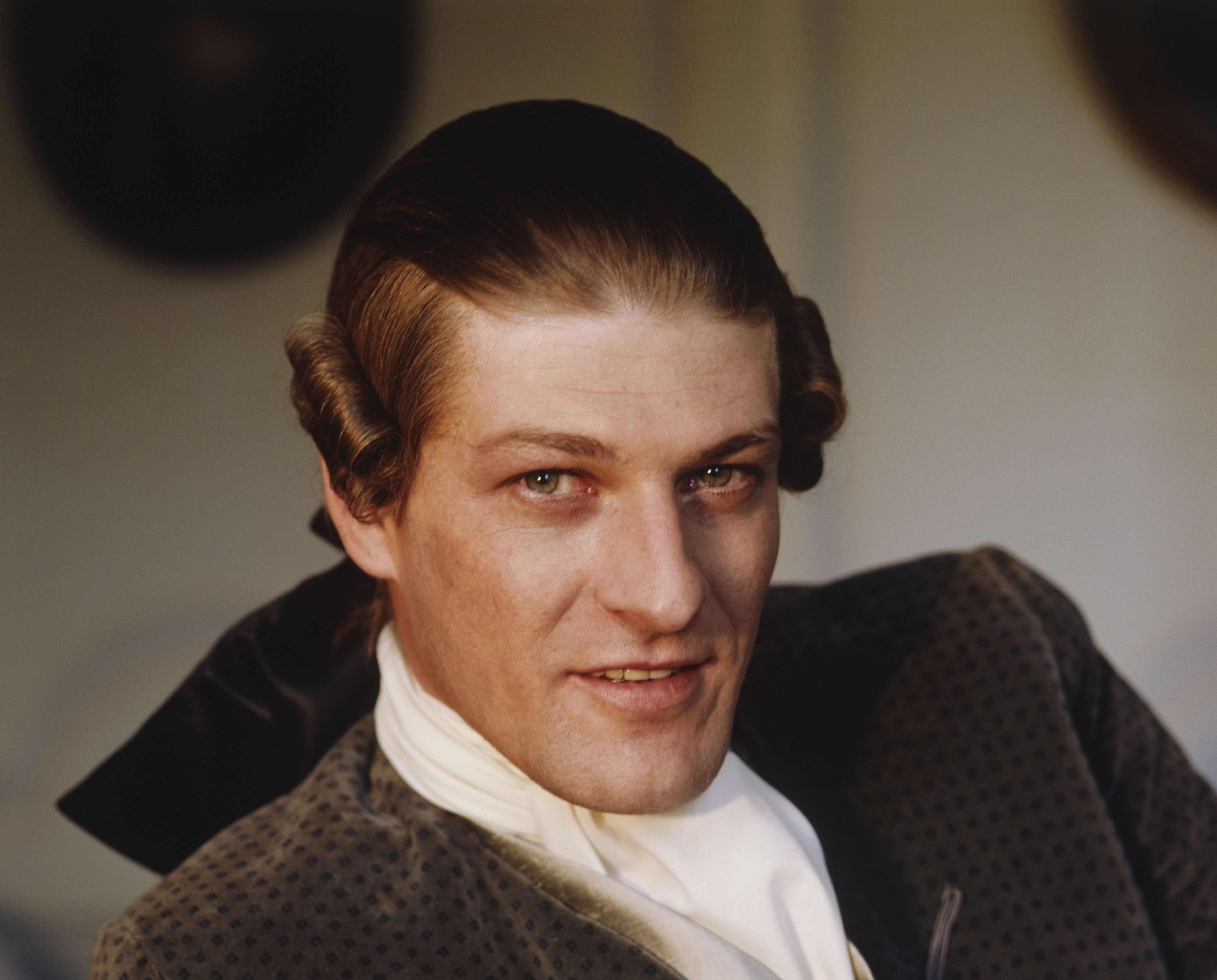
In the 1997 version (w/ Sean Bean and Sophie Marceau), the leads not only look good together, but actually look like they are in love.  Though that film has its own flaws, it has much more passion in it.

The director in the miniseries made some odd choices.  Sometimes a handheld camera is not needed, but it’s used anyway.  There are too many close-ups and not enough light.  In the ’97 version, when Anna and Vronsky first meet, you can see their mutual attraction.  But in this version, the crucial moment becomes ho-hum.  Anna just looks at Vronsky for a moment through her veil- a lost opportunity for the director.  Their first dance is much more romantic/dramatic in the’97 version.  (It reminded me of Scarlett and Rhett’s first dance in Gone with the Wind.)

The actors who rise to the occasion in the miniseries are Douglas Henshall (Constantine Levin) and Paloma Baeza (Princess Kitty).  Henshall, whose real Scottish accent pops out in a few scenes, is the long-haired/bearded gentleman farmer w/ a past.  He thinks too much and worries if he’ll ever win over Kitty, who is innocent and young.  Baeza’s character starts out as a silly girl w/ a crush on the dashing Vronsky.  In time, Kitty learns about love and blossoms into a mature/sensitive wife.

 No one may build their happiness on another’s pain.

Anna’s philandering brother Stiva (played by Mark Strong) and his wife Dolly(played by Amanda Root) both get some nice lines.  “I love him, but I don’t respect him,” Dolly admits toward the end of the film.  She tolerates her husband’s affairs (just as many Russian nobles did at that time).

Anna and Vronsky’s love affair is atypical for their circle.  They truly are in love, not just fooling around b/c of lust or boredom.  Stephen Dillane (who plays Karenin) won’t give Anna a divorce, so she and Vronsky can’t marry.  Anna is forbidden to see her 8 y.o. son and becomes a social outcast.  Vronsky can’t give his baby daughter his name w/o that divorce.

Every time I tried to display my innermost desires – a wish to be morally good – I met with contempt and scorn, and as soon as I gave in to base desires I was praised and encouraged.  –Leo Tolstoy wrote two years after publication of Anna Karenina

After Levin meets Anna, he tell her brother that he liked her b/c “she’s so honest.”  Anna eventually spirals downward, turning to alcohol and opium.  She accuses Vronsky of betraying her w/ a younger woman.  Vronsky goes off to take care of some business for his mother.  But Anna is so paranoid and desperate by this point that she throws herself under a train.

Some recent views

Witness for the Prosecution

This 1957 courtroom-drama, based on an Agatha Christie story, starts out slow, but really packs a punch!  The stars are Tyrone Power (playing against type), Marlene Dietrich (very compelling), and Charles Laughton (providing most of the humor).  There is a lot of dialogue, but it’s very well-crafted.  Famed London lawyer Sir Wilfrid (Laughton) takes on the case of Leonard Vole (Power) mainly because he’s intrigued by Vole’s German wife, Christine (Dietrich).  Leonard, charming yet jobless, is the prime suspect in the murder of a wealthy widow he befriended.  Christine, who is cold and clever, doesn’t act like the typical worried wife.  Sir Wilfrid tells Christine that a woman w/ her personality won’t be seen sympathetically by the jury.  I don’t want to give too much away, so check out this film for yourself.          


The Fifteen Streets

Some dreams do come true in Catherine Cookson (1906-1998) novels, but not w/o hardship and loss.  This TV movie, based on her most popular novel, was filmed on location and looks very authentic.  If you want to read the book, it’s suitable for both young adults (junior high age) and grown-ups.  Since Cookson herself grew up in a working-class/Catholic/Northern community, she truly knows her characters.  Despite being born illegitimate and poor, Cookson pulled herself up into middle-class respectability- becoming a teacher, novelist, and eventually- dame of the British Empire.    

At the turn of the 20th century, hard-working dockworker John O’Brien (Owen Teale) meets independent-minded Mary Llewellyn (Clare Holman), the teacher of his little sister Katie.  John and Mary are both concerned about young Katie’s future; she’s a bright/curious child who dreams of being a teacher.  John fears the family will not have enough money to pay for such training.  

John’s younger brother Dominic (Sean Bean) causes a lot of trouble in the family and community.  While John is sober and fair-minded, Dominic loves drinking and fighting.  Mr. O’Brien also likes to drink; he’s angered by the fact that he’s getting old and not being chosen for work as much.  Mrs. O’Brien is pregnant at the start of the story w/ her sixth child. 

Love doesn’t come smoothly for John and Mary.  The Llewellyns live in a middle-class house with fine furnishings; the O’Brien’s live in a small rowhouse near the docks.  However, they both share a love of words and a deep physical attraction.  They meet secretly, knowling that their courtship is out of the norm in their community.     

 Clarissa


Sean Bean plays the villain Sir Robert Lovelace in this 1991 TV miniseries based on a Samuel Richardson (1689-1761) novel.  The daughter of an 18th century (recently) wealthy family, Clarissa Harlowe (Saskia Wickham), is known for her piety, obedience, and beauty.  But unlike most young women, she wants to remain single, quite satisfied w/ her books and female friends for company.  In time, her family plans to marry her off to Mr. Soames, a man she finds repellant b/c of his looks and manners.  Clarissa, feeling desperate and friendless, runs off with Lovelace, the handsome/ill-reputed nobleman who’d been sending her secret letters.     


Lovelace, a known womanizer, pretends to seek redemption by reading the Bible and spending time w/ Clarissa.  His real goal is to wear down her virtue.  He comments to his best friend that he’s “never known a virtuous maid to hold out more than a month.”  But Clarissa won’t be had so easily!  Lovelace also wants to take revenge on James, Clarissa’s cold-hearted older brother.  

Though  James, as well as his sister Arabella, are rather one-dimensional villains, Clarissa’s best friend Anne is a n interesting character.  She’s a smart and sarcastic woman w/ a steady beau, but she doesn’t respect or love him.  She keeps him waiting, wondering if marriage is the right choice.   


“The Mill on the Floss” (1997)

Running Time: 90 minutes 

Starring: Emily Watson, James Frain, Bernard Hill, and Ifan Meredith

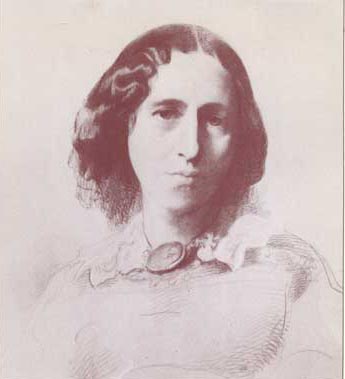
Marian Evans (pen name: George Eliot) grew up in the country, then went to the city to further her career.  The focus of her writing was often on small town outsiders, such as herself.   In her early 30s, Eliot began a long-term relationship w/ an older married man, George Henry Lewes.  He was a noted philosopher/critic who had an open marriage.  Eliot’s decision to defy the conventions of Victorian England created a bitter rift between her and her older brother, Isaac,  for most of their lives.  This conflict is at the core of her most personal novel, The Mill on the Floss, published in 1860.

The Tulliver family, headed by the strong-willed Edward (Bernard Hill) has owned/managed their mill along the River Floss for generations.   Mrs. Tulliver comes from a wealthier background, so her sisters look down on her marriage to Edward.  The family has two kids, very close in age, though different in temperment.

Eliot’s father, like Mr. Tulliver, was a businessman who had married a woman from a higher social class. His wife’s sisters were rich, ultra-respectable, and self-satisfied. These maternal aunts provided the character models for the aunts in the novel.

Mr. Tulliver decides that Tom, as the only son, should have a better future than he did.  He’s sent off to study with a local parson as an adolescent, much to the dismay of sister Maggie.  As one reader of the novel commented: “her fierce intelligence and strong streak of independence bring her into constant conflict with her family.”  Maggie seeks the love and approval of Tom, even when he treats her harshly.

At the parsonage, Tom studies alongside Phillip Wakem, the only son of the cold-hearted lawyer who’s trying to take over the land/water around the Tulliver mill.  Phillip, who is hunchbacked, is a kind boy who draws, sings, and plays the violin.  When Maggie visits, she and Phillip become fast friends.  Though their fathers despise each other, Maggie tells to Tom that “bad men can have good sons.”

Seven years later, the young adult Tom (Ifan Meredith) leaves school and gets a job at a successful trading business in the village, Guest & Co.  He sets his mind to saving all he can in order to help the family mill, which is more in danger than ever.  Edward’s health is very poor; Mrs. Tulliver has borrowed all she can from her relations.

When Phillip (James Frain) returns from Europe, it gives Maggie (Emily Watson) a reason to smile.   They resume their friendship, meeting in secret to discuss books and ideas.   Like Maggie, Eliot was extremely intelligent, energetic, imaginative and unconventional.  In the book, Maggie is described as a “strikingly attractive young woman, tall with full lips, and a crown of jet black hair.”  We can see that Phillip is deeply in love w/ her.  Tom eventually forces Maggie to choose between the family and Phillip.

Then Maggie meets Stephen Guest, the handsome/easygoing fiance of her cousin, Lucy Deane.  Maggie’s lack of social pretension makes her very charming to Stephen, and he declares his love.   Maggie admits that she loves him, too. Can she fulfill herself while still being morally responsible?