The Crown (Netflix): Coming NOV 4th

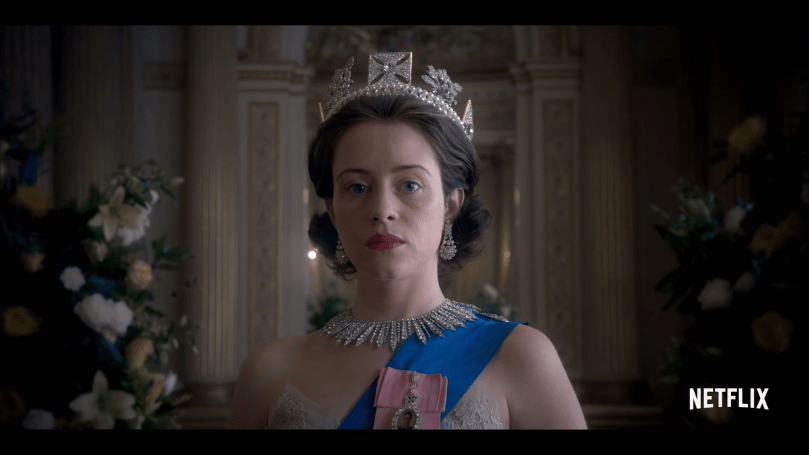
ClaireFoy_TheCrown_coronation.png
Queen Elizabeth II (Claire Foy) wearing her famous coronation jewels , sash, and gown.

The Crown focuses on Queen Elizabeth II as a 25-year-old newlywed faced with the daunting prospect of leading the world’s most famous monarchy while forging a relationship with legendary Prime Minister, Sir Winston Churchill. The British Empire is in decline, the political world is in disarray, and a young woman takes the throne….a new era is dawning. Peter Morgan’s masterfully researched scripts reveal the Queen’s private journey behind the public facade with daring frankness. Prepare to be welcomed into the coveted world of power and privilege and behind locked doors in Westminster and Buckingham Palace….the leaders of an empire await. -Netflix Summary

the-crown-cast-779x400
Matt Smith, Claire Foy, and John Lithgow

Lead Actors: Claire Foy (Queen Elizabeth II), Matt Smith (Philip Mountbatten, Duke of Edinburgh), & John Lithgow (Sir Winston Churchill)

Supporting Actors: Jeremy Northam, Eileen Atkins, Victoria Hamilton, Harriet Walter, Ben Miles & Alex Jennings

Director: Stephen Daldry

Writer/Producer: Peter Morgan

queen-elizabeth-the-crown
Claire Foy as Queen Elizabeth II and the real queen in wedding clothes.

This highly-anticipated series will be available on November 4th. Two seasons with a total of 20 episodes are planned (so far), as noted in Variety.  Daldry was the director of Billy Elliott and The Hours.  In 2006, Peter Morgan wrote The Queen (starring Helen Mirren).

Rather than finding this woman and this predicament less and less interesting it becomes more and more interesting.  The Queen’s story is a good way to examine the modern history of England because she is so intertwined with the British constitution and the British soul. -Peter Morgan

I’m excited to see Foy in a starring role; she was great in the miniseries Little Dorritt.  Matt Smith (best known for Dr. Who) can handle both comedy and drama.  Maybe he will get a chance to do both? And it’s so cool to see the film/stage veteran, Lithgow, in good shape and working regularly!  The official trailer (below) gives us some hint, BUT not too much, re: the crux of the series- how a young woman manages different roles (daughter, queen, wife, and mother).       
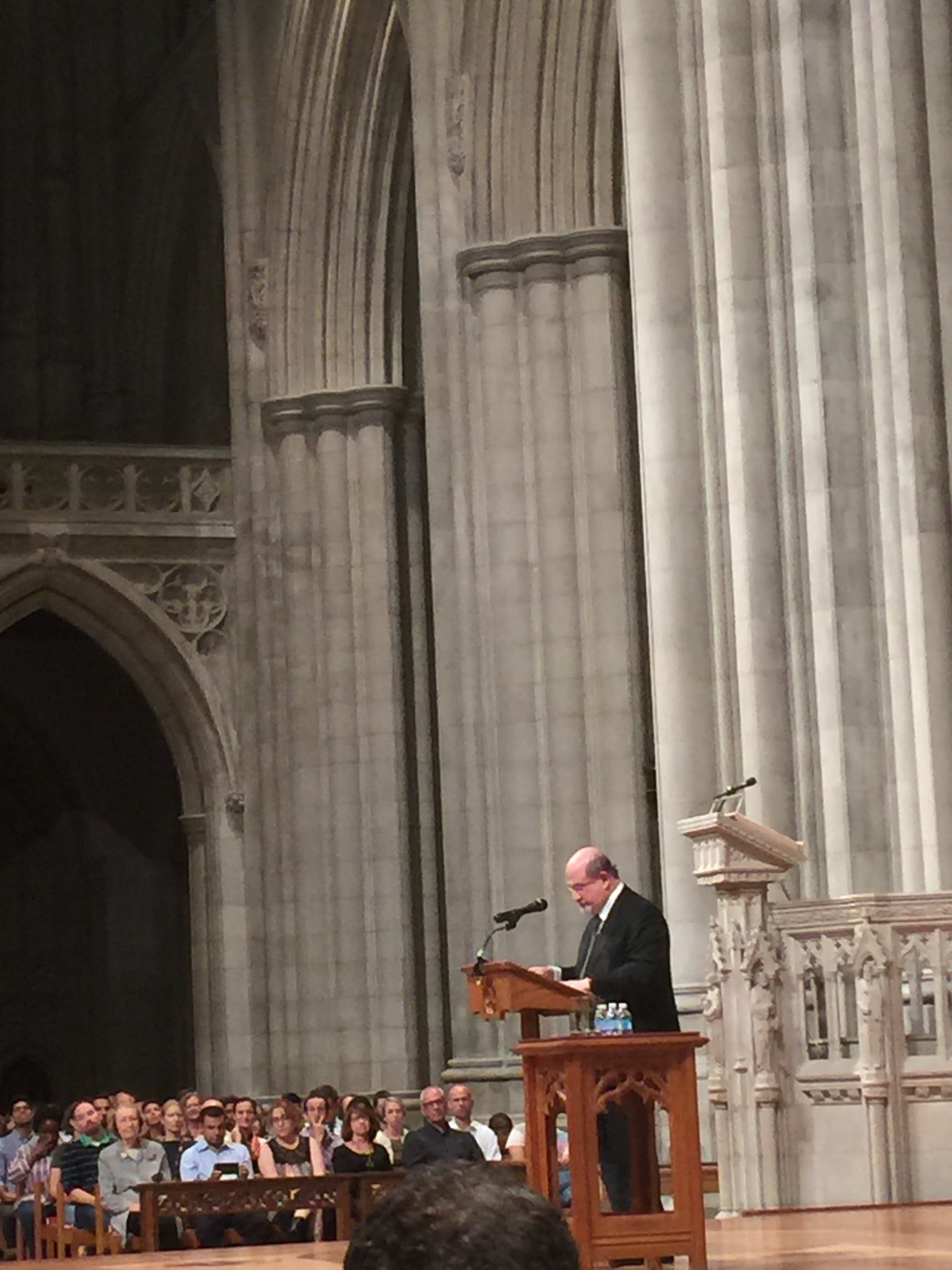
 

The Eudora Welty Lecture Series at The National Cathedral: Salman Rushdie (October 20, 2016)

img_11861

Salman Rushdie continues to be a controversial figure, but in today’s world, I feel that voices like his (British, Indian, and atheist) need to be heard MORE than ever!  Depending on your age, you may know Rushdie from the fatwa (which was placed on him by Ayatollah Khomeini of Iran), his cameo on Bridget Jones’ Diary, or his short-lived marriage to Padma Lakhshmi (of Top Chef fame).  Or maybe you have a FEW of his books (BUT are intimidated to read)?  A few years ago, a book club I organized both read Haroun and the Sea of Stories, which is Rushdie’s YA book. 

*NOTE: Special thanks to my friend Lana for above photo and taking notes.

The Beginning of Rushdie’s Life as a Writer:

He realized that he would never write a good book until he knew who he was (not English, but Indian).

He was part of first generation of free Indian Children.

His father told bedtime stories (oral tradition strong in his family)- animal stories; tales of heroes.  His mother told local tales: gossip,  scandal, secrets (when he included  in stories, she said he “got in trouble”).  One of his academic grandfathers took him to university library, where he discovered Agatha Christie.  His other grandfather was a very religious man (prayed 5X/day, fasted, etc.) He was also open to any/all ideas; Rushdie admitted that he didn’t believe in God (age 10).

Read comics from early age.  He was lucky to have a lending library/bookstore nearby where he got into Perry Mason mysteries, Alice in Wonderland.

The Wizard of Oz (film) inspired him to write his first story at age 10.

His family had a tradition of kissing books and bread to apologize to it and place someplace where wouldn’t happen again (food for mind; food for the body).

Left Bombay 1961 for English boarding school at age 13 (his idea, not his parents’).  Maybe he had an”unnoticed love of adventure” b/c was quiet as a child?

Got into Cambridge, but didn’t want to go b/ c of racism faced at boarding school earlier.  He went and enjoyed it a lot; studied history; wrote for student newspaper.  He also got into Borges and Joyce at this time, and learned about incident of satanic verses (in his last semester).

His parents moved to Karachi, Pakistan; this was not an appealing place for him.  His father initially disapproved, but then supported his return to England after he graduated from Cambridge.

Wrote TV commercials and scripts in London for an ad agency (where he worked part-time).  In the early 1970s, he wrote and published, but these works were not successful because he hadn’t known himself enough.  He decided to understand what he was doing wrong and traveled to India, which entered state of emergency (1977).

Midnight’s Children: Started in 3rd person, but then told from Salim’s voice and it was better (voice not my own, but gave me voice).  Kept working  in advertising again to pay bills.  This book took 5 years to write it because was learning how to write.  He also needed to blend news with fiction.

Quotes:

Geography is key [to a person’s writing]. Writers (like Faulkner): Have roots/history and can mine the earth for a lifetime of stories.

Work we do about the past, changes the future.

 As we discover, we remember, as we remember, we discover.

Stories are not true- but can make you know truths that truths cannot tell.

Can’t write until you hear people speak, because can’t tell their story if you don’t hear their voice.

I think the greatest gift my family gave me was freethinking. 

[On his trip to India when writing Midnight’s Children]: From childhood, dig out memories from attics of mind.  Healing of rift within myself that separated me from my past…  drank deeply from well of India. 

Write what you know, but only if what you know is interesting. 

Bonnie and Clyde (1967)

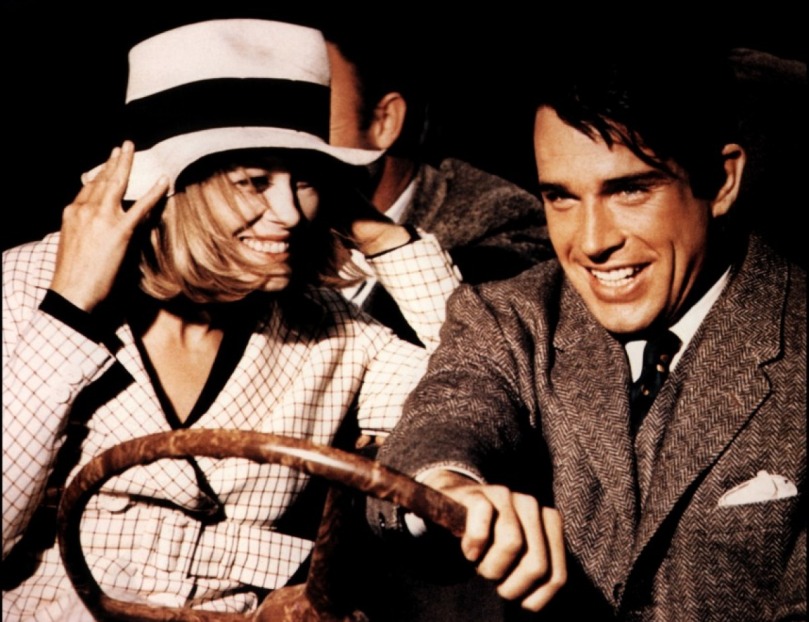
bonnieandclyde_driving
Bonnie Parker (Faye Dunaway) and Clyde Barrow (Warren Beatty) on the run!

Synopsis: In 1934, Bonnie Parker, a waitress, and Clyde Barrow, a criminal, just released from prison, are immediately attracted to what the other represents for their life when they meet by chance in West Dallas, Texas. Bonnie is fascinated with Clyde’s criminal past, his bravado in talking about it, and the power of his gun. Clyde sees in Bonnie someone who wanted more out of life- like himself. They decide to join forces to embark on a life of crime (mainly robbing banks) to make fast money and have fun.  Their  small gang of willing accomplices includes C.W. Moss (a mechanic) and Buck Barrow, one of Clyde’s older brothers.  Buck’s wife, a former preacher’s daughter, reluctantly joins in, but then becomes hysterical when faced w/ danger. 

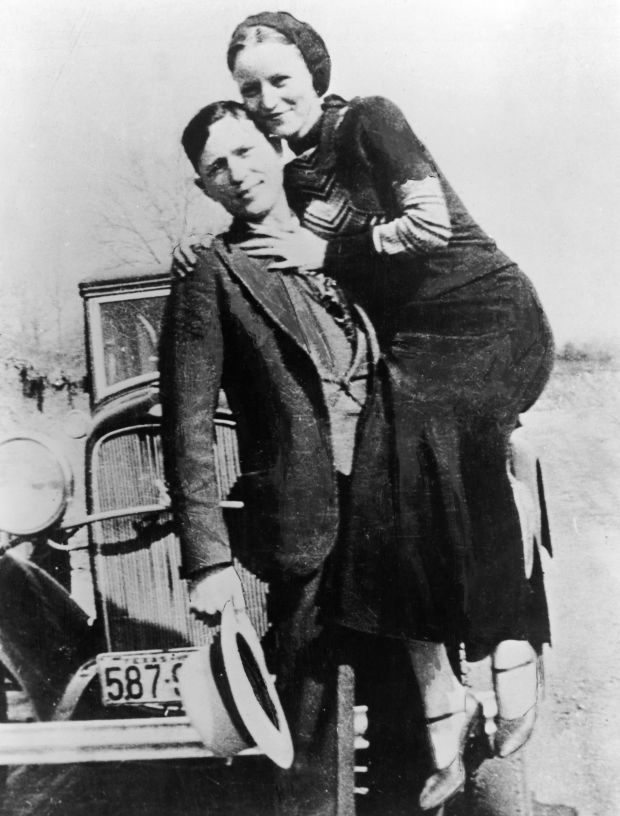
bonnieandclyde_reallife
Newspaper photo of the real life Bonnie and Clyde

If all you want’s a stud service, you get on back to West Dallas and you stay there the rest of your life.  You’re worth more than that.  A lot more than that.  You know it and that’s why you come along with me.  -Clyde says to Bonnie

To modern eyes, this movie is rather tame, BUT in it’s day, it caused quite a stir!  In a TV interview, director Arthur Penn pointed out that this film shows for the first time the firing of a gun and the consequences in ONE single frame. Before that, you’d see a gun being fired, then cut, and the next scene would show the bleeding body.  This was the first film to use squibs (which were embedded in costumes and wired to a central control that made them explode in sequence to create the illusion of being shot).

Leading man Warren Beatty (who was at the top of his profession then) wanted his then-girlfriend, Natalie Wood, for the role of Bonnie. However, SHE refused in order to be able to meet daily w/ her therapist. Producers auditioned a LOT of young actresses (incl. Jane Fonda) for the role of Bonnie; at first, they thought Faye Dunaway was not “hot.”  But then Beatty screen-tested w/ her and was convinced that she was the BEST one for the role. 

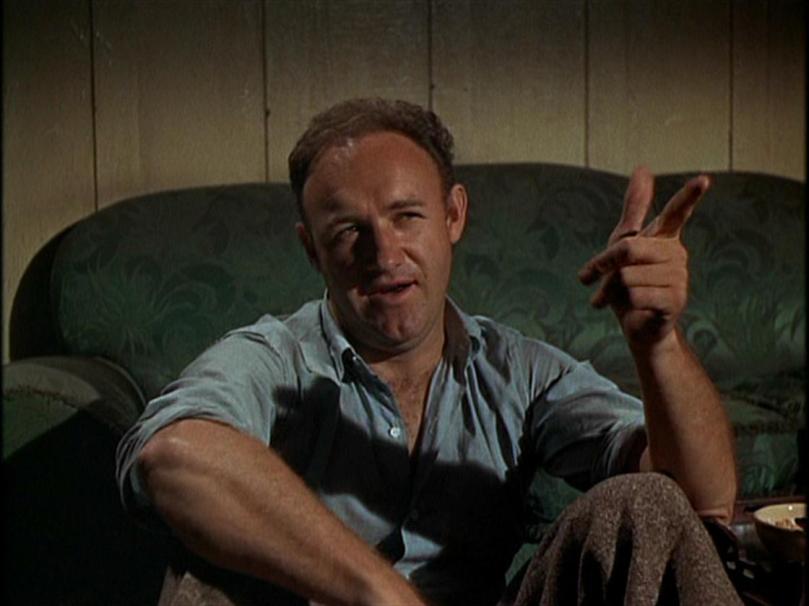
bonnieandclyde_genehackman
Gene Hackman (in one of his early roles) plays Clyde’s big brother- Buck

Warner Bros. thought it would be a flop, BUT it was a hit!  Roger Ebert had ONLY been a film critic for 6 mos. when he saw this film and hailed it as the first masterpiece he had seen on the job. ONE of the reasons why the film was so successful was because of its anti-establishment stance; people were becoming disillusioned with America’s involvement in Vietnam at this time.

barrowfamily
Young Estelle Parsons (Roseanne’s mom in the ABC sitcom) plays Buck’s wife.

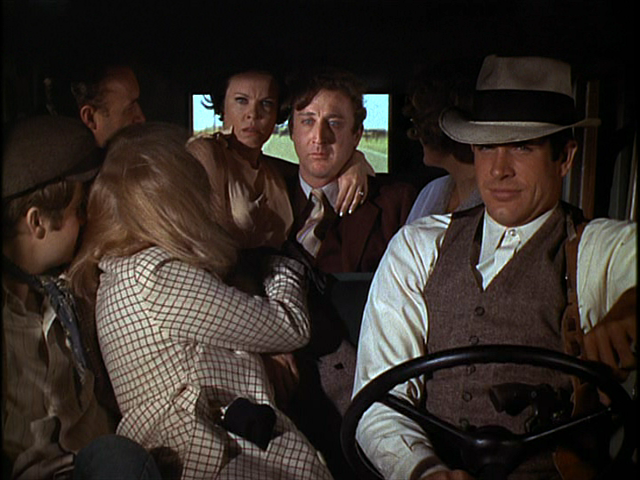
There is SOME humor in this film, too, thanks in part to Gene Wilder (in his debut)!  He plays Eugene, a wealthy Romeo who is robbed of his shiny new car while making out w/ his girlfriend, Velma, on the porch.  Eventually, the couple end up in Eugene’s car WITH the robbers!  When Bonnie asks Velma how old she is, she quickly responds with “33.” Eugene is silent and looks shocked (so she MUST have lied about it before)- LOL!

bonnieandclyde_genewilder.png

Here is a list of Hollywood conventions that were broken in this film (from a commentator on IMDB):

  1. The mix of comic scenes with scenes of violence, intense drama and that weird, beautiful family reunion scene.
  2. The realistic (for the time) portrayal of violence, with blood and moans and pain.
  3. The frank sensuality (for its time).
  4. The likeability (some would say glorification) of criminals (we are sad when they die).
  5. The unlikeability of the sheriff (who, in prior years, would have been the hero).
  6. The portrayal of an unconventional “family” who live together and mostly love each other, reflecting the ’60s hippie ethos.
  7. The use of period music (the bluegrass) rather than all orchestral scoring.
  8. The pointed social commentary (the Depression-era dispossessed, the poor farmer shooting at the bank sign and his foreclosed home, portrayal of the Establishment as villains).
  9. The depiction of “style” (the clothes, the brash attitudes, the coolness) and how its used to establish the triumph outsiders over law-abiding “squares.”

2016 AFI Latin American Film Festival: Magallanes (Peru)

In modern-day Lima, middle-aged Harvey Magallanes (Damian Alcazar) works as a driver for his former commanding officer, the wheelchair-bound Colonel (Frederico Luppi), who has lost his memory.  He spends the rest of the day as a taxi driver and drinking w/ Army buddy/mechanic, Milton.   

One morning, he picks up a harried/young/indigenous woman in his cab- Celina (Magaly Solier).  Magallanes is VERY shaken up, looking upset; it turns out that she doesn’t recognize him.  He follows Celina to a convention, learning that she needs money for her hair salon.  After talking to Milton and his reluctant sister, Magallanes sees an opportunity to make some easy money.  WHAT is his connection to Celina?  WHY does he look so guilty?  This film starts out slow (it’s a character drama for the most part), then eventually builds to an (VERY un-Hollywood) climax, which will totally change your view of the protagonist!          

The brilliance of the story is that we find ourselves pulling for Magallanes right up until the moment when we can’t possibly forgive him his transgressions … any more than Celina can. More than an example of the jumbled mess of war and terrorists, the film is a wonderful observation of human nature and how we often rationalize our worst actions to the point of delusion of our own goodness. No matter how hard we try to put things behind us, the bad choices are always there. Some sins just cannot be washed away, and redemption is not always possible.

-Comment from IMDB