A Face in the Crowd (1957) starring Andy Griffith, Patricia Neal & Walter Matthau

poster_a_face_in_the_crowd

We became acquainted with a community of strangers – it was not like a work experience, it was a life experience, a thing that affects you very deeply. We became a part of that Arkansas community settling down in new homes there. It was a terrific experience, right from the beginning, the people we met, the insights we got, the privilege we had of being inside a society that otherwise we would never have touched.  -Andy Griffith

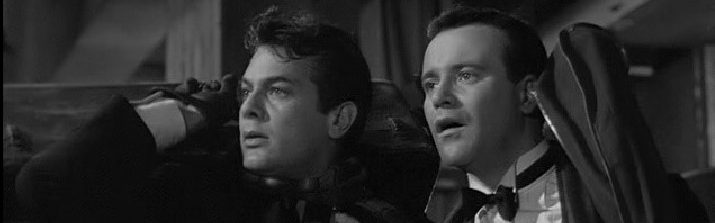
Larry Rhodes (Andy Griffith, in his 1st movie role- VERY far from Sheriff Andy and Matlock) is in a small-town Arkansas jail when the niece of a radio station owner, Marcia Jeffries (Patricia Neal- always great in every role), interviews him and has him sing an impromptu song for a weekly radio program.  She even names him “Lonesome, ” much to his surprise and amusement.

face-in-the-crowd_jail

You put your whole self into that laugh, don’t you?  -Marcia asks

Marcia, I put my whole self into everything I do.  -Lonesome replies

Lonesome quickly proves to be quite popular with his homespun humor/song lyrics. He soon has a radio show of his own (in Memphis).  An opportunistic/ambitious office worker, Joey DePalma (Anthony Franciosa) lands Lonesome a contract for a TV show (in NYC) thanks to support of Vitajex, a new dietary supplement.
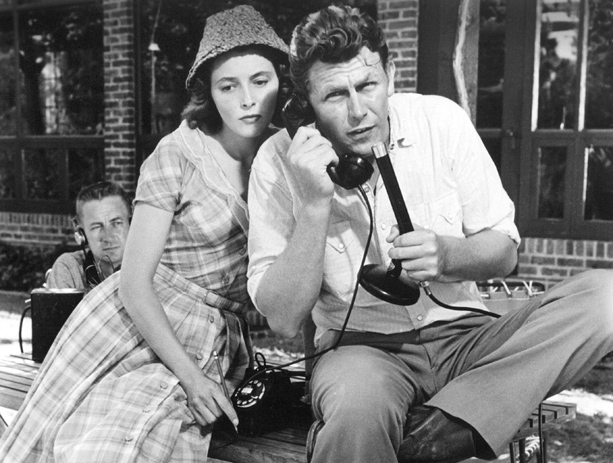
A Face in the Crowd (1957) Directed by Elia Kazan Shown from left: Patricia Neal, Andy Griffith
A Face in the Crowd (1957)
Directed by Elia Kazan
Shown from left: Patricia Neal, Andy Griffith

I was totally taken by surprise by this edgy, brilliant movie. I was also mesmerized by the beautiful and fabulous Patricia Neal. …she just smoked in this movie.  -IMDB comment

They love his voice, they love his guitar, they love his ideas… they should know some of his ideas.  -Marcia says re: Lonesome

Lonesome becomes SO popular that he gets his own television show.  He brings his “Girl Friday” Marcia w/ him to NYC.  Their working relationship gets complicated, BUT you need to watch it to find out how!

A FACE IN THE CROWD, Andy Griffith, 1957

The portion of the film where [Lonesome] “reinvented” the marketing message of the pill was like a precursor of current Viagra commercials, particularly the blonde in bed talking about how the pill helped her “boyfriend.”  -IMDB comment

Didn’t you know? All mild men are vicious. They hate themselves for being mild, and they hate the windy extroverts whose violence seems to have a strange attraction for nice girls. You should know better.  -Mel comments re: men like him

Mel Miller (Walter Matthau) is one of the writers who works on this show; he develops feelings for Marcia. In no time, Lonesome attracts the attention of a retired general, who introduces him to an aspiring politician.

face-in-the-crowd_admiration

I’m not just an entertainer. I’m an influence, a wielder of opinion, a force… a force!  -Lonesome exclaims re: his power over the masses

A comparison to the fictional Lonesome and the too real Donald Trump can’t be avoided. Art imitating life or is it life imitating art?  -IMDB comment

Did you know Marlon Brando (a frequent collaborator of director Elia Kazan) was considered for the lead role?  One of the hosts at TCM pointed this out after the film ended; it was shown in early October. Brando refused, probably b/c he knew that would’ve been woeful miscasting! 

On Twitter, a viewer noted that the dinner scene in Lonesome’s spacious penthouse was styled like the one in Citizen Kane.  Director Spike Lee noted that A Face in the Crowd film was a BIG inspiration for his film, Bamboozled.   
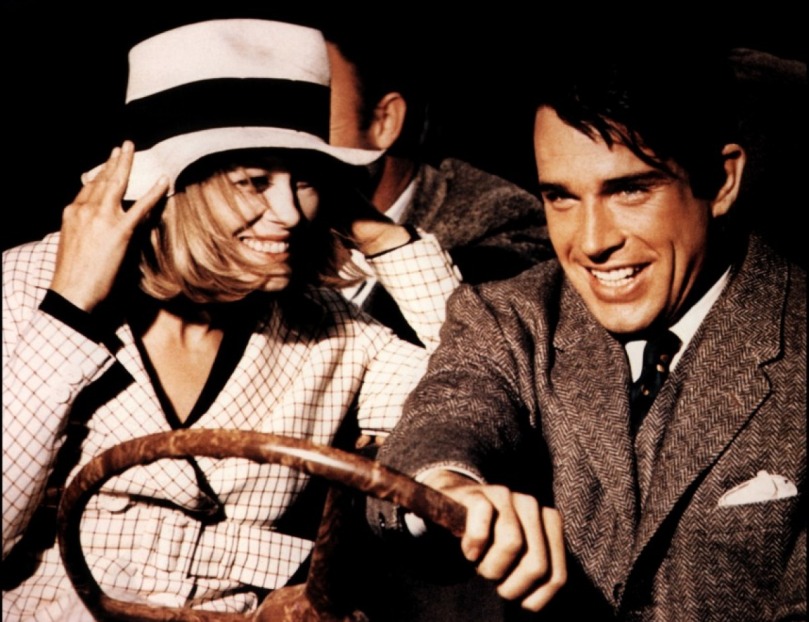
Bonnie and Clyde (1967)

bonnieandclyde_driving
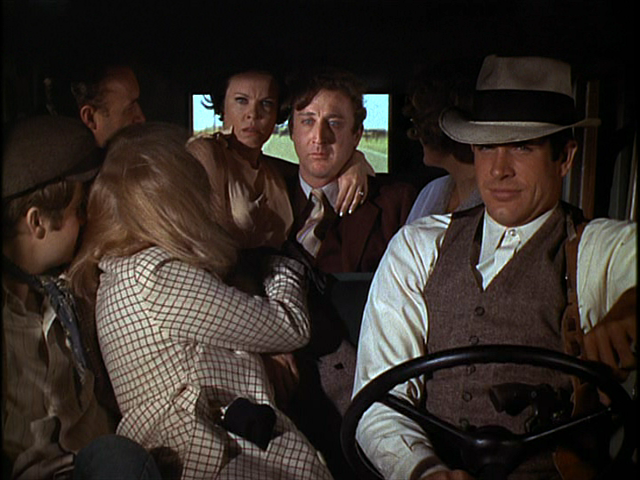
Bonnie Parker (Faye Dunaway) and Clyde Barrow (Warren Beatty) on the run!

Synopsis: In 1934, Bonnie Parker, a waitress, and Clyde Barrow, a criminal, just released from prison, are immediately attracted to what the other represents for their life when they meet by chance in West Dallas, Texas. Bonnie is fascinated with Clyde’s criminal past, his bravado in talking about it, and the power of his gun. Clyde sees in Bonnie someone who wanted more out of life- like himself. They decide to join forces to embark on a life of crime (mainly robbing banks) to make fast money and have fun.  Their  small gang of willing accomplices includes C.W. Moss (a mechanic) and Buck Barrow, one of Clyde’s older brothers.  Buck’s wife, a former preacher’s daughter, reluctantly joins in, but then becomes hysterical when faced w/ danger. 

bonnieandclyde_reallife
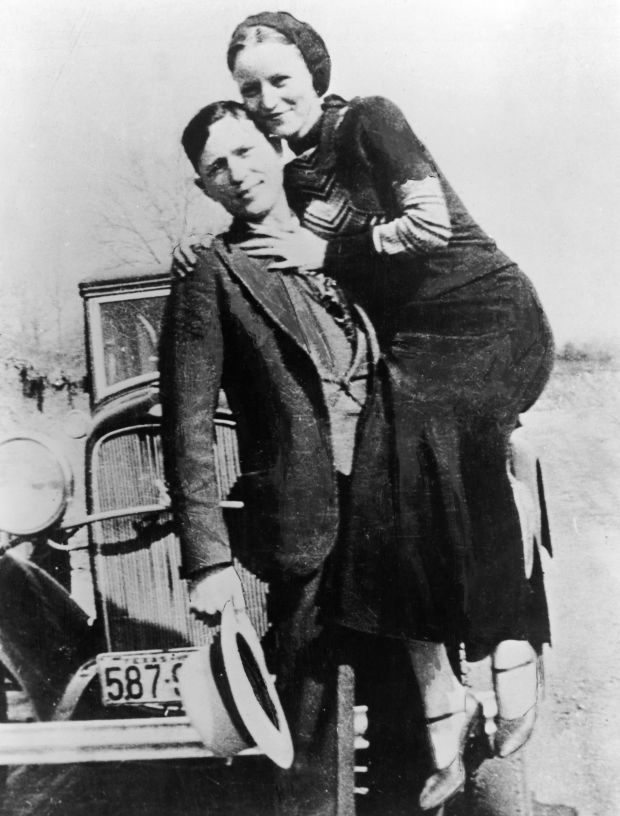
Newspaper photo of the real life Bonnie and Clyde

If all you want’s a stud service, you get on back to West Dallas and you stay there the rest of your life.  You’re worth more than that.  A lot more than that.  You know it and that’s why you come along with me.  -Clyde says to Bonnie

To modern eyes, this movie is rather tame, BUT in it’s day, it caused quite a stir!  In a TV interview, director Arthur Penn pointed out that this film shows for the first time the firing of a gun and the consequences in ONE single frame. Before that, you’d see a gun being fired, then cut, and the next scene would show the bleeding body.  This was the first film to use squibs (which were embedded in costumes and wired to a central control that made them explode in sequence to create the illusion of being shot).

Leading man Warren Beatty (who was at the top of his profession then) wanted his then-girlfriend, Natalie Wood, for the role of Bonnie. However, SHE refused in order to be able to meet daily w/ her therapist. Producers auditioned a LOT of young actresses (incl. Jane Fonda) for the role of Bonnie; at first, they thought Faye Dunaway was not “hot.”  But then Beatty screen-tested w/ her and was convinced that she was the BEST one for the role. 

bonnieandclyde_genehackman
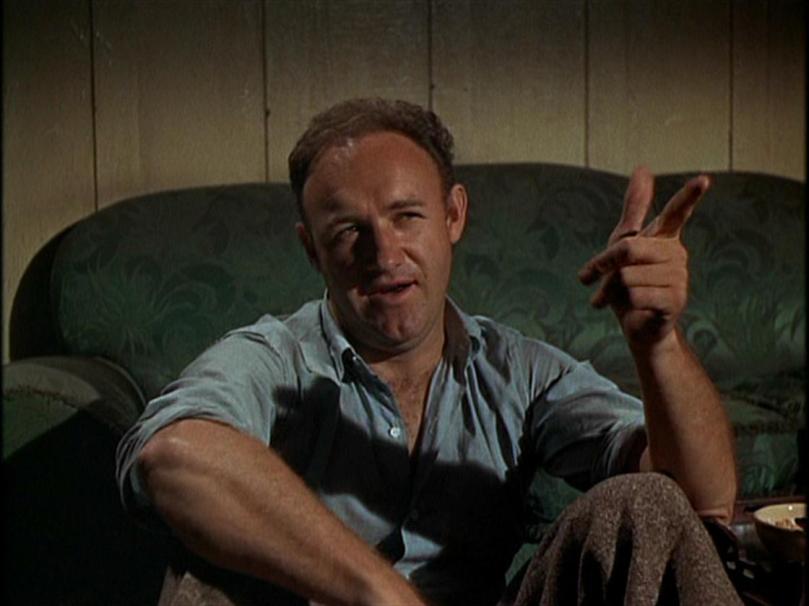
Gene Hackman (in one of his early roles) plays Clyde’s big brother- Buck

Warner Bros. thought it would be a flop, BUT it was a hit!  Roger Ebert had ONLY been a film critic for 6 mos. when he saw this film and hailed it as the first masterpiece he had seen on the job. ONE of the reasons why the film was so successful was because of its anti-establishment stance; people were becoming disillusioned with America’s involvement in Vietnam at this time.

barrowfamily
Young Estelle Parsons (Roseanne’s mom in the ABC sitcom) plays Buck’s wife.

There is SOME humor in this film, too, thanks in part to Gene Wilder (in his debut)!  He plays Eugene, a wealthy Romeo who is robbed of his shiny new car while making out w/ his girlfriend, Velma, on the porch.  Eventually, the couple end up in Eugene’s car WITH the robbers!  When Bonnie asks Velma how old she is, she quickly responds with “33.” Eugene is silent and looks shocked (so she MUST have lied about it before)- LOL!

bonnieandclyde_genewilder.png

Here is a list of Hollywood conventions that were broken in this film (from a commentator on IMDB):

  1. The mix of comic scenes with scenes of violence, intense drama and that weird, beautiful family reunion scene.
  2. The realistic (for the time) portrayal of violence, with blood and moans and pain.
  3. The frank sensuality (for its time).
  4. The likeability (some would say glorification) of criminals (we are sad when they die).
  5. The unlikeability of the sheriff (who, in prior years, would have been the hero).
  6. The portrayal of an unconventional “family” who live together and mostly love each other, reflecting the ’60s hippie ethos.
  7. The use of period music (the bluegrass) rather than all orchestral scoring.
  8. The pointed social commentary (the Depression-era dispossessed, the poor farmer shooting at the bank sign and his foreclosed home, portrayal of the Establishment as villains).
  9. The depiction of “style” (the clothes, the brash attitudes, the coolness) and how its used to establish the triumph outsiders over law-abiding “squares.”

The More the Merrier (1943) starring Jean Arthur

the-more-the-merrier-dual-solo-rumba

Do you realize that practically most of the trouble in the world comes from people lying to people? Just take Hitler, for instance.  -Dingle on morals

This funny and VERY well-written romantic/screwball comedy, directed by George Stevens (A Place in the Sun, Giant) is a MUST-SEE for any fan of classic film!  I saw it for the first time (on TCM) last week, then wondered why I’d never heard of it before. 

themorethemerrierbreakfast

Damn the torpedoes – full steam ahead!  –Dingle on seizing the moment

In WWII era Washington, DC, there is a housing shortage and “8 women for every man,” BUT Connie Milligan (Jean Arthur) ends up w/ TWO unwanted roomies.  First, there is retired industrialist, Benjamin Dingle (James Coburn- Best Supporting Actor Oscar winner), then mechanic-turned-soldier, Joe Carter (Joel McCrea).  Mr. Dingle sublets half of his room to the younger man, considering him “a high type, clean cut, nice young fellow.” When Dingle plays (unlikely) matchmaker, hilarity and romance ensue!  

more_the_merrier_sorry

There are two kinds of people – those who don’t do what they want to do, so they write down in a diary about what they haven’t done, and those who are too busy to write about it because they’re out doing it! -Dingle on life


Now Voyager (1942) starring Bette Davis, Paul Henreid & Claude Rains

Now-Voyager-bette-davis-15644428-1195-947

The untold want, by life and land ne’er granted,

Now, Voyager, sail thou forth, to seek and find.  

-From the poem The Untold Want by Walt Whitman

Claude Rains Now Voyager

This box office smash (the BIGGEST of Bette Davis’ career) is loved by MANY, maligned by a few (including film critic Pauline Kael, who referred to it as “schlock”).  The premise is nothing new- an ugly duckling (w/ extra pounds, thick eyebrows, dowdy clothes, and VERY low self-esteem) turning into a beautiful (and more importantly, confident) swan.  

The heroine- neurotic Charlotte Vale (Davis)- is helped by her sister-in-law Lisa, a pioneering psychotherapist named Dr. Jaquith (Claude Rains), and eventually- a friend who becomes more- Jerry Durrance (Paul Henreid). The villain in this film is Charlotte’s mother, Mrs. Vale (Gladys Cooper), a widow of considerable wealth in Boston.  She is a domineering woman, displeased by everyone, though her harshest criticism is for her youngest child- Charlotte.   

nv1

If the psychological elements, glamorous clothes, or music don’t draw you in- there is also a BIG love story element.  But learning to love (and accept) oneself is a key theme in this tale.  As Charlotte tells the depressed preteen Tina: “You can have a kind of beauty… one that comes from within, because you are kind to people.” 

The Little Foxes (1941) starring Bette Davis

LittleFoxes_poster.jpg

Take us the foxes, the little foxes, that spoil the vines: for our vines have tender grapes. -Chapter 2, Verse 15, Song of Solomon, King James Bible

This film’s screenplay was adapted from Lillian Hellman’s stage play by herself. A few others, including Dorothy Parker, worked on it also.  The film was helmed by William Wyler- a director that needs NO introduction. 

In turn of the 20th century, small town Southern aristocrat, Regina Hubbard Giddons (Bette Davis- NEVER one to shy away from unsympathetic roles), wants more freedom (travel to Chicago) and access to money (her older brothers inherited ALL their businessman father’s money).  Regina’s brothers (bachelor Ben and abusive husband Oscar) are ALMOST as ruthless as her!  Oscar’s wife, Birdie, comes from a former wealthy planter family, but she is disrespected by almost everyone (aside from her black servants and niece).

BetteDavis_LittleFoxes

You can flout society’s rule and be Regina, or you can ‘toe the line’ and be Birdie, who is blissfully ignorant of the political meaning of anything happening around her. She requires the charity of men to even survive.  -IMDB commentator 

Regina also wants her sweet/clueless teen daughter, Alexandra (Teresa Wright), to meet more eligible men in high social circles.  However, the girl already has a steady presence in her life- David, the local newspaperman.  (This character was created for the movie to provide a caring ally for Alexandra.)  Oscar’s son,  Leo (Dan Duryea), has had his eyes on his cousin for a LONG time.   

You can’t make a picture without a villain . . . it pays well and you last.  -Dan Duryea, actor

One day, Regina decides that her daughter is the BEST person to go and fetch her father, Horace (Herbert Marshall) from Baltimore where he has been recuperating for SOME time.