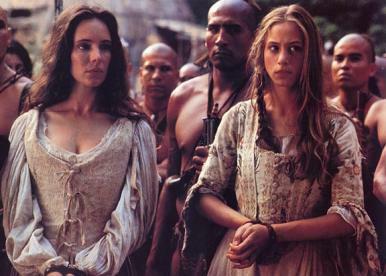
“The Last of the Mohicans” (1992)

I recall first watching this film in 1995 during a high school English class.  It was on this past Sunday, so I checked it out again.  It’s full of action, stunning natural beauty (it was filmed in North Carolina), gorgeous music, and is very well-acted.

The hero is Nathaniel Poe (Daniel Day-Lewis, one of the finest actors of his generation), also known as Hawkeye, a white orphan adopted by a Mohican chief named Chingachgook (Russell Means) and raised alongside his own son Uncas (Eris Schweig).  Nathaniel is an expert marksman, tracker, and quite friendly w/ some of the white colonists (such as the Cameron family) of this wild frontier.  But he’s his own man, proudly saying that he’s “beholden to no one.”

Things change when the French and Indian War begins in 1757; the colonists are bound by law to join the militia and aid the British troops.  The men fear for their families.  What will happen if their wives and children are attacked while they’re away fighting at Fort William Henry?  Jack Winthrop, one of the young settlers and Nathaniel’s friend, goes to Albany to voice this concern.  General Webb grants the men permission to leave the militia if their homes are in danger.

Meanwhile, Cora (Madeleine Stowe) and her teen sister Alice (Jodhi May) are traveling to see their father, General Munro, at the fort.  They are accompanied by family friend, and Cora’s suitor, Major Duncan Hayward (Steven Waddington), more than a dozen soldiers, and a stoic Mohawk guide named Magua (Wes Studi).

All hell breaks loose when Magua (who is actually a Huron allied w/ the French) attacks the soldiers.  He’s then joined by more Huron men.  Chingachgook, Uncas, and Nathaniel rush in for the rescue.  When Magua takes aim at Cora, Nathaniel wonders why.

This film looks very authentic.  Day-Lewis is in top form for the very physically demanding role, as are the supporting actors.  Though this film was catagorized as a romance, I wished there had more a little more instead of the fighting.  Both Nathaniel and Cora (outspoken/determined) have a sense of nobility about them.

Nathaniel is larger than life-selflessly fighting for love of his father, brother, and Cora.  He’s also a romanticist-at one w/ nature, independent-minded, and noble in thought and action.  On the opposite end is Magua- a fallen warrior who’s “heart is twisted,” and fighting for revenge.  Both are formidable and memorable.

“Dresden” (w/ “North & South’s” John Light)

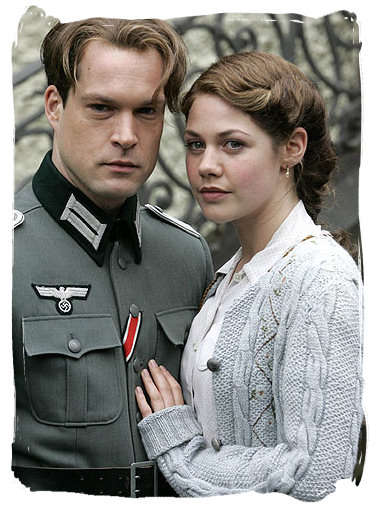
As you may recall, John Light’s lawyer character in the 2004 BBC miniseries, North & South, was thwarted in love.  Margaret chose Mr. Thornton over Henry Lennox.  In 2006, the Shakespearean-trained actor co-starred in a terrific miniseries set in WWII; it was the most expensive German film made for TV.  It was shot on location in the gorgeous city of Dresden, which suffered from (unnecessary) bombings in 1945, near the tail end of WWII.  As the director says, it’s an antiwar movie; it doesn’t glorify either the Brits or the Germans.

Anna Mauth (Felicitas Woll) is a 24 y.o. German nurse who planned to go to med school, but stayed home to help her father, the director of the local hospital.  She is pretty, hardworking, and full of life.  At the start of Part 1, Anna bravely assists Alexander (a young doc/her long-term bf) in the operating room while air raid sirens wail in the background.  Anna empathizes w/ Maria, her best friend/fellow nurse, who is married to a Jewish man.  She is worried about her (“patriotic”) younger sister, who is dating an official of the Third Reich.

Robert Newman (John Light) is a British bomber pilot who has to bail out of his Lancaster when engines catch fire.  He parachutes down into a field where he and his comrades are attacked by a group of very angry men.  Robert just gets shot in the stomach.  He finds shelter in a shed, removes his jacket, dog tags, and other signs of being British.  Robert dons a rough, long coat and heads toward Dresden.  Along they way, he sees many refugees.  He sneaks into the hospital while the staff are busy handling many incoming wounded soldiers.

This film has it all- family,  romance, mystery, and action.  It is simply riveting, mainly b/c of the four leads’ convincing performances, high production value, and (some scary/realistic) special effects.  Viewers will quickly relate to Anna- a wonderful character who tries to do the right thing.  Woll and Light (who speaks mostly German here) have great chemistry together.  They communicate volumes w/ just their eyes and expressions!

Two Films (w/ “North & South” actors)


The Glass Virgin (1995)

What qualities makes one a “gentleman” or “lady?”  Is one’s identity determined from birth, or can it change?  These are the questions at the core of Catherine Cookson’s The Glass Virgin.  As a child in 1870s England, Annabelle LeGrange is sheltered by her mother and servants.  One day, her curiosity leads her to see something long kept hidden. 

During a trip into town, Annabelle is rescued from a runaway coach by a young outsider, Miguel Mendoza (Brendan Coyle).  Seeing his strength, Mr. LaGrange offers him a job.  Miguel, who is actually Irish, says he’ll only work w/ horses.  In time, he teaches Annabelle to ride, and they become good friends.       

The 17 y.o. Annabelle (a young Emily Mortimer) flees from her life of upper-middle class comfort when her true parentage in revealed and her “father” arranges a marriage to be rid of her.  Annabelle’s only ally is Miguel, who insists on traveling w/ her to find another life.  The pair find work on a small farm, then a bigger one run by a good-hearted, fair-minded family.  They say they are cousins and live as such, never as a couple.   

Over the course of one tough, life-changing year, Annabelle learns and matures into her own person.  She teaches Miguel to read, and says that he has a lot of potential.  He falls in love w/ her, but keeps it hidden, as her station in life was so above his.  Can Annabelle marry a working-class man?  What will she do when called back to her mother and old way of life?


This film is not very well-made and had a low budget; it was a TV miniseries.  There are no frills, some bad (wooden) acting from supporting players, and weird transitions.   Most of the dialogue is very simple.  (Honestly, I watched it just b/c Brendan Coyle was in it.  He does a great job, as usual!)  Emily Mortimer, who was a newcomer to film then, takes some time to grow into her role.

Some viewers thought it was weird that an older friend from childhood became a love interest.  (But wait, what about Emma and Mr. Knightley?  He was 16 yrs older than her.)  Those who read the novel noted that Miguel was only 10 yrs older than Annabelle.  I had a Renaissance Lit prof who said that “we shouldn’t put the values from our modern world onto the past.”            


The Impressionists (2008)

This is one of the most gorgeous films I’ve ever seen!  (It ranks up there w/ A Walk in the Clouds, which Rogert Ebert praised as the “type of movie you’d want to live in.”)  It’s actually a 3-part miniseries, has a strong ensemble cast, and is a true story. 

The elderly Claude Monet (Julian Glover) talks about his life, and that of his fellow Impressionist painters, to a reporter.  The younger Monet (Richard Armitage) left home, served in the army, then went to Paris to study.  At the school, he met the wealthy/jovial Renoir (Charlie Condou) and doctor-in-training- Bazille (James Lance).  They chafed against their “old school” teacher’s methods and eventually went off by themselves to paint.  As we know, Monet was inspired by the outdoors (nature) and always sought to “capture the light.” 


The young artists deal w/ money troubles, various romances, government art critics (that seek to protect the image of “good art”), and their own frustrations.  There are stories about quirky painters, such as Cezanne- a hermit who’s actually from a wealthy family.  There are interesting tales behind famous paintings.  Did you know that the woman in the green dress became Monet’s first wife?  He approached her in the marketplace and asked to paint her portrait. 

Monet’s second wife (played by Amanda Root) was the former wife of his benefactor.  At first, she didn’t see what was the big deal about his work- LOL!  One reason that I liked this film was that two of my fave actors were playing a couple.  (Below is an Impressionistic promo pic w/ RA and Root.) 


If you haven’t yet, watch RA and Coyle together in the 2004 BBC miniseries North & South!  Here is a short clip:

http://www.youtube.com/watch?v=fM0gsBnbfrc

You can watch the entire film here:

http://www.youtube.com/watch?v=oN58WAmuuqI


“Garrow’s Law” (Series 1)

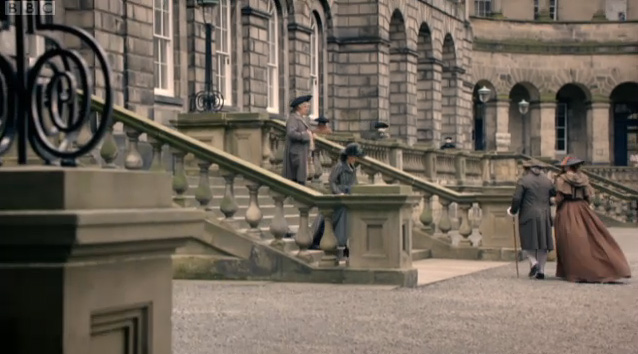
Who’d have thought late 18th century London (just a few years after our American Revolution) would be such an exciting setting for a courtroom drama!?  The cases you see on this TV show are based on real cases of the Georgian era.  The protagonist is a confidant, intelligent, and passionate young man  ahead of his time.  He doesn’t just want to practice the law- he wants to change it (as the system is rigged heavily against defendants).  Hmmm… sounds a bit like the young John Adams!

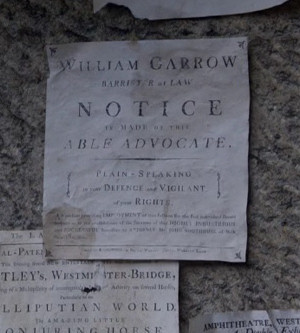
All lawyers aren’t bad- LOL!  William Garrow, the son of a humble headmaster (principal), didn’t go to Oxford.  He learned at his father’s school, then studied with a mentor (a solicitor) in Billingsgate.  Being ambitious and energetic, he eventually pushed aside paperwork (writing briefs) and became a barrister.  He tried his first case at age 23- unthinkable in our time!  Garrow is the one credited w/ the the phrase “innocent until proven guilty.”  He didn’t play it safe, even in his personal life.

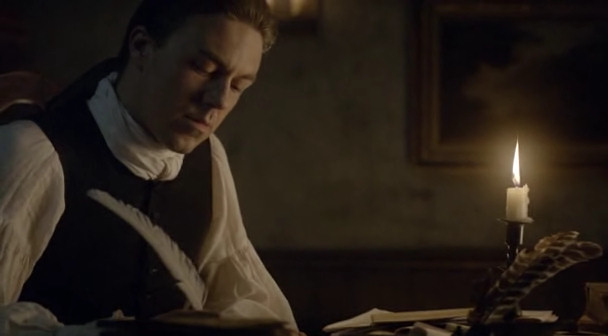
Garrow (Andrew Buchan, who had supporting roles in the newest Jane Eyre and Cranford) is an eager hothead when we first meet him.  His mentor, Mr. Southouse (musical theater and TV veteran Alun Armstrong), cautions him against speaking too boldy in court and losing the sympathy of the (very powerful) judges.  Garrow wants to address the jury, and does on several occasions, though this is frowned upon.

p01zvthm


MP Sir Arthur Hill (Rupert Graves, most recently seen in Sherlock), is impressed by Garrow’s performance in court.  His beautiful, well-read, and opinionated wife, Lady Sarah (Lyndsey Marshal from Rome) is also impressed.  However, at their dinner party, we quickly learn that Garrow’s politics are quite different from Sir Arthur’s.


Lady Sarah admires Garrow’s strong convictions (in line with many of her own forward-thinking ideals).  She often observes trials, sitting beside the judge and other notable people.  Lady Sarah even pays for Garrow to help a poor young servant.  Their mutual respect and admiration eventually grows into more (you’ll have to see).  Also, politics and his ambition create a big distance between Arthur and Sarah.

The dialogue on this show is very well-written!  (It sounds fresh, though it’s not modern.)  The production value is very high.  The sets, costumes, and music are all perfect for the period.  Buchan even looks boyishly handsome in a powdered white wig, black robe, and chunky heeled shoes.

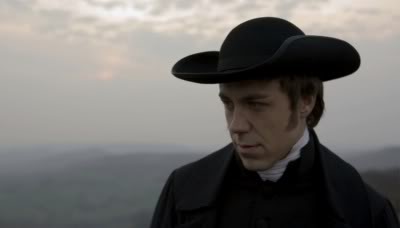
Buchan played clergyman St. John Rivers, Jane’s buttoned-up (and very emotionally repressed) cousin/suitor, in the 2006 BBC version of Jane Eyre.

In Cranford and Return to Cranford, Buchan played carpenter/family man Jem Hearne.

NOTE: Do NOT read further unless you want to know details from S1 eps.

Episode 1

p01gkwxr.jpg

You will learn that the law is not a game for gentleman. -Garrow to Silvester (an Oxford-educated prosecutor)

Garrow has been buried in paperwork, but gets a case at the Old Bailey in Ep 1. Everything was rigged against the defendant, as Southouse explains after giving Garrow the brief the night before the trial. He can’t visit his client in jail. He won’t be given a copy of the indictment. He won’t get to hear re: the evidence the prosecution has against his client. (Yikes, we’ve come a LONG way!)

The prisoner in the dark has too long been left to rot for want of counsel. -Garrow says to Sir Arthur Hill, a minister at Parliament

You lack manners. You were too angry and you lost control. -Southouse says to a disenchanted Garrow after his loss

silvester_garrow

The second case Garrow gets is thanks to Lady Sarah, who insists that her involvement be kept a secret, b/c it’d be like “an infidelity” in the eyes of her more conservative husband. A young unmarried washerwoman, Elizabeth Jarvis, has been accused of “infanticide” (though she insists her baby was stillborn). Garrow and Lady Sarah interview the defendant in Newgate Prison (VERY unusual), then have an independent doctor (“surgeon”) examine Elizabeth, then the body of her deceased child.

How can it be an improvement in my court where I play a lesser part? -Judge Bullard says (bemused) to Lady Sarah during lunch break from court

Episode 2

gl12

By now, Garrow has some claim to fame, and he likes getting the approval (since his parents are deceased). He (hesitantly) takes on the VERY unpopular case of a young man accused of cutting beautiful young gentlewomen in broad daylight. The defendant’s doting mother insists her son could never do such things, though he loves drinking, pros, and runs through money. The media refers to him as “The Monster,” and in time, so do the public. BUT just b/c a defendant is unlikeable doesn’t mean he’s guilty!

Episode 3

gl32

This ep focuses a BIT more on Garrow’s petsonal life; we see that he has more to learn still (though in court, he has a way w/ juries). When he thinks Silvester insulted Lady Sarah (who Garrow is in love w/), he challenges his nemesis to a duel. Mr. Southouse is bewildered, thinking Garrow is crazy and needs to bow out. But Garrow’s hot-headed/stubborn side wins over!

The main case Garrow handles is that of a noted “thief-taker” (bounty hunter to us modern folk) who could be using less clever/scared thieves to commit bigger crimes for his gain.

Episode 4

We are of like minds, you and I. -Garrow says to Lady Sarah

Sir Arthur tells Garrow his good news, which could mean that Lady Sarah could be lost to him forever. She insists that she won’t leave her husband.

The crux of this ep centers on the case of a businessman/husband/father to 3 young children, Joseph Hamer. He has been imprisoned in Newgate for 3 mos. ONLY for gathering w/ those who think like him and exercising free speech. His wife, Mary, impresses Southouse and Garrow w/ her convinction and strength; she wants the BEST defense for the man she loves. There has been NO charge (reminds one of Guantanamo cases) yet, BUT Garrow will take the case.

Your case, Joseph, is played out in the shadow of the guillotine. They [the aristocracy] fear you. -Garrow puts things into context when he meets his defendant

Late one night, Joseph is dragged from his cell to a meeting w/ ministers of Parliament (incl. Sir Arthur). They grill the humble shoemaker w/ questions, BUT he asks for actual charges. Lady Sarah wonders what’s all the noise-the jailers and heavy shackles disturbed her quiet. She meets Joseph in the hall, and realizes that her husband MAY be on the wrong side of justice. Finally, Joseph gets his day in court, BUT the charge is “high treason” (so he could be hanged)!
Atonement (2008)

Ah, young love!  There’s nothing like it if it’s done well (in film), but it doesn’t always end happily.  I went to see this film in the theater when it first came out; it stayed on my mind for some time.  I saw it again recently, and gained more appreciation for it.

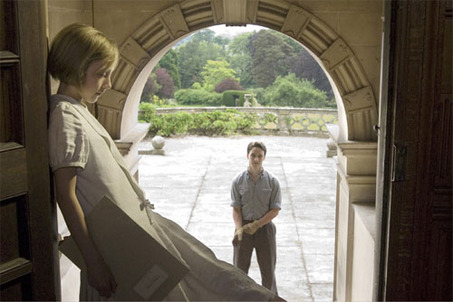
Cecilia Tallis (Keira Knightley) and Robbie Turner (James McAvoy) are two young people in their early 20s who are spending a hot summer day on a gorgeous estate.  She is the old man’s daughter; he is the housekeeper’s son.  They both attended Cambridge- he w/ the money and blessings of Mr. Tallis.  Soon, Robbie plans to go to med school.  Cecilia is restless- waiting for something to happen.

The film starts slow, but it doesn’t take too long to see that Robbie and Cecilia are suppressing their intense attraction to each other.  Cecilia’s precocious 12 y.o. sister, Briony (Saoirse Ronan), has a huge crush on Robbie.  In the past, she has written many stories, bound them in leather, and presented them to Robbie as gifts.  He looks on Briony as a good friend, calling her “pal.”  (Briony is the central character in the story; she’s also the storyteller.)

Briony misunderstands several events througout the day and evening.  In no time, everything is shattered for the couple.  Being a sheltered and judgmental child, Briony doesn’t realize the impact of her words/actions.  Robbie is yanked off to jail; Cecilia leaves the family.  In time, he’s sent to fight in France; she becomes a nurse.

The first section of this film is particularly appealing to the eye.  We see beautiful flowers, streams, and lots of sunlight.  At dinner, Cecilia is a vision in a flowing green gown.  Director Joe Wright refers to this portion as “the time before the fall” (before WWII, before the lovers are separated).

This film really sets a mood.  At times, it may seem a bit too slow to some viewers.  There was great chemistry between Keira and James, and they look amazing together!  I enjoyed how Romola Garai (who plays the young adult Briony) did a lot w/ very little dialogue.  The supporting characters all fit their parts; Benedict Cumberbatch was creepy (in a subtle way) as the chocolate millionaire, Paul Marshall.

The adult Briony (played by Vanessa Redgrave) atones for her terrible mistake by giving the lovers a happy ending in her novel.  She creates an almost too good hero in Robbie.  Atonement made me think of all the young people (from many nations) who died b/c of the events of WWII. They never got the chance to fulfill their potential, have relationships, and grow old.