The Little Foxes (1941) starring Bette Davis

LittleFoxes_poster.jpg

Take us the foxes, the little foxes, that spoil the vines: for our vines have tender grapes. -Chapter 2, Verse 15, Song of Solomon, King James Bible

This film’s screenplay was adapted from Lillian Hellman’s stage play by herself. A few others, including Dorothy Parker, worked on it also.  The film was helmed by William Wyler- a director that needs NO introduction. 

In turn of the 20th century, small town Southern aristocrat, Regina Hubbard Giddons (Bette Davis- NEVER one to shy away from unsympathetic roles), wants more freedom (travel to Chicago) and access to money (her older brothers inherited ALL their businessman father’s money).  Regina’s brothers (bachelor Ben and abusive husband Oscar) are ALMOST as ruthless as her!  Oscar’s wife, Birdie, comes from a former wealthy planter family, but she is disrespected by almost everyone (aside from her black servants and niece).

BetteDavis_LittleFoxes

You can flout society’s rule and be Regina, or you can ‘toe the line’ and be Birdie, who is blissfully ignorant of the political meaning of anything happening around her. She requires the charity of men to even survive.  -IMDB commentator 

Regina also wants her sweet/clueless teen daughter, Alexandra (Teresa Wright), to meet more eligible men in high social circles.  However, the girl already has a steady presence in her life- David, the local newspaperman.  (This character was created for the movie to provide a caring ally for Alexandra.)  Oscar’s son,  Leo (Dan Duryea), has had his eyes on his cousin for a LONG time.   

You can’t make a picture without a villain . . . it pays well and you last.  -Dan Duryea, actor

One day, Regina decides that her daughter is the BEST person to go and fetch her father, Horace (Herbert Marshall) from Baltimore where he has been recuperating for SOME time. 

The Lusty Men (1952) starring Robert Mitchum

The Lusty Men_poster

One ‘o the things that’s wrong is all the books and rules on success is written by successful men.  Now that’s wrong.  Fellers like you and me’d get a lot more help if the books and rules on success was written by a failure. That’d make sense.  -Jeremiah, the humble, old, bachelor farmer who lives in Jeff’s former family house explains (in a sort of epilogue to the main story)

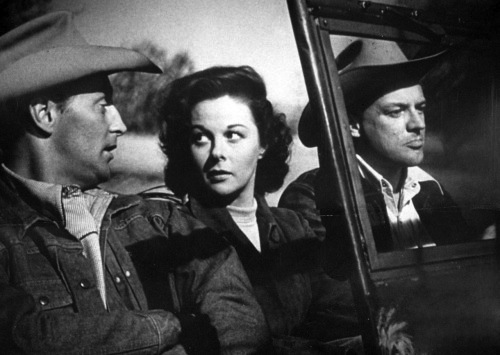
This is a film that seems tailor-made for Robert Mitchum; it has drama, GREAT dialogue, a love triangle, and plenty of action/thrills (involving the rodeo)!  I just learned that it was directed by the prolific Nicholas Ray (In a Lonely Place, Rebel Without a Cause, King of Kings, etc.)  After he sustains a rodeo injury, star rider Jeff McCloud (Mitchum), returns to his hometown after many years of absence. He signs on as a ranch hand, where he is befriended by fellow ranch hand Wes Merritt (Arthur Kennedy, a strong supporting man, esp. of the Western genre) and his wife Louise (Susan Hayward in a strong/engaging performance).

The Lusty Men_meeting

Louise: Wes tells me you once made three thousand dollars in one day, rodeoin’.

Jeff: That’s right.

Louise: And threw it all away.

Jeff: Oh, I didn’t throw it away. It just sorta’… floated.

The Merritts seem like a solid, happy couple, though they also have ambitions for their own little farm.  Wes thinks that rodeo winnings (fast money) could help finance it.  Wes convinces Jeff (who is a BIT reluctant) to coach him, but Louise has strong doubts.  She thinks that the couple should just keep saving slowly.  But, despite his easygoing/humble demeanor, Wes has a lust for adventure!

The Lusty Men_truceThere never was a bronc that couldn’t be rode, there never a cowboy that couldn’t be throwed. Guys like me last forever.  -Jeff says to Louise

It turns out that Wes is QUITE good in the events he signs up for in his first rodeo, impressing his new peers on the circuit.  Of course, the money is GREAT, so he decides to go on the road (BEFORE checking w/ Louise).  She is surprised by this hasty decision, BUT goes on the road w/ her husband and Jeff.  How will Wes and Louise deal w/ their new success/lifestyle?  What will become of Jeff… and his burgeoning feelings for Louise?  Watch this film to find out!    

Home from the Hill (1960) starring Robert Mitchum

home from hill_posterKind of man that walks around with nothing in his pockets, no identification because everyone knows who you are. No cash because anyone in town would be happy to lend you anything you need. No keys ’cause you don’t keep a lock on a single thing you own. And no watch because time waits on you. Wade (Robert Mitchum) explains to his 18 y.o. son Theron (George Hamilton) about the kind of man he should aim to be

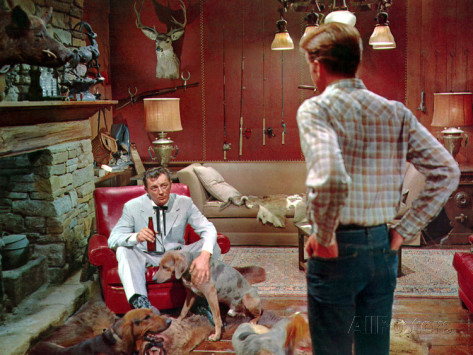
“Wow, what a speech!”  My dad commented.  Plus, who doesn’t LOVE Robert Mitchum!?  He was the quintessential “man’s man” (NOT unlike George Clooney is today).  If you read this blog, you know that I’m a BIG fan of Mitchum’s acting!  In this (dysfunctional) family drama set, he plays wealthy, womanizing, and hard-drinking Texan- Capt. Wade Hunnicutt.  (Warning: It’s a LONG film, but has some VERY fine moments!)  I saw it on TCM last month; you can check it out for $2.99 on Amazon Instant Video.  This film, b/c it came out in 1960, could pull the cover off topics which were hidden/NOT directly mentioned in previous decades.

home from hill_denHe’s got a mind of his own. I gave him that. Don’t think he’s gonna come to heel like one of your hunting dogs at the snap of your fingers.  -Hannah (Eleanor Parker) explains to Wade about Theron

Mitchum suits his role VERY well, BUT he’s well-matched by onscreen wife Eleanor Parker.  (The actress, best known for the playing curvy/glam/ independent baroness in The Sound of Music, passed away almost 2 yrs. ago at age 91.)  But unlike that iconic role, Parker has a VERY different look in this film- she’s thin, dressed prim/proper, yet also a fighter (in her own way). 

home from hill_dateTheron (a bright, kind, sensitive, yet sheltered young man) has to navigate his parents, falling in love (first time), and more.  For most of her son’s life, Hannah has kept him away from his father and his bad influences.  One Summer, Wade decides that he must teach the boy “how to be a man.”  In time, Theron discovers a BIG secret about his family!

From the Terrace (1960) starring Paul Newman & Joanne Woodward

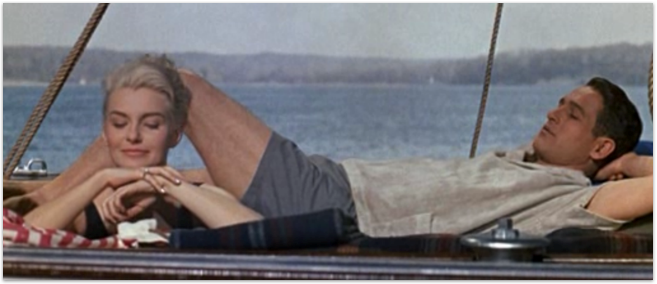
terrace_boating

Alcoholism, dysfunctional families, romance, infidelity (w/ its gendered double-standards), and America’s obsession w/ money and power are  the main themes in this (ahead of it’s time) melodrama.  I watched it last night (on Netflix); of course, Paul Newman and Joanne Woodward (who were married for 2 years at that time) were the draw.  Wow, if you want to see some HOT onscreen chemistry, check out their scenes together (first half of the film)!  As for Newman, he’s the definition of Hollywood’s total package (looks, presence, talent, the ability to be both humorous and serious, etc.) 

terrace_driving

In 1946, Aflred Eaton (Newman) returns to suburban Philly after serving in the Navy (WWII) to the loving arms of… his household staff.  His parents checked out long ago.  His father (Leon James) puts all his heart into his steel mill and mourning someone who will never return.  His mother (Myrna Loy) has turned to alcohol and another man.  A private nurse lives with her- a great shock to Alfred.  As his best pal, Alex Porter (a young and dapper George Grizzard), says he “needs to get out of that house” and their expectations.  Like many young folks, Alfred heads to NYC.

In a few months time, Alfred falls in love with Mary St. John (platinum-haired Woodward), a blue blood from Delaware.  She is engaged to another man and her parents would not approve of Alfred’s “qualifications,” Alex quickly explains.  “There are all types of qualifications,” Alfred slyly retorts.  After winning Mary’s hand, he starts working with Alex on designing/selling small planes on Long Island, but grows tired of being left out of the decision-making.  (The business was financed by the Porter family.)  An accident of chance propels Alfred into the society, then business, of one of the wealthiest financiers on the East Coast.  Alfred throws himself into his work, repeating his father’s mistake, and neglects Mary (not content to sit at home alone in their fancy Manhattan apartment). 

The Catered Affair (1956)

This is a great little movie filled with real life heartache and genuine emotion. Bette Davis gives a strong performance as the matriarch of the family determined to give her only daughter a proper wedding even though the family can’t afford to do so.  Ernest Borgnine is perfectly cast as the slovenly, hard working taxi cab driver.  In fact, everyone is up to par in this film, but it’s the real life situations that tug at your heart strings.  IMDB review

catered1

The trick is not to become somebody else.  You become somebody else when you’re in front of a camera or when you’re on stage.  There are some people who carry it all the time.  That, to me, is not acting.  What you’ve gotta do is find out what the writer wrote about and put it into your mind.  -Ernest Borgnine on his method of acting

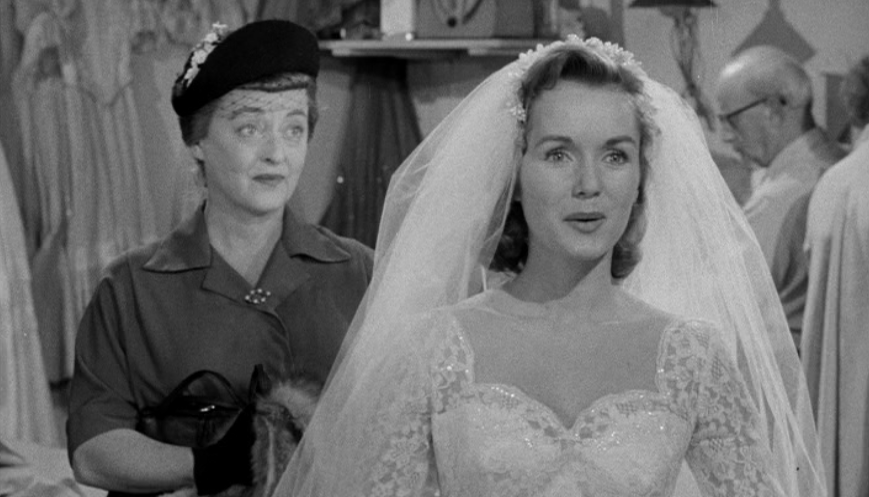
I watched this film, written by Paddy Chayefsky (Marty), last weekend w/ my parents; they had seen it before and really liked it.  It took me a FEW minutes to realize that the mother was Bette Davis- LOL!  She is totally transformed; they gave her a “make-under,” as we’d say today.  Tom (Borgnine) and Agnes Hurley (Davis) are working-class/devout Irish-Catholics living in a small apartment in the Bronx with a daughter, son, and Agnes’ older brother.  Tom, a taxi driver, has been saving money for many years to buy a cab and license (medallions don’t come cheap nowadays either).  They both become concerned when their eldest child, daughter Jane (Debbie Reynolds in an early role), announces that she’s getting married to her long-time beau, a teacher- Ralph (Rod Taylor). 

catered2

Jane, who has an office job, insists that she wants a very small wedding and no reception.  Agnes thinks that’s not good enough, lamenting to Tom: “We never did anything for that girl!”  Agnes knows what she missed out on, and now wants those experiences for her daughter.  In no time, Jane’s wedding planning gets out of hand, thanks to the wishes of Agnes and Ralph’s parents (who are more better off financially).   Jane tells Ralph she doesn’t want to end up like her parents.  We learn more about the Hurleys (strained/seemingly loveless) marriage.  Agnes awkwardly tells Jane that marriage is not like dating; there will be sacrifices and compromises (mostly made by women).